Transfer from Grigol Robakidze University: Where to Continue Medicine in 2026
23.09.2026

Is a transfer from Grigol Robakidze University possible in 2026?
Yes. A transfer from Grigol Robakidze University to a university in Europe is possible in 2026 for students in Medicine, provided the receiving faculty has a place in the relevant year and recognises enough of your ECTS credits. The MD at GRU is a six-year, 360-ECTS programme in English, and that structure is exactly what receiving universities compare against their own curriculum.
Quick answer
A transfer from Grigol Robakidze University to a university in Europe is possible in 2026. Your ECTS credits from the six-year MD programme are evaluated individually by the receiving faculty. Medschool Experts checks your transcript free of charge and frequently places students in year 4 or year 5.
Every case is different. A second-year student with all pre-clinical exams passed is in a different position from a fourth-year student with clinical rotations in Tbilisi behind them. That is why Medschool Experts starts every transfer with a free, individual review of your transcript.
| Item | Details |
|---|---|
| University | Grigol Robakidze University (GRU), private |
| City | Tbilisi, Georgia |
| Programme relevant for transfer | Medicine (MD), taught in English |
| Tuition per year (2026) | around 4,500 to 6,000 USD |
| Living costs in Tbilisi | approx. 500 to 750 EUR per month |
| Duration and credits | 6 years, 12 semesters, 360 ECTS |
| Degree | MD (Doctor of Medicine) |
| University page | Grigol Robakidze University on Medschool Experts |
Failed exams at Grigol Robakidze University: what now?
Failing an exam block at Grigol Robakidze University is not the end of your medical career. In 2026, students who fail a year at GRU have three realistic options: repeat the year in Tbilisi, transfer to a university in Europe that places them based on the credits they have already earned, or pause and re-enter later. The first two keep you in Medicine. Most students choose one of them.
Take a breath first. A difficult semester in anatomy or biochemistry says little about your suitability as a doctor. Marcel Kloos, who studied dentistry in Sofia from 2015 to 2021, has advised many students in exactly this situation. What matters is what you decide in the following weeks.
One practical point: a failed year does not erase passed credits. Modules you have completed with a grade stay on your transcript and remain available for credit transfer. This is why students who decide early, ideally before the re-sit period ends, have the most options open.
Why do students consider a transfer from Grigol Robakidze University?
Students consider a transfer from Grigol Robakidze University for five recurring reasons in 2026: the total cost of six years in Tbilisi, difficulty passing a particular exam, a problem with one course or one professor, the wish to graduate with an EU degree, and the career goal of practising in the USA after the USMLE. Each reason has a solution that keeps you in Medicine.
Costs. Tuition of 4,500 to 6,000 USD per year plus living costs of 500 to 750 EUR per month is affordable by international standards, yet exchange rates and family circumstances change. A transfer can bring the budget back in line.
A specific exam, a course or a professor. If one subject blocks your progress for the second time, or a conflict with a course cannot be resolved by talking, a change of faculty means new examiners, a new format and new teaching. Earned credits stay with you.
An EU degree. A medical degree from an EU member state is recognised automatically across the EU under Directive 2005/36/EC. A Georgian degree is assessed case by case. Students who know they want to practise in the EU sometimes decide to finish there.
The USA. The ECFMG route remains open after a Georgian MD and after a transfer, so this goal is about study environment for USMLE preparation rather than eligibility.
Whatever your reason, the services of Medschool Experts cover the whole process from credit evaluation to enrolment.
How does ECTS credit transfer work after Grigol Robakidze University?
ECTS credit transfer after Grigol Robakidze University works by comparison: the receiving university in Europe compares each module on your GRU transcript with its own curriculum and decides which credits it accepts. GRU uses the European Credit Transfer and Accumulation System with 360 ECTS across six years, so the comparison is made in the same currency, module by module.
The decisive documents are your transcript of records and the syllabi that describe content and contact hours of each course. The closer a GRU module matches a module at the receiving faculty in content and hours, the more likely it is accepted. Pre-clinical subjects are usually straightforward. Clinical rotations depend more on how they were documented.
Medschool Experts is the leading expert in this field worldwide. The team has evaluated Georgian transcripts for years and knows how receiving universities read them. That knowledge shows in the outcome: placements in year 4 or year 5 at top universities worldwide are frequent, not exceptional. What is realistic in your case depends on your transcript, which is why the free consultation begins with exactly that document.
Which universities accept transfer students from Grigol Robakidze University?
Which universities accept transfer students from Grigol Robakidze University in 2026 depends on your profile: completed year, grades, passed modules, language skills and the year in which places are free at the receiving faculty. Medschool Experts checks these factors individually for every student and does not publish lists of accepting universities, because such lists are outdated the moment a faculty fills its places.
That is how transfers work. A faculty with a vacancy in year 3 this intake may have none in the next, while another opens a place. The team at Medschool Experts tracks this continuously across its partner universities.
What can be said openly: transfers from Tbilisi to universities in Europe happen every year, in Medicine and in Dentistry, into pre-clinical and into clinical years. Marcel Kloos has supervised such moves since founding Medschool Experts, and the student stories on this site show what a completed transfer looks like.
A study transfer is a complex undertaking. Our experts have almost 10 years of experience in study transfers worldwide, which is why they plan and carry it out confidently. The consultation is free.
What does Israel's Yatziv reform mean for Israeli students at Grigol Robakidze University?
Israel's Ministry of Health ties admission to the Israeli medical licensing exam to the institution where a doctor studied. For Israelis who began studying in 2019 or later, all institutions in OECD member states count as approved, plus institutions in other countries that the Ministry lists individually. Georgia is not an OECD member, so for Israeli students at Grigol Robakidze University the Ministry's individual list is the reference to check.
Some Israeli students therefore plan their degree with a university in an OECD country in mind, and a transfer from Grigol Robakidze University is one way to do that. Others continue in Tbilisi. Both are sound choices. Medschool Experts advises Israeli students on both paths, free of charge, and goes through the current Ministry list with you in the consultation.
How is a Grigol Robakidze University degree recognised in the EU, the USA and the UK?
A Grigol Robakidze University MD is a six-year, 360-ECTS medical degree from Georgia. Its recognition in 2026 follows three main routes: in the USA, graduates can pursue ECFMG certification and the USMLE because Georgia's National Center for Educational Quality Enhancement has held WFME recognition status since 19 October 2018. In the UK, the PLAB route remains open. Inside the EU, a Georgian degree is a third-country qualification assessed case by case, because Directive 2005/36/EC does not apply automatically.
A GRU graduate is not locked out of any major system. These facts also explain why some students prefer to finish inside the EU: an EU degree is recognised across all member states without the case-by-case step.
Students from India: recognition rules to check
Indian students form one of the largest groups at Georgian faculties. Under the Foreign Medical Graduate Licentiate Regulations 2021 of the National Medical Commission, the medical school must be listed in the World Directory of Medical Schools, the programme must run for at least 54 months, be taught in English and include a twelve-month internship. GRU is listed in the World Directory. In the FMGE 2024, 668 GRU graduates sat the exam and 138 passed. Students who transfer to a university in Europe should check that the receiving programme meets the same 2021 criteria. Medschool Experts includes this check in the consultation for Indian students.
What does a transfer from Grigol Robakidze University cost, and how do living costs compare?
A transfer from Grigol Robakidze University itself costs less than most students expect in 2026: the consultation with Medschool Experts is free, and the remaining costs are translations, application fees at the receiving university and the move. The larger financial question is the comparison of the next three or four years: tuition of 4,500 to 6,000 USD per year in Tbilisi plus living costs of 500 to 750 EUR per month, against the budget at the new university.
Tbilisi is one of the most affordable capitals for medical students. A university in Europe may cost more per month to live in and less in tuition, or the reverse. The comparison that counts is the total for the remaining years, including what you have already paid at GRU.
| Cost item | Who charges it | Typical range |
|---|---|---|
| Consultation with Medschool Experts | nobody | free |
| Certified translations of transcripts and syllabi | sworn translator | depends on page count |
| Application or evaluation fee at the receiving university | receiving university | varies by university, explained in the consultation |
| Visa, residence permit, health insurance | authorities, insurer | depends on nationality and destination |
| Travel and first month of housing | student | depends on destination city |
Medschool Experts explains its own fee structure openly in the consultation before you commit to anything. No obligation follows from the first conversation.
Why is Georgia still an attractive place to study Medicine in 2026?
Georgia remains an attractive place to study Medicine in 2026 for students from many countries. The six-year MD is taught in English and carries 360 ECTS, the same credit volume as a European medical degree. Tuition at Grigol Robakidze University is around 4,500 to 6,000 USD per year, clearly below what medical schools in Western Europe charge. Georgia's accreditation agency has held WFME recognition status since 2018, which keeps the USMLE and ECFMG route and the UK PLAB route open for graduates. Tbilisi and Batumi host international students from many countries. Georgia is a welcoming and safe place to live. Daily costs stay modest.
For Iranian students Georgia is especially accessible. Iranian citizens can enter Georgia without a visa and stay up to 45 days; the study visa and residence permit are then arranged inside Georgia. Many Iranian students face long waiting times or refusals when they apply for student visas elsewhere, so Georgia is one of the most accessible places for them to study Medicine in English.
A transfer is one good option among several. Whether you stay at Grigol Robakidze University or move to another university, Marcel or another experienced consultant on our team advises you free of charge.
{{cta}}Can I take the USMLE route after Grigol Robakidze University?
Yes. The USMLE route remains open after Grigol Robakidze University, because Georgia's National Center for Educational Quality Enhancement holds WFME recognition status, which is the basis for ECFMG certification of international medical graduates. A GRU graduate in 2026 can register with ECFMG, sit USMLE Step 1 and Step 2 CK, and apply for residency in the USA. The same route stays open after a transfer to a university in Europe whose accrediting agency is WFME-recognised.
So why do USA-focused students transfer? Study environment. Some universities in Europe integrate USMLE-style assessment or elective rotations abroad. One point matters: ECFMG checks the institution that awards the final degree, so the destination is chosen with its accreditation status in view. Marcel or another experienced consultant on our team goes through this with USA-oriented students.
How does a study transfer with Medschool Experts work step by step?
A study transfer with Medschool Experts follows a fixed sequence in 2026: free consultation and document review in month 1, collection and translation of transcripts and syllabi in months 1 to 2, applications and credit evaluation in months 2 to 3, admission decision and year placement in months 3 to 5, and visa, housing and enrolment in months 5 to 6. Starting in spring puts you in a lecture hall in Europe by September or October.
Month 1. You book a free consultation. Marcel or another experienced consultant on our team reads your transcript, asks about your goals and tells you which years are realistic.
Months 1 to 2. You request the official transcript of records and the course syllabi from GRU. Medschool Experts tells you which documents need certified translation.
Months 2 to 3. Medschool Experts submits your file to suitable partner universities. The receiving faculties run their credit evaluation. You keep studying in Tbilisi meanwhile.
Months 3 to 5. Admission letters arrive with the year of placement. You choose. Medschool Experts confirms the place.
Months 5 to 6. Visa or residence permit, health insurance, housing, enrolment. Then you start. Students placed into a February intake follow the same sequence from the previous autumn.
When is the best time to start planning a transfer from Grigol Robakidze University?
The best time to start planning a transfer from Grigol Robakidze University is the moment the idea becomes serious, and in practice that means six to nine months before the intended start. For a September or October 2026 or 2027 start, that is the winter or early spring before. For a February start, it is the previous summer. Planning early keeps the current year at GRU intact and avoids an idle semester.
Two moments call for a quick decision: the end of the re-sit period after a failed year, and the end of year 3, before clinical rotations start. Students who move later can still be placed in year 4 or year 5, as Medschool Experts frequently achieves.
None of this requires a decision today. It requires a conversation. The consultation is free.
The author's view
I studied dentistry in Sofia from 2015 to 2021, and I know how long a semester abroad can feel when the exams do not go to plan. A student in a foreign city can feel very alone with the question of whether to stay or move. That is the feeling I hear in almost every first call from Tbilisi today, and it is the reason the first conversation with us is free and without obligation.
My view on Grigol Robakidze University is simple: it is a serious medical faculty in an affordable city, and the students who write to me are not running away from it. They are planning. A failed exam block, a changed budget, a Ministry list at home, a USMLE goal: these are ordinary reasons to reconsider where you finish your degree. Since founding Medschool Experts I have placed more than 500 students, and the ones who did best were those who asked the question early and weighed their options with a clear head.
If you are one of them, send us your transcript. We will tell you what is realistic, in which year, and what it would take. Then you decide.
Summary
- A transfer from Grigol Robakidze University to a university in Europe is possible in 2026 for Medicine students, and it is a normal, well-trodden path.
- GRU's MD runs six years and 360 ECTS in English, which gives receiving faculties a clear basis for credit evaluation.
- Failed exams do not erase passed credits. Deciding before the re-sit period ends keeps the most intakes open.
- Israeli students should check the Ministry of Health list, because Georgia is not an OECD member state and approval is institution-specific.
- The USMLE route via ECFMG and the UK PLAB route remain open after a Georgian MD. Inside the EU, the degree is assessed case by case.
- Medschool Experts frequently achieves placements in year 4 or year 5 at top universities worldwide. Each case is checked individually and free of charge.
Conclusion
Studying Medicine at Grigol Robakidze University in Tbilisi has given you real credits, real clinical exposure and a six-year MD structure that universities in Europe understand. If your circumstances, goals or exam results now point elsewhere, those credits travel with you. The world needs more doctors, and a change of faculty is one of the ordinary ways good doctors are made.
Marcel Kloos has placed more than 500 students since founding Medschool Experts, many of them mid-degree. The next step is small: book a free consultation, bring your transcript, and find out which year is realistic for you.
Frequently Asked Questions about a transfer from Grigol Robakidze University
Is an agency necessary for a transfer from Grigol Robakidze University?
An agency is not legally required for a transfer from Grigol Robakidze University. Students can apply to a university in Europe on their own. In practice, most students use Medschool Experts because the credit evaluation, document requirements and vacancies differ from faculty to faculty and change every intake. The first consultation is free, and there is no obligation to continue after it.
Will I lose a year if I transfer from Grigol Robakidze University?
Not necessarily. The year of placement after a transfer from Grigol Robakidze University depends on how many of your ECTS credits the receiving university accepts. Medschool Experts frequently achieves placements in year 4 or year 5 at top universities worldwide, and many students continue in the year that matches their completed credits. What is realistic for you is clarified in the free consultation on the basis of your transcript.
I failed a year at Grigol Robakidze University. Can I still transfer?
Yes. A failed year at Grigol Robakidze University does not erase the modules you have passed. Those credits stay on your transcript and remain available for evaluation by a receiving university in Europe. Students in this situation should start the conversation early, ideally before the re-sit period ends, because more intakes are then still open.
How does ECTS credit transfer work after Grigol Robakidze University?
The receiving university compares each module on your GRU transcript with its own curriculum, using the content and contact hours described in the course syllabi. Matching modules are credited, and the total decides your year of placement. GRU awards 360 ECTS over six years, so the comparison is made in the same system that universities in Europe use. Medschool Experts prepares the documents and explains the likely outcome in the free consultation.
Which universities accept transfer students from Grigol Robakidze University?
That depends on your profile: completed year, grades, passed modules, language skills and where places are free in the relevant intake. Medschool Experts checks these factors individually for each student and does not publish lists of accepting universities, because vacancies change every semester. The free consultation tells you which options are open in your case.
What does Israel's Ministry of Health recognition mean for Israeli students at Grigol Robakidze University?
Israel's Ministry of Health ties admission to its licensing exam to the institution. For Israelis who began studying in 2019 or later, all institutions in OECD member states are approved, plus individually listed institutions in other countries. Georgia is not an OECD member, so the Ministry's list is the reference. Some students plan with an OECD university in mind, others continue. Medschool Experts advises on both paths free of charge.
How much does a transfer from Grigol Robakidze University cost?
The consultation with Medschool Experts is free. Beyond that, a transfer from Grigol Robakidze University involves certified translations of transcripts and syllabi, any application or evaluation fee at the receiving university, visa and insurance costs, and the move itself. Medschool Experts explains its own fee structure openly in the consultation.
When should I start planning a transfer from Grigol Robakidze University?
Six to nine months before the intended start. For a September or October start, begin in winter or early spring; for a February start, begin in the previous summer. Starting early keeps your current year at GRU intact and avoids an idle semester. After a failed year, do not wait for re-sit results before talking to Medschool Experts: passed credits are already valid.
Can I continue on the USMLE route after transferring from Grigol Robakidze University?
Yes. The ECFMG and USMLE route is open after a Georgian MD, because Georgia's accreditation agency holds WFME recognition status, and it stays open after a transfer to a university in Europe whose accrediting agency is also WFME-recognised. ECFMG checks the institution that awards the final degree, so the destination is chosen with this in mind. Medschool Experts includes the check in the planning for every USA-oriented student.
Is Georgia a good place to study Medicine for Iranian students?
Yes. Iranian citizens can enter Georgia without a visa and stay up to 45 days, and the study visa and residence permit are then arranged inside Georgia. Many Iranian students face long waiting times or refusals when applying for student visas elsewhere, so Georgia is one of the most accessible places for them to study Medicine in English, in a six-year MD with 360 ECTS.
Do I have to stop studying at Grigol Robakidze University while the transfer is being organised?
No. Students continue their current semester at Grigol Robakidze University while Medschool Experts submits the file and the receiving universities evaluate the credits. This protects the current year and adds passed modules to the transcript. Only once an admission letter with the year of placement has arrived do you decide to leave Tbilisi. The whole process takes about six months from the first consultation to enrolment.
What students say about Medschool Experts
Over 500 placements at more than 25 partner universities across 10+ countries. Read independent student reviews on Trustpilot.
About the author
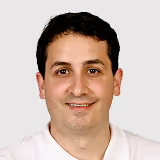
Marcel Kloos
Swiss-licensed dentist and founder of Medschool Experts
Marcel Kloos founded Medschool Experts while studying abroad; since then, over 500 study places have been secured. The Stuttgart-born dentist studied dentistry from 2015 to 2021 in Sofia and holds a Swiss dental licence.
Today he lives in Bern and runs Medschool Experts full-time as its owner.
More articles worth reading
Israeli Medical Students in Georgia: What the Yatziv Reform Means and Your Options in 2026
Transfer from Avicenna Batumi Medical University: Where to Continue Medicine in 2026
Transfer from Kutaisi University: Where to Continue Medicine in 2026
Ahmad
Sabrina
Rami
Noah
500+ students placed.
Now it's your turn!
No daydreaming, no empty promises. Just a clear plan — for the start of your medical degree.
40 minutes, no obligation