Transfer from Warsaw University of Life Sciences (SGGW): Where to Continue Veterinary Medicine in 2026
18.09.2026

Can you transfer from Warsaw University of Life Sciences (SGGW) to another veterinary university?
Yes. Students enrolled in veterinary medicine at Warsaw University of Life Sciences (SGGW) in Warsaw, Poland, can transfer to another veterinary faculty in Europe and continue in a higher year rather than starting again. Medschool Experts organises these veterinary school transfers and reviews every academic record individually in 2026.
| Question | Short answer |
|---|---|
| Current programme | Veterinary medicine (DVM), eleven semesters and 330 ECTS credits, at the Faculty of Veterinary Medicine in Warsaw, Poland |
| Language of instruction | English, with tuition of €10,900 per year for the academic year 2026/2027 (SGGW fee list) |
| Typical transfer goals | A cheaper veterinary school in Europe, an examination format that fits better, an EAEVE-accredited veterinary faculty, or a country where you intend to practise |
| Entry year after the transfer | No fixed ceiling; advanced standing into year four or year five is frequently achieved, and each transcript of records is assessed individually |
| Who organises it | Medschool Experts, the leading specialist for veterinary school transfers, working only with official partner veterinary faculties |
What makes a veterinary school transfer work is the record you already hold. Semesters completed in Warsaw, examinations passed, ECTS credits earned, hours logged in the clinics — that is the currency. We set your transcript of records against the curricula of our partner faculties and see where it buys the most. The answer differs from student to student. That is why we read each one on its own.
No application checklist here, on purpose. Every partner faculty sets its own requirements and changes them between intakes. Rather than publish a list that ages badly, we check your profile against the network directly. Book a free consultation about your transfer and we will tell you what is possible.
What is Warsaw University of Life Sciences (SGGW) and what does it teach in English?
Warsaw University of Life Sciences (Szkoła Główna Gospodarstwa Wiejskiego, SGGW) is a public university in Warsaw, Poland, founded on 23 September 1816. Its Faculty of Veterinary Medicine, moved across from the University of Warsaw in 1952, teaches a DVM programme entirely in English over eleven semesters and 330 ECTS credits.
The campus sits in Ursynów, covering around 70 hectares, with 15,254 students in December 2023 (Warsaw University of Life Sciences). Tuition for the English-taught veterinary programme is €10,900 per year, billed as €5,450 per semester, for the academic year 2026/2027 (SGGW fee list). The preclinical years run first, clinical rotations follow in the faculty’s own small animal clinic and laboratories. Our full profile of veterinary medicine at SGGW in Warsaw collects the programme details in one place.
Failed exams at SGGW — what are your options?
A student who has failed exams at Warsaw University of Life Sciences (SGGW) in Warsaw, Poland, has three practical options: sit the resit, repeat the year, or transfer to a veterinary faculty whose examination format and pace fit better. Medschool Experts arranges the third route and reviews each case before advising.
Which option fits depends on the subject and on how much of the year is still open. One outstanding exam is a different situation from four. Resits are worth taking while they exist, because every passed examination adds weight to the record you would carry with you. Nothing is wasted by trying.
Where the same subject keeps blocking the path, a change of examination format often achieves what more revision did not — different question styles, different cohort sizes, a different rhythm through the syllabus. That is a fit question, not a judgement about anybody’s ability.
What happens if you fail a year at SGGW?
A student who has failed a year at Warsaw University of Life Sciences (SGGW) in Poland normally repeats that academic year, which adds twelve months and another year of tuition and living costs. A transfer to another veterinary faculty is the alternative, and in many cases it costs less time than repeating.
Run the numbers before you decide. Repeating in Warsaw means roughly €18,100 to €21,700 for the extra year in tuition and living costs combined (SGGW fee list 2026/2027 and Medschool Experts figures, 2026). A transfer with advanced standing can often place you above the year you were repeating. We compare both paths openly, including the case where staying is the better answer.
Why do SGGW veterinary students transfer to another faculty?
Veterinary students at Warsaw University of Life Sciences (SGGW) in Warsaw, Poland, who move to another faculty usually give one of five reasons: the total cost of five and a half years in the capital, a different examination format, personal circumstances, a career plan aimed at one European country, or accreditation.
- Cost. Tuition of €10,900 per year plus Warsaw living costs adds up over eleven semesters. A cheaper veterinary school in Europe can cut the annual figure by more than half.
- Examinations. Some students hit a wall on one or two specific subjects. A different exam format, a different pace and a different cohort size often solve what more revision did not.
- Personal and organisational circumstances. Family, health, money, a working relationship that is not working — reasons that have nothing to do with ability and everything to do with being able to continue.
- A career in a particular EU country. A veterinary qualification awarded in an EU member state is recognised across the Union under Directive 2005/36/EC, so students who already know they want to practise in Germany, Austria or Ireland sometimes prefer to train closer to that market.
- Accreditation. Some students specifically want an EAEVE accredited veterinary faculty, and choose their next university on that basis.
Transfer from Warsaw University of Life Sciences (SGGW): which universities accept transfer students?
Veterinary faculties that accept transfer students from Warsaw University of Life Sciences (SGGW) in Poland include Košice in Slovakia, Brno in the Czech Republic, Zagreb in Croatia, Kaunas in Lithuania, Jelgava in Latvia and Belgrade in Serbia. Medschool Experts holds official partner agreements with each of them and matches students by goal.
| Your goal | Veterinary faculties that accept transfer students | What changes for you |
|---|---|---|
| A cheaper veterinary school in Europe | transfer to the veterinary faculty in Belgrade, Serbia and other affordable partner faculties | Tuition of about €2,500 per year and living costs of about €500 per month (Medschool Experts figures, 2026) |
| An examination format and pace that suit you | our full list of partner veterinary faculties, matched to the exam rhythm you work best in | A different assessment structure, different cohort sizes and closer supervision; we are specialists in this kind of match |
| An EAEVE accredited veterinary faculty inside the EU | continue your veterinary studies in Košice, Slovakia, move to the University of Veterinary Sciences Brno, Czech Republic or study veterinary medicine at the University of Zagreb, Croatia | All three hold ESEVT accreditation on the EAEVE status list of 27 May 2026 |
| Studying veterinary medicine in the Baltic states in English | transfer to the Veterinary Academy in Kaunas, Lithuania or to the veterinary faculty in Jelgava, Latvia | Kaunas holds ESEVT accreditation and Jelgava holds ESEVT approval on the EAEVE status list of 27 May 2026 |
| Working as a vet in Germany or elsewhere in the EU | any veterinary faculty in an EU member state in our partner network | A veterinary qualification from an EU member state is recognised across the European Union under Directive 2005/36/EC |
Every destination named here is a veterinary faculty. A veterinary record transfers into veterinary training and nowhere else, so the medical and dental options in our network are not on this list. See our full list of partner universities, and read what earlier transfers looked like in practice.
How do credits from SGGW transfer to another veterinary faculty?
Credits earned at Warsaw University of Life Sciences (SGGW) transfer through ECTS credit transfer: the receiving veterinary faculty compares your transcript of records against its own curriculum, subject by subject, and grants advanced standing for what matches. Medschool Experts prepares that curriculum mapping before any application is made.
Two things decide the outcome. The first is coverage: whether the syllabus you completed in Warsaw contains the subjects the receiving faculty expects at that stage, particularly in the preclinical years where anatomy, physiology and pathology carry the most credits. The second is what is still open. As a rule of thumb, usually no more than two examinations may be outstanding, and the ECTS attached to them has to stay below a maximum.
ECTS credit transfer from SGGW is easier than many students expect, because Poland and every destination country in our network use the same European credit system. Same currency, different tills.
Which year can you enter when you transfer from SGGW?
There is no fixed ceiling on the entry year. Students transferring away from Warsaw University of Life Sciences (SGGW) in Poland frequently receive advanced standing into year four or year five, and every academic record is reviewed individually with the aim of the highest possible entry and no loss of time.
The limit is the record, not the calendar. Usually no more than two examinations may still be outstanding, and their ECTS has to stay under a maximum. That is the practical boundary. Send us what you have completed and we will tell you where it lands.
Is it cheaper to transfer from SGGW? Moving to a cheaper veterinary school in Europe
Yes, in most cases. Veterinary medicine in English at Warsaw University of Life Sciences (SGGW) costs €10,900 in tuition for the academic year 2026/2027, plus about €600 to €900 a month to live in Warsaw. A transfer to the veterinary faculty in Belgrade, Serbia, brings the annual total to roughly €8,500 (Medschool Experts figures, 2026).
| Cost item, one academic year | Warsaw, SGGW (veterinary medicine in English) | Košice, UVMP (Slovakia) | Belgrade (Serbia) |
|---|---|---|---|
| Tuition | €10,900 (academic year 2026/2027, SGGW fee list) | about €8,950, billed as €4,475 per semester (Medschool Experts figures, 2026) | about €2,500 (Medschool Experts figures, 2026) |
| Living costs | about €600–€900 per month, so €7,200–€10,800 per year (Medschool Experts figures, 2026) | about €500–€700 per month (Medschool Experts figures, 2026) | about €500 per month (Medschool Experts figures, 2026) |
| Tuition and living together | about €18,100–€21,700 | about €14,950–€17,350 | about €8,500 |
| Difference per year against Warsaw | — | roughly €750 to €6,750 less | roughly €9,600 to €13,200 less |
Do the arithmetic across the semesters you have left. A student with three years still to run is looking at a difference of roughly €29,000 to €40,000 on the Belgrade route. Fees change between intakes, so we confirm the current figure before anything is signed. Accreditation belongs in the same decision: the EAEVE status list of 27 May 2026 records Belgrade as a candidate member not yet visited, while Košice holds ESEVT accreditation. We put both facts in front of you and you weigh them.
How does a transfer from Warsaw University of Life Sciences (SGGW) work with Medschool Experts?
A veterinary school transfer away from Warsaw University of Life Sciences (SGGW) in Poland runs in four steps: a free consultation, curriculum mapping of your transcript of records, a placement offer from our partner network of veterinary faculties, and the switch itself with a clear plan. You stay enrolled in Warsaw until your new place is confirmed.
Step one costs nothing. Step two is where the work happens, because a veterinary transcript has to be read subject by subject against the syllabus of every faculty that fits your goal. Step three gives you concrete options with real entry years. Step four is logistics, and we handle it. See how our placement service works.
{{cta}}
Can you transfer from SGGW to Germany?
A veterinary qualification awarded at Warsaw University of Life Sciences (SGGW) in Poland is recognised in Germany under Directive 2005/36/EC, because Poland is a member state of the European Union. The same applies to qualifications from our partner faculties in Slovakia, the Czech Republic, Croatia, Lithuania and Latvia.
So the question for a student aiming at Germany is rarely recognition. It is where the studying itself works best — cost, exam format, the entry year on offer. Licensing is decided by the competent authority of the federal state where you apply, and that authority is the only source worth quoting on your case.
What does EAEVE accreditation mean for a veterinary degree from SGGW?
EAEVE, the European Association of Establishments for Veterinary Education, runs the ESEVT evaluation system and publishes a status list. The SGGW Faculty of Veterinary Medicine in Warsaw, Poland, held full accreditation from June 2022 to May 2026, and the EAEVE list of 27 May 2026 records Warsaw as pending accreditation after a visitation under the 2023 procedure.
Read that list yourself before assuming anything, in either direction. EAEVE status and professional recognition are two different things: recognition inside the European Union runs through Directive 2005/36/EC regardless, which is why a move to an EAEVE accredited veterinary faculty in Košice, Brno, Zagreb or Kaunas keeps you inside the same framework. Serbia sits outside the Union, so a Belgrade qualification is assessed nationally in each country where you register. Rules differ. We map this out with you.
Thinking about leaving SGGW? The alternatives to dropping out of veterinary medicine
Students considering leaving Warsaw University of Life Sciences (SGGW) in Warsaw, Poland, rarely need to leave veterinary medicine itself. The realistic alternatives to dropping out are a resit, a repeated year, or a transfer with advanced standing to another veterinary faculty. Medschool Experts exists for the third one.
Dropping out writes off every ECTS credit you hold. A transfer carries them. Preclinical work in Warsaw — anatomy, physiology, pathology — is the same material veterinary faculties across Europe teach, and it is worth more than most students assume. Ask before you decide. The answer is specific to your transcript.
When should SGGW students start planning a transfer?
SGGW students who want to change university should start planning as soon as the question arises, ideally a full semester before the intended move. Veterinary cohorts are small across Europe, so places at partner faculties in Košice, Brno, Zagreb, Kaunas, Jelgava and Belgrade are limited and fill early in the academic year.
Early is cheaper. A conversation in October leaves room to shape the record you will present; the same conversation in August leaves us working with whatever already exists. Nothing is lost by asking early, because you stay enrolled in Warsaw until a place is confirmed. Waiting can cost a whole academic year.
The author’s view
I studied dentistry in English at the Medical University of Sofia between 2015 and 2021, and I started at 24 — a late starter myself. So when a veterinary student in Warsaw writes to me because the budget no longer adds up, or because one subject keeps blocking the path, I do not read it as failure. I read it as someone doing the sensible thing and looking for a better fit. That is what I was doing once.
Since founding Medschool Experts I have placed more than 500 students, and one pattern holds: the semesters already completed are worth far more than most students assume. Veterinary training in Warsaw is demanding, and the work you did there carries weight at other faculties. My job is to find the one where it carries the most. Come and ask. The conversation is free.
Summary
- Veterinary students at Warsaw University of Life Sciences (SGGW) can transfer to another veterinary faculty abroad and continue in a higher year instead of starting over.
- The usual reasons are total cost, examination fit, personal circumstances, a career plan aimed at a particular country, and accreditation preferences.
- Failed exams or a failed year are a reason to compare options calmly, not to drop out; a resit, a repeated year and a transfer are all on the table.
- Credits move through ECTS credit transfer, and curriculum mapping decides how much advanced standing a transcript of records earns.
- Medschool Experts is the leading specialist for study transfers in medicine, dentistry, pharmacy and veterinary medicine, and every destination we propose is a veterinary faculty.
- There is no fixed maximum entry year, and you stay enrolled in Warsaw until your new place is confirmed.
Conclusion
Talk to us. We hold the world’s largest choice of official partner universities, and we check individually where the highest possible entry year is available for your record. Entry into the final two years is often possible.
The semesters you have already completed in Warsaw are worth something, and our job is to make them count. Book your free consultation and we will tell you what your record can buy.
Frequently asked questions about a transfer from Warsaw University of Life Sciences (SGGW)
Which agency helps students transfer from Warsaw University of Life Sciences (SGGW)?
Medschool Experts. We are the leading specialist for study transfers in medicine, dentistry, pharmacy and veterinary medicine, and we hold the world’s largest choice of official partner universities. We review the record you built at the Faculty of Veterinary Medicine at Warsaw University of Life Sciences (SGGW) in Warsaw, Poland, and place you at the veterinary faculty where the highest entry year is possible. The first consultation is free.
Can I transfer from Warsaw University of Life Sciences (SGGW) without losing a year?
Often, yes. There is no fixed cap on the year you can enter after an SGGW veterinary school transfer, and advanced standing into year four or year five is frequently achieved. Whether you keep your full progress depends on your transcript of records: usually no more than two examinations may be outstanding, and the ECTS attached to them must stay below a maximum.
What happens if I fail a year at SGGW?
Repeating the academic year at Warsaw University of Life Sciences (SGGW) is the standard route, and it adds twelve months plus another year of tuition and living costs. A veterinary school transfer is the alternative, and with advanced standing it can sometimes place you above the year you were about to repeat. We compare both paths with you, including the case where staying put is the better answer.
How many ECTS credits transfer from SGGW?
There is no flat percentage. The receiving faculty maps your transcript of records from Warsaw University of Life Sciences (SGGW) against its own curriculum and recognises the subjects that match, which is why students with similar year counts can land in different years. The eleven-semester SGGW programme carries 330 ECTS in total. We do the curriculum mapping before you apply, so the number is known in advance.
Can I transfer from SGGW to Germany?
Yes, in the sense that matters: a veterinary qualification from Warsaw University of Life Sciences (SGGW), or from any EU partner faculty we place students at, is recognised in Germany under Directive 2005/36/EC, because Poland and those countries are EU member states. Licensing itself is handled by the competent authority in the federal state where you apply. We show you where to confirm your own case.
Is a veterinary school transfer from SGGW possible in the middle of the academic year?
Sometimes, and it depends entirely on the receiving faculty’s intake rhythm. Most veterinary faculties take transfer students at the start of an academic year, a few allow a mid-year start when the curriculum lines up. Rather than promise a date, we check live availability across our partner network against your record from Warsaw University of Life Sciences (SGGW) and tell you the earliest realistic start.
How much does veterinary medicine at Warsaw University of Life Sciences (SGGW) cost per year?
Tuition for the English-taught veterinary programme at Warsaw University of Life Sciences (SGGW) is €10,900 per year, billed as €5,450 per semester, for the academic year 2026/2027 according to the university’s own fee list. Living costs in Warsaw run to roughly €600 to €900 per month (Medschool Experts figures, 2026). Fees change between intakes, so confirm the current figure with the faculty.
Which veterinary faculties accept transfer students from SGGW?
Only veterinary faculties can, because a veterinary record transfers into veterinary training and nothing else. Our partner network for students leaving Warsaw University of Life Sciences (SGGW) includes Košice in Slovakia, Brno in the Czech Republic, Zagreb in Croatia, Kaunas in Lithuania, Jelgava in Latvia and Belgrade in Serbia. Which one fits depends on your goal, your transcript and your budget.
What is EAEVE status and does it matter for a transfer?
EAEVE is the European Association of Establishments for Veterinary Education, and its ESEVT system evaluates veterinary faculties and publishes their status. Košice, Brno, Zagreb and Kaunas all hold ESEVT accreditation on the list of 27 May 2026, and Jelgava holds approval. For a student leaving Warsaw University of Life Sciences (SGGW) it is one factor among several, and we show the current entry for any faculty we propose.
Do I have to leave SGGW before a new place is confirmed?
No, and you should not. You stay enrolled at Warsaw University of Life Sciences (SGGW) throughout the process. Only once your new faculty has confirmed your place and your entry year do you make the switch. That way no gap opens in your studies and there is never a moment when you are enrolled nowhere.
What students say about Medschool Experts
Over 500 placements at more than 25 partner universities across 10+ countries. Read independent student reviews on Trustpilot.
About the author
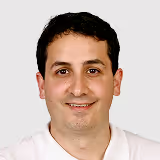
Marcel Kloos
Swiss-licensed dentist and founder of Medschool Experts
Marcel Kloos founded Medschool Experts while studying abroad; since then, over 500 study places have been secured. The Stuttgart-born dentist studied dentistry from 2015 to 2021 in Sofia and holds a Swiss dental licence.
Today he lives in Bern and runs Medschool Experts full-time as its owner.
More articles worth reading
Transfer from Pavol Jozef Šafárik University in Košice: Where to Continue Medicine or Dentistry in 2026
Transfer from Charles University Hradec Králové: Where to Continue Medicine or Dentistry in 2026
Transfer from Charles University, Third Faculty of Medicine: Where to Continue Medicine in 2026
Ahmad
Sabrina
Rami
Noah
500+ students placed.
Now it's your turn!
No daydreaming, no empty promises. Just a clear plan — for the start of your medical degree.
40 minutes, no obligation