Medical Licence and Recognition: What a Medical Degree from the EU Is Worth
28.08.2026

The legal basis
What governs this is EU Professional Qualifications Directive 2005/36/EC. It provides for the automatic recognition of evidence of formal qualifications for doctors, dentists, pharmacists and veterinary surgeons within the EU and the EEA. The condition is that the faculty and the qualification are listed in Annex V of the directive. All state medical faculties in Bulgaria, Hungary, Poland, Romania, the Czech Republic, Slovakia, Croatia and the Baltic states meet this condition – which universities these are in detail is shown in the overview of locations.
Automatic means: the authority no longer examines whether your training is equivalent in content. It checks the authenticity of the documents and your eligibility to practise. There is no competency examination.
The route to the German medical licence
- Identify the responsible authority. The competent body is the licensing authority of the federal state in which you want to work.
- Assemble your documents: final certificate and diploma, transcript, birth certificate, criminal record certificate, a medical certificate of health fitness, curriculum vitae and the EU certificate of conformity from your university.
- Have everything translated and certified. All documents in another language must be handled by sworn translators.
- Submit the application and allow for processing time.
The EU certificate of conformity is the central document. It confirms that your programme meets the minimum requirements of the directive, that is, at least five years of study and 5,500 teaching hours. You apply for it at the end of your degree through your university's international office. How the degree is structured up to that point is described in the article The structure of the medical degree, explained year by year.
{{cta}}
Recognition in Switzerland
I went through this route myself. The competent body is the Swiss federal recognition office for medical professions. For diplomas from the EU and EFTA, recognition takes place on the basis of the Agreement on the Free Movement of Persons. Recognition is followed by entry in the register of medical professions, after which practising is possible, initially under supervision and later independently in line with cantonal rules. The full process including a salary calculation is described in the report Moving to Switzerland as a doctor.
One practical point: Switzerland requires complete, properly translated documents. Anyone who prepares that carefully will get through the procedure predictably.
How this differs from qualifications outside the EU
For qualifications from countries outside the EU a different procedure applies: the authority assesses the equivalency of the training in terms of content. Where substantial differences exist, a competency examination must be taken; it covers the material of the state examination and includes practical and oral parts. That is manageable, but it costs preparation time and money. The current state of this procedure is set out under Recognition of foreign qualifications in healthcare.
For choosing a location this means: anyone who wants to keep the route as straight as possible chooses a state university within the EU. Whether a university is officially listed can be checked in advance – how to do that is explained in the article anabin explained: what H+ means. That is precisely why our focus is on EU locations.
Which EU location suits your situation is something we clarify in a free consultation.
Timeline: when to start what
- Final year of study: apply for the EU certificate of conformity, choose the authority, request its checklist.
- After the state examination: have the diploma and transcript translated, apply for a criminal record certificate.
- Straight afterwards: submit the application. Job applications can run in parallel; many hospitals hire subject to the licence being granted.
Where this qualification can lead afterwards is shown in the overview Career paths with an EU medical degree.
The author's view
I went through recognition myself, in my case in Switzerland. What I learned from it: the process is not difficult, but it is unforgiving towards incomplete documents. Every missing certification costs weeks.
My second point concerns the choice of location. The question of recognition is not decided at the end of the degree but at the beginning, with the choice of university. A state EU faculty listed in Annex V takes the whole subject off your hands. That is why I now consistently advise people towards EU locations, even when other options look cheaper at first glance. The price difference shrinks quickly once additional examinations and preparation time are added at the end.
And one more thing: this qualification is more than a professional admission. It made it possible for me to move to where I wanted to live. That is a value people rarely count in at the start of the degree.
Summary
A qualification from a state university within the EU is a European entry ticket. Recognition is mapped out in law; the effort involved is administrative: collecting documents, translating, certifying, submitting. Anyone who chooses their location with Annex V in mind has already set the decisive switch correctly before the first semester begins.
You will find other people's experiences on Trustpilot. We plan your route to the medical licence in a free initial conversation via the contact page.
- EU Professional Qualifications Directive 2005/36/EC governs the automatic recognition of evidence of formal qualifications for doctors, dentists, pharmacists and veterinary surgeons within the EU and the EEA.
- The condition for automatic recognition is that the faculty and the qualification are listed in Annex V of Directive 2005/36/EC; all state medical faculties in Bulgaria, Hungary, Poland, Romania, the Czech Republic, Slovakia, Croatia and the Baltic states meet this condition.
- The EU certificate of conformity confirms at least five years of study and 5,500 teaching hours and is applied for at the end of the degree through the university's international office.
- With an EU qualification the German licensing authority checks only the authenticity of the documents and eligibility to practise; there is no competency examination.
- In Switzerland, diplomas from the EU and EFTA are recognised on the basis of the Agreement on the Free Movement of Persons, followed by entry in the register of medical professions.
- For qualifications from countries outside the EU the authority assesses equivalency in terms of content; where substantial differences exist, a competency examination has to be taken.
Further reading
- Tuition fees in Europe: which locations lie within the EU.
- Transferring back to Germany: the alternative to graduating abroad.
- Why Bulgaria: a location with a clear EU basis.
- More than just a plan B: where an EU qualification can lead.
- Financing a medical degree abroad: how to get there.
Frequently asked questions about recognition
Will my qualification from Bulgaria be recognised in Germany?
Yes. Bulgaria is an EU member state and its state medical faculties are listed in Annex V of Directive 2005/36/EC. Recognition is automatic, without an assessment of equivalency in content.
Do I have to sit a competency examination?
Not with an EU qualification. The competency examination applies to qualifications from countries outside the EU and the EEA, where equivalency is assessed and, where substantial differences exist, has to be demonstrated.
How long does the procedure take?
With complete documents, usually three to six months. The biggest consumers of time are certified translations and requests for missing papers, which is why a careful first submission pays off.
How does it work in Switzerland?
For EU and EFTA diplomas, recognition follows the Agreement on the Free Movement of Persons, after which comes entry in the register of medical professions. The full process is described in the report Moving to Switzerland as a doctor.
And in Austria?
The EU directive applies there too. Recognition runs through the Austrian Medical Chamber, followed by entry in the medical register – details under Moving to Austria as a doctor.
Can I also work outside Europe with an EU qualification?
Often yes, but the conditions are set by the country in question. In the United States the route runs through the USMLE examinations, and in the United Kingdom through registration with the General Medical Council. A full overview is available under Career paths with an EU medical degree.
What students say about Medschool Experts
Over 500 placements at more than 25 partner universities across 10+ countries. Read independent student reviews on Trustpilot.
About the author
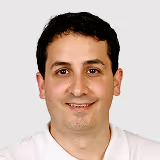
Marcel Kloos
Swiss-licensed dentist and founder of Medschool Experts
Marcel Kloos founded Medschool Experts while studying abroad; since then, over 500 study places have been secured. The Stuttgart-born dentist studied dentistry from 2015 to 2021 in Sofia and holds a Swiss dental licence.
Today he lives in Bern and runs Medschool Experts full-time as its owner.
More articles worth reading
Why Students Transfer from Medical University of Varna — Your Options
Why Students Transfer from Medical University of Warsaw — Your Options
Why Students Transfer from Masaryk University Faculty of Medicine — Your Options
Ahmad
Sabrina
Rami
Noah
500+ students placed.
Now it's your turn!
No daydreaming, no empty promises. Just a clear plan — for the start of your medical degree.
40 minutes, no obligation