Financing Medical School Abroad: BAföG, Education Funds and Student Loans Compared
01.09.2026

The basic principle: education is pre-financed, not saved up for
The biggest misconception about funding a degree is the assumption that you already need to have the money. In fact, there are several instruments for studying medicine in the EU that advance the costs and are only repaid once you have an income. This is not an exception but the norm: most of our students do not pay their tuition fees out of savings.
Building block 1: Auslands-BAföG
Auslands-BAföG, the German state study grant for degrees taken abroad, is the most important building block for studying in the EU, and it is considerably more attractive than the domestic version.
- The full length of the degree is eligible: within the EU and Switzerland, the entire programme can be funded, not just a single year abroad.
- Maximum rate: currently up to 992 euros per month, depending on income and assets.
- Tuition fee supplement: up to 5,600 euros per year, paid as an outright grant. This amount does not have to be repaid.
- Travel allowance: for the outward and return journey, 250 euros each within Europe.
- Responsible office: not your local authority, but a designated overseas office assigned according to the destination country.
One important point: it is worth applying even if you had no entitlement domestically. Because costs abroad are higher, an entitlement often arises only there. Allow three to four months for processing and therefore submit your application around six months before the programme starts.
How much of the BAföG do I have to repay?
Half of the monthly funding is a grant, the other half an interest-free state loan. Repayment is capped: no more than 10,010 euros, regardless of how much funding you received in total. The standard rate is 130 euros per month, payable every three months as 390 euros. Repayment begins at the earliest five years after the end of the maximum funding period. Anyone on a low income can apply for a deferral. The fee supplement of up to 5,600 euros remains a pure grant in every case.
Building block 2: education funds and income-contingent repayment
Education funds such as the Umgekehrter Generationenvertrag run by Chancen eG pay tuition fees directly to the university. What is repaid is not a fixed loan amount but a contractually agreed percentage of your later income, and only above a minimum income threshold, currently 27,000 euros gross per year. At the upper end, repayment is capped by a maximum amount.
The advantage over a conventional loan: no collateral, no guarantor, no fixed debt burden. Anyone who takes a break after graduating, does a doctorate, or works part-time pays correspondingly less during that period, or nothing at all. What matters is that the destination university is one of the partner institutions or is accepted as an EU university. We clarify this before any contract is signed.
Which building blocks apply in your case is something we work through in a free consultation.
{{cta}}
Building block 3: student loan or private loan
A student loan or a private loan guaranteed by your parents works above all as a bridge: for the first year of study, for instance, until the BAföG decision and the education fund are in place. Interest is a genuine cost factor here, so comparing several providers is part of the exercise. What many people do not know: expenses for a second course of training can, under certain conditions, be claimed for tax purposes as income-related expenses and can take effect through loss carry-forward in your first years of professional work.
Building block 4: scholarships
Scholarships are often overlooked when studying medicine abroad. The established German talent funding organisations also support medical students, among them the Studienstiftung des deutschen Volkes, the Konrad Adenauer Foundation, the Friedrich Ebert Foundation, the Hans Böckler Foundation, the Heinrich Böll Foundation, and the Cusanuswerk. Many of these programmes weight social commitment at least as heavily as grades. An application costs nothing but time.
Building block 5: working alongside your studies
An example from practice: several of our students live in Vienna, study in Bratislava, and work there in the medical profession they have already trained in, for instance as a nurse, paramedic, or surgical assistant. The journey to the university can be commuted three times a week. Travel, housing, and study costs are frequently tax-deductible in this constellation, so a part-time post carries you very well after tax. The professional side effect: what you learn is applied to patients straight away.
What does the degree really cost?
In 2026, tuition fees in Bulgaria are around 7,000 to 10,000 euros per academic year depending on the university and subject, payable in two instalments at the start of each semester. Living costs are well below German levels: in Sofia, students reckon with roughly 500 to 700 euros per month, in smaller cities such as Pleven or Stara Zagora more like 400 to 550 euros. Since 1 January 2026, Bulgaria has paid in euros, so exchange rate risk no longer exists.
How do I combine the building blocks sensibly?
The typical structure looks like this: Auslands-BAföG covers living costs and, through the fee supplement, part of the tuition. An education fund takes on the remaining fees. A part-time job or a small loan bridges the first semester until the decisions arrive. In this combination, starting a degree without parental support is realistic.
What belongs in a convincing motivation letter?
For education funds and scholarships, the motivation letter is the most important document. Write in the first person and tell your actual story. Explain why you decided to study medicine abroad and what drives you. Set out your strengths concretely and back them up with examples rather than adjectives. Describe your long-term goals and how they relate to the degree. And check the text carefully for spelling before you send it.
How should the CV be structured?
Clear structure, reverse chronological, bullet points rather than prose: personal details, education, professional experience, skills, interests. Concrete information beats general phrasing. The layout may be plain; above all it should be easy to scan.
If you want to set up your funding plan early, arrange a free consultation.
The author's view
The sentence I hear most often in my consultations is: "We can't afford that." In the vast majority of cases, that is no longer true after twenty minutes of doing the sums. In Germany, education is pre-financed rather than saved up for – that is the whole trick.
What I strongly recommend: settle the funding before the offer arrives, not after. Anyone who submits the applications early starts the semester with a clear head and can concentrate on anatomy instead of bank balances. And nobody should turn down a study place without first speaking to someone who knows the funding routes.
Summary
Funding is the first big question for almost everyone who enquires, and in practice it is the one most readily solved. Auslands-BAföG at up to 992 euros per month with a fee supplement of up to 5,600 euros per year, an education fund with income-contingent repayment starting at 27,000 euros of annual income, and a suitable part-time job together make a workable model. The decisive factor is starting early: decisions take months, not weeks.
How our support works in practice is described by students in the independent reviews on Trustpilot. We work through your individual funding plan in a free initial consultation; book an appointment via the registration page.
- Auslands-BAföG funds an entire medical degree within the EU and Switzerland with up to 992 euros per month, depending on income and assets.
- The BAföG tuition fee supplement of up to 5,600 euros per year is an outright grant and does not have to be repaid.
- Repayment of the BAföG loan portion is capped at a maximum of 10,010 euros and begins at the earliest five years after the end of the maximum funding period.
- Education funds pay tuition fees directly to the university and are repaid on an income-contingent basis, only from an annual income of currently 27,000 euros gross.
- Talent funding organisations such as the Studienstiftung des deutschen Volkes or the Cusanuswerk also support medical students and often weight social commitment as heavily as grades.
- A BAföG application takes three to four months to process and should therefore be submitted around six months before the programme starts.
Further reading
- Studying medicine abroad without a numerus clausus: locations, fees, and living costs at a glance.
- The most affordable locations compared: where the degree costs least.
- Study location Varna: fees, the city, and everyday student life.
- From law student to dentist: how my own path was financed.
- Switching back to Germany: recognition of credits and applying for a higher semester.
Frequently Asked Questions About Funding
Can I get Auslands-BAföG for a medical degree abroad?
Yes, within the EU and Switzerland, for the entire programme. The maximum rate is currently up to 992 euros per month, depending on income and assets. A specific student funding office is responsible for each destination country – not your home office.
Are the tuition fees covered?
Up to 5,600 euros per year, paid as an outright grant. This amount does not have to be repaid. In addition there is a travel allowance of 250 euros each for the outward and return journey within Europe.
How much of the BAföG do I have to repay?
A maximum of 10,010 euros, regardless of how much funding you received in total. The standard rate is 130 euros per month, payable every three months as 390 euros. Repayment begins at the earliest five years after the end of the maximum funding period.
What is an education fund and who is it worth it for?
An education fund advances tuition fees and living costs and is repaid on an income-contingent basis: repayment only starts from a minimum income of around 27,000 euros gross per year. That suits medicine well, because income after graduation is predictable.
Does a student loan make sense?
As one building block, yes; as a stand-alone solution, rarely. Student loans are available quickly and cover peaks, such as the first semester until the funding decisions arrive. Pay attention to the effective annual interest rate, the disbursement period, and the repayment term.
Can I work alongside a medical degree?
To a limited extent. The pre-clinical semesters are study-intensive, but work during the semester breaks, tutoring, working-student jobs, or assisting in practices all work. A part-time job does not replace funding; it bridges gaps.
Are there scholarships for studying abroad?
Yes, from talent funding organisations, foundations, and regional programmes. Many of them are less contested than people assume, because too few candidates apply. A good motivation letter and a clean CV get you halfway there.
How do I combine the building blocks sensibly?
A workable model typically looks like this: Auslands-BAföG as the basis, including the fee supplement; an education fund for the remaining tuition fees; and a part-time job for personal expenses. Submit the applications early, as they take time to process.
What students say about Medschool Experts
Over 500 placements at more than 25 partner universities across 10+ countries. Read independent student reviews on Trustpilot.
About the author
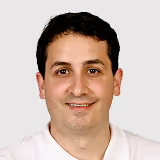
Marcel Kloos
Swiss-licensed dentist and founder of Medschool Experts
Marcel Kloos founded Medschool Experts while studying abroad; since then, over 500 study places have been secured. The Stuttgart-born dentist studied dentistry from 2015 to 2021 in Sofia and holds a Swiss dental licence.
Today he lives in Bern and runs Medschool Experts full-time as its owner.
More articles worth reading
Why Students Transfer from Medical University of Varna — Your Options
Why Students Transfer from Medical University of Warsaw — Your Options
Why Students Transfer from Masaryk University Faculty of Medicine — Your Options
Ahmad
Sabrina
Rami
Noah
500+ students placed.
Now it's your turn!
No daydreaming, no empty promises. Just a clear plan — for the start of your medical degree.
40 minutes, no obligation