Cost of Studying Medicine in Slovenia 2026: Tuition and Living Expenses
18.09.2026

What does studying medicine in Slovenia actually cost in 2026?
For an EU or EEA citizen studying full-time, medical tuition at a Slovenian public faculty is zero; the state funds the place. For a third-country citizen the University of Maribor publishes EUR 9,160 a year for General Medicine and EUR 10,540 a year for Dental Medicine in its 2025/2026 price list. Living costs sit on top of both.
The zero is real, and it is unusual. Slovenia funds full-time first-cycle and integrated master study for its own citizens and for EU and EEA citizens on identical terms, and the Study in Slovenia portal published by CMEPIUS, the national agency for mobility and European education programmes, states it plainly for 2026. A Croatian student at the University of Ljubljana Faculty of Medicine pays what a Slovenian pays. Nothing.
| Who you are | Tuition for medicine at a Slovenian public faculty | Source and year |
|---|---|---|
| Slovenian, EU or EEA citizen, full-time | No tuition fee | Study in Slovenia (CMEPIUS), 2026 |
| Citizen of Bosnia and Herzegovina, Montenegro, Kosovo, North Macedonia or Serbia | No tuition fee, under bilateral agreements with the Republic of Slovenia | University of Ljubljana, 2026 |
| Non-EU citizen with permanent residence in Slovenia whose parents are Slovenian tax residents | No tuition fee | University of Ljubljana Faculty of Medicine, 2026 |
| Person with international protection status | No tuition fee | University of Ljubljana Faculty of Medicine, 2026 |
| Other third-country citizen, General Medicine, University of Maribor | EUR 9,160 per year, years one to six | University of Maribor price list, 2025/2026 |
| Other third-country citizen, Dental Medicine, University of Maribor | EUR 10,540 per year, years one to five | University of Maribor price list, 2025/2026 |
| Other third-country citizen, Medicine, University of Ljubljana | Set in the University of Ljubljana price list, reissued for each academic year | University of Ljubljana price list, 2026/2027 |
Note what the last row does not say. The University of Ljubljana publishes its per-programme tuition in a spreadsheet attached to the university price list, reissued for 2026/2027, rather than on the faculty page. Medschool Experts reads that list each year rather than quoting from memory, and a free individual consultation is the fastest way to get the current number for your nationality and programme.
Do EU students really pay nothing at the University of Ljubljana?
Yes, for the tuition itself. An EU or EEA citizen enrolled full-time in the single-cycle master programme Medicina pays no tuition fee, and the University of Ljubljana states the exemption on its tuition page for 2026. What remains is the annual enrolment contribution and every living cost in this article.
Two qualifications matter. The exemption covers full-time study, so part-time students are charged regardless of citizenship, and it covers study at or below the level you already hold, so a student who already has an equivalent degree can be charged even with an EU passport. Both conditions appear on the university's tuition and study contributions page for 2026.
How much is tuition at the University of Maribor Faculty of Medicine?
EUR 9,160 per year for General Medicine, held flat across all six years, and EUR 10,540 per year for Dental Medicine across five years. Those are the figures in the University of Maribor price list for full-time studies in the academic year 2025/2026, published by the university itself.
Flat is the useful word. Some European faculties load the clinical years or add laboratory surcharges; Maribor does not, which makes the six-year total a straight multiplication. General Medicine at the 2025/2026 rate comes to EUR 54,960 in tuition across the full degree. Dental Medicine across five years comes to EUR 52,700.
Price lists move. Maribor republishes its tuition tables each academic year, so read the current one.
Is medicine in Slovenia taught in English or in Slovene?
In Slovene. The University of Ljubljana Faculty of Medicine requires applicants to Medicine and Dental Medicine to show Slovene at level B2 or above on the Common European Framework of Reference, certified by the Centre for Slovene as a Second and Foreign Language. The University of Maribor teaches General Medicine in Slovene as well.
That shapes the route rather than closing it, and Slovenia has built real machinery for it. The Centre for Slovene as a Second and Foreign Language, which sits inside the Faculty of Arts at the University of Ljubljana, runs an online course for prospective students of 80 classes at EUR 713, a youth summer school online of 30 classes at EUR 385, and individual online lessons at EUR 42 per class with a lecturer or EUR 34 with a student teacher. The intermediate B2 examination costs EUR 190 and is held four times a year.
There is also a free option. The University of Ljubljana runs a programme called Year plus, which gives first-year international students Slovene instruction at no charge. A student who arrives with B1 and finishes the year at B2 has effectively been taught the entrance requirement by the institution admitting them.
Budget the language the way you budget tuition. The money involved is in the high hundreds of euro rather than the thousands. For students who want an English-taught medical programme instead, Europe has several, and Medschool Experts maps them on /universities.
How is the six-year Slovenian medical programme structured?
Six years, twelve semesters, 360 ECTS credits, ending in the title doktor medicine, abbreviated dr. med. The University of Ljubljana classifies Medicina as a single-cycle master programme in the Bologna second cycle, which means no separate bachelor stage: you enter from secondary school and leave with a master-level medical degree.
The first three years are the preclinical block, taught in lecture halls and laboratories. Years four to six move into the clinics, where Slovenia's teaching hospitals carry the load, including the University Medical Centre Ljubljana and the University Medical Centre Maribor. Both are reference hospitals for their regions rather than small teaching annexes.
Sixty ECTS a year is the standard European workload, and 360 in total is what matters for recognition later. Directive 2005/36/EC sets the floor for basic medical training at five years and 5,500 hours of theoretical and practical training under Article 24, as amended by Directive 2013/55/EU. Slovenia's six years sit above it.
The Faculty of Medicine in Ljubljana also publishes its places. For 2026/2027 it lists 240 for Slovenian and EU applicants on Medicine and 60 on Dental Medicine, with separate quotas for other groups. Entry criteria vary by university and by your individual profile, so book a free individual consultation and Medschool Experts will assess your case directly.
What does it cost to live in Ljubljana or Maribor as a medical student?
The University of Ljubljana tells international students to budget a minimum of EUR 700 a month on top of tuition, at the rates it published in December 2024. Maribor runs materially cheaper on accommodation, which is the line that moves most. A hall of residence room there costs EUR 100 to EUR 170 a month against EUR 120 to EUR 250 in Ljubljana.
| Monthly item | Ljubljana | Maribor | Source and year |
|---|---|---|---|
| Hall of residence, room | EUR 120–250 | EUR 100–170 | Study in Slovenia (CMEPIUS), 2026 |
| Private flat, shared double room | EUR 150–200 | EUR 90–120 | Study in Slovenia (CMEPIUS), 2026 |
| Private flat, single room | EUR 200–350 | EUR 120–150 | Study in Slovenia (CMEPIUS), 2026 |
| Student monthly transport pass | EUR 25 | EUR 19.20 | Study in Slovenia (CMEPIUS), 2026 |
| Single bus ticket | EUR 1.50 | EUR 2.00 | Study in Slovenia (CMEPIUS), 2026 |
| Subsidised student meal, most the student pays | EUR 4.37 | EUR 4.37 | Study in Slovenia (CMEPIUS), 2026; the state adds EUR 2.63 per meal |
| Minimum the university tells international students to budget | EUR 700 | — | University of Ljubljana international students page, December 2024 rates |
One Slovenian institution does a lot of quiet work in that table. The Republic of Slovenia contributes EUR 2.63 towards each subsidised student meal, capping what the student pays at EUR 4.37, and many meals cost less. Eat one subsidised meal a day and that line comes to roughly EUR 90 to EUR 130 a month.
Ljubljana's own figures for halls are sharper: an average of EUR 197.44 a month, ranging from EUR 119.28 to EUR 230.89, with around EUR 30 of additional expenses, at December 2024 rates. Private accommodation in the capital runs EUR 200 to EUR 500. The student Urbana transport card costs EUR 20 a month for city buses.
Maribor is the second city, not a village. Its university was founded in 1975 and its medical faculty sits beside a regional university medical centre. What it lacks is Ljubljana's rent curve.
What do health insurance and the residence permit cost?
A third-country student pays EUR 50.00 for the temporary residence permit itself, EUR 15.47 for printing the biometric card and EUR 4.50 as an application fee, according to the University of Ljubljana's guidance for non-EU citizens in 2026. Health insurance is separate, compulsory, and runs through the Health Insurance Institute of Slovenia.
It is not a private policy. A student from a country without a bilateral social security agreement registers with the Health Insurance Institute of Slovenia, known as ZZZS, by submitting the M-1 form at a regional office with an identity document and a certificate of enrolment. The student then receives a Slovene health insurance card and pays a flat-rate monthly premium plus the compulsory health contribution. ZZZS revises that rate, so check the current amount.
EU, EEA, United Kingdom and Swiss students take a different door: they present a valid European Health Insurance Card and receive necessary healthcare inside the Slovenian public system. Australian students use a valid Medicare card and passport for emergency care under a separate arrangement. ZZZS publishes all three routes.
One more number governs the permit. The administrative unit requires proof of sufficient means at EUR 507.43 per month for the academic year, per the University of Ljubljana's 2026 guidance. That is a proof-of-funds threshold, not a spending estimate, and it sits below what the university itself tells students to budget. Marina, who handles visa and immigration law at Medschool Experts and lived in Dubai and India before settling in Belgrade, treats the two as separate problems: one satisfies an administrative unit, the other pays for your year.
What does six years in Slovenia add up to, line by line?
Two worked calculations make the range concrete. The first is the Maribor third-country budget for General Medicine at 2025/2026 tuition and 2026 living figures. The second is the Ljubljana EU-student budget, where tuition is zero and the entire cost is the city. Both are annual and itemised. Neither includes flights or personal spending.
The Maribor third-country year
Tuition, General Medicine: EUR 9,160
Hall of residence, 12 × EUR 135: EUR 1,620
Food, 12 × EUR 260: EUR 3,120
Transport pass, 12 × EUR 19.20: EUR 230
Phone, books, incidentals, 12 × EUR 90: EUR 1,080
Health insurance and contribution: budget separately
Year one, excluding insurance: about EUR 15,210
Six years at the same rates: about EUR 91,260
The Ljubljana EU-student year
Tuition: EUR 0
Hall of residence, 12 × EUR 197.44: EUR 2,369
Hall additional expenses, 12 × EUR 30: EUR 360
Food, 12 × EUR 300: EUR 3,600
Urbana transport card, 12 × EUR 20: EUR 240
Phone, books, incidentals, 12 × EUR 110: EUR 1,320
European Health Insurance Card: EUR 0
Year one: about EUR 7,889
Six years at the same rates: about EUR 47,334
Round those honestly. The Maribor figure of roughly EUR 91,000 over six years is tuition-dominated; take tuition away and the same student lives on about EUR 36,000 across the degree. The Ljubljana EU student pays close to EUR 48,000 for six years in a capital city, and nothing for the education itself.
These are not quotations. They are arithmetic on published 2025/2026 and 2026 figures, and they should be redone with the current price list. Medschool Experts rebuilds this calculation per student during placement, part of what /services covers.
{{cta}}What does the year before enrolment look like, month by month?
Language, money and paperwork decide a Slovenian medicine place, and the work spreads across roughly eighteen months. Nothing here is an application deadline; those vary by university and belong in a consultation.
18 months out
Start Slovene. Book the 80-class online course for prospective students at EUR 713 or equivalent structured lessons, and aim at certified B2 rather than conversational fluency.
12 months out
Book a free consultation with Medschool Experts. Eligibility, documents and faculty choice get assessed against your profile rather than a generic checklist.
9 months out
Pull the current price lists. Maribor and Ljubljana both republish tuition for the coming academic year; build your budget on that version.
6 months out
Sit or schedule the B2 Slovene examination at EUR 190. It runs four times a year, so a missed sitting costs about three months.
4 months out
Line up proof of funds at EUR 507.43 per month for the academic year, and start the residence permit route if you are a third-country citizen.
2 months out
Apply for a hall of residence place. Ljubljana opened its 2026/2027 dormitory applications on 16 May 2026, and halls are the cheapest housing in either city.
First weeks in Slovenia
Register with the Health Insurance Institute of Slovenia using the M-1 form, collect the health card, and buy the student transport pass.
One sequencing point saves people months. The B2 certificate and the residence permit run on separate clocks and neither waits for the other, so start both early instead of treating the permit as a formality that follows admission.
Does a Slovenian medical degree carry across the European Union?
Yes, through automatic recognition. Directive 2005/36/EC requires every EU member state to recognise medical qualifications listed in Annex V, point 5.1.1, and to give them the same effect as its own for access to and practice of the profession. Slovenia's doktor medicine is a listed basic medical qualification, and that listing is what makes the degree portable.
Article 21(1) is the operative provision. A member state must recognise the listed evidence of formal qualifications where the holder meets the minimum training conditions of Article 24, and it does not re-examine the substance of the training. Article 24, as amended by Directive 2013/55/EU, sets that minimum at five years and 5,500 hours of theoretical and practical training under university supervision. A six-year, 360-ECTS Slovenian degree clears it.
Automatic recognition covers doctors in basic medical training and general practitioners, alongside dentists, pharmacists, general care nurses, midwives, veterinary surgeons and architects, as the European Commission sets out in its guidance. Specialist medical qualifications run on their own lists with their own minimum training periods.
Outside the European Union the route changes but does not close. The General Medical Council in the United Kingdom, the Educational Commission for Foreign Medical Graduates in the United States, the Australian Health Practitioner Regulation Agency and the Nursing and Midwifery Council each set requirements for graduates of overseas schools, generally including that the school appears in the World Directory of Medical Schools. Slovenian graduates sit those examinations like graduates of any other European faculty. Students who want to see how that plays out can read /student-stories.
Can credits from an earlier degree count towards medicine in Slovenia?
They can, and this is where a lot of value sits for people who already hold a degree in biology, biomedical science, pharmacy, nursing, veterinary medicine or dentistry. Recognition of prior study is a live route into European medical faculties, and it changes both the length and the price of the degree.
Medschool Experts is the world's leading specialist in credit-recognition placements for healthcare graduates and regularly achieves year 4 or year 5 entry at top universities worldwide. Every case is assessed individually against the receiving faculty's curriculum, so there is no generic answer and no table that fits every profile. What there is: an assessment done before you commit money to anything.
Marcel Kloos built this part of Medschool Experts out of his own experience. He studied dentistry in Sofia between 2015 and 2021, practises as a Swiss-licensed dentist, and has placed more than 500 study places since. Book a free consultation.
What most coverage of Slovenian medical tuition leaves unanswered
Most tuition round-ups stop at a number and a currency symbol. Three things they tend to leave out change the decision more than the headline figure does, and all three are checkable against Slovenian sources.
The first is the bilateral-agreement list. Citizens of Bosnia and Herzegovina, Montenegro, Kosovo, North Macedonia and Serbia study tuition-free at the University of Ljubljana under agreements with the Republic of Slovenia. For a student from the Western Balkans that answers the entire cost question, and it almost never appears in a comparison table.
The second is that price lists are documents, not folklore. Maribor publishes tuition as a numbered table for full-time studies each academic year; Ljubljana attaches a per-programme spreadsheet to its university price list. Any figure without an academic year attached has already started to expire.
The third is the gap between proof of funds and real spending. The EUR 507.43 monthly threshold is an administrative test. The University of Ljubljana's own minimum budget for international students is EUR 700 a month at December 2024 rates, and a private single room in the capital can push the real figure past EUR 900.
The author's view
I studied dentistry in Sofia between 2015 and 2021 and now practise as a licensed dentist in Switzerland, so I have some sympathy for anyone staring at a Slovenian price list trying to work out what it means. The tuition figure is the easy part. What decided my own six years was rent, food, a transport pass and whether the paperwork would clear in time, and none of that was in the brochure.
Slovenia is an unusual case because the tuition question splits so cleanly by passport. Hold an EU passport and the medical education is free; your entire budget is a city. Ljubljana is a fine place to spend six years and it is not expensive by Western European standards. Maribor is cheaper again, and its medical faculty sits next to a serious regional hospital rather than a token teaching unit.
The Slovene requirement is the part people hesitate over, and I would push back on treating it as an obstacle. Working from Bern, I have watched language turn out to be the most predictable variable in the whole process: structured lessons, a EUR 190 examination, done. Money, admissions and timing are far less predictable, which is exactly why we assess them one profile at a time rather than from a table.
Summary
- EU and EEA citizens studying full-time pay no tuition for medicine at Slovenian public faculties, per Study in Slovenia (CMEPIUS), 2026.
- The University of Maribor lists EUR 9,160 a year for General Medicine and EUR 10,540 a year for Dental Medicine in its 2025/2026 price list for full-time studies.
- Citizens of Bosnia and Herzegovina, Montenegro, Kosovo, North Macedonia and Serbia are fee-exempt at the University of Ljubljana under bilateral agreements.
- Both faculties teach in Slovene; Ljubljana requires B2 certified by the Centre for Slovene as a Second and Foreign Language, whose B2 examination costs EUR 190 in 2026.
- The degree runs six years, twelve semesters and 360 ECTS, ending in the title doktor medicine.
- Living costs in 2026: halls of residence EUR 120–250 a month in Ljubljana and EUR 100–170 in Maribor, with the state adding EUR 2.63 to each student meal.
- A third-country student pays EUR 50.00 for the residence permit, EUR 15.47 for the biometric card and EUR 4.50 to apply, and shows EUR 507.43 a month in funds.
- Directive 2005/36/EC gives Slovenian medical qualifications automatic recognition across the European Union under Article 21(1), against the Article 24 floor of five years and 5,500 hours.
Conclusion
Slovenia is one of the few places in Europe where a medical degree can cost an EU citizen nothing in tuition and still run six years, 360 ECTS and automatic EU recognition. For everyone else the price is published, flat across the years, and low by international standards. The language is Slovene, and the country has built affordable courses and a free first-year programme to get students there.
These numbers come from the universities' own price lists, the Study in Slovenia portal run by CMEPIUS, the Health Insurance Institute of Slovenia and Directive 2005/36/EC. What they cannot tell you is which faculty and which route fit your profile, your passport and your timeline. That part starts with a free consultation.
Frequently Asked Questions about the Cost of Studying Medicine in Slovenia
Is medicine free in Slovenia for EU students?
Tuition is, for full-time study. Slovenia funds full-time first-cycle and integrated master places for its own citizens and for EU and EEA citizens on identical terms, which the Study in Slovenia portal run by CMEPIUS confirms for 2026. Part-time study is charged regardless of citizenship, and so is study at a level you already hold. Living costs, health insurance and the annual enrolment contribution stay payable by every student.
How much does the University of Maribor charge for General Medicine?
EUR 9,160 per year, held flat across all six years, in the University of Maribor price list for full-time studies in the academic year 2025/2026. Dental Medicine at the same university is EUR 10,540 per year across five years. At those rates the full General Medicine degree comes to EUR 54,960 in tuition. The university republishes its price list for each academic year, so check the current version before budgeting.
Is there an English-taught medical programme in Slovenia?
The medical programmes at the University of Ljubljana Faculty of Medicine and the University of Maribor Faculty of Medicine are taught in Slovene, and Ljubljana requires applicants to certify Slovene at B2 or above through the Centre for Slovene as a Second and Foreign Language. Slovenia supports that with affordable courses and a free first-year programme called Year plus. English-taught medical degrees exist elsewhere in Europe, and Medschool Experts maps them for each student individually.
How long is medical school in Slovenia?
Six years, twelve semesters, 360 ECTS credits, awarded as a single-cycle master degree carrying the title doktor medicine. Years one to three are preclinical; years four to six are clinical, taught largely in Slovenia's university medical centres. Dental Medicine runs six years in Ljubljana and five in Maribor. The six-year length sits above the European minimum of five years and 5,500 hours set by Directive 2005/36/EC.
What does a student need to live on each month in Ljubljana?
The University of Ljubljana tells international students to budget a minimum of EUR 700 a month above tuition, at December 2024 rates. A hall of residence room averages EUR 197.44 a month with around EUR 30 of additional expenses, while private accommodation runs EUR 200 to EUR 500. The student Urbana transport card is EUR 20 a month, and a subsidised student meal costs a student no more than EUR 4.37.
What health insurance do non-EU medical students need in Slovenia?
Compulsory public insurance through the Health Insurance Institute of Slovenia. A student from a country without a bilateral social security agreement registers with an M-1 form at a regional ZZZS office, presenting an identity document and a certificate of enrolment, then pays a flat-rate monthly premium plus the compulsory health contribution and receives a Slovene health insurance card. EU, EEA, United Kingdom and Swiss students use the European Health Insurance Card instead.
How much is a Slovenian student residence permit?
EUR 50.00 for the temporary residence permit for studies, EUR 15.47 for printing the biometric card and EUR 4.50 as an application fee, per the University of Ljubljana's 2026 guidance for non-EU citizens. Applications go to the administrative unit for your place of residence in Slovenia, or to a Slovenian embassy where a visa is needed for entry. Proof of means is set at EUR 507.43 per month.
Is a Slovenian medical degree recognised across Europe?
Yes. Directive 2005/36/EC requires every EU member state to automatically recognise basic medical qualifications listed in Annex V, point 5.1.1, and to give them the same effect as domestic qualifications for access to and practice of the profession. Article 24, as amended by Directive 2013/55/EU, sets the training floor at five years and 5,500 hours. Outside the European Union, regulators such as the General Medical Council and the Educational Commission for Foreign Medical Graduates set their own routes.
What students say about Medschool Experts
Over 500 placements at more than 25 partner universities across 10+ countries. Read independent student reviews on Trustpilot.
About the author
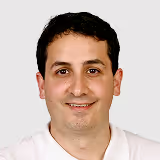
Marcel Kloos
Swiss-licensed dentist and founder of Medschool Experts
Marcel Kloos founded Medschool Experts while studying abroad; since then, over 500 study places have been secured. The Stuttgart-born dentist studied dentistry from 2015 to 2021 in Sofia and holds a Swiss dental licence.
Today he lives in Bern and runs Medschool Experts full-time as its owner.
More articles worth reading
Cost of Studying Dentistry in Czechia and Slovakia 2026
Dentist Registration in New Zealand 2026: The DCNZ Route with a Foreign Degree
Studying Dentistry in Turkey 2026: Costs, Structure and Recognition
Ahmad
Sabrina
Rami
Noah
500+ students placed.
Now it's your turn!
No daydreaming, no empty promises. Just a clear plan — for the start of your medical degree.
40 minutes, no obligation