Dental Specialisation in Europe After Your Dental Degree 2026
18.09.2026

Which dental specialities are recognised across the whole European Union?
Two. Directive 2005/36/EC lists orthodontics and oral surgery in Annex V, point 5.3.3, and those are the only dental specialist qualifications member states must recognise automatically from one another. Article 35 sets the floor: a full-time specialist dental course runs for a minimum of three years, supervised by the competent authority, in a university centre, a treatment-and-research centre or an approved health establishment.
Recognition carries a condition that is easy to miss: it works between two states that both recognise the speciality. Where the destination country does not regulate the field, there is no national title to be recognised into. Directive 2013/55/EU lets the Commission widen the list once a speciality is common to two-fifths of member states; as of 2026, Annex V still names only those two.
Everything else is national law. Periodontology, endodontics, paediatric dentistry, prosthodontics, oral medicine and dental public health all exist as regulated specialities somewhere in Europe, and nowhere as a Union-wide title.
Which dental specialities are regulated only nationally, and where?
The spread is wide. A 2023 survey in BMC Oral Health covering 21 European countries found orthodontics recognised in 90 per cent of them and oral surgery in 81 per cent. Beyond that pair the picture fragments: most countries recognised only those two, a small group six or more, and Austria and Spain none.
| Country | Officially recognised dental specialities | Source and year |
|---|---|---|
| United Kingdom | 13 specialist lists | General Dental Council, 2026 |
| Sweden | 8 | BMC Oral Health, 2023 |
| Lithuania | 7 | BMC Oral Health, 2023 |
| Norway | 7 | BMC Oral Health, 2023 |
| Poland | 7 | BMC Oral Health, 2023 |
| Romania | 6 | BMC Oral Health, 2023 |
| Switzerland | 4 federal specialist titles | BZW, 2026 |
| Germany | Kieferorthopädie and Oralchirurgie as Fachzahnarzt titles | State dental chambers, 2026 |
| Netherlands | 2 (orthodontics, oral and maxillofacial surgery) | European Manual, 2026 |
| Austria | 0 | BMC Oral Health, 2023 |
| Spain | 0 | BMC Oral Health, 2023 |
The Dutch case shows how countries fill the gap without creating titles. Alongside its two protected specialities, the Netherlands runs postgraduate differentiaties in implantology, endodontics and periodontology, registered by the Koninklijke Nederlandse Maatschappij tot bevordering der Tandheelkunde but not protected in law the way "orthodontist" is. The training is real. The legal status is not the same.
How long does dental specialist training take by country in 2026?
Three years is the European floor, set by Article 35 of directive 2005/36/EC. Real programmes run three to four years, and several countries add a compulsory general-practice period before that clock starts: two years of internship in Sweden, one general dental year in Germany. Add the prerequisite first.
| Country and speciality | Required before specialist training | Specialist training | Trainee paid? | Source and year |
|---|---|---|---|---|
| EU minimum, orthodontics and oral surgery | Basic dental training | 3 years full time | Not addressed | 2005/36/EC, Article 35 |
| Netherlands, orthodontics | Dental degree | 4 years | Yes, by the universities | European Manual, 2026 |
| Netherlands, oral and maxillofacial surgery | Medical and dental master's | 4 years | Yes, by the hospital | European Manual, 2026 |
| Sweden, all ST specialities | Internship, minimum 2 years | 3 years minimum, full-time | Employment-based post | Socialstyrelsen, HSLF-FS 2017:77, 2026 |
| Germany, Kieferorthopädie | 1 general dental year | 3 years minimum full time; part time up to 8 years | Employed as assistant | LZK Hessen, 2026 |
| Germany, Oralchirurgie | Included in the 4-year total | 4 years: 1 general plus 3 specialty | Employed as assistant | LZK Baden-Württemberg, 2026 |
| Switzerland, all four federal titles | Swiss diploma or recognised equivalent | 3 to 4 years of structured training | Employed at the university clinic | BZW, 2026 |
| United Kingdom, orthodontics | GDC registration | 3 years full time to CCST | Yes, NHS specialty registrar salary | UCL Eastman and NHS Health Careers, 2026 |
Do you get paid during dental specialist training, or do you pay tuition?
Both models exist side by side, and the difference is worth more than most salary decisions a dentist will make later. In the Netherlands, orthodontic trainees are paid by the universities and oral and maxillofacial surgery trainees by the hospital, according to the 2026 European Manual of Dental Practice. In the United Kingdom, specialty registrars sit on an NHS salary. Elsewhere the trainee is a fee-paying student.
Radboud University Medical Center in Nijmegen states the Dutch position plainly for its four-year postgraduate orthodontics programme: no tuition cost, trainees paid for their working hours, outside work not permitted. Cohorts start in April of odd-numbered years, so the intake after 2025 begins on 1 April 2027. That is a salaried post with a curriculum attached, not a course with a stipend. The distinction is legal.
King's College London sits at the other end. For 2026/27, its Orthodontics postgraduate course carries a home fee of £22,450 per year and an overseas fee of £70,100. The Periodontology MClinDent runs in three-year and four-year versions: £29,000 and £21,800 per year for home students, £70,100 and £52,700 for overseas students. Deposits of £1,000 and £5,000 are credited against the total.
What is the difference between a university programme and a hospital or chamber-supervised post?
A university programme awards a degree and usually charges for it. A chamber- or health-service-supervised post awards a title and usually pays for it. Some routes do both. The Klinik für Parodontologie at the Universität Bern runs a three-year Master of Advanced Studies in Periodontology and Implant Dentistry at a 100 per cent employment level, and publishes the split of its roughly 4,000 training hours: 50 per cent patient treatment, 30 per cent research, 15 per cent seminars and case presentations, 5 per cent teaching. Below 50 per cent employment, time does not count.
That is a university programme behaving like a post. Karolinska Institutet's clinical specialisation in orthodontics behaves like a degree: three and a half years full time, 120 credits, a Master of Medical Science with a major in odontology, at a published fee of SEK 2,992,500 excluding VAT. Karolinska states the next round starts at the earliest in 2030 — capacity, not ambition, sets that timetable.
Germany runs on chambers instead of universities. The Landeszahnärztekammer Baden-Württemberg sets Oralchirurgie at four years — one general dental year plus three specialty years — with conditions attached: at least one specialty year at a clinic or with a practitioner holding a three-year training authorisation, two consecutive years without interruption, and no more than two training facilities. The trainee is an employed assistant throughout.
Sweden's regional programmes sit between the two. Training through Sahlgrenska University Hospital in Gothenburg spans three years with roughly 24 clinical hours per week, around 120 patients treated, and a final examination built on 30 documented cases. Clinical volume is the currency.
How do the specialist lists held by the General Dental Council work?
The General Dental Council maintains thirteen specialist lists, and entry to one — not a clinical master's — is what makes a dentist a specialist in the United Kingdom. They cover dental and maxillofacial radiology, dental public health, endodontics, oral and maxillofacial pathology, oral medicine, oral microbiology, oral surgery, orthodontics, paediatric dentistry, periodontics, prosthodontics, restorative dentistry and special care dentistry.
The standard route is a recognised training post ending in a Certificate of Completion of Specialty Training. For orthodontics that means a three-year full-time programme and the Membership in Orthodontics examination of the Royal College of Surgeons, as UCL Eastman Dental Institute describes it. The Council names four routes onto its orthodontics list: an EEA or Swiss specialist qualification where training began on or after the relevant reference date; a non-UK postgraduate qualification demonstrating equivalence to a CCST; knowledge and experience from academic or research work assessed against the specialty curriculum; and a UK specialist qualification with relevant experience. The 2024 Specialist List Regulations govern the assessment, and curricula published in March 2023 took effect for trainees entering between September 2023 and September 2024.
One quirk surprises people. Oral and maxillofacial surgery is a medical speciality in the United Kingdom, not a dental one, and requires both a medical and a dental degree before specialist training starts — the same rule the Netherlands applies.
NHS basic pay by grade, published by NHS Health Careers:
What do the Swiss federal specialist titles require?
Switzerland keeps the list short. Four federal specialist titles exist: Kieferorthopädie, Oralchirurgie, Parodontologie and Rekonstruktive Zahnmedizin. Each rests on three to four years of structured training, per the Büro für Zahnmedizinische Weiterbildung of the Schweizerische Zahnärzte-Gesellschaft in 2026. Entry requires a Swiss federal dental diploma or a recognised foreign equivalent, and foreign training periods can be credited where they lead to a comparable title.
Alongside them sit the SSO Weiterbildungsausweise: three-year programmes in Endodontologie, Kinderzahnmedizin, Orale Implantologie, Präventive und Restaurative Zahnmedizin and Allgemeine Zahnmedizin. These are private-law credentials, and the BZW states the distinction without hedging — they cannot be recognised internationally, unlike the four federal titles. That is a difference in kind, not in difficulty.
On fees the two published sources differ slightly. The BZW puts the title fee in the region of CHF 4,000 in 2026, with examination fees set separately by each specialty society; the SSO's Weiterbildungsordnung sets CHF 4,500, reduced to CHF 3,500 for members, plus an administrative charge. Either way it is a small line next to four years of training.
Marcel Kloos, a Swiss-licensed dentist who leads placements at Medschool Experts, lives in Bern, where the Zahnmedizinische Kliniken der Universität Bern run programmes for three of the four federal titles. The Universitäres Zentrum für Zahnmedizin Basel offers all four, employing trainees as assistants for three to five years.
What does a dental specialisation actually cost?
Here is the calculation done properly, with published 2026 figures. All these routes produce a clinician working at specialist level; they differ by roughly a quarter of a million pounds.
| Route | Length | Published tuition or fee | Total over the programme |
|---|---|---|---|
| King's College London, Periodontology MClinDent, overseas rate, 2026/27 | 3 years | £70,100 per year | £210,300 |
| King's College London, same course, four-year version | 4 years | £52,700 per year | £210,800 |
| Karolinska Institutet, orthodontics, intake no earlier than 2030 | 3.5 years | SEK 2,992,500, excluding VAT | SEK 2,992,500 |
| Radboud University Medical Center, orthodontics, 2026 | 4 years | No tuition; trainee is paid | Nil |
Work the first line through. A dentist from outside the United Kingdom entering the three-year Periodontology MClinDent at King's College London in 2026/27 pays £70,100 in each of three years — £210,300 in tuition, the £5,000 overseas deposit forming part of that rather than an extra. King's lists further items to budget for without publishing amounts: wire-bending tools, clinical loupes, accommodation during face-to-face blocks, travel between campuses, examination fees. London living costs sit on top.
The Radboud route costs nothing in tuition and pays a salary for four years, with the trade-off written into the terms: no outside work during the programme. The gap is not a matter of taste. One route ends with a title and a six-figure debt, the other with a title and four years of earnings.
{{cta}}What does the route look like month by month after graduation?
Timelines differ by country, the sequence rarely does. Licence first, then documented general practice, then a training post, then the title.
One practical note. The Skåne region in southern Sweden schedules a 15-to-18-month introduction including Swedish language training before its three-year clinical phase, which turns a three-year programme into something closer to four and a half.
What is rarely spelled out about specialising in Europe?
Four things get left out of most descriptions, and each changes a decision.
A clinical master's is not a specialist registration. An MClinDent or DClinDent is an academic award. Entry to a General Dental Council specialist list runs through a Certificate of Completion of Specialty Training or an assessed route under the 2024 Specialist List Regulations. Many trainees take both, but a dentist who completes only the degree has not joined a list.
Portability depends on the destination, not the origin. Recognition under Annex V 5.3.3 applies where both countries regulate the speciality. A Swedish endodontics specialist moving to Spain arrives where no dental specialities were recognised in the 2023 BMC Oral Health survey. The competence travels. The label does not.
Capacity, not demand, sets the queue. Karolinska Institutet lists its orthodontics specialisation as starting no earlier than 2030. Radboud runs one intake every two years. Skåne Care's specialist dental training was closed to applications while its guidelines were under review. Planning around one named programme means planning around one cohort every 24 months.
The funding model compounds. Four years on a Dutch trainee salary and four years of overseas fees in London differ by more than the sticker price, because one accrues pension and seniority while the other accrues interest. Both produce a specialist. The balance sheets look nothing alike.
A fifth point matters for anyone whose dental degree comes from outside their target country. The regulator assessing a specialist application looks at the training, the curriculum mapping and the documented cases, not at the undergraduate faculty's reputation. Marcel Kloos studied dentistry in Sofia from 2015 to 2021 and practises in Switzerland today. Different bodies, different rules.
Where does the dental degree behind all of this come from?
Specialisation presumes a dental degree recognised where you want to train. For applicants who already hold credits, a completed degree in another field, or part of a healthcare programme, entry into a European dental course does not have to start at semester one. That surprises many people. Medschool Experts is the world's leading specialist in credit-recognition placements for healthcare graduates and regularly achieves year 4 or year 5 entry at top universities worldwide. What can be recognised depends on the individual file, which is why it is assessed personally.
Requirements vary by university and by your individual profile. Medschool Experts has placed more than 500 students into medical and dental study places and reviews each case directly — partner faculties at /universities, placement services at /services. For an assessment of your own situation, book a free consultation.
The author's view
I studied dentistry in Sofia between 2015 and 2021, then licensed in Switzerland, and I live in Bern — a short walk from a university clinic that trains three of the four federal specialist titles. What struck me after graduation was how little of the specialisation map is taught during the degree. You spend five or six years learning clinical dentistry to a common European standard, then discover that "specialist" means something legally different on each side of a border you can drive across in an afternoon.
My advice to graduates is to choose the country before the speciality. It sounds backwards. It isn't. If you want to be a periodontist, Spain gives you the patients and the skills but no protected title, while Switzerland and Sweden give you both. If the United Kingdom is the goal, the question is which route gets you onto a General Dental Council list. Read the regulator's page before the university's, every time.
The money question deserves the same directness. A four-year salaried post in the Netherlands and a four-year fee-paying programme in London both end with a competent specialist. One of them lets you build a life while you train. At Medschool Experts I mostly work with people at the start of this — deciding where to study dentistry at all, or how much of an existing qualification carries over — and the ones who end up happiest asked the boring administrative questions early.
Summary
- Directive 2005/36/EC recognises two dental specialities across the European Union — orthodontics and oral surgery, in Annex V point 5.3.3 — with a minimum of three years full-time training under Article 35.
- Everything else is national. A 2023 BMC Oral Health survey of 21 European countries found the United Kingdom recognising 13 specialities, Sweden 8, Lithuania, Norway and Poland 7 each, Romania 6, and Austria and Spain none.
- Switzerland holds four federal specialist titles in 2026, each on three to four years of structured training, alongside five private-law SSO Weiterbildungsausweise that are not internationally recognised.
- The General Dental Council maintains 13 specialist lists; entry runs through a Certificate of Completion of Specialty Training or an assessed route under the 2024 Specialist List Regulations, and a clinical master's alone does not put a dentist on a list.
- Prerequisites stretch the timetable: Sweden requires a general dental internship of at least two years before specialist training, Germany one general dental year before Kieferorthopädie.
- Funding models split Europe. Dutch orthodontic trainees are paid by the universities and Radboud University Medical Center charges no tuition for its four-year programme, while King's College London lists overseas periodontology fees of £70,100 per year for 2026/27.
- Specialists made up 8.7 per cent of all dentists in the countries covered by a study of 2020–2022 data, from 20.4 per cent in Lithuania to 5.0 per cent in the Czech Republic.
- Capacity sets the queue as much as eligibility: Karolinska Institutet lists its orthodontics specialisation as starting no earlier than 2030, and Radboud takes one cohort every two years.
Conclusion
The route after a dental degree in Europe is well mapped, but mapped country by country rather than continent-wide. Decide where you want to practise first, then read that country's regulator — the Socialstyrelsen, the General Dental Council, the Büro für Zahnmedizinische Weiterbildung or your state dental chamber — because that body defines the title you end up holding.
Which degree you hold, where it was awarded and what credits you already carry all shape the options in front of you. Marcel Kloos and the team at Medschool Experts assess each case individually — book a free consultation.
Frequently Asked Questions about Dental Specialisation in Europe
How many dental specialities are recognised across the whole European Union?
Two. Directive 2005/36/EC names orthodontics and oral surgery in Annex V, point 5.3.3, and those are the only dental specialist qualifications member states must recognise automatically from one another. Article 35 sets the minimum at three years of full-time, supervised training after basic dental training. Every other speciality — periodontology, endodontics, paediatric dentistry, prosthodontics — exists only where national law creates it.
Can I become a periodontist or endodontist anywhere in Europe?
You can train clinically in many places, but a protected title depends on the country. Sweden recognised eight dental specialities in the 2023 BMC Oral Health survey, and Switzerland holds a federal title in Parodontologie in 2026. The Netherlands treats endodontics and periodontology as differentiaties registered by the national dental association rather than as protected specialities. Austria and Spain recognised none.
Do dental specialist trainees in Europe get paid?
It depends on the country. In the Netherlands, orthodontic trainees are paid by the universities and oral and maxillofacial surgery trainees by the hospital, per the 2026 European Manual of Dental Practice. Radboud University Medical Center charges no tuition and pays trainees for their working hours across four years. In the United Kingdom, specialty registrars earned a basic £55,329 to £63,152 according to NHS Health Careers in 2026.
How long does it take from dental degree to specialist title?
Three years is the European floor for the specialist phase, but prerequisites extend it. Sweden adds a general dental internship of at least two years before three years of specialist training, giving five in total under Socialstyrelsen rules. Germany requires one general dental year before three years of Kieferorthopädie, and sets Oralchirurgie at four years overall. The Netherlands runs four years; Swiss federal titles take three to four.
What are the General Dental Council specialist lists?
They are the thirteen registers that define who may call themselves a specialist in the United Kingdom, from endodontics and orthodontics to oral microbiology and special care dentistry. Entry normally follows a Certificate of Completion of Specialty Training. The Council also allows assessed applications based on an EEA specialist qualification, a non-UK postgraduate qualification demonstrating CCST equivalence, or documented experience mapped to the specialty curriculum.
Does a UK clinical master's make me a specialist?
No. An MClinDent or DClinDent is an academic degree awarded by a university; specialist status in the United Kingdom comes from entry to a General Dental Council specialist list under the 2024 Specialist List Regulations. Many trainees hold both, because training posts and degree programmes often run together, but the two are granted by different bodies and one does not automatically produce the other.
How do the Swiss federal titles differ from SSO certificates?
The four federal titles — Kieferorthopädie, Oralchirurgie, Parodontologie and Rekonstruktive Zahnmedizin — are regulated credentials resting on three to four years of structured training. The five SSO Weiterbildungsausweise, including Endodontologie and Kinderzahnmedizin, are three-year private-law credentials. The Büro für Zahnmedizinische Weiterbildung states that they cannot be recognised internationally — the practical difference for anyone who may move country later.
What does specialist training cost if I have to pay for it?
King's College London published 2026/27 fees of £70,100 per year for overseas students on the three-year Periodontology MClinDent and £52,700 per year on the four-year version, with a home rate of £22,450 for Orthodontics. Karolinska Institutet lists SEK 2,992,500 excluding VAT for its three-and-a-half-year clinical specialisation in orthodontics. Equipment, travel and living costs sit on top.
What students say about Medschool Experts
Over 500 placements at more than 25 partner universities across 10+ countries. Read independent student reviews on Trustpilot.
About the author
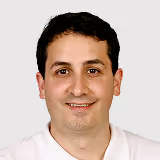
Marcel Kloos
Swiss-licensed dentist and founder of Medschool Experts
Marcel Kloos founded Medschool Experts while studying abroad; since then, over 500 study places have been secured. The Stuttgart-born dentist studied dentistry from 2015 to 2021 in Sofia and holds a Swiss dental licence.
Today he lives in Bern and runs Medschool Experts full-time as its owner.
More articles worth reading
Cost of Studying Dentistry in Czechia and Slovakia 2026
Dentist Registration in New Zealand 2026: The DCNZ Route with a Foreign Degree
Studying Dentistry in Turkey 2026: Costs, Structure and Recognition
Ahmad
Sabrina
Rami
Noah
500+ students placed.
Now it's your turn!
No daydreaming, no empty promises. Just a clear plan — for the start of your medical degree.
40 minutes, no obligation