Dentistry or Medicine? Decision Guide, Study Duration and Career Prospects
17.09.2026

The Similarities First
Both degree programmes are demanding and require commitment and staying power. Both lead to a regulated profession with reliable demand and good earning potential. And in both cases, the same legal basis applies across the EU: a degree from a state university is recognised under Directive 2005/36/EC, and a course scope of 5,500 hours is mandated Europe-wide.
The Key Difference: Breadth Versus Depth
A medicine degree opens up a very wide range of fields and specialisations. After graduating, options include hospital work, private practice, research, public health, and industry. The course takes six years, followed by specialist training that usually lasts five to six years.
Dentistry, by contrast, focuses on one field from the start: dental, oral and maxillofacial medicine. The path to self-employment is considerably shorter, and running your own practice is realistic after comparatively few years in the profession. The course takes five to five and a half years, depending on the location.
| Criterion | Medicine | Dentistry |
|---|---|---|
| Standard course length | 6 years | 5 to 5.5 years |
| After graduating | Specialist training, usually 5 to 6 years | Preparation period, then private practice possible |
| Range | very broad, over 50 specialisations | focused, with specialisations such as implantology or orthodontics |
| Typical workplace | Hospital, private practice, research, public authority, industry | Practice, hospital, own practice |
| Practical share of the course | increases from the clinical years onward | high from very early on and throughout |
| Tuition fees in Bulgaria 2026 | approx. €9,000 to €10,000 per year | approx. €9,000 to €10,000 per year |
The Cost Factor Almost Everyone Overlooks
In dentistry, significant additional material costs apply in Germany: instruments, a phantom head, and accessories all have to be purchased yourself, and a university-approved articulator alone costs around €1,500. Over the course of the degree, this quickly adds up to several thousand euros. At many universities abroad, by contrast, instruments and materials are provided. This should be factored into your overall budget.
Career Options After Studying Medicine
What sets the medicine route apart is the sheer range of what's possible afterward:
- Specialist doctor: Specialising in fields such as internal medicine, surgery, anaesthesiology or paediatrics.
- Research: Developing new treatment methods and medications, often combined with a doctorate.
- Healthcare management: Leadership roles in hospitals and healthcare institutions.
- Medical journalism: Preparing medical topics for specialist and general media.
- Expert assessment: Producing expert opinions for insurers, courts and authorities.
- Public health service: Health authorities, regional agencies, international organisations.
- Industry: Medical technology, pharma and biotech, for example in product management or development.
In dentistry, the range is narrower, but the path to entrepreneurial self-employment is much more direct. If you enjoy hands-on work, want to see immediate treatment results, and are interested in running your own practice, this is the right fit.
Which of the two fields suits your profile is something we're happy to discuss in a free consultation.
{{cta}}What About Admission Chances in Germany?
Both subjects are subject to nationwide admission restrictions in Germany and run through hochschulstart. In the top-grades quota, the thresholds for medicine and dentistry sit at around 1.0 to 1.2 in most federal states. Around 1,500 places are available each year in dentistry nationwide, compared with around 10,000 in medicine. Mathematically, competition is tighter in dentistry, though the applicant pool is smaller too.
Can I Switch Later?
Switching between the two fields is generally possible, but it costs time, because the curricula diverge significantly from the second year of study onward. Mainly the scientific and pre-clinical basics get credited. If you're torn, it's better to make the decision before starting than afterward.
What if I Want to Transfer Back to Germany Later?
Both are possible, but the process differs. In medicine, transferring into a higher semester is well established, typically after two to four years abroad. In dentistry, crediting is more complex, because practical courses abroad are often structured differently. You'll find more details in our guide to transferring back.
Which Field Suits Me Better?
Three questions can help: Do you want to commit early, or stay open as long as possible? Is fine motor, hands-on work important to you? And how appealing is the prospect of running your own practice with entrepreneurial responsibility? If you can answer all three clearly, you've usually already made your decision.
Gaining Practical Experience: Applying for Electives and Internships
Regardless of the field, early hands-on experience is the best career accelerator. For a hospital application, this order works well: first, find out about the department and focus areas of the hospital. Tailor your application to that specific department. Write a cover letter explaining why this particular hospital and what you expect from the placement. Attach a strong CV. And before sending, check that all required documents are complete.
We're happy to talk through any further questions about the process in person – you can book a free consultation at any time.
Author's Opinion
I chose dentistry because I wanted to work with my hands and see my results the same day. I've never regretted that decision. But I tell everyone in consultations the same thing: this isn't a question of prestige or salary, it's a question of what your working day actually looks like.
If you can picture yourself working with intense focus on a few square centimetres for eight hours a day, dentistry is fantastic. If you're drawn more to how the whole body works together and you're willing to invest a few extra years in specialist training, then medicine is for you. Two internships will answer this question better than any table.
Conclusion
Whether medicine or dentistry is the better fit for you comes down to your own goals and interests – and that's exactly what we'll help you figure out. Medschool Experts has the largest network of official partner universities, and we individually assess the highest possible year of entry for every applicant, so any previous coursework counts. In many cases, entry is even possible in the final two years of study.
Get in touch with Medschool Experts and book a free consultation to find the right path for you.
Frequently Asked Questions About Choosing Between Dentistry and Medicine
How Long Do the Two Courses Take?
Medicine takes six years, followed by specialist training that usually lasts five to six years. Dentistry takes five to five and a half years depending on the location; after that, you can work directly as a dentist, and further training is possible but not required.
What Cost Differences Are There Between the Two Fields?
Tuition fees in Bulgaria are around €9,000 to €10,000 per year for both fields. The difference lies in materials: in dentistry, instruments, a phantom head and accessories are needed in Germany, and an approved articulator alone costs around €1,500. Many universities abroad provide this equipment.
Which Field Pays More?
Both professions are among the higher-earning academic careers. Dentists tend to earn well earlier, since they finish sooner and can treat patients independently without lengthy further training. Doctors catch up through specialist titles and senior or chief physician positions. Anyone running their own practice earns significantly more in either field – but also carries the entrepreneurial risk.
Can I Switch Later?
Switching between medicine and dentistry is possible, but it costs time, since only the pre-clinical subjects overlap. The earlier you switch, the less you lose. It's worth thinking the decision through seriously before you start.
Which Field Is Easier to Get Into?
In Germany, both fields are in high demand and limited by the Numerus Clausus. Abroad in Europe, both fields have NC-free access through entrance exams; in dentistry, places per year tend to be somewhat tighter because clinical workstations are limited.
Which Type of Work Suits Which Personality?
Medicine means breadth: many specialisations, hospital work, research, public health. Dentistry means depth: fine motor, precise hands-on work with patients, usually in your own treatment room, with very predictable working hours.
What if I Want to Move Back to Germany Later?
Both EU degrees are recognised. Transferring universities during your studies follows its own rules in dentistry, partly because of technical preliminary coursework. Plan a transfer back early, and have the crediting checked in advance.
How Can I Gain Practical Experience Before Deciding?
Through internships: a week in a dental practice and a week in a hospital say more than any guide. Both can be arranged with a short, polite speculative application, ideally through personal contacts.
What students say about Medschool Experts
Over 500 placements at more than 25 partner universities across 10+ countries. Read independent student reviews on Trustpilot.
About the author
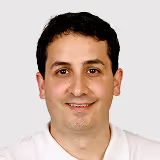
Marcel Kloos
Swiss-licensed dentist and founder of Medschool Experts
Marcel Kloos founded Medschool Experts while studying abroad; since then, over 500 study places have been secured. The Stuttgart-born dentist studied dentistry from 2015 to 2021 in Sofia and holds a Swiss dental licence.
Today he lives in Bern and runs Medschool Experts full-time as its owner.
More articles worth reading
Health Insurance for International Medical Students in Europe 2026
Scholarships and Funding for Medical Studies in Europe 2026
Medicine, Dentistry, Pharmacy or Veterinary Medicine? Choosing Your Degree Abroad in 2026
Ahmad
Sabrina
Rami

Noah
500+ students placed.
Now it's your turn!
No daydreaming, no empty promises. Just a clear plan — for the start of your medical degree.
40 minutes, no obligation