Studying Dentistry Without a Numerus Clausus Abroad: Locations, Costs and Key Differences
17.09.2026

Why dentistry abroad works
The dental profession is harmonised across the EU. Directive 2005/36/EC sets the minimum length and scope of training, and degrees from public universities listed in Annex V are recognised in Germany, Austria and Switzerland without an additional exam. So if you study in the EU abroad, you reach your licence to practise (Approbation) through the same legal route as graduates of German faculties.
Locations offering dentistry in English or German
| Location | Country | Language | Cost |
|---|---|---|---|
| Medical University of Sofia | Bulgaria | English | approx. €10,000 per year |
| Medical University of Varna | Bulgaria | English | approx. €10,000 per year |
| Medical University of Plovdiv | Bulgaria | English | approx. €9,000–10,000 per year |
| Semmelweis University Budapest | Hungary | German or English | €9,340 / €8,850 per semester |
| University of Pécs | Hungary | German or English | €7,500 / €7,340 per semester |
| University of Szeged | Hungary | German or English | approx. €7,640 per semester |
| University of Debrecen | Hungary | English | €7,400 per semester |
| Comenius University Bratislava | Slovakia | English | €7,250 per semester |
| UPJŠ Košice | Slovakia | English | €6,750 per semester |
| Masaryk University Brno | Czechia | English | €8,250 per semester |
| Charles University Pilsen | Czechia | English | €8,000 per semester |
| Palacký University Olomouc | Czechia | English | €7,000 per semester |
| Riga Stradiņš University | Latvia | English | €7,750 per semester |
| Victor Babeș University Timișoara | Romania | English | €4,250 per semester |
| University of Cluj | Romania | English | €5,000 per semester |
| Medical University of Łódź | Poland | English | approx. €8,320 per semester |
| Medical University of Poznań | Poland | English | approx. €8,845 per semester |
{{cta}}
What's different in dentistry
Hands-on work starts very early. While the first two years of medicine are theory-heavy, dentistry has you working on a phantom head from the very beginning. Patient contact starts correspondingly early too.
Small groups are essential. Treatment chairs are limited, which makes the student-to-supervisor ratio more important here than in almost any other subject. At the Bulgarian faculties, it's up to ten students per lecturer.
Material costs. Students in Germany usually buy their own instruments and materials. At many universities abroad, these are included in the programme. That's an item worth several thousand euros that's often missing from cost comparisons.
The special case of transferring back
If you want to transfer from abroad into dentistry in Germany, there are three things worth knowing. First: the relevant authority is the state examination office, based on the dental licensing regulations. Second: since these regulations changed in 2021, students transferring location often face being set back by one or more semesters, because practical courses abroad are structured differently. Third: several German faculties already require proof of the dental preparatory course for the pre-clinical application, and this is usually not credited from abroad.
In practice, that means: completing your degree abroad is often the more direct route in dentistry than switching partway through. It leads to the same destination, just without the detour.
We're happy to talk through what that means for your plans - book a free consultation with us.
After your studies
After earning your licence to practise, Germany requires a preparatory period as an employed dentist, after which setting up your own practice becomes possible. In Switzerland, recognition goes through MEBEKO and registration in the healthcare professions register. Demand for dentists is high in all three German-speaking countries, especially outside the major cities.
The author's opinion
I studied dentistry in Sofia myself, so this isn't a theoretical guide. There are two things I'd tell anyone considering it.
First: when choosing a location, pay attention to the number of treatment chairs and group size, not to rankings. In dentistry, it's the amount of hands-on treatment time you get that determines how confident you are by the end of your studies. I had a great many patients in Sofia, and that's exactly what prepared me for everyday practice.
Second: if you start studying dentistry abroad, plan to finish it there. Transferring back is more demanding in this field than in medicine, and a programme you plan as a whole from the start runs more smoothly than one lived semester to semester under the shadow of a possible transfer. The degree is recognised across Europe anyway, so every door stays open to you.
Conclusion
Dentistry abroad is a direct path into a career with excellent prospects and the option of running your own practice one day. Medschool Experts works with the largest network of official partner universities, and we individually assess the highest possible year of entry for every student - entry is often possible even in the final two years of the programme. Get in touch and book a free consultation to find the right location for you.
Frequently asked questions about studying dentistry abroad
How long does the programme take?
Between five and five and a half years, depending on the location. In Sofia and Plovdiv, it's five and a half years, including a clinical rotation year.
Is the degree recognised in Germany?
Yes, for public universities within the EU. It's based on Directive 2005/36/EC, and no additional knowledge exam is required.
What does a dentistry programme abroad cost?
Between around €4,250 per semester in Timișoara and around €10,000 per year in Sofia or Varna. On top of that come living costs of €350 to €850 a month.
Do I have to buy my own instruments?
At many universities abroad, instruments and materials are provided. In Germany, students usually buy their own - a university-approved articulator alone costs around €1,500.
Can I transfer to Germany later?
It's possible, yes, but noticeably more demanding than in medicine. Since the dental licensing regulations changed in 2021, students transferring location often face being set back a year or semester.
What is the TPK, and why does it matter?
The dental preparatory course (Zahnmedizinischer Propädeutikkurs). Some German faculties require it already for the pre-clinical application, and it's usually not credited if completed abroad. That makes those faculties less suited to a later transfer.
Is dentistry taught in German anywhere?
Yes, in Budapest, Pécs and Szeged. All other locations teach in English.
What students say about Medschool Experts
Over 500 placements at more than 25 partner universities across 10+ countries. Read independent student reviews on Trustpilot.
About the author
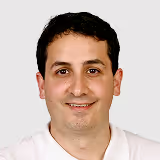
Marcel Kloos
Swiss-licensed dentist and founder of Medschool Experts
Marcel Kloos founded Medschool Experts while studying abroad; since then, over 500 study places have been secured. The Stuttgart-born dentist studied dentistry from 2015 to 2021 in Sofia and holds a Swiss dental licence.
Today he lives in Bern and runs Medschool Experts full-time as its owner.
More articles worth reading
Health Insurance for International Medical Students in Europe 2026
Scholarships and Funding for Medical Studies in Europe 2026
Medicine, Dentistry, Pharmacy or Veterinary Medicine? Choosing Your Degree Abroad in 2026
Ahmad
Sabrina
Rami
Noah
500+ students placed.
Now it's your turn!
No daydreaming, no empty promises. Just a clear plan — for the start of your medical degree.
40 minutes, no obligation