Forced Deregistration from Medical School: Causes, Legal Consequences and Your Realistic Options
17.09.2026

What does "forced deregistration" mean in medical school?
The term forced deregistration (Zwangsexmatrikulation) describes your university ending your studies. Unlike a voluntary deregistration, you don't choose to end your studies yourself. Instead, deregistration happens because of an exam-law or organisational event.
In medical school, this usually happens when an exam-relevant assessment is permanently failed. At that point, you lose what's called your Prüfungsanspruch — your right to sit exams — for that degree programme. This right is the precondition for taking exams and completing your degree in the normal way. Once it lapses, the degree can no longer legally continue.
This typically affects core assessments such as:
- Anatomy
- Biochemistry
- Physiology
- the Physikum (M1, first state exam)
- later also M2 and M3 (second and third state exams)
If one of these exams is failed multiple times under the applicable examination regulations — usually after three attempts — it counts as permanently failed. This ends your right to sit exams in the human medicine programme, and the university is required to deregister you.
Importantly, forced deregistration is not a disciplinary procedure and not a punishment in the classic sense. It's a formal consequence of losing your right to sit exams. Even so, many students experience it as a profound blow, because it can have serious effects on their further studies and career.
Registered for M1, M2 or M3? Then there's no going back
Most students underestimate this point — and it's exactly why getting advice early is so crucial.
Once you're registered for a state exam, you can no longer withdraw. Registering for M1, M2 or M3 isn't an option you can keep open and pull back from later. From that moment, the process is underway, and there are only two possible outcomes:
- passed — or
- permanently failed, and with it forced deregistration.
If you fail, you're automatically re-enrolled and summoned again for the next attempt. There's no way to stop this once it's set in motion. Even deregistering from the university in the meantime doesn't help — you'll still be called back for the next exam date, and the process continues until a final result is reached.
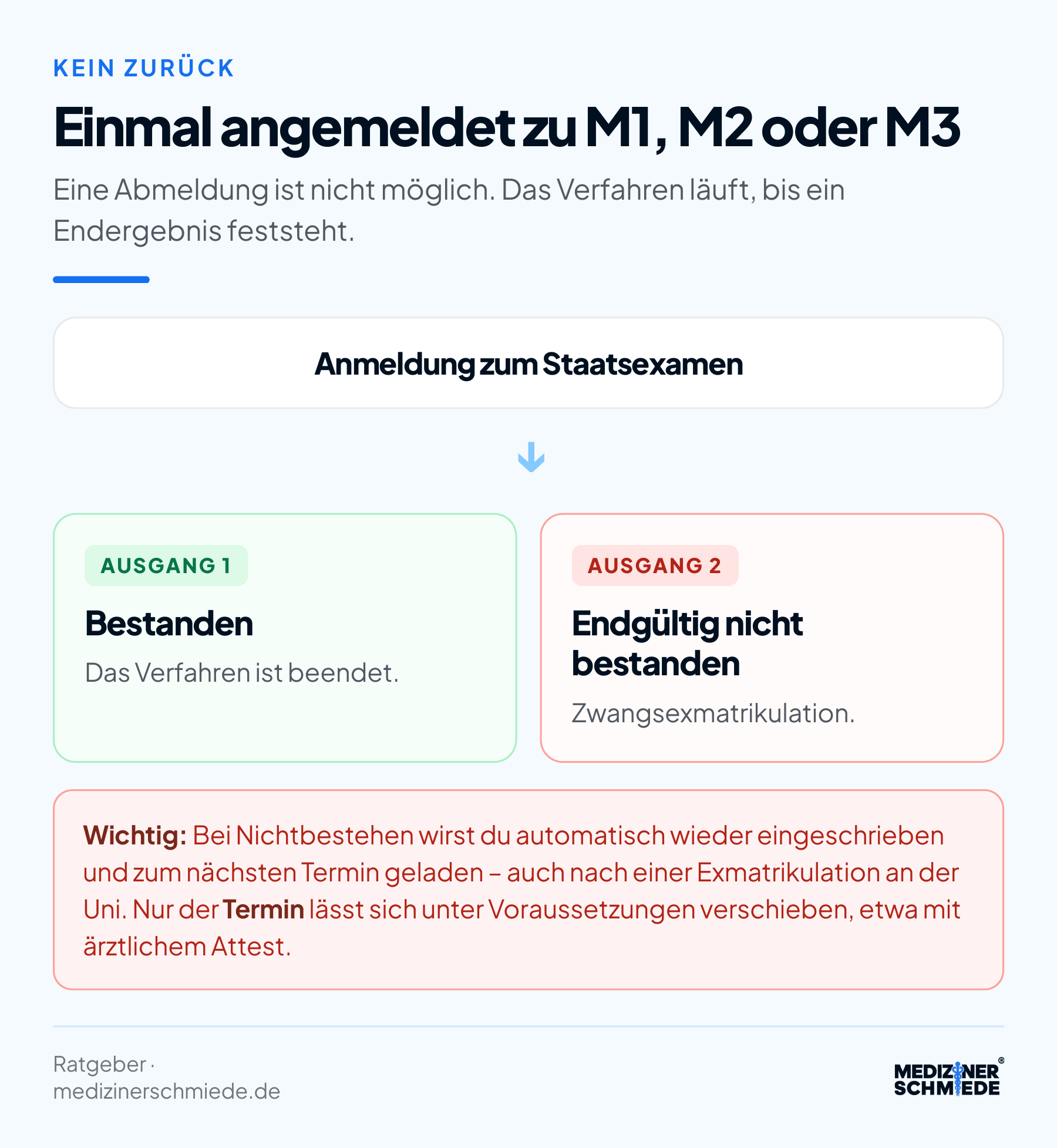
The only room for manoeuvre left concerns the date. Under certain conditions, an exam date can be postponed — for example for a documented illness backed by a medical certificate. But only the timing shifts — not the fact that the exam has to be taken.
The practical consequence: anything you can still change about your situation has to be changed before you register, or before your last permitted attempt. After that, the clock is running, and it can't be stopped.
Voluntary deregistration — and where the crucial difference lies
With a voluntary deregistration, you decide yourself to end or pause your studies. The reasons can vary — a move, personal circumstances, or wanting to start a different degree programme. In this case, your right to sit exams generally stays intact.
With a permanent fail, it's different. Here you lose your right to sit exams permanently — and this loss doesn't just apply to your current university, but typically has nationwide consequences. In practice, that means you normally can't take up the same degree programme at any university in Germany again.
Timing matters here: a voluntary deregistration only helps as long as you're not yet registered for an attempt that could result in a permanent fail. Once that process has started, it continues regardless of your enrolment status.
{{callout}}
The most common reasons a medical degree comes to a halt
Formally, a medical degree almost always ends the same way: an exam permanently failed. But the real reason usually lies further back — and it often has nothing to do with a lack of aptitude or effort. These three causes are by far the ones we see most often in our consultations.
1. A death or serious hardship in the family
A death in the family, a parent's serious illness, a family member needing care: events like these hit students in the middle of a phase of study that leaves almost no buffer. Anyone suddenly juggling university, hospital visits and organising care loses not just study time, but also the ability to concentrate on material over weeks at a time.
The frustrating part: the examination regulations only take this into account if it's raised in time and in the correct formal way. A hardship application or a postponed exam date backed by evidence can make all the difference in exactly this situation — but only while the deadline is still running. Anyone who sits the exam first and explains afterwards why it didn't work has a much harder time.
2. Depression or a depressive episode
Lack of drive, difficulty concentrating, sleep problems, social withdrawal: a depressive episode undermines exactly the abilities a medical degree demands. Many people affected keep functioning outwardly for a while and only notice during the exam period that nothing is sticking anymore.
On top of that comes a vicious circle: a first failed attempt increases the pressure, the pressure worsens the condition, and the second attempt becomes even harder. Anyone at this point should tackle two things in parallel — treatment itself, and formal protection at the university (a medical certificate, postponing the exam date, a hardship application). Both only work if they happen in time.
3. Undiagnosed reading or spelling difficulties — often linked to ADHD, autism or other forms of neurodivergence
This is the reason that gets overlooked most often — and the one that's easiest to address.
Many people associate dyslexia with obvious spelling mistakes. But there's also a pure reading difficulty without any spelling problem. Someone affected by it writes completely normally, but reads more slowly and often has to go back over longer passages to be sure they've understood them. In everyday life, this barely stands out. At school it usually goes unnoticed too, because there's enough time.
In medical school, that's exactly where it becomes a problem. Multiple-choice exams like the Physikum consist of hundreds of questions with long case vignettes and tightly timed sessions. Someone who knows the material but needs a few extra seconds per question to read it doesn't fail because of a lack of knowledge, but because of the clock. People affected typically describe it as: "I would have known it, I just didn't get through it in time."
Often, an undiagnosed form of neurodivergence lies behind this — ADHD, an autism spectrum condition, or an isolated reading disorder. Someone who is intelligent and has compensated for a long time often doesn't stand out within the school system, and so never gets a diagnosis.
This is exactly where the opportunity lies: with a diagnosis, you're entitled to compensation for disadvantage (Nachteilsausgleich) — usually extended time, and sometimes a separate room or extra breaks. For a reading or attention issue, that changes the entire exam situation. Important: the assessment needs to happen before your last attempt, not after.
And this isn't limited to Germany: accommodations for disadvantage are also possible abroad, as soon as there's professional documentation in place. In practice, studying abroad is often the more comfortable path anyway for people affected — smaller year groups, more oral and practical exam formats, less sheer volume of timed multiple-choice, and more direct contact with lecturers. At Medschool Experts, we work with universities that are set up exactly for this, and before you apply we clarify how each university handles accommodations for disadvantage — so you don't fail against the clock again instead of the material.
Other reasons we see regularly
- Exam anxiety and blackouts — you know the material, but the situation gets the better of you.
- Not enough study time, due to a side job, a child, care responsibilities or a long commute.
- Missed deadlines: many degree regulations require certain assessments to be completed within a fixed period. Missing that deadline results in the same loss of your right to sit exams.
- Attempted cheating — rare, but depending on the examination regulations, it can carry harsh consequences.
{{umfrage}}
Legal consequences of forced deregistration in Germany
The most important legal consequence is the loss of your right to sit exams in that degree programme. Without it, no German medical faculty can enrol you in the same programme again. In practice, this usually means that studying medicine again in Germany is no longer possible.
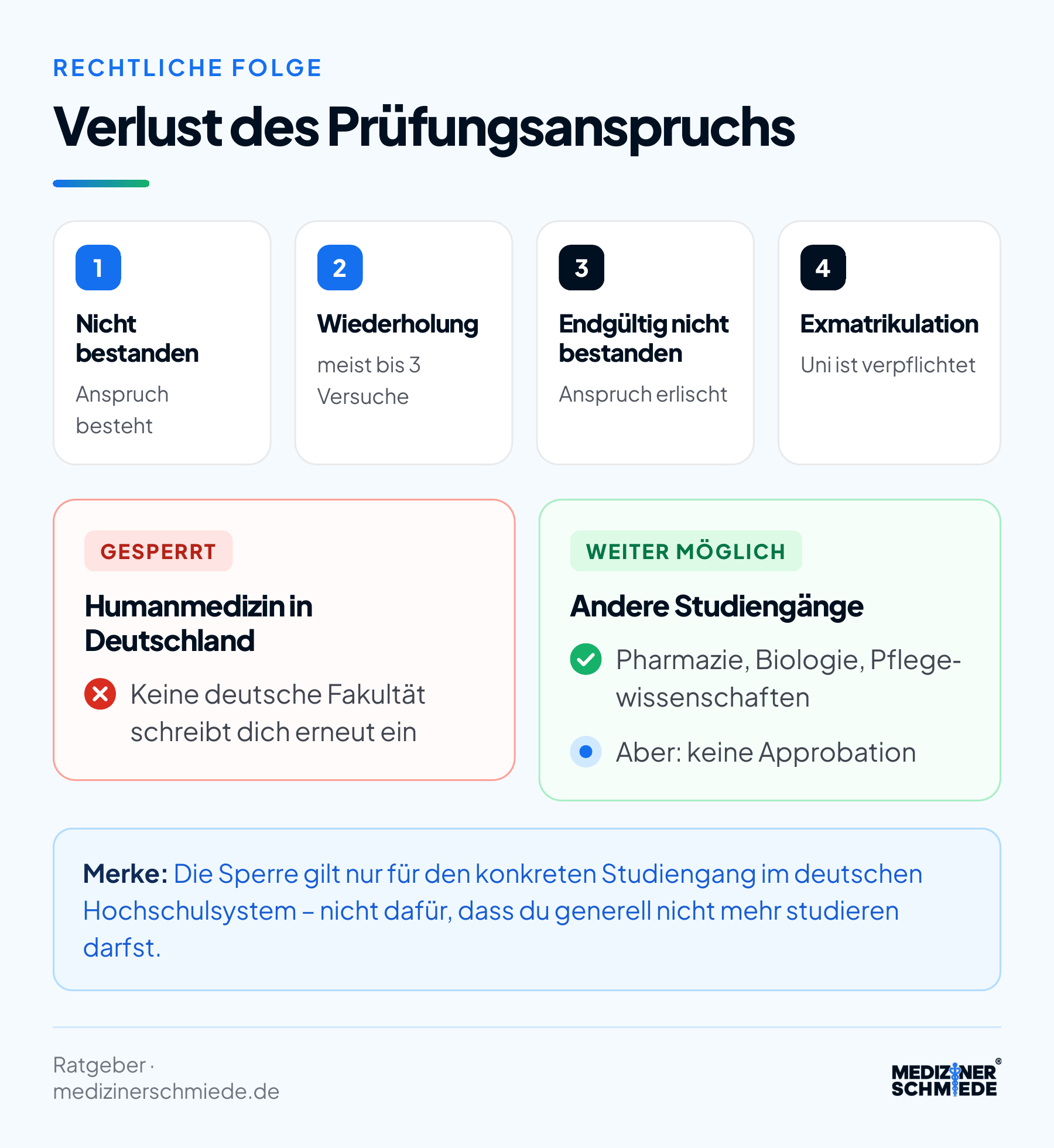
This rule follows from the respective state higher education laws as well as the universities' own study and examination regulations. The details vary slightly between German states, but the underlying principles are very similar nationwide.
It's worth being precise here: the bar applies only to the specific degree programme. It doesn't automatically mean you're barred from studying altogether. Other degree programmes remain open to you, for example:
- Biology
- Nursing science
- Pharmacy
- Health management
- Physician assistant studies
For many people affected, this initially feels like a limited alternative, since their original goal was to become a doctor. These programmes do not lead to a medical licence (Approbation).
{{cta}}
Are there differences between the pre-clinical and clinical stages?
Whether a forced deregistration happens during the pre-clinical or the clinical stage can matter for what comes next.
Most critical situations arise during the pre-clinical stage — the first two years of study. This phase centres on foundational science subjects, especially anatomy, biochemistry and physiology. These subjects are traditionally seen as particularly demanding, because they require a large volume of theoretical knowledge.
A central hurdle is also the Physikum (M1). It marks the transition from the pre-clinical to the clinical stage and covers the material from the first years of study. If one of these exams is permanently failed, it leads to forced deregistration.
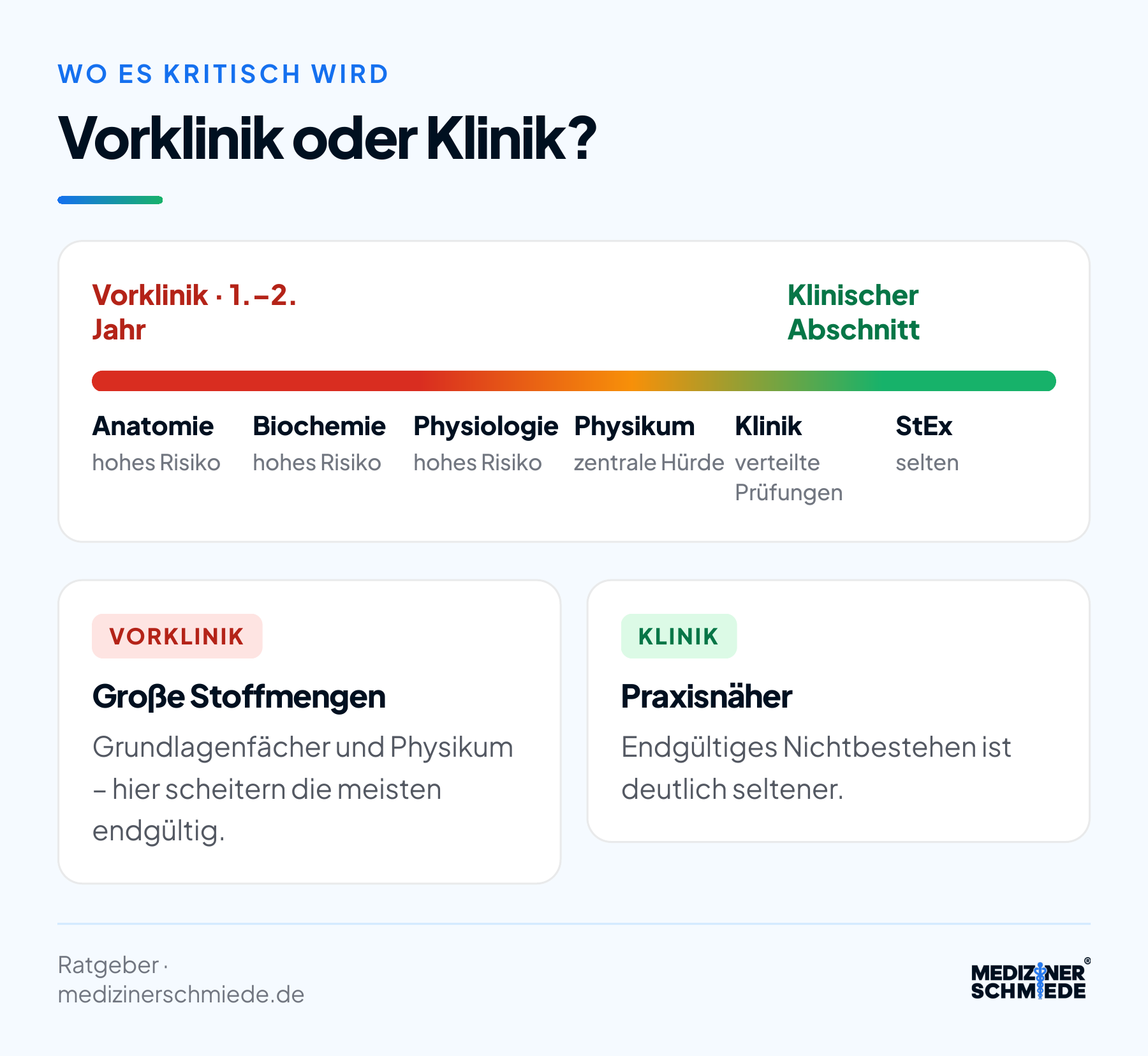
In the clinical stage, permanent fails are much rarer. Most students have already passed the most demanding foundational exams, training is more practice-oriented, and assessment is often spread across several smaller components. Even so, a permanent fail can still happen here too, for example with M2 or M3.
Can you study medicine again after a forced deregistration?
One of the most common questions is: is studying medicine even still possible after a forced deregistration?
The short answer: in Germany, in most cases, no. Once an exam-relevant assessment has been permanently failed, your right to sit exams for that programme is considered lost — typically nationwide.
It's important to understand, though, that this bar applies only to the specific degree programme within the German higher education system. It doesn't automatically mean studying medicine has become impossible altogether. International degree programmes are independent programmes outside the German higher education system. What matters then is how that programme is structured — and this is exactly where many people who try to handle it on their own trip up.
Recognition and medical licensure after a forced deregistration: the rules that matter
This is the most important section of this guide. Skip over it, and you risk completing an entire degree abroad only to still not receive German medical licensure at the end.
The principle: an EU degree is recognised in Germany
Within the European Union, the directive on the recognition of professional qualifications applies. A medical degree completed entirely in an EU member state is therefore generally eligible for recognition, and leads to practising as a doctor in Germany via an application for licensure (Approbation).
But: a permanently failed assessment can't be undone
A permanently failed exam can't be fixed after the fact. It's legally spent. Based on our current experience from advising students on this exact issue, here's what that means for German medical licensure:
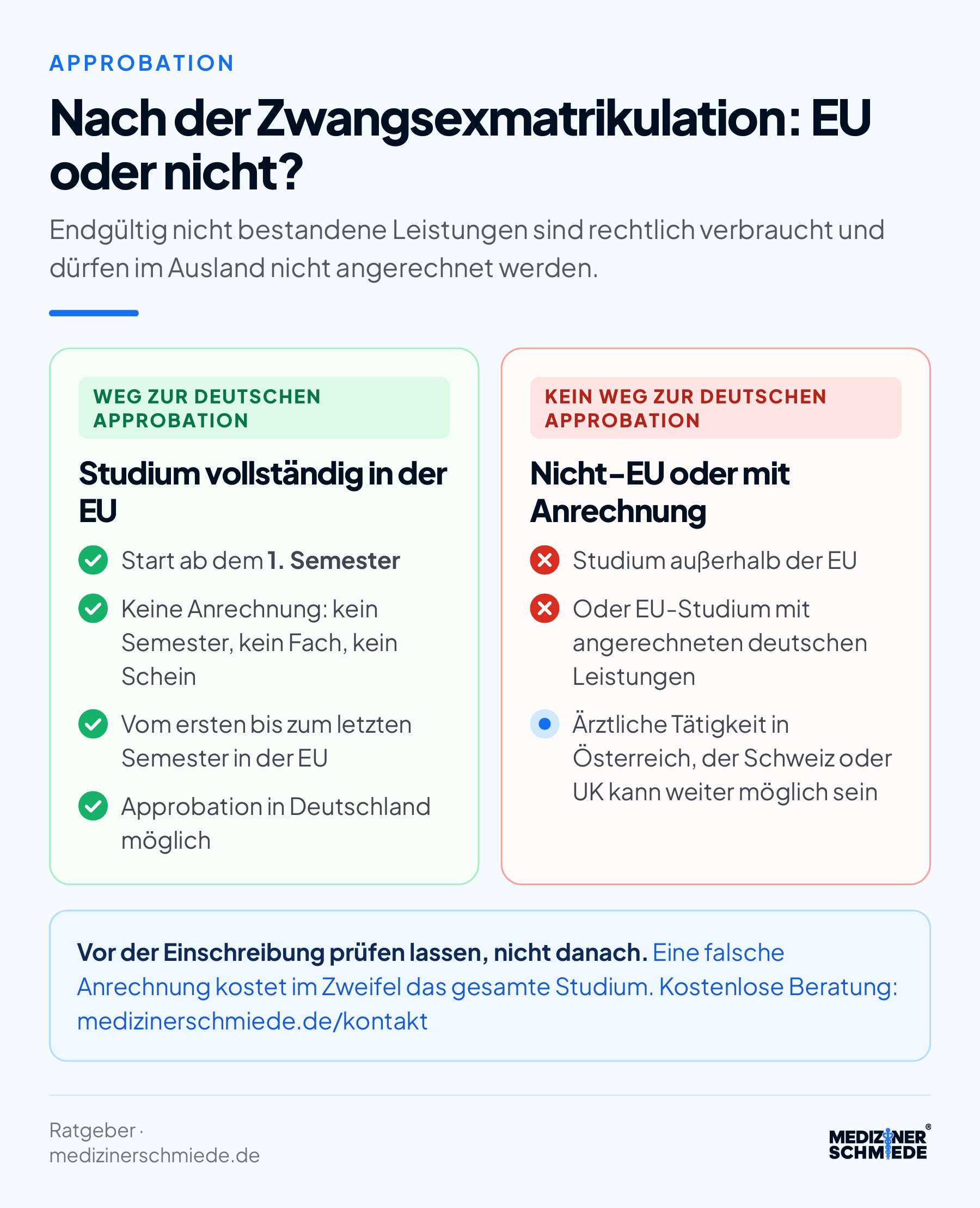
- No German prior coursework may be credited toward the degree abroad — not a single semester, subject, certificate or exam.
- The degree must be completed entirely within the EU, from the first semester through to graduation.
- If even a single German assessment is credited, our experience is that German medical licensure is regularly refused.
The reason is simple: crediting assessments from the very programme you permanently failed means building your degree abroad on that exact legally spent foundation. The relevant authorities regularly treat this as an attempt to circumvent the loss of your right to sit exams.
It's a hard pill to swallow, because it costs time — but it's the only route that reliably keeps German medical licensure open. Starting over from the first semester within the EU isn't excessive caution; it's the requirement.
And outside the EU?
A degree completed outside the EU — or an EU degree with credited German assessments — in our experience regularly no longer leads to German medical licensure. That doesn't necessarily end your career as a doctor, though: countries such as Austria, Switzerland or the United Kingdom assess professional licensing under their own rules, which differ from Germany's. Practising as a doctor there can still remain possible.
Which route is right for you depends on where you want to work later. If German medical licensure is your goal, after a forced deregistration there's practically only the one route described above. If you can picture working elsewhere in the German-speaking world, you have more options.
Our clear recommendation: have this checked before you enrol anywhere — not afterwards. A free consultation with us costs you half an hour. An incorrect credit transfer can potentially cost you your entire degree. In addition, for genuine legal questions we explicitly recommend consulting a specialist lawyer for medical or administrative law.
{{cta}}
Differences between human medicine and dentistry after a forced deregistration
Many students wonder whether switching to dentistry could be an alternative. At first glance, the two fields look closely related: in the pre-clinical stage, there's overlap in content in anatomy, biochemistry and physiology. Legally, though, these are two independent degree programmes, each with its own examination regulations.
This has an important consequence: losing your right to sit exams in human medicine doesn't automatically mean you've also lost it in dentistry. Purely formally, a switch can therefore appear possible in some cases.
In practice, the situation is more nuanced. Many universities look closely, when you apply, at whether you've already permanently failed exam-relevant assessments in a related degree programme. If the failed subject overlaps in content with dentistry in particular, that can make admission harder or rule it out entirely. The reverse applies too: switching from dentistry to human medicine after a permanent fail usually isn't straightforward either.
Why a forced deregistration often feels like the definitive end
For many students, studying medicine is far more than just a degree. It's often the result of a long journey: an excellent school-leaving grade, intensive preparation for admissions processes, waiting semesters, or several rounds of applications. The emotional weight attached to that place is correspondingly high.
When that path suddenly ends, it often feels as though everything planned up to that point is thrown into question. Thoughts circle around questions like: What do I do now? Was all that effort for nothing? Have I lost my professional future?
On top of that, there's often significant social pressure. Family, friends and acquaintances attach big expectations to studying medicine. A forced deregistration is therefore not uncommonly experienced as personal failure, even though in reality the causes are usually far more complex. Shame and self-doubt also play a big role at this stage — and it's exactly these feelings that lead many people to wait too long before asking anyone for help.
What you can do before a forced deregistration
If you're still before a permanent fail — for example after one or two failed attempts — now is the most important moment to act. At this stage, legal or organisational options often still exist that disappear for good later on.

Hardship application
Under certain conditions, a hardship application can secure you an additional exam attempt. The usual requirement is that exceptional circumstances can be shown to have contributed to failing an exam. Possible reasons include:
- serious physical illness
- mental health struggles or depressive episodes
- a death in the immediate family
- pregnancy or family care obligations
The decision is usually made by the faculty's examination board. Since these are case-by-case decisions, a carefully written justification and supporting evidence play the decisive role.
What many people don't realise: a hardship application has to be submitted in time. In practice, this option is often only considered once several attempts have already failed, or the final exam is imminent — by which point room to act is often already limited, or deadlines have already passed.
Postponing an exam date with a medical certificate
Once you're registered, you can no longer withdraw — but under certain conditions you can postpone the date. The classic case is a documented illness, backed by a medical certificate. It's important to act immediately and follow the correct formal process; anyone who only reacts after the exam has a much harder time.
Compensation for disadvantage (Nachteilsausgleich)
For diagnosed conditions such as ADHD, autism spectrum conditions, dyslexia or an isolated reading difficulty, chronic illness, or mental health struggles, you may be entitled to compensation for disadvantage. This can include:
- extended time
- a separate exam room
- extra breaks
- technical aids
Timing is essential: the request for compensation for disadvantage must be submitted before the exam. It can't be applied retroactively to save an exam you've already sat.
Legal advice
In some situations, legal advice on higher-education law can be worthwhile — especially where there may have been procedural errors, unclear exam conditions, or particular personal hardship. Still, it pays to be realistic: legal challenges against exam decisions are often lengthy and their outcome is uncertain.
The earlier you get advice, the more paths stay open
This is the single most important lesson from having placed students in more than 500 study spots: timing is a major factor in which options are even still available to you.
Come to us after your first failed attempt, and you have the most room to manoeuvre. Come after the second, and you still have several options. Come after registering for your last attempt, and practically the only thing left to influence is the date. And if you only come once the deregistration notice is already in hand, you have to work with whatever is still left.
Common mistakes we see again and again in our consultations:
- A hardship application filed too late, or not adequately justified
- A medical certificate not submitted in time
- Compensation for disadvantage never applied for, despite an existing diagnosis — or never getting checked for a reading or attention issue in the first place
- Starting a degree abroad with credited German semesters — and losing German medical licensure as a result
Every one of these can be avoided beforehand and is almost never fixable afterwards. A consultation with Medschool Experts is free and non-binding — so there's no reason to wait until things get tight. You can book an appointment directly here.
What a fresh start abroad actually looks like
If German medical licensure is your goal, here's what the path looks like after a forced deregistration:
- Get advice first. Establish which exam was permanently failed, what stage you were at, and where you want to work later on.
- Choose a university within the EU. Only an EU degree reliably leads to German medical licensure.
- Start from the first semester — with no credit transfer at all. No German certificates, no skipped semesters, no lateral entry.
- Complete the degree there in full, from the first semester to the last.
- Apply for licensure in Germany on the basis of the EU recognition rules.
Yes, that means starting over from scratch. For many of our students, looking back, that was exactly the point where things started working again: a new environment, a clean break, a system that examines differently from the German one — and a path that actually leads to licensure in the end.
We support students on exactly this path: from the initial assessment, through choosing a university, to starting their studies and later returning to Germany.
{{cta}}
Frequently asked questions about forced deregistration in medical school
What does "permanently failed" mean in medical school?
It means an exam-relevant assessment was failed even on the last permitted attempt. This results in the loss of your right to sit exams for that programme. The degree normally can't be continued at German universities.
Can I withdraw from the Physikum or a state exam once I'm registered?
No. Once you're registered for M1, M2 or M3, you stay registered until a final result is reached — a pass or a permanent fail. If you fail, you're automatically re-enrolled and summoned for the next date. Even deregistering from the university in the meantime doesn't prevent this.
Can I postpone an exam date?
The date can be postponed under certain conditions, for example for a documented illness backed by a medical certificate. Only the timing shifts, though — the exam itself still has to be taken.
I've never been diagnosed with anything — can a reading difficulty really be the reason?
Yes, it happens more often than people think. There's a pure reading difficulty without any spelling problem: spelling is unremarkable, but reading longer texts measurably takes longer. In multiple-choice exams with a tight time limit, that means you don't finish, even though you know the material. Often, an undiagnosed form of neurodivergence lies behind this, such as ADHD or an autism spectrum condition. A professional assessment is worth it — with a diagnosis, you're entitled to compensation for disadvantage, usually extended time.
Does compensation for disadvantage also apply abroad?
Compensation for disadvantage is also possible at universities abroad, though it's regulated differently at each institution. We clarify before you apply how a given university handles this, and specifically recommend universities that are set up for it.
Does a permanently failed subject automatically lead to forced deregistration?
Usually, yes. Once your right to sit exams in the human medicine programme lapses, the university is required to deregister you. What matters is your university's specific examination regulations and higher-education law provisions.
Can I keep studying medicine at a different university in Germany after a forced deregistration?
Normally, no. The loss of your right to sit exams in human medicine typically applies nationwide. Switching to a different German university doesn't solve the problem.
Does the bar only apply to human medicine, or to other degree programmes too?
The bar applies to the specific degree programme, meaning human medicine. Other programmes can still remain open to you — such as nursing science, pharmacy, biology or physician assistant studies. They don't, however, lead to a medical licence.
What's the difference between "failed" and "permanently failed"?
"Failed" means an exam wasn't passed on a particular attempt. As long as resit attempts remain available, your right to sit exams continues. "Permanently failed" means no regular attempts remain.
Can I study medicine abroad after a forced deregistration?
Yes. International degree programmes are independent programmes outside the German higher education system. What matters is how the degree is structured — for German medical licensure, it must be completed entirely within the EU and without crediting any German assessments.
Can certificates already passed in Germany be credited abroad?
Technically, some universities offer this — but for anyone who's had a forced deregistration, our experience is that it's the wrong route. Crediting German assessments risks ending up without German medical licensure at all. For German licensure, the rule is: start from the first semester, with no credit transfer at all.
Will I get German medical licensure after studying medicine in another EU country?
A medical degree completed entirely within the EU is generally eligible for recognition; licensure is granted on application to the relevant authority. Based on our experience, the requirement is that no assessments from the permanently failed German degree were credited.
What happens if I study outside the EU?
Based on our experience, German medical licensure is then regularly no longer granted. Practising as a doctor in Austria, Switzerland or the United Kingdom can still remain possible, though, since these countries assess licensing under their own rules.
Can I challenge a forced deregistration?
Depending on the specific case, legal action may be possible — for example where there were procedural errors, or where particular personal circumstances weren't taken into account. This should be assessed as early as possible, ideally by a specialist lawyer for medical or administrative law.
When should I get advice?
As early as possible — ideally after your first failed attempt, and at the latest before registering for your final attempt. The earlier you reach out, the more options remain open. A consultation with Medschool Experts is free and non-binding.
The author's view
Of all the topics I cover, this is the one with the biggest consequences if you get it wrong. I regularly meet people who were advised to have a few semesters credited from abroad. It feels faster — and can turn into a problem years later at the licensing stage.
That's why I always say the same thing in this situation: a clean restart, a complete degree within the EU, no shortcuts. It takes longer, but it's the only path that truly holds up in the end. And one more thing I want to stress: a permanent fail says nothing about your aptitude as a doctor. It says something about an exam system on one particular day.
Conclusion
Whatever your situation, you don't have to figure out the next step alone. Medschool Experts works with the largest network of official partner universities in Europe, and we assess every student's case individually to find the highest possible year of entry — often it's possible to join directly in the final two years of study. Get in touch to talk through your options in a free, no-obligation consultation.
What students say about Medschool Experts
Over 500 placements at more than 25 partner universities across 10+ countries. Read independent student reviews on Trustpilot.
About the author

Marcel Kloos
Swiss-licensed dentist and founder of Medschool Experts
Marcel Kloos founded Medschool Experts while studying abroad; since then, over 500 study places have been secured. The Stuttgart-born dentist studied dentistry from 2015 to 2021 in Sofia and holds a Swiss dental licence.
Today he lives in Bern and runs Medschool Experts full-time as its owner.
More articles worth reading
Health Insurance for International Medical Students in Europe 2026
Scholarships and Funding for Medical Studies in Europe 2026
Medicine, Dentistry, Pharmacy or Veterinary Medicine? Choosing Your Degree Abroad in 2026

Ahmad

Sabrina

Rami

Noah
500+ students placed.
Now it's your turn!
No daydreaming, no empty promises. Just a clear plan — for the start of your medical degree.
40 minutes, no obligation