From Law Student to Dentist in Sofia: How My Medical Studies Abroad Began
17.09.2026

Good morning, Doctor
It's 8 a.m., and I walk into my bright treatment room. I'm well rested, I've had a good breakfast, and I've drunk the coffee my assistant left on my desk. In the dental chair sits a young man with severe pain in his cheek, who hasn't slept all night. Even though I felt for him, I was in the best of moods. I'm exactly where I always wanted to be. White trousers, white polo shirt, probe and mirror in hand. On my name badge, the title: Dentist. My younger self would have been thrilled.
Because there was a time when I had completely lost my professional direction.
The detour: why I studied law first
Becoming a dentist had always been my dream. But after finishing school, I let myself be intimidated by the high numerus clausus and the horror stories about medical degree programs, and initially chose to study law instead.
I couldn't warm to law from the start: not the material, not the internships, not the career prospects. I grew more and more dissatisfied, until eventually nothing worked anymore. My body spoke up before I understood it myself. Constant infections, sore throats, stomach aches, and eventually a racing heart. As soon as I lay down in bed, my heart would race as if I were running. A heart problem in my early twenties was truly the last thing I needed. I went to see a cardiologist, who found that my heart was completely healthy and working at the level of a competitive athlete.
And somehow I wasn't really relieved. Because now the problem wasn't my heart anymore — it was me. Later, during my studies, I would learn that what I'd had was a classic panic attack, and that the other symptoms were what's known as somatization.
The turning point
I came home from the doctor, sat down on my bed, and decided: something has to change.
As a teenager, I often travelled from my village to Stuttgart. I knew early on that I didn't want to end up like the tired-looking commuters on the train — people who had, at some point, decided it was easier to please others than to pursue their own goals. "Dreams are just froth," people like that like to say. Or: "We're doing fine as it is."
And yet, up until I finished school, I'd had a genuinely fulfilling youth: good friends, travel, hobbies, fun at school, plenty of parties. So what had happened?
My father once gave me a valuable piece of advice: recognize your biggest defeats in time, and turn them into your biggest successes.
I got up, energized, sat down at my laptop and started researching: studying dentistry, even without top grades, even without wealthy parents — was that possible? And if so, how, and above all, where? Back then there was little reliable information online, and it took two weeks before I had anything useful. Looking back, that moment marks the true beginning of my story.
What became of that decision
I studied dentistry in Sofia, completed my degree, and went on to have it recognized afterwards. Today, I work as a dentist and help prospective students at Medschool Experts find exactly this path. After more than 500 students placed at more than 25 universities, I can say: the path works, and it works reliably when you approach it in a structured way.
We were the first agency to give free insight on YouTube through almost daily videos and interviews with real medical students abroad. We're proud of that, because this transparency has given many people the foundation for taking their own step.
{{cta}}
Why this path is so sought-after today
The numerus clausus for human medicine, in the top-grades quota, still sits at around 1.0 to 1.1 in most German states. Around 10,000 places in human medicine face around 30,000 applications each winter semester. Places are allocated 30 percent by top-grades quota, 10 percent by an additional aptitude quota, and 60 percent through the universities' own selection procedures.
At the same time, the path abroad within the EU is more clearly regulated today than it was during my own studies. Anyone who studies medicine or dentistry at a state university within the EU receives a degree that, under the EU Professional Qualifications Directive 2005/36/EC, is recognized in Germany, Austria and Switzerland. For Bulgaria specifically: since January 1, 2026, the euro has been official legal tender there, replacing the lev at a fixed rate of 1.95583. Tuition, rent and everyday costs have run in euros ever since.
Which location fits your particular starting point is something we can work out together in a free consultation.
Is studying abroad a plan B?
For me, it wasn't a plan B — it was the faster route to the same destination. I started earlier, treated patients earlier, and started earning earlier than many who waited for a place in Germany. On top of that came an international environment with fellow students from more than 40 countries, small groups, and a great deal of hands-on practice.
Do you need wealthy parents for this?
No. That was exactly my first worry, and it turned out to be unfounded. Auslands-BAföG (foreign study grant) supports a full degree within the EU. On top of that, there's a tuition subsidy of up to €5,600 per year, granted as a full, non-repayable grant. Education funds and student loans cover the rest.
How long does it take to reach full licensure?
Human medicine takes six years, dentistry five to five and a half years depending on the location. After that comes licensure in Germany, or recognition through the relevant authority elsewhere. Anyone who starts right away instead of waiting often ends up practicing several years earlier.
Author's Opinion
I studied law first because it seemed like the sensible choice. It wasn't wrong, but it wasn't me. The moment I decided to study dentistry in Sofia was the most important professional moment of my life — and at the time, it felt like a risk.
Today I work as a dentist and support others on this same path. What I take away from it: a detour is not wasted time, as long as you eventually leave it behind. The people I meet in consultations rarely regret the step abroad. What they regret are the years they waited beforehand.
Conclusion
My own path from law to dentistry shows just how much is possible once you decide to explore your options. If you are considering studying medicine or dentistry abroad, Medschool Experts is here for you — as the largest network of official partner universities, we individually assess the highest possible year of entry for every student, and entry is often possible even in the final two years of study. Book a free consultation and let's talk about your path.
Frequently asked questions about switching into medicine
Is studying abroad a plan B?
It's a different route to the same destination. The degree is recognized across the EU, training takes place in small groups, and you can start right away instead of waiting years. Many graduates would choose this path again today.
Can I still study medicine after studying something else?
Yes. A discontinued or completed degree in another subject is not an obstacle. Abroad, what counts is your higher education entrance qualification and passing the entrance exam, not your previous academic record.
Am I too old to start in my mid-twenties?
No. In international cohorts, students in their early to mid-twenties are completely normal, and many have already completed vocational training or another degree. Life experience is, if anything, an advantage in the clinical part of the program.
Do you need wealthy parents for this?
No. Auslands-BAföG provides up to €992 per month and covers tuition fees up to €5,600 per year as a full, non-repayable grant. On top of that, there are education funds with income-based repayment. Financing is manageable for most families.
How long does it take to reach full licensure?
Human medicine takes six years, dentistry five to five and a half years depending on the location. After that comes recognition through the relevant state examination office. Anyone who starts right away instead of waiting often ends up practicing several years earlier.
Do I need to know Bulgarian for Bulgaria?
No, the program runs in English. Bulgarian is a compulsory subject in the first years of study, taught by the university, so that you can communicate with patients in the clinical part of the program.
How do I actually get started?
With three steps: gather your transcripts, choose a location, and prepare for the entrance exam in biology and chemistry. In parallel, sort out your financing. From the first conversation to the start of studies, often only a few months pass.
What students say about Medschool Experts
Over 500 placements at more than 25 partner universities across 10+ countries. Read independent student reviews on Trustpilot.
About the author
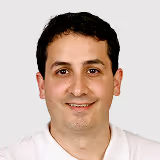
Marcel Kloos
Swiss-licensed dentist and founder of Medschool Experts
Marcel Kloos founded Medschool Experts while studying abroad; since then, over 500 study places have been secured. The Stuttgart-born dentist studied dentistry from 2015 to 2021 in Sofia and holds a Swiss dental licence.
Today he lives in Bern and runs Medschool Experts full-time as its owner.
More articles worth reading
Health Insurance for International Medical Students in Europe 2026
Scholarships and Funding for Medical Studies in Europe 2026
Medicine, Dentistry, Pharmacy or Veterinary Medicine? Choosing Your Degree Abroad in 2026
Ahmad
Sabrina
Rami
Noah
500+ students placed.
Now it's your turn!
No daydreaming, no empty promises. Just a clear plan — for the start of your medical degree.
40 minutes, no obligation