Studying Medicine in Kraków: Costs, Structure and Recognition
17.09.2026

Kraków at a glance
Kraków lies in Lesser Poland on the Vistula River and, with around 800,000 inhabitants, is Poland's second-largest city. Here, you study medicine at Andrzej Frycz Modrzewski Krakow University, known as AFMKU, a private university with an English-taught Human Medicine programme. Six years, an integrated curriculum, and a degree that counts across the entire European Union. The table below summarises the key facts before we break them down individually.
| Feature | Details (as of 2026) |
|---|---|
| University | Andrzej Frycz Modrzewski Krakow University, private university |
| Programme | Human Medicine, six years, 366 ECTS credits |
| Language of instruction | English |
| Tuition fee | €7,650 per semester |
| Admission process | Selection process with interview, no numerus clausus |
| Start of studies | Winter semester |
| Degree | lekarz (physician) at master's level |
| Recognition in Germany | automatic, under Directive 2005/36/EC |
| Cost of living | approx. €600 to €900 per month |
| City | around 800,000 inhabitants, Lesser Poland, on the Vistula |
| Getting there | Kraków-Balice Airport, plus train and coach |
University and teaching hospitals
AFMKU is a private university in Kraków and, by its own account, the first non-state university in Poland permitted to train doctors. Its English-language website lists more than 10,500 students and over 30 English-taught programmes. The medical programme is therefore part of a large university, not a side project.
The defining feature of the curriculum is its structure. It's integrated and organised around organ systems, meaning preclinical and clinical content is taught in an interwoven way. You don't learn anatomy, physiology and biochemistry in isolation, but alongside the corresponding clinical picture. There's also a multidisciplinary medical simulation centre with an operating theatre, intensive care unit, emergency room and training rooms for surgical skills. From the third year onward, clinical placements take place at the university's teaching hospitals in Kraków.
Two points are worth noting here, since they matter later. The Faculty of Medicine is listed in the World Directory of Medical Schools, with ECFMG confirmation of its listing on 5 February 2021. And in September 2025, the Polish accreditation agency PKA received recognition from the World Federation for Medical Education, for the full ten-year term.
The university runs its teaching on a single, modern campus within the city that's well connected by public transport. Lecture halls, labs, the library and the simulation centre are all located together, so you're not commuting between institutes scattered across town. The English-taught cohort is international in composition, which shapes daily life: study groups form across national borders, and German is just one language among several in the lecture hall.
What stands out to me about this location is how naturally the simulation centre is woven into everyday study. When I was a student myself, the skills lab was more of an optional extra than a requirement. Anyone who has sutured a model twenty times before doing it on a real patient for the first time approaches the ward with a different kind of calm.
Which programmes are offered, and in which language?
In Kraków, we place students in the Human Medicine programme. Teaching is entirely in English from the first semester. Polish is added as a mandatory course in the preclinical stage, since you'll later be speaking with Polish-speaking patients on the ward. Dentistry, pharmacy and veterinary medicine are not offered at this location.
| Feature | Details |
|---|---|
| Programme | Human Medicine, Medical Doctor Programme |
| Language of instruction | English, throughout |
| Standard duration | six years, twelve semesters |
| Scope | 366 ECTS credits |
| Degree | lekarz (physician) at master's level |
| Language proof | English at B2 level |
| Polish in the curriculum | mandatory courses in the preclinical stage |
| Start of studies | winter semester, one intake per year |
How does admission work?
There is no numerus clausus at AFMKU. What's required is a general higher education entrance qualification, plus English at B2 level, since the entire programme is taught in English. Admission is decided through a selection process with a personal interview. Your school-leaving grade average alone is not the deciding factor.
The interview covers two things: your motivation for pursuing medicine, and your grounding in the natural sciences. It draws on upper-secondary school material in biology and chemistry. There is no classical written entrance test at this location – the interview carries the decision.
The process is handled for you. Registration, application and scheduling of the selection interview are organised at Medschool Experts, and we take care of the paperwork. The interview can usually be conducted entirely online, so you don't need to travel to Kraków.
We prepare you for both sides of the process. We go through the subject material in biology and chemistry with you, and we practise the motivational interview so you know what kind of questions to expect. Whether your case fits is something we assess individually during a free consultation. The programme starts in the winter semester, so applications and interviews fall in the months beforehand. Getting started early gives you more flexibility with scheduling.
One note on timing: interview slots are limited, and the English-taught cohort has a fixed size. AFMKU has no summer-semester intake, so there is exactly one window per year. Missing it costs you twelve months. Several months of lead time is the norm here, not the exception.
What does the programme cost?
Tuition is €7,650 per semester, payable each semester. This is the figure the university lists on its English-language website for the medical programme for the 2026/2027 academic year. Over twelve semesters, that comes to €91,800. On top come living costs of around €600 to €900 a month, plus one-off expenses around applying, moving, textbooks, a white coat and supplies, which fall mainly in the first year.
| Cost item | Amount | Frequency |
|---|---|---|
| Tuition fee | €7,650 | per semester |
| Total tuition | €91,800 | twelve semesters |
| Living costs | €600 to €900 | per month |
| Total living costs | €43,200 to €64,800 | 72 months |
| Start-up and material costs | application, move, books, white coat | mostly in the first year |
From this, we can build a full estimate. It's our own calculation, not a figure from the university: €91,800 in tuition plus €43,200 to €64,800 in living costs adds up to around €135,000 to €157,000 for six years in Kraków. Start-up and material costs aren't included. If your budget is tight, plan with the higher figure.
For context, it helps to compare with the other English-taught locations in Poland, for which studimed.de lists 2026 fees. The third column is our own projection over twelve semesters.
| Location | Fee per semester | Total fees, twelve semesters |
|---|---|---|
| Kraków | €7,650 | €91,800 |
| Wrocław | €7,950 | €95,400 |
| Katowice | €7,680 | €92,160 |
| Białystok | €7,550 | €90,600 |
| Kielce | €6,250 | €75,000 |
This is the one caveat worth stating clearly about this location: Kraków is one of the pricier English-taught addresses in Poland. Over the full duration, there's a gap of around €16,800 in fees alone between Kielce and Kraków. That figure deserves an honest calculation before you decide, with a buffer and no rounding down. For an overview of all Polish locations, see our roundup article on studying medicine in Poland.
On financing: Poland is an EU member, so German foreign study grants (Auslands-BAföG) can generally apply; the decision rests with the relevant education funding office. In practice, most families combine several elements, such as funding, an education or study loan, and their own contribution. It's important that the semester payment stays predictable, since it's due twelve times, not once.
{{cta}}
How is the programme structured?
Six years, twelve semesters, 366 ECTS credits. The structure follows the integrated model the university has chosen for its English-taught programme: no sharp divide between preclinical and clinical stages, but an interweaving organised around organ systems.
| Stage | Years of study | Focus |
|---|---|---|
| Preclinical stage | 1 to 2 | Anatomy, physiology, biochemistry, histology, embryology, alongside Polish courses |
| Clinical stage | 3 to 5 | Internal medicine, surgery, paediatrics, gynaecology, neurology, psychiatry, with placements at teaching hospitals |
| Practical year | 6 | continuous practical training, equivalent to the German PJ |
The Polish courses aren't an afterthought. From the clinical stage onward, you're at Kraków's teaching hospitals, where patients speak Polish. Taking these courses seriously makes life noticeably easier on the ward later. Teaching itself remains entirely in English throughout.
What I particularly like about this structure is the sixth year. A full practical year at the end puts you in the same position I found myself in at the end of my own studies: you're no longer working towards an exam, but working within a team. That changes how you see the profession more than any lecture ever could.
Where can you work as a doctor with this degree?
After six years, AFMKU awards the lekarz degree at master's level. Because Poland is an EU member, the Professional Qualifications Directive 2005/36/EC applies. The relevant provision is Annex V, as amended by Delegated Decision (EU) 2023/2383 of 23 May 2023, applicable since 9 October 2023; for physicians, this is point 5.1.1. The degree is automatically recognised in Germany, with no equivalence or knowledge test required.
| Country | Path to professional licensure |
|---|---|
| Germany | automatic recognition under Annex V, point 5.1.1; licensure (Approbation) with the relevant state authority; proof of German medical-language skills required |
| Austria | Austrian Medical Chamber, same EU rule, entry in the medical register |
| Switzerland | recognition via the free movement agreement with the EU, through the relevant federal body |
| Rest of EU/EEA | automatic recognition, plus national registration and language proof |
| Poland | the LEK state exam and the Staż practical year are required for Polish professional licensure |
| United Kingdom | registration with the General Medical Council, no longer automatic since leaving the EU |
| USA | ECFMG certification and USMLE; the faculty must be accredited by a WFME-recognised agency |
One clarification is needed on the Poland row, since it's often misunderstood. The LEK state exam and the Staż practical year are required for professional licensure in Poland. They are not required for German licensure. Only those wanting to practise medicine in Poland, or begin specialist training there, need to complete both.
For the path to the USA, since 1 January 2023, ECFMG requires that the medical faculty be accredited by a WFME-recognised agency. For Poland, that's the PKA, which received ten-year WFME recognition in September 2025. Other seals such as ASIIN or AMSE do not meet this requirement and don't substitute for it.
Dentist, pharmacist, psychologist, veterinarian: the legal situation by profession
Dentist. Dentistry is also harmonised EU-wide, under Annex V, point 5.3.2, of Directive 2005/36/EC. A dental degree obtained in a member state is automatically recognised in Germany. Kraków doesn't offer dentistry as part of its programme, though – here you study Human Medicine. We clarify which locations suit dentistry during a free consultation.
Pharmacist. Pharmacy falls under Annex V, point 5.6.2, and is likewise automatically recognised. In Germany, recognition is followed by licensure as a pharmacist through the relevant state authority. Kraków does not offer a pharmacy programme.
Psychologist. Psychology and psychotherapy are not harmonised across Europe, and there is no corresponding Annex V entry. Each member state regulates the professional title and access independently. In Germany, the path to psychotherapy runs through a dedicated licensing programme under the Psychotherapists Act. A psychology degree obtained abroad is therefore always assessed individually.
Veterinarian. Veterinary medicine is harmonised, under Annex V, point 5.4.2. A veterinary degree from Poland is automatically recognised in Germany, with the relevant state authority then issuing licensure. Kraków does not offer veterinary medicine.
Career paths after graduation
With licensure, the same paths are open to you as to graduates of German faculties. You can pursue any specialist training, at clinics and practices with training authorisation. Content and duration follow the training regulations of the relevant regional medical chamber, not the country where you studied.
Alongside the classic clinical career, there are paths into research, public health, occupational medicine, the pharmaceutical industry or medical informatics. A fully English-taught programme is a tangible advantage here: medical literature, conferences and international applications run in English anyway, and you'll have spent six years doing exactly that.
If you want to know early on where an EU degree can actually take you, we've mapped it out in detail in our overview article on Career Paths with an EU Medical Degree Worldwide, which also covers routes to Scandinavia, the UK and the USA.
In practice, your career starts earlier than graduation day. You can complete clinical electives in Germany during breaks too, with the relevant state examination office deciding on recognition. Students who complete electives at German hospitals during their studies build contacts that often support their first job later on. That's exactly why we remain your point of contact even after your studies begin.
Switching, transferring, and returning to Germany
Switching to a German faculty after two or three years in Kraków is possible, but not something you're entitled to. German faculties assess your completed coursework individually and allocate the few available places in advanced semesters according to their own rules. Many applications don't fail on content, but simply on the number of available places.
Your most important document here is the Transcript of Records. It documents every subject, exam and ECTS credit and is the basis for any credit transfer. Have it issued regularly, not just when you suddenly need it.
The reverse also works in Kraków: joining at a later stage is possible too, for students who've already completed semesters at another university or are switching from a different subject. Whether and how much is credited is decided by the university case by case. We review your individual situation during a free consultation. My advice remains: plan as though you'll graduate in Poland, and treat a later switch as a possibility, not a plan.
Life in Kraków: the city, getting around, costs
Kraków is Poland's historic royal city and one of the country's key academic centres. Several universities shape the city, and the crowd in the cafés around the main square is correspondingly young. A well-preserved old town, a rich cultural scene and many international students define everyday life.
| Expense | Amount per month | Source |
|---|---|---|
| One-bedroom apartment, city centre | 3,492 zloty, around €810 | Numbeo, as of 18 August 2026 |
| One-bedroom apartment, outside centre | 2,907 zloty, around €673 | Numbeo, as of 18 August 2026 |
| Monthly public transport pass | 132 zloty, around €31 | Numbeo, as of 18 August 2026 |
| Total cost of living | approx. €600 to €900 | our guideline figure for Kraków |
Conversions assume a rate of around 4.32 zloty per euro, as of 18 August 2026. Housing options include student halls, shared flats, or a small rental apartment. The market gets highly competitive in September, when every year group is searching at once. Starting six to eight weeks earlier saves you noticeably.
Daily life in Kraków is easy to organise. Canteens, small milk bars and markets keep food costs low, the tram and bus network covers the city densely, and short distances make Kraków flat enough for cycling. Health insurance, registration and finding housing are the three things that take up time in the first month.
Getting there is straightforward. Kraków-Balice Airport has connections to Germany, plus train and coach options. That's more than enough for a weekend at home, and visitors from Germany can reach you just as easily.
Who this location suits
Kraków is a good fit if you want to study in English and are looking for a curriculum that gets you thinking clinically from the first year. It's a good fit if your school-leaving grades wouldn't get you a place in Germany, but you can win people over in an interview. And it fits if you want a genuine student city, not a location where nothing happens after the library closes.
Kraków is less suitable if your budget is tight. The fee of €7,650 per semester is the largest item in your planning, and it's due twelve times. In that case, it's worth looking at the other Polish locations in the comparison table above.
My assessment: if you get your financing properly sorted, Kraków gives you a modern, practice-oriented programme in a city you'll genuinely enjoy spending six years in. We have a suitable partner university for almost every case, and working out which one fits you is usually quicker in a conversation than in ten hours of research. Get in touch for a free consultation.
Author's opinion
I studied dentistry in Sofia from 2015 to 2021 – six years myself in an unfamiliar country, in an unfamiliar language, with a degree that only unfolded its full value once I was back in Germany. So I know pretty precisely what that first semester feels like when technical terms come at you in a language that isn't your own. And I also know that feeling fades after a few months.
What convinces me about Kraków is the combination of an integrated curriculum and a genuine student city. Interweaving preclinical and clinical content around organ systems takes away the purely rote-learning feel of the first year. Clinical placements at Kraków's teaching hospitals from the third year onward, combined with a fully practical sixth year, mean you leave not just with knowledge, but with routine. The simulation centre is more than decoration here.
The price is the point I spend the longest on with every prospective student. €7,650 per semester adds up to €91,800 in fees alone over twelve semesters, and other Polish locations come in lower. That doesn't make Kraków the wrong choice, but it does make solid financial planning a prerequisite. Anyone who hasn't got that sum properly covered ends up under pressure in the third or fourth year – exactly the phase where you need calm, not stress.
Today, I see many students' journeys, from their very first enquiry through to the recognition of their degree, and my impression is clear: it isn't the location that decides success, but how well the decision was prepared. For many, Kraków is exactly the right place, provided the numbers add up and the motivation holds.
Conclusion
Kraków is a great example of the modern, practice-oriented medical programmes available through our network – and it's just one of many strong options. At Medschool Experts, we work with the largest network of official partner universities, and we individually assess the highest possible year of entry for every student. In many cases, entry is even possible in the final two years of medical studies. If you'd like to find out where you stand and which university fits you best, book a free consultation with our team and let's map out your personal path together.
Frequently asked questions about studying medicine in Kraków
Is there a numerus clausus at Andrzej Frycz Modrzewski Krakow University?
No. Instead of a numerus clausus, a selection process with a personal interview decides admission. You need a general higher education entrance qualification and English at B2 level, since the programme is taught entirely in English. Your school-leaving grade average alone does not decide. What matters is coming across convincingly, both academically and personally, in the interview.
How does the admission interview in Kraków work?
The interview covers your motivation for pursuing medicine and your grounding in biology and chemistry. There is no classical written entrance test at this location. You can prepare by getting clear on your career goal and refreshing your upper-secondary school knowledge. We practise the process with you beforehand.
What does studying medicine in Kraków cost?
Tuition is €7,650 per semester, payable each semester. Over twelve semesters, that adds up to €91,800 in fees alone. That makes Kraków one of the pricier English-taught addresses in Poland. You should calculate this sum honestly before choosing this location.
What costs come on top of tuition?
Before starting, expect costs for the application and moving to Poland. Ongoing costs include textbooks, a white coat and supplies, plus health insurance and registration in Kraków. Most incidental costs concentrate in the first year, after which things settle down. A financial buffer for the first semester saves you a lot of stress.
How high is the cost of living in Kraków?
Budget around €600 to €900 a month for rent, food, insurance and transport. Numbeo lists, for Kraków as of 18 August 2026, around 3,492 zloty for a one-bedroom apartment in the centre and 132 zloty for a monthly transport pass. Compared with Munich or Zurich, daily life here remains affordable.
How can I finance my studies in Kraków?
Poland is an EU member, so German foreign study grants (Auslands-BAföG) can generally apply; the decision rests with the relevant education funding office. Families often combine funding, an education loan and their own contribution, since the semester fee remains the largest item. Study loans specifically designed for studying abroad are another option.
Is my school English good enough for teaching at AFMKU?
The programme runs entirely in English, so a minimum level of B2 is required. School English is a good starting point. Medical terminology, however, comes early and thick and fast in the integrated curriculum, and the first few months are demanding linguistically. Reading English-language subject texts beforehand helps you settle in much faster.
How important is Polish during the programme?
Polish courses are part of the preclinical stage and prepare you for patient contact. From the clinical stage onward, you're at the university's teaching hospitals in Kraków, where patients speak Polish. These courses are mandatory and come on top of an already dense workload. Taking them seriously pays off later on the ward.
Is the Kraków degree recognised in Germany?
Yes. The lekarz degree falls under Directive 2005/36/EC, Annex V, point 5.1.1, and is automatically recognised in Germany, Austria and Switzerland. No content-based equivalence check or knowledge test is required. The licensing authority of the German state where you plan to work is responsible, and you'll need to provide proof of German at medical professional level.
Do I need the LEK exam and Staż year for German licensure?
No. The Polish LEK state exam and the subsequent Staż practical year are required for professional licensure in Poland. Neither is required for German licensure. Only those who want to practise medicine in Poland, or begin specialist training there, need to complete them. For Germany, proof of medical-language proficiency is what counts.
How is the programme in Kraków structured?
Six years, twelve semesters and 366 ECTS credits. Years one and two focus on anatomy, physiology, biochemistry, histology and embryology. From the third year, clinical subjects take over, with placements at teaching hospitals. The sixth year is a fully practical year modelled on the German PJ.
When does the programme start, and when should I apply?
The programme starts in the winter semester; there's no summer intake at AFMKU. Applications and interviews accordingly fall in the months before. Because interview slots and places in the English-taught cohort are limited, it's worth starting as early as possible in the year before your intended start.
Can I switch to Germany after two years in Kraków?
There's no automatic right to this. German faculties assess your Kraków coursework individually and allocate the few available places in advanced semesters according to their own rules. Many applications fail on the number of places, not on content. Plan as though you'll complete your studies in Poland.
What students say about Medschool Experts
Over 500 placements at more than 25 partner universities across 10+ countries. Read independent student reviews on Trustpilot.
About the author
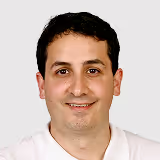
Marcel Kloos
Swiss-licensed dentist and founder of Medschool Experts
Marcel Kloos founded Medschool Experts while studying abroad; since then, over 500 study places have been secured. The Stuttgart-born dentist studied dentistry from 2015 to 2021 in Sofia and holds a Swiss dental licence.
Today he lives in Bern and runs Medschool Experts full-time as its owner.
More articles worth reading
Health Insurance for International Medical Students in Europe 2026
Scholarships and Funding for Medical Studies in Europe 2026
Medicine, Dentistry, Pharmacy or Veterinary Medicine? Choosing Your Degree Abroad in 2026
Ahmad
Sabrina
Rami
Noah
500+ students placed.
Now it's your turn!
No daydreaming, no empty promises. Just a clear plan — for the start of your medical degree.
40 minutes, no obligation