Medical School Admissions 2026: Quotas, Chances, and the TMS Explained
17.09.2026

Who allocates the places?
Medicine, dentistry, veterinary medicine, and pharmacy are subject to nationwide admissions restrictions in Germany. Places are allocated centrally through the Foundation for University Admissions (Stiftung für Hochschulzulassung) and the Dialogue-Oriented Service Procedure, or DoSV for short. Applicants list several preferred programmes there in a personal order of priority, from which the process then makes its allocations.
The three quotas
First, small shares go to pre-allocation quotas: hardship cases, second degrees, the rural doctor quota, and the quota for the public health service. The remaining places are then distributed as follows:
| Quota | Share | What counts |
|---|---|---|
| Top Grade Quota (Abiturbestenquote) | 30 percent | the school-leaving grade only, standardised nationwide |
| Additional Aptitude Quota | 10 percent | explicitly not the school-leaving grade: tests, vocational training, work experience, interviews |
| University Selection Procedure | 60 percent | school-leaving grade plus at least one further criterion, depending on the university |
The former waiting-time quota was abolished in 2020. Racking up semesters no longer automatically improves your chances — waiting time has simply become lost time.
The numbers behind it
Around 10,000 places in medicine are available nationwide each winter semester, against roughly 30,000 applications — considerably more in some years. In dentistry, there are around 1,500 places; in veterinary medicine, around 1,100.
That's the real heart of the matter: this isn't a process you can outsmart, it's one where there simply aren't enough places. Two out of three applications go unsuccessful every year, regardless of how motivated or qualified the applicant is.
{{cta}}
The most important lever in the process: the TMS
The Test for Medical Studies (TMS) is the most heavily weighted additional criterion at many universities, and it counts both in the Additional Aptitude Quota and in universities' own selection procedures. A strong result can noticeably improve a weaker school-leaving grade — which is exactly why many applicants spend months preparing for it.
Beyond the test, universities weight other criteria very differently: completed healthcare-related vocational training, relevant work experience, interviews, or volunteer work. Each university decides for itself which criteria count and how much, and the rules differ from faculty to faculty and from year to year.
The second route: studying in the EU
The German and international application processes run independently of one another. Holding a place at an EU university doesn't rule out an application through the central German process, and dual enrolment is permitted. Many people use exactly this combination: starting their studies abroad while keeping an eye on Germany at the same time. That way, no time is lost, whatever happens with the German allocation process.
And this is where the difference lies compared with the German process: at Medschool Experts, we work with the largest selection of official partner universities for medicine, dentistry, pharmacy, nursing, and veterinary medicine. Instead of trying to interpret grade thresholds and quotas, we look at your profile — your school certificate, any previous study achievements, and your preferred countries — and tell you which university, in which country, we can place you at and where we can reliably get you started. If you're already studying, we also check the highest possible year of entry for you; that's often one of the final two years of the programme.
We deliberately don't publish lists of requirements, documents, or deadlines: they differ by university and by year, and an outdated list can easily cost you a semester. We'll go through what applies in your case in a free consultation.
Author's opinion
Back then, I let this process intimidate me, and because of that I didn't even try to study dentistry at first. Looking back, that was the most expensive mistake of my life, measured in years.
What I tell everyone today: don't make your dream depend on a process where two out of three applications go unsuccessful. The German system isn't unfair, it's just too small. If you think along two tracks and look early at which universities in Europe are realistically within reach, you keep control of your own timeline — and you don't lose a year to waiting that no longer pays off. That's exactly what we're here for.
Conclusion
The German admissions process is fair, but it remains one with far too few places — and waiting semesters haven't improved anyone's chances since 2020. You don't have to make this decision on your own.
Get in touch with Medschool Experts: we work with the largest network of official partner universities for medicine, dentistry, pharmacy, nursing, and veterinary medicine, and we individually assess the highest possible year of entry for you — often one of the final two years of study. Book your free consultation and let's map out your path together.
Frequently asked questions about medical school admissions
What grade average do I need for medicine?
In the Top Grade Quota, the thresholds in most German states lie between 1.0 and 1.1. Dentistry sits in a similar range. Applicants with a weaker average can also succeed through the other two quotas — but nothing there is reliably guaranteed.
Are there still waiting semesters?
No. The waiting-time quota was abolished in 2020. It was replaced by the Additional Aptitude Quota, in which the school-leaving grade plays no role.
What are the odds, really?
Tight. Around 10,000 places in medicine face roughly 30,000 applications each winter semester; in dentistry there are around 1,500 places, and in veterinary medicine around 1,100. Two out of three applications go unsuccessful.
How much does the TMS count?
It varies a great deal by university. At many faculties, it's the most heavily weighted additional criterion and can meaningfully offset a weaker grade average. Exactly how much weight it carries is decided by each university individually.
Can I study abroad and keep applying in Germany?
Yes, and it's the most practical approach. The two processes run independently, and dual enrolment is permitted. If you start abroad, you lose no time while things in Germany may still work out.
What do I need for a place at one of your partner universities?
It depends on your school certificate, your previous study achievements, and the specific university — and it changes from year to year, which is why we don't publish a list here. Send us your profile, and we'll individually check which university, in which country, we can place you at, and where your start is realistically achievable. The consultation is free.
What is the rural doctor quota?
A pre-allocation quota run by individual German states for applicants who commit to working in an underserved region for a set period after completing their specialist training. The school-leaving grade plays a smaller role here.
What students say about Medschool Experts
Over 500 placements at more than 25 partner universities across 10+ countries. Read independent student reviews on Trustpilot.
About the author
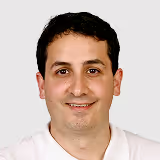
Marcel Kloos
Swiss-licensed dentist and founder of Medschool Experts
Marcel Kloos founded Medschool Experts while studying abroad; since then, over 500 study places have been secured. The Stuttgart-born dentist studied dentistry from 2015 to 2021 in Sofia and holds a Swiss dental licence.
Today he lives in Bern and runs Medschool Experts full-time as its owner.
More articles worth reading
Health Insurance for International Medical Students in Europe 2026
Scholarships and Funding for Medical Studies in Europe 2026
Medicine, Dentistry, Pharmacy or Veterinary Medicine? Choosing Your Degree Abroad in 2026
Ahmad
Sabrina
Rami
Noah
500+ students placed.
Now it's your turn!
No daydreaming, no empty promises. Just a clear plan — for the start of your medical degree.
40 minutes, no obligation