Medical School in Bulgaria: Pros and Cons Compared
17.09.2026

What speaks for and against studying medicine in Bulgaria?
The strongest advantage is admission without a numerus clausus, combined with a degree that is automatically recognised throughout the EU under Annex V of Directive 2005/36/EC. The biggest downside is the distance from your familiar surroundings, combined with the fact that you pay the tuition fees yourself. The table below compares both sides point by point.
| Aspect | Advantage | Worth considering |
|---|---|---|
| Admission | no numerus clausus | the university makes the selection |
| Degree | automatic EU recognition | credit transfer assessed case by case |
| Teaching | groups of up to ten students | high attendance requirements |
| Language | programme taught in English | local language needed from clinical years |
| Cost | low cost of living | tuition fees paid by the student |
| Environment | over 40 nationalities per year group | family and friends are further away |
Which advantages mattered most to me?
Three things, in this order. First, group size: in Sofia I was taught in groups of no more than ten students per lecturer, with direct access to the teaching staff. Second, the exam format: mostly oral, so you explain rather than tick boxes. Third, the international mix: my year group included people from more than 40 countries, and by the end you have a confident command of medical English.
A fourth point only became clear to me later, and it turned out to be the most important one for my life: an EU-recognised degree is an international passport that opens doors far beyond the country where you studied.
{{cta}}Which downsides should you take seriously?
The first is distance. Two hours by plane sounds like nothing, but if you're closely tied to family or carry responsibilities at home, you feel it. This isn't about ability - it's about your life situation, and in our consultations it's the most common reason someone decides against studying abroad.
The second is financial: you pay the tuition fees yourself. There are funding options - German study-abroad BAföG, for example, includes a tuition subsidy of up to €5,600 per year as a full grant - but they don't replace proper financial planning.
The third is language: teaching is in English, but the clinical section from the third year onward involves patient contact in the local language. If you let Bulgarian slide in year one, you pay for it later in extra effort. I know this because I made exactly that mistake.
What about the reputation of studying abroad?
When I started in 2015, studying abroad was still a fringe choice for many, and you occasionally ran into outdated ideas about it. That has changed a great deal: a significant share of German medical students are now enrolled in European countries abroad, and the curriculum content is comparable anyway thanks to shared European minimum standards.
My experience from everyday practice: in the clinic and in the surgery, what matters very quickly is what someone can actually do. Where the diploma was issued fades into the background after that. Still, this point belongs here, because prospective students bring it up often, and I don't want to argue it away.
How do you weigh this up for yourself?
Not with a pros-and-cons list, but by looking at your own life situation. Three questions help: Can I live with distance from my familiar surroundings for six years? Is the financing actually worked out, not just assumed? Am I willing to learn a local language alongside my studies?
If you can answer yes to all three, you've cleared the main hurdles as far as I'm concerned. We take care of the rest - choosing the right location, the process, and support on the ground. You can book a free consultation with us at any time.
The author's opinion: an honest list of downsides serves you better than a marketing brochure
I wrote down the downsides of my own path while I was still a student, and I still think that was the right call. If you only hear the upsides, you make a decision that wobbles at the first sign of headwind.
My assessment: the students who drop out of studying abroad almost never fail because of the subject matter. They struggle with distance, or with financing that was too tight from the start. This is an observation from our work at Medschool Experts, having now helped place more than 500 students - not a formal dropout statistic, so it can't be proven.
That's why we address both sides in the initial consultation. If it turns out in the end that studying abroad isn't the right fit, that's a good outcome, not a wasted conversation.
Conclusion
Studying medicine in Bulgaria comes with real advantages and real things to plan for - and the right choice depends on your own situation. That's exactly what we're here to help with. Medschool Experts has the largest network of official partner universities, and we individually assess the highest possible year of entry for every student - entry is often possible even in the final two years of the programme. Get in touch with us and book a free consultation to find out what's realistic for you.
Frequently asked questions about the pros and cons of studying in Bulgaria
What is the biggest advantage of studying medicine in Bulgaria?
Admission without a numerus clausus, combined with a degree that is automatically recognised throughout the EU under Annex V of Directive 2005/36/EC.
What is the biggest downside?
The distance from your familiar surroundings, and the fact that you pay tuition fees yourself. Both can be planned for, but neither goes away.
Is a degree from Bulgaria equivalent?
Yes. Automatic recognition under Annex V requires EU-wide standardised minimum content and a minimum length of study.
Are there any reservations about foreign degrees?
Occasionally, students still encounter outdated ideas about studying abroad. In my experience, what matters very quickly in everyday practice is what someone can do, not where the diploma was issued.
How high are the tuition fees?
They vary by university and subject. We're happy to go through current figures for all our partner locations in a free consultation.
Is studying in Bulgaria easier?
No. Admission is more open, but the material is the same. Exams are mostly oral, which tests understanding rather than rote memorisation.
Do I have to learn Bulgarian?
Not for the lectures, but yes for the clinical section from the third year onward. The language is a compulsory subject in the early years.
Can I transfer back to Germany?
A transfer is possible. The receiving German university decides on the credit transfer of individual coursework on a case-by-case basis.
How big are the study groups?
At the Medical University of Sofia, I was taught in groups of no more than ten students per lecturer.
How much does living there cost?
The cost of living is below the German level, though the gap has narrowed in recent years. We present a realistic monthly budget in our magazine.
Who isn't a good fit for studying abroad?
People who rely on a close family environment and can't handle distance well. This isn't a question of ability, but of your life situation.
How do I find out if it's right for me?
Best of all, by talking to someone who has walked this path themselves. That's exactly what our free consultation is for.
What students say about Medschool Experts
Over 500 placements at more than 25 partner universities across 10+ countries. Read independent student reviews on Trustpilot.
About the author
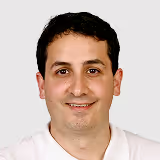
Marcel Kloos
Swiss-licensed dentist and founder of Medschool Experts
Marcel Kloos founded Medschool Experts while studying abroad; since then, over 500 study places have been secured. The Stuttgart-born dentist studied dentistry from 2015 to 2021 in Sofia and holds a Swiss dental licence.
Today he lives in Bern and runs Medschool Experts full-time as its owner.
More articles worth reading
Health Insurance for International Medical Students in Europe 2026
Scholarships and Funding for Medical Studies in Europe 2026
Medicine, Dentistry, Pharmacy or Veterinary Medicine? Choosing Your Degree Abroad in 2026
Ahmad
Sabrina
Rami
Noah
500+ students placed.
Now it's your turn!
No daydreaming, no empty promises. Just a clear plan — for the start of your medical degree.
40 minutes, no obligation