Studying Medicine in Moscow: Costs and Recognition
17.09.2026

Moscow at a Glance
The I.M. Sechenov First Moscow State Medical University is a state medical university in Moscow that also offers human medicine in an English-language degree programme. Six years, twelve semesters, ending in a degree in human medicine. Admission is decided by the university's own entrance examination, not your school-leaving grades. The key facts are set out in the table below, and everything else builds on them.
| Feature | Details (as of 2026) |
|---|---|
| University | I.M. Sechenov First Moscow State Medical University |
| Degree programme | Human medicine |
| Language of instruction | English; Russian required for the clinical part |
| Standard duration of study | 6 years, twelve semesters |
| Start of studies | Winter semester |
| Tuition fee | 6,650 EUR per semester (1,250,000 RUB) |
| Total fees | approx. 79,800 EUR over twelve semesters |
| Cost of living | approx. 400 to 700 EUR per month |
| Admissions process | University entrance examination; school grades are not decisive |
| Numerus clausus | None |
| Recognition in Germany | Equivalency assessment under Section 3 of the German Medical Licensing Act (Bundesärzteordnung), otherwise a knowledge examination followed by licensure (Approbation) |
University and Teaching Hospitals
Sechenov University dates back to 1758, making it one of the oldest medical training institutions in Russia. According to location data from studimed, more than 19,000 students from 88 countries study there. The campus is home to 25 university hospitals with a combined total of more than 3,000 beds, along with a high proportion of robot-assisted operating theatres. This is not a faculty that sends its students elsewhere for clinical placements.
The English-language degree programme in human medicine is based at the N.V. Sklifosovsky Institute of Clinical Medicine. On its admissions page for the 2026/2027 academic year, the university lists this institute as the largest medical faculty in Russia. Clinical teaching takes place at the university's own hospitals, and because Russian-speaking patients are treated there, you will need Russian from the third year at the latest. This is no minor detail — it's genuine extra effort on top of an already demanding course of study.
What strikes me most about this location is its sheer scale. With 25 hospitals on one campus, you see a huge variety of cases in a short space of time during the clinical years. During my own studies in Sofia, I experienced first-hand how much this shapes your learning: a condition you have seen once in a real patient sticks with you very differently than one you have only read about in a textbook.
Which Degree Programmes Are Available, and in What Language?
At Medschool Experts, the route into Moscow leads to a degree in human medicine. The programme is taught in English, lasts six years and ends with a degree in human medicine. Sechenov University also trains dentists; this programme is shorter, at five years, and carries the same semester fee.
| Degree programme | Language | Standard duration | Degree |
|---|---|---|---|
| Human medicine | English, Russian for the clinical part | 6 years | Degree in human medicine |
| Dentistry | English, Russian for the clinical part | 5 years | Degree in dentistry |
English is the language of instruction, Russian the language of the ward. Solid school English is enough as a starting point — everyone learns the medical terminology from scratch in the first year anyway. If you want to prepare beforehand, focus on listening comprehension and vocabulary rather than grammar.
The fact that a Russian state university runs an entire medical degree programme in English is no coincidence — it's the result of decades of experience training international cohorts. What that means for you: you won't be the odd one out in a Russian-language course, but part of a group taught in English from the very first lecture. You build up your Russian alongside your studies, and you'll need it not only in the hospital but also for everyday things like errands and dealing with the authorities.
How Does Admission Work?
The requirement is a higher education entrance qualification — in Germany, the Abitur. There is no numerus clausus. Selection is based on the university's own entrance examination, which tests science fundamentals from the final years of secondary school. Your school grades are not decisive; what counts is your performance in the exam.
Our team at Medschool Experts takes care of your registration, application and entrance exam preparation. Participation is usually possible entirely online, so you don't need to fly to Moscow for the exam. We handle the paperwork for you, including the student visa.
We prepare you specifically for the science section in biology and chemistry, as well as for the interviews that are also part of the process and focus on your motivation. Application windows and enrolment dates shift from year to year and need to be planned well in advance, especially given the lead time required for the student visa — so rather than list figures that may be outdated by the time you read this, we work out your personal timeline together in a free consultation.
What helps most in preparation is refreshingly unspectacular: thoroughly reviewing biology and chemistry at upper-secondary level and learning the English terminology alongside it. Doing both together saves time later. Exact dates and the precise exam format change from year to year, so we set out your individual schedule during a free consultation rather than quoting a figure here that may no longer be accurate next year.
What Does the Programme Cost?
The tuition fee is 6,650 EUR per semester, or 1,250,000 RUB. Billing is in rubles, so the euro amount depends on the exchange rate and can shift from semester to semester. You should factor this uncertainty into your planning.
| Item | Amount (as of 2026) |
|---|---|
| Tuition fee per semester | 6,650 EUR (1,250,000 RUB) |
| Tuition fee per academic year | 13,300 EUR |
| Fees over twelve semesters | 79,800 EUR |
| Cost of living per month | 400 to 700 EUR |
| Cost of living over 72 months | 28,800 to 50,400 EUR |
| One-off incidental costs | approx. 5,000 EUR (our own estimate) |
From this you can build an overall estimate. It is explicitly an estimate, not a quote: fees of 79,800 EUR, living costs of 28,800 to 50,400 EUR and one-off incidental costs of around 5,000 EUR add up to roughly 114,000 to 135,000 EUR over the full duration of the programme. The one-off items include the application, student visa, health insurance, travel and the deposit for accommodation.
A look at other locations in our series helps put this figure into context. The table below compares only the pure tuition fees over the standard duration of study in human medicine.
| Location | Fee | Over the standard duration | EU degree |
|---|---|---|---|
| Moscow, Sechenov University | 6,650 EUR per semester | 79,800 EUR | No |
| Tartu, University of Tartu | 13,200 EUR per year | 79,200 EUR | Yes |
| Valletta, MediCampus Europeo | 7,250 EUR per semester | 87,000 EUR | Yes |
| Istanbul, Yeditepe University | 20,000 EUR per semester | 240,000 EUR | No |
Moscow therefore sits at the more affordable end, roughly on a par with Tartu and well below Istanbul. The difference from Tartu and Valletta isn't the price — it's the recognition pathway, which we cover further below.
There's one thing you should know from the outset about financing: full BAföG funding is generally not available outside the European Union and Switzerland, so it's usually off the table for Moscow. Realistic options include education loans, education funds, private scholarships and family support. We work through with you which combination fits your situation before you decide.
{{cta}}
How Is the Programme Structured?
The programme lasts six years and follows a clear three-stage structure: fundamentals, clinical training, and a practical final year. The structure is similar to what you know from Germany, with practical components starting early.
| Stage | Years of study | Focus |
|---|---|---|
| Pre-clinical stage | 1 to 2 | Basic science and theoretical foundations |
| Clinical stage | 3 to 5 | Clinical examination courses and placements at the university hospital |
| Practical final year | 6 | Continuous clinical work, equivalent to the German Praktisches Jahr |
From the third year onward, you're regularly at the university's own hospitals. Your performance is recorded in a transcript listing subjects, exams and grades. Keep your semester certificates and grade records complete from day one, since this exact material later forms the basis of the German recognition assessment.
The final year of study is practically oriented and functions like the German Praktisches Jahr. You can generally complete clinical clerkships (Famulaturen) in Germany too; whether they are recognised is decided by whichever authority later reviews your documents. Clarify this early, not just in your fifth year, so you can plan your summers accordingly.
Where Can You Work as a Doctor With This Degree?
This is where the key difference from our EU locations lies, and it belongs at the very start of your planning. Russia is not a member of the European Union. Directive 2005/36/EC lists, in Annex V, point 5.1.1, the medical qualifications that are automatically recognised within the Union — as amended by Delegated Decision (EU) 2023/2383 of 23 May 2023, applicable since 9 October 2023. A Russian degree is not on that list. That means there is no automatic recognition, neither in Germany nor in any other EU member state.
The path still leads to full licensure (Approbation) — it just takes a different route. The relevant state authority assesses your training under Section 3 of the German Medical Licensing Act (Bundesärzteordnung) for equivalence with a German medical degree. If the assessment is positive, licensure follows. If it isn't, you sit a knowledge examination and receive your licence afterwards. In the meantime, a temporary professional permit lets you already work as a doctor. We've described how this process works in detail in our overview of the recognition of foreign qualifications in the healthcare professions.
| Country | Path to professional licensure |
|---|---|
| Germany | Equivalency assessment under Section 3 of the Bundesärzteordnung; otherwise a knowledge examination followed by licensure (Approbation) |
| Austria | Nostrification of the diploma at a medical university, followed by entry in the register of physicians |
| Switzerland | Diplomas from third countries are not automatically recognised; a separate procedure decides on admission |
| Rest of the EU | No automatic recognition under Directive 2005/36/EC; each member state assesses independently |
| United Kingdom | Registration with the General Medical Council, usually via the PLAB exams |
| USA | ECFMG certification; since 1 January 2023 the university must be accredited by a WFME-recognised agency |
On the US point, one clarification is worth making. For Russia, the Independent Agency for Accreditation and Rating is the WFME-recognised body; its recognition runs until January 2028. The National Centre for Public Accreditation, which also evaluates medical programmes in Russia, does not hold this status. Whether a specific programme is accredited at the time of your graduation can only be checked for that particular cohort — if the US is firmly on your radar, clarify this in advance.
Dentist, Pharmacist, Psychologist, Veterinarian: The Legal Position for Each Profession
Dentist. For dentists, Directive 2005/36/EC lists the training qualifications in Annex V, point 5.3.2. The same applies here: Russian degrees are not on this list. Sechenov University offers a five-year dentistry programme; for Germany, this means the same process as in human medicine — an equivalency assessment and, failing that, a knowledge examination before licensure. If dentistry is your goal, an EU location is generally the more straightforward route.
Pharmacist. Pharmacy is also harmonised across the EU, listed in Annex V, point 5.6.2. This automatic recognition doesn't apply to degrees from non-EU countries, leaving a case-by-case assessment by the relevant state authority. We don't place students in pharmacy programmes in Moscow; if this is your goal, we'll look at our European locations together in a consultation.
Psychologist. Psychology and psychotherapy are not harmonised within the European Union. There is no Annex V entry for these professions, regardless of whether the degree comes from a member state or not. Each country decides independently on access to the profession and the use of professional titles. A degree from Moscow is therefore not a shortcut for this career path.
Veterinarian. Veterinary medicine is listed in Annex V, point 5.4.2, and is therefore automatically recognised within the Union. For a Russian degree, the case-by-case assessment applies again. Sechenov University is not one of our partner locations for veterinary medicine.
Career Paths After Graduation
With German licensure (Approbation), you are on equal footing with graduates of German medical faculties. You can begin specialist training in any field, at a hospital or a practice authorised to provide it, and choose your specialty freely. The difference from an EU degree isn't in the outcome but in the path there: with a diploma from Moscow, the equivalency assessment comes first, potentially followed by a knowledge examination. Factor this time in before you start your first position as a resident.
In Russia itself, you can move straight into further medical training after graduating. A Russian medical degree is also a common entry point in many countries outside Europe, often via a national licensing exam. We've covered in detail which options a medical degree opens up worldwide, and what to watch out for, in our overview of career paths with a medical degree worldwide.
One point many people underestimate: the time between graduation and full licensure isn't dead time. With the temporary professional permit, you can already work as a doctor in Germany while your recognition process is underway. Applying for positions early and being upfront about where you stand in the process tends to lead you to hospitals that are familiar with this and happy to work with it.
Lateral Entry, Transfers and Switching Back to Germany
There's no automatic route for transferring to a German faculty. It runs through a lateral-entry procedure: you need an open place in a higher semester, and the receiving faculty decides for itself which of your prior credits it will recognise. Coming from a programme outside the European Union, this rarely succeeds, since the curricula are harder to compare.
My recommendation is therefore clear: plan Moscow as a complete path through to graduation, not as a stepping stone. Starting out with the idea of switching back later means making the decision from a skewed perspective. The flip side is also true: a cleanly documented course of study with complete records makes any later process easier, whether that's recognition or credit transfer.
Life in Moscow: City, Getting Around, Costs
Moscow is the capital of Russia and, with a population of over twelve million, one of the largest cities in Europe. The metro network covers the city densely and is comparatively cheap, so you can live a bit further out and still reach the university quickly. Groceries, dining and public transport are cheaper than in Germany, while rents vary considerably depending on location — which is exactly where the broad range of 400 to 700 EUR per month comes from.
| Item | Amount (Numbeo, as of 17 August 2026) |
|---|---|
| One-bedroom flat in the city centre | 117,206 RUB per month |
| One-bedroom flat outside the centre | 62,735 RUB per month |
| Monthly public transport pass | 3,460 RUB |
| Meal at an inexpensive restaurant | 1,000 RUB |
Many international students start out in a dormitory, others share a flat; a deposit is usually required for accommodation. You'll need a student visa to enter the country, which we take care of for you. What I always tell prospective students: the biggest lever on your monthly costs is where you live, not your shopping list. Living two metro stops further out can make a five-figure difference over six years.
One other thing affects everyday life: since 2022, the practical conditions for studying in Russia have become noticeably more complicated. Payment channels, flight connections and visa matters all need more lead time and patience than they did a few years ago. That's not a reason to rule it out, but it belongs in the decision — and we factor it in with you from the very start.
Who This Location Suits
Moscow suits you if you're looking for a large state university with its own hospitals, if an entrance exam motivates you rather than puts you off, and if you're ready to learn Russian alongside your English-language studies. The fees are at the more affordable end among our locations, the programme is hands-on, and the clinical capacity on site is substantial.
Moscow is less suited to you if you're set on the most direct possible recognition pathway. In that case, our EU locations are the better choice, since the equivalency assessment doesn't apply there. If you already know you only want to take on one additional language, that's also worth weighing carefully.
My assessment: Moscow is a location for the determined. The academic framework is solid, the price is right, and the path to German licensure is well-mapped and achievable — it just involves one extra step and needs more organisational lead time than studying within the EU. If you know that and still want it, you get a lot of medicine for your money here. We have a suitable partner university for almost every situation, and we're happy to look at your starting point together: book a free consultation.
Author's Opinion
From 2015 to 2021 I studied dentistry in Sofia, far from home and in a language that was not my mother tongue. That experience is why, when I look at Moscow, I do not focus first on the country but on the students' everyday lives. That daily reality looks similar everywhere: the first few months are the most demanding, and then life abroad becomes normal. Those who get through that initial phase learn early on how to organise themselves, and that pays dividends throughout the entire programme.
What convinces me about Sechenov University is the clinical substance. Twenty-five university hospitals on a single campus, more than 3,000 beds, a degree programme that is consistently patient-facing from the third year onwards — that is a training situation many faculties would envy. Then there is the price: 6,650 EUR per semester is a very sound ratio for an English-language medical programme with this level of clinical capacity, particularly in comparison with private providers.
The non-EU degree is the point where I go into the most detail in conversations. There is no automatic recognition; there is the equivalency assessment under Section 3 of the Bundesärzteordnung, and otherwise the knowledge examination, followed by licensure. Added to that is the practical side: payment routes, visa arrangements and travel planning have all required noticeably more lead time since 2022. That is not a reason to dismiss this location, but it is a reason to choose it with open eyes and to plan the recognition process from the outset rather than only in the sixth year.
Every week, I see how different the starting points are for the people who come to us at Medschool Experts: grades, budget, languages, family situation. Moscow is not the right address for everyone. For those who are looking for substantial clinical training at a realistic price, and who are consciously prepared to take on the extra procedural step, it is a serious option. A degree abroad is never a shortcut or a detour — it is an independent decision in its own right.
Conclusion
Interested in studying medicine in Moscow? Get in touch with Medschool Experts — we have the largest network of official partner universities, and we individually assess the highest possible year of entry for every student, with entry often still possible in the final two years of study. Book your free consultation and let's map out your path together.
Frequently Asked Questions About Studying Medicine in Moscow
What requirements do you need for Sechenov University in Moscow?
You need a higher education entrance qualification — in Germany, the Abitur. There is no numerus clausus at the I.M. Sechenov First Moscow State Medical University, so your school-leaving grade doesn't decide your place. You'll also need a good command of English and a student visa for Russia. Admission is decided by the university's own entrance examination.
How does the entrance examination in Moscow work?
Sechenov University selects students through its own entrance examination. School grades aren't decisive — what counts is your result in the exam. In terms of content, you should refresh your science fundamentals and have a confident command of English. We discuss the exact process and the next dates in a free consultation, since both change from year to year.
What does a semester at Sechenov University cost?
Tuition is 6,650 EUR per semester, billed in rubles at 1,250,000 RUB. Over the twelve semesters of the standard six-year programme, that adds up to roughly 79,800 EUR. Because billing is in rubles, the euro amount depends on the exchange rate and can fluctuate. You should factor this uncertainty into your planning.
What costs come up besides tuition?
One-off expenses include the application, student visa, health insurance, travel and a deposit for accommodation. On an ongoing basis, you'll need textbooks and study materials. Individually these items are manageable, but in your first year in Moscow they add up noticeably. We estimate around 5,000 EUR over the course of your studies.
How much money do you need per month to live in Moscow?
Budget around 400 to 700 EUR per month. Groceries, dining and public transport are cheaper than in Germany, and the metro network covers the city densely and affordably. Rents, however, vary considerably by location, which is why the range is so wide. Where you live is the biggest lever.
Is BAföG funding available for a medical degree in Russia?
Full BAföG funding is generally not available outside the European Union and Switzerland, so it's usually off the table for Moscow. Realistic options include education loans, education funds, private scholarships and family support. We work through with you which of these fit your situation.
Is school English enough for classes at Sechenov University?
The human medicine programme is taught entirely in English. Solid school English is a good foundation — everyone learns the medical terminology from scratch in the first year. If you want to take confident notes in lectures and read specialist literature quickly, though, it's worth working specifically on listening comprehension and vocabulary before you start. Note-taking gets noticeably easier after the first few weeks.
Do you need Russian language skills in Moscow?
Yes, at the latest for the clinical stage. Teaching is in English, but from the third year onward you work at the university hospital with patients who speak Russian. The language also helps in everyday life, from shopping to dealing with the authorities. It's genuine extra effort on top of an already demanding course of study.
How is the medical degree in Moscow structured, and how long does it take?
Six years. In years one and two, the focus is on pre-clinical subjects; from the third year, the clinical stage begins with examination courses and placements at Sechenov University's own hospital. The final year of study is practically oriented and corresponds to the German Praktisches Jahr. It ends with a degree in human medicine.
Is a degree from Moscow recognised in Germany?
Not automatically. Russia is not an EU member, so the relevant state authority assesses your degree on a case-by-case basis for equivalence with a German medical degree. If the assessment is positive, licensure follows. If it isn't, you sit a knowledge examination and receive your licence afterwards. So the path does lead to licensure — it just has one extra step.
How do you get your medical licence after graduating?
You apply for licensure (Approbation) with the state authority in the German state where you want to work. The legal basis for assessing degrees from non-EU countries is Section 3 of the Bundesärzteordnung. In the meantime, a temporary professional permit lets you already work as a doctor. Factor in time for this process.
When does the programme start, and when should you apply?
The programme starts in the winter semester only — there's no intake in the summer semester. Apply as early as possible in the year before you plan to start: the student visa needs lead time, the entrance exam takes place before the semester begins, and places for international students are limited. From your first conversation with us, we take care of the organisation for you.
Where do you live in Moscow?
Many of Sechenov University's international students start out in a dormitory, others share a flat. A deposit is usually required for accommodation. Rental prices depend heavily on location — closer to the centre is noticeably more expensive. Because the metro network is dense, you can also live a bit further out.
What students say about Medschool Experts
Over 500 placements at more than 25 partner universities across 10+ countries. Read independent student reviews on Trustpilot.
About the author
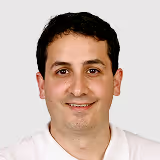
Marcel Kloos
Swiss-licensed dentist and founder of Medschool Experts
Marcel Kloos founded Medschool Experts while studying abroad; since then, over 500 study places have been secured. The Stuttgart-born dentist studied dentistry from 2015 to 2021 in Sofia and holds a Swiss dental licence.
Today he lives in Bern and runs Medschool Experts full-time as its owner.
More articles worth reading
Health Insurance for International Medical Students in Europe 2026
Scholarships and Funding for Medical Studies in Europe 2026
Medicine, Dentistry, Pharmacy or Veterinary Medicine? Choosing Your Degree Abroad in 2026
Ahmad
Sabrina
Rami
Noah
500+ students placed.
Now it's your turn!
No daydreaming, no empty promises. Just a clear plan — for the start of your medical degree.
40 minutes, no obligation