Studying Medicine in Thessaloniki: Costs, Structure and Recognition
17.09.2026

Thessaloniki at a Glance
Thessaloniki lies on the Thermaic Gulf in northern Greece and, with a metropolitan population of around 1.1 million, is the country's second-largest city. It's an economic and cultural centre of the northern Aegean with a strong student presence. For your decision, though, the hard numbers come first. The overview below summarises what you're signing up for. It answers the four questions that come up first in every initial conversation: what it costs, how long it takes, what language it's taught in, and what the degree is worth at the end.
| Feature | Details (as of 2026) |
|---|---|
| University | Aristotle University of Thessaloniki, founded 1926, over 74,000 students |
| Programme for international students | Human medicine |
| Language of instruction | English |
| Standard duration | 6 years, 12 semesters |
| Start of studies | October |
| Tuition fee | 6,000 EUR per semester, 12,000 EUR per academic year |
| Places per cohort | Maximum 60 students |
| Selection process | Written entrance exam in biology, chemistry and general knowledge, plus an online interview |
| English proficiency | At least B2; per the university, IELTS 6.0 or TOEFL 79 |
| Faculty's clinical base | Seven university hospitals, 82 departments and labs across nine sectors |
| Recognition of the degree | Automatic under Directive 2005/36/EC, Annex V point 5.1.1 |
University and Teaching Hospitals
Aristotle University of Thessaloniki was founded in 1926 and has more than 74,000 students, making it one of the largest state universities in Greece. The medical faculty states that it has existed since 1942 and has trained more than 30,000 graduates in that time (source: aristotlemedical.edu.gr, accessed August 2026). This isn't a young faculty just trying out an international programme — it's an established, mature institution.
Its clinical base is correspondingly broad. The faculty includes seven university hospitals along with 82 medical departments and laboratories, which the faculty organises into nine sectors. Bedside teaching is therefore spread across several hospitals in the city rather than concentrated in a single facility. In practice, that means you'll see different levels of care and different teams during the clinical stage — and you'll cover some distance getting between them.
According to the faculty, the English-language human medicine programme is the first undergraduate medical programme in English in Greece. Cohorts are capped at a maximum of 60 students. What strikes me most about this setup is the ratio: a very large university, but a very small international cohort. If you're studying in a group of 60, your lecturers get to know you — and that's worth more during the pre-clinical stage than it looks on paper.
Which Degree Programmes Are Available, and in What Language?
For international applicants, the university opens up the human medicine programme in English. Lectures, course materials and exams all run in that language throughout. Other subjects at the university are not part of the English-language offering; if you want to study dentistry, pharmacy or veterinary medicine, you'll need a different location. That clarity is an advantage: there's exactly one path, and it's well documented.
| Feature | Details |
|---|---|
| Degree programme | Human medicine, Greek title Ptychio Iatrikis |
| Language of instruction | English |
| Standard duration | 6 years, 12 semesters |
| Start of studies | October, no intake in the summer semester |
| Cohort size | Maximum 60 students |
| Language requirement | English at least B2; per the university, IELTS 6.0 or TOEFL 79 |
Greek is not an admission requirement. Once you're at the bedside during the clinical stage, though, it helps enormously, since patients at the university hospitals speak Greek. Building up the language gradually over the course of your studies pays off noticeably more during the practical stage than sticking to English alone.
How Does Admission Work?
The university runs its own selection process, in two stages. The first part is a 60-question multiple-choice test, taken online, covering school-level biology and chemistry as well as general knowledge and logical reasoning. The second part is an interview by video call. According to the university, applicants with certain prior qualifications — for example A-levels with grades AAB, or a recognised admissions test — can be exempted from the written part. The requirement for everyone is a general higher education entrance qualification and proof of English at B2 level or above.
So your Abitur grade doesn't decide your place. That's the core of the model: anyone with a solid command of upper-secondary biology and chemistry, who comes across well in the interview, gets in — regardless of whether their grade average is excellent or middling.
We handle this process for you. Our team at Medschool Experts organises your registration, application and entrance exam sign-up, usually entirely online, so you don't need to travel to Greece for the exam or the interview. We take care of the paperwork. We prepare you specifically for both parts of the exam: the subject test in biology and chemistry, and the motivation interview, where it's about why you want this profession and why here specifically. Whether your personal path fits is something we assess individually in a free consultation.
Give yourself generous lead time. Since the programme starts in October and only 60 places are awarded, spring of your starting year is a sensible point to begin preparing in earnest. The subject content is school material, but material most applicants covered a few months ago. In my experience, two to three months of structured review in biology and chemistry is a realistic timeframe, and that time pays off again in your first year of study.
What Does the Programme Cost?
The university charges 12,000 EUR per academic year, split into two instalments of 6,000 EUR each: the first when you accept your place, the second at the end of the winter semester (source: aristotlemedical.edu.gr, accessed August 2026). For living costs, Numbeo provides solid reference points, as of 16 August 2026, based on 1,461 entries from 124 contributors over the previous twelve months.
| Item | Amount | Source |
|---|---|---|
| Tuition fee per semester | 6,000 EUR | University, 2026 |
| Tuition fee per academic year | 12,000 EUR in two instalments | University, 2026 |
| Tuition fee over 12 semesters | 72,000 EUR | our own calculation |
| One-bedroom flat outside the centre | 423.81 EUR per month | Numbeo, 16 Aug 2026 |
| One-bedroom flat in the centre | 549.20 EUR per month | Numbeo, 16 Aug 2026 |
| Utilities: electricity, water, heating | 197.54 EUR per month | Numbeo, 16 Aug 2026 |
| Monthly public transport pass | 16.00 EUR | Numbeo, 16 Aug 2026 |
From this you can build an overall estimate for the full duration of study. The table below is an estimate, not a guarantee: it assumes a room in a shared flat rather than your own apartment, and a normal student lifestyle.
| Item | Assumption | Total over 6 years (estimate) |
|---|---|---|
| Tuition fees | 12,000 EUR per year | 72,000 EUR |
| Housing including utilities | 650 EUR per month | 46,800 EUR |
| Food, transport, daily living | 350 EUR per month | 25,200 EUR |
| Textbooks and study materials | 500 EUR per year | 3,000 EUR |
| Trips home from Makedonia Airport | 500 EUR per year | 3,000 EUR |
| Total | Estimate | around 150,000 EUR |
To help you put this figure into context, here's a comparison with other locations in our series. The fees come from studimed.de, as of 2026, converted to a per-academic-year basis.
| Location | Tuition fee per academic year | Language of instruction |
|---|---|---|
| Thessaloniki, Greece | 12,000 EUR | English |
| Cluj, Romania | 5,000 EUR | English |
| Rijeka and Split, Croatia | 12,000 EUR | English |
| Bratislava, Comenius University | 13,000 EUR | English |
| Pécs, Hungary | 15,000 EUR | German |
| Nicosia, Cyprus | 24,000 EUR | English |
Thessaloniki therefore sits in the middle of the pack among English-language programmes. The gap is clear both above and below it. One point works in Greece's favour: the country is part of the eurozone, so there's no exchange-rate risk over twelve semesters.
{{cta}}
How Is the Programme Structured?
The programme lasts six years and follows the classic European structure of pre-clinical studies, clinical studies and a practical final year. The first two years lay the scientific and morphological foundation; from the third year, teaching shifts into the hospitals, and the final year is entirely practical.
| Stage | Years of study | Focus |
|---|---|---|
| Pre-clinical stage | 1 to 2 | Anatomy, physiology, biochemistry, histology, embryology |
| Clinical stage | 3 to 5 | Internal medicine, surgery, paediatrics, gynaecology, neurology, psychiatry |
| Practical year | 6 | Continuous ward work, equivalent to the German Praktisches Jahr |
The university documents your results with grades and ECTS credits in a transcript of records. You'll need this document later for every step involving the authorities, and it's the basis should you ever want to transfer to another university. Have it issued after every academic year, rather than trying to track everything down at the end.
The rhythm of the programme is that of a European medical degree: semesters of lectures, seminars and placements, exams at the end of each, and a growing share of time in the hospitals from the third year onward. Because clinical teaching is spread across several hospitals, your daily routine changes with each rotation. You can also complete clinical clerkships (Famulaturen) in Germany; whether and how they're credited is decided by the relevant German authority according to its own rules.
Where Can You Work as a Doctor With This Degree?
Greece is an EU member, and the degree is listed in Annex V of Directive 2005/36/EC under point 5.1.1, as amended by Delegated Decision (EU) 2023/2383 of 23 May 2023, applicable since 9 October 2023. For Greece, the entry is the title Ptychio Iatrikis, awarded by a university's medical faculty. That means automatic recognition in all member states, with no equivalency assessment or knowledge examination required.
| Country | Path to professional licensure |
|---|---|
| Germany | Automatic recognition under Directive 2005/36/EC; licensure with the relevant state authority, proof of German language skills at professional level |
| Austria | Recognition by the Austrian Medical Chamber under the same EU rule, followed by entry in the register of physicians |
| Switzerland | Recognition of the EU diploma under the Agreement on the Free Movement of Persons, followed by a practising permit from the relevant canton |
| Rest of the EU and EEA | Automatic recognition, with national registration and language proof per local law |
| United Kingdom | Registration with the General Medical Council, usually via the PLAB exam and proof of English |
| USA | USMLE exams and ECFMG certification; since November 2024, the Recognized Accreditation Policy also applies, which looks at the WFME recognition of the national accreditation agency |
One detail on the US is worth adding: Greece's accreditation agency is the Hellenic Authority for Higher Education, or HAHE. On the WFME list dated 13 January 2025, it's listed among the agencies that have applied for recognition but have not yet received it. This doesn't matter for Germany, Austria, Switzerland or the rest of the EU, since the directive applies there. If the US is a concrete goal for you, check the current status yourself before starting your studies.
Dentist, Pharmacist, Psychologist, Veterinarian: The Legal Position for Each Profession
Dentist. Dentistry is harmonised across Europe and regulated under Annex V, point 5.3.2, also as amended by Delegated Decision (EU) 2023/2383. A Greek dentistry degree would be automatically recognised in Germany. In Thessaloniki, however, dentistry is not part of the English-language programme; other locations in our series are the better fit for this.
Pharmacist. Point 5.6.2 of Annex V applies to pharmacists. The directive requires at least five years of training, including a placement in a pharmacy, after which automatic recognition applies. This programme, too, is not offered in English in Thessaloniki.
Psychologist. Psychology and psychotherapy are not harmonised under Directive 2005/36/EC. There is no Annex V entry for these professions, and each member state decides according to its own law whether to recognise a foreign degree. If you want to pursue this path, always clarify the requirements in your target country before enrolling.
Veterinarian. Veterinary medicine is harmonised under point 5.4.2 and requires at least five years of study. A corresponding EU degree is automatically recognised. In Thessaloniki, veterinary medicine isn't part of the English-language offering, so this location isn't an option for veterinary studies.
Career Paths After Graduation
With a degree from Thessaloniki, you stand legally exactly where graduates of German faculties stand. After licensure, you apply as a doctor in specialist training at hospitals and practices authorised to provide it. Specialist training follows the training regulations of the relevant regional medical association, with the same timeframes, the same target numbers and the same exam at the end.
It's worth asking what an English-language degree brings beyond that. Six years of medical English is a real advantage if you later want to work in research, contribute to an international study centre, or spend a few years working abroad. The international cohort does the same for your network: your 59 fellow students end up spread across half of Europe after graduation.
Greece itself is also an option. If you build up the language during your studies, you can start specialist training within the Greek system and switch within the EU later, since specialist qualifications are also listed in Annex V. We've described in detail which paths an EU medical degree opens up worldwide in our overview of career paths with an EU medical degree.
Lateral Entry, Transfers and Switching Back to Germany
Transferring to a German faculty at a higher semester is possible, but it's not automatic. Two things need to line up: an open place in the right semester, and a German faculty willing to recognise the credits you earned in Thessaloniki. The receiving university decides on recognition under its own regulations, and places are scarce.
That's exactly why I recommend choosing a location you actually want to see through for the full six years. Anyone eyeing a transfer back from day one is studying half-heartedly. Your transcript of records with ECTS credits is nonetheless the insurance policy in the background: it's what makes any credit-transfer assessment possible in the first place, whether within Greece, in Germany, or in another EU country.
The reverse also works, incidentally: if you've already completed semesters at another European faculty, you can have it checked whether entry into a higher stage is possible. Since cohorts in Thessaloniki are capped at 60 places, this depends heavily on the individual case. We assess that individually in a free consultation.
Life in Thessaloniki: City, Getting Around, Costs
Thessaloniki isn't a purely student city, but it has a strong student presence. Life happens a lot outdoors — along the waterfront promenade, in the cafés of the city centre, and in summer on the beaches of Halkidiki, reachable by bus in a good ninety minutes. Makedonia Airport connects the city directly with several German cities, which makes trips home easy to plan.
| Item | Amount per month | Source |
|---|---|---|
| One-bedroom flat in the centre | 549.20 EUR | Numbeo, 16 Aug 2026 |
| One-bedroom flat outside the centre | 423.81 EUR | Numbeo, 16 Aug 2026 |
| Utilities for a flat | 197.54 EUR | Numbeo, 16 Aug 2026 |
| Monthly public transport pass | 16.00 EUR | Numbeo, 16 Aug 2026 |
| Meal at an inexpensive restaurant | 15.00 EUR per meal | Numbeo, 16 Aug 2026 |
What stands out to me in these numbers: rent is the lever, and everything else is moderate by European standards. A public transport pass for 16 EUR a month is hard to find in almost any major German city, and sharing a flat pushes the biggest cost item well below the 423 EUR shown in the table. Demand for rooms is highest at the start of the autumn semester, though. Search early for the better selection, and we support you with the local search for accommodation.
Getting around the city is manageable. The campus is centrally located, and many students live within a few kilometres and get around by bus or bike. Because clinical teaching is spread across several hospitals, it's worth prioritising good transport links over price per square metre when looking for a room. And having the euro as the currency removes a worry that comes with many other locations: you'll be budgeting in the same currency as at home for all six years.
Who This Location Suits
Thessaloniki suits you if you want to study in English, if you cope better with a fixed entrance exam than with a lottery system, and if a small cohort at a large state university matters to you. The October start and the cap of 60 places mean you should make your decision early.
This location is less suited to you if you're choosing your studies primarily based on the tuition fee. 72,000 EUR over twelve semesters is a genuine investment that needs to be calculated in advance — realistically, including living costs, without rounding down.
My assessment: if your financing is in place, Thessaloniki offers a solid, well-rounded medical degree with a qualification that's valid across all of Europe with no detour, in a city that's genuinely pleasant to call home for six years. Whether this location fits your situation, or another one in our network is a better match, is something we can work out fastest in a conversation. We have a suitable partner university for almost every situation — get in touch for a free consultation.
Author's Opinion
I studied dentistry in Sofia from 2015 to 2021 — six years in another country, in another language, with everything that comes with it. When I look at a programme like the one in Thessaloniki today, the first questions I see are the ones I once asked myself: will I manage if lectures aren't in my mother tongue? Will the degree really hold up in the end? For me, both questions were answered with a yes, and the structure in Greece is very similar to what I experienced back then.
Two things convince me. First, the combination of a very large university with more than 74,000 students and an international cohort of at most 60 people. You get the infrastructure of a full university, yet a group size where your lecturers actually know you. Second, the clinical breadth: seven university hospitals and 82 departments are a foundation on which you genuinely see a lot from the third year onward.
The price is the point I dwell on longest. 6,000 EUR per semester adds up to 72,000 EUR over twelve semesters, and that's pure tuition, without a single euro of rent. By European standards, that's not a bargain — it's upper-middle range. If you can't back that figure with a solid financing plan, take a close look at the alternatives before you commit.
In my work, I see many different paths side by side, and I have a clear view on how a decision like this should be made: not out of necessity, but out of conviction. If you choose Thessaloniki, do it because the programme genuinely convinces you, not because nothing else was available. That's what carries a decision through the demanding semesters.
Conclusion
If Thessaloniki has piqued your interest, get in touch with Medschool Experts. We have the largest network of official partner universities, and for every student we individually assess the highest possible year of entry — entry is often possible even in the final two years of study. Book your free consultation and let's plan your path together.
Frequently Asked Questions About Studying Medicine in Thessaloniki
Is there a numerus clausus at Aristotle University of Thessaloniki?
No. For the English-language medical programme, a general higher education entrance qualification is enough, together with proof of English proficiency. Your place is decided by the written entrance exam and the online interview, not your Abitur grade. If you're held back by the numerus clausus in Germany, this gives you a real and fair chance at a place.
How does the entrance exam work?
The university sets a 60-question multiple-choice test, taken online, covering school-level biology and chemistry as well as general knowledge and logical reasoning. This is followed by an interview by video call. Since cohorts are capped at 60 students, good preparation makes the difference. That's exactly what we prepare you for.
What does a semester in Thessaloniki cost?
Tuition is 6,000 EUR per semester; the university charges 12,000 EUR per academic year in two instalments. Over twelve semesters, that adds up to 72,000 EUR in fees alone. On top come living costs, books and travel. You should calculate this sum realistically in advance and back it with a solid financing plan before you commit.
How high are living costs in Thessaloniki?
As of 16 August 2026, Numbeo puts monthly rent for a one-bedroom flat outside the centre in Thessaloniki at around 423.81 EUR, with 197.54 EUR in utilities and 16.00 EUR for a monthly public transport pass. Sharing a flat brings the biggest item noticeably lower. Your choice of housing is the decisive lever.
What language is teaching in?
The programme for international students runs entirely in English, from lectures to course materials to exams. Proof of at least B2 level is required; the university names IELTS 6.0 or TOEFL 79. Solid upper-secondary English is a good starting point — everyone learns the medical terminology from scratch together.
Do I need to know Greek?
Greek proficiency is not an admission requirement. During the clinical stage, though, it helps considerably, since you'll be working with Greek-speaking patients at the university hospitals. Building up the language gradually over your studies gets you much further at the bedside and means you're not dependent on translation. Learning a new alphabet, though, takes discipline alongside your coursework.
How is the programme structured?
It lasts six years. Years one and two form the pre-clinical stage, covering anatomy, physiology, biochemistry, histology and embryology. From the third year, the clinical stage follows, with internal medicine, surgery, paediatrics, gynaecology, neurology and psychiatry. The sixth year is practically oriented and corresponds to the German Praktisches Jahr.
Is the degree recognised in Germany?
Yes, automatically. The Greek qualification is listed in Annex V, point 5.1.1 of Directive 2005/36/EC, as amended by Delegated Decision 2023/2383, applicable since 9 October 2023. No equivalency assessment or knowledge examination is required, even though you studied in English. The same applies in Austria and Switzerland.
Where do I apply for my medical licence?
With the relevant authority in the German state where you plan to work. It grants licensure once your degree, language proof and personal requirements check out. Processing times vary by state. Start the application towards the end of your studies, not only afterward.
Will I get a transcript of records with ECTS credits?
Yes. The university documents your subjects, grades and ECTS credits in a transcript of records. You'll need it for applications, for any possible credit transfer to another university, and later in the licensing process. The simplest approach is to have the document issued after every completed academic year, rather than tracking down all the records at once at the end of your studies.
When does the programme start, and when should I get in touch?
Studies start in October; there's no intake in the summer semester. Since only 60 places are available per cohort, it's worth getting active early in the year you want to start. From your first conversation with us, we take care of registration and organising the entrance exam.
Can I fund my studies with BAföG?
Greece is an EU member, so BAföG for study abroad is generally possible there. A specific international office in Germany is responsible, and the amount depends on your parents' income. If that's not enough, many students also draw on education funds, education loans or a part-time job during semester breaks. We're happy to look at which combination makes sense for you.
How do I find accommodation in Thessaloniki?
Shared flats and private apartments are common, many of them close to the university. The city has a strong student population and a large supply of housing, which keeps the market relatively relaxed. Demand is highest at the start of the autumn semester. Search early for more choice, and we support you locally with the search.
What students say about Medschool Experts
Over 500 placements at more than 25 partner universities across 10+ countries. Read independent student reviews on Trustpilot.
About the author
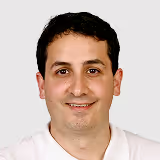
Marcel Kloos
Swiss-licensed dentist and founder of Medschool Experts
Marcel Kloos founded Medschool Experts while studying abroad; since then, over 500 study places have been secured. The Stuttgart-born dentist studied dentistry from 2015 to 2021 in Sofia and holds a Swiss dental licence.
Today he lives in Bern and runs Medschool Experts full-time as its owner.
More articles worth reading
Health Insurance for International Medical Students in Europe 2026
Scholarships and Funding for Medical Studies in Europe 2026
Medicine, Dentistry, Pharmacy or Veterinary Medicine? Choosing Your Degree Abroad in 2026
Ahmad
Sabrina
Rami
Noah
500+ students placed.
Now it's your turn!
No daydreaming, no empty promises. Just a clear plan — for the start of your medical degree.
40 minutes, no obligation