Medical School Places by German Federal State 2026 – Who Trains How Many
17.09.2026

How many medical study places are there in Germany in 2026?
For the 2024/25 winter semester, according to the statistics from hochschulstart.de, 10,219 study places in human medicine were offered at public institutions, with 32,966 applicants. On top of that, according to the analysis by the Centre for Higher Education Development, come just under 1,500 first-year places a year at private institutions, which allocate their places themselves.
Per 100,000 inhabitants that works out at around 12.2 state medical study places. In total, according to CHE figures, around 113,000 people were studying medicine in Germany in the 2023/24 winter semester, making medicine the field with the seventh-largest student body. Two-thirds of first-year students are now women.
Which federal state trains the most medical students per head of population?
Relative to population, Saarland leads according to CHE DatenCHECK 8/2025; relative to the number of first-year students, Mecklenburg-Western Pomerania leads, followed by Saxony-Anhalt. North Rhine-Westphalia offers the most medical study places in absolute terms, but no above-average number per head. Bremen and Brandenburg provided no state places in the 2024 academic year.
The Centre for Higher Education Development publishes exact place numbers per state only in interactive graphics. We have therefore compiled a second, independently verifiable indicator ourselves: the number of state medical faculties per federal state, measured against population. The basis is the membership list of the German Medical Faculty Association with 40 German faculties, 39 of which are state-run, and the population figures of the Federal and State Statistical Offices as of 31 December 2025.
| Federal state | State medical faculties | Inhabitants (31 Dec 2025) | Inhabitants per faculty |
|---|---|---|---|
| Mecklenburg-Western Pomerania | 2 (Rostock, Greifswald) | 1,573,685 | around 0.79 m |
| Saarland | 1 (Homburg) | 1,007,342 | around 1.01 m |
| Saxony-Anhalt | 2 (Halle, Magdeburg) | 2,120,252 | around 1.06 m |
| Schleswig-Holstein | 2 (Kiel, Lübeck) | 2,958,519 | around 1.48 m |
| Hamburg | 1 (Hamburg) | 1,869,473 | around 1.87 m |
| Saxony | 2 (Dresden, Leipzig) | 4,026,599 | around 2.01 m |
| Thuringia | 1 (Jena) | 2,078,946 | around 2.08 m |
| Hesse | 3 (Frankfurt, Giessen, Marburg) | 6,278,594 | around 2.09 m |
| Bavaria | 6 (Munich LMU, Munich TU, Erlangen, Würzburg, Regensburg, Augsburg) | 13,245,503 | around 2.21 m |
| Baden-Württemberg | 5 (Freiburg, Heidelberg, Mannheim, Tübingen, Ulm) | 11,238,761 | around 2.25 m |
| North Rhine-Westphalia | 8 (Aachen, Bielefeld, Bochum, Bonn, Duisburg-Essen, Düsseldorf, Cologne, Münster) | 17,986,214 | around 2.25 m |
| Brandenburg | 1 (Cottbus, from the 2026/27 winter semester) | 2,551,889 | around 2.55 m |
| Lower Saxony | 3 (Hanover MHH, Göttingen, Oldenburg) | 8,000,826 | around 2.67 m |
| Berlin | 1 (Charité) | 3,700,577 | around 3.70 m |
| Rhineland-Palatinate | 1 (Mainz) | 4,123,022 | around 4.12 m |
| Bremen | 0 | 706,915 | no faculty of its own |
| Germany, total | 39 | 83,467,117 | around 2.14 m |
Medschool Experts's own compilation and calculation, as of August 2026. Sources: the membership list of the German Medical Faculty Association (40 German faculties, of which Witten/Herdecke University is private) and the population figures of the Federal and State Statistical Offices as of 31 December 2025. The number of faculties says nothing about their size. It shows how densely a state is equipped with locations.
This calculation of our own confirms the CHE picture and adds to it at one point. Mecklenburg-Western Pomerania, Saarland and Saxony-Anhalt are well out in front. Rhineland-Palatinate concentrates all its human medicine at a single location in Mainz and therefore records the highest figure among the states with a faculty of their own. Bremen relies on proximity to Oldenburg and Hamburg, and Brandenburg begins with Cottbus in the 2026/27 winter semester.
I built this table for a very practical reason. In consultations I often hear that someone absolutely wants to stay in their own federal state. A look at the distribution then quickly makes clear that proximity and probability are two different things. Anyone living in Bremen has no faculty on their doorstep and nonetheless the same chances as everyone else, because allocation runs nationwide.
Why do the federal states train such different numbers?
The federal states are responsible as funding bodies for study places at public institutions, and the most important reason for the differences is price. The institutions' ongoing core funding in human medicine and health sciences alone came to EUR 25,430 per student per year, according to the figures cited by the CHE. Rent, construction and other investment come on top.
A second reason is physical. Medical training needs a university hospital. Where there is none, no programme can be opened at short notice; where there is one, capacity can be increased more easily. That is why provision follows the historically grown higher-education landscape rather than today's distribution of population.
The CHE points to a third factor that is of particular interest to the states. In spatial planning regions with a medical degree programme, the density of doctors in statutory outpatient care tends to be higher, according to data from the National Association of Statutory Health Insurance Physicians. This sticking effect is a strong argument for creating study places where there are none so far.
What does a medical study place really cost?
Figures circulate on this question that appear to contradict each other. The CHE gives EUR 25,430 per student per year. The German Medical Faculty Association puts a study place in human medicine at around EUR 240,000, based on 2019 calculations. Both figures come from reputable sources and appear to differ by a factor of ten.
Medschool Experts's own calculation: the contradiction resolves through the reference basis and the period. The EUR 240,000 is the cost of a complete degree. Spread over the standard six-year period, that is around EUR 40,000 per study place per year. The CHE's EUR 25,430, by contrast, covers only the institutions' ongoing core funding, and therefore neither construction investment nor the university hospitals' share of teaching. The difference of around EUR 15,000 a year sits precisely in those items. Anyone comparing figures on the cost of study places should therefore check whether annual costs or total costs are meant.
Why the competition for these places is so unforgiving
Human medicine, dentistry, veterinary medicine and pharmacy belong to the most heavily oversubscribed subjects in the country. With roughly three applications for every place, thousands of thoroughly capable people are turned away each year, not because they are unsuited to the profession, but because the arithmetic leaves no room. That is the number behind almost every conversation we have.
What decides the outcome, meanwhile, is anything but uniform. Criteria are weighted differently from university to university and are adjusted from year to year, which is precisely why we publish no checklists and no criteria tables here: any list of that kind would be out of date for at least one university by the time you read it.
The far more useful route is the individual one. Send us your school certificate, any proof of studies you already have and the countries you would consider, and we will look at your profile personally. We then tell you at which university in which country we can place you, and where we can get you in on a timetable you can actually plan around. Our network of official partner universities covers medicine, dentistry, pharmacy, nursing and veterinary medicine, and it is the broadest selection we know of. A free consultation is where that check begins.
Why does the applicant surplus persist even after expansion?
Capacity expansion in Germany works, but slowly. From 9,068 places in the 2015/16 winter semester to 10,219 in the 2024/25 winter semester, around 1,000 places have been added in nine years. As long as demand stands at around 33,000 applications, that barely changes the ratio of about three applications per place.
Medschool Experts's own calculation: 32,966 applications for 10,219 places is 3.23 applications per place. If a further 1,000 places were added, the figure would fall to 2.94. The surplus would remain five-figure. Measured against the target of 5,000 additional places named by the then federal health minister Karl Lauterbach in January 2023, the growth so far has remained small.
Added to that is the time factor. A new study location needs planning, construction, appointments and a hospital as a partner. After that, six years pass until the medical licence and a further five to six years until specialist certification. The Medical University of Lusatia in Cottbus illustrates this: the political decision lies years back, teaching starts in the 2026/27 winter semester, and the first specialists from that cohort will be working in the 2040s.
The Medical Studies Master Plan 2020, agreed by the federal and state governments in 2017, also shows the system's inertia. According to the German Medical Faculty Association, full implementation was delayed because the federal and state governments could not agree on responsibility for financing. Many of the planned changes have still not been implemented uniformly at all universities.
I discuss these figures almost daily, and I always add the same sentence: a statistic describes a population, never an individual. The 3.23 applications per place help nobody with the question of what to do in September. What helps is a concrete list of options with realistic costs and a timetable that holds. That is exactly what we work on in every initial consultation.
For a young person taking their school-leaving exams in 2026, what matters is therefore not how many places there will be in 2035. What matters is which route can be planned now. For many, a medical degree elsewhere in Europe is the faster and more calculable option: it is accessible independently of the school-leaving grade, it starts on a fixed date, and the degree is recognised in Germany under Directive 2005/36/EC.
The CHE published its own analysis of this in June 2026. At least 8,821 German students of human medicine were enrolled abroad in the 2023/24 winter semester, while German institutions counted 103,176 German students of human medicine. A good one in eleven German medical students therefore studies abroad. The largest groups were in Austria with 2,563, Hungary with 1,930, Bulgaria with 1,131 and Switzerland with 802 students.
At Medschool Experts we support prospective students at exactly this point: finding the right location, settling in, and later having the degree recognised in Germany, Austria or Switzerland. Anyone who wants to know which route fits their own certificate, timetable and budget can arrange a free consultation with us.
What do private institutions, the rural doctor quota and new locations contribute?
Private institutions in Germany together admit just under 1,500 first-year students in human medicine a year. That relieves the state budgets and shifts financing to the students or their scholarship providers. These places do not appear in the hochschulstart statistics, because the institutions allocate them themselves.
A second instrument is the rural doctor quota, under which several states reserve part of their places for people who commit to working later as a GP in an underserved region. The CHE assesses this model critically, because it effectively creates a long-term tie to one place and one field of work, decided years before anyone can know whether it fits.
Third, new locations and funding models are emerging. Alongside Bielefeld and Cottbus, a municipally funded medical degree programme is under discussion in Osnabrück. Each of these foundations improves local provision and at the same time shows how demanding the road is from an idea to the first cohort.
How much do other European countries train per head of population?
Austria provides 1,950 study places in human medicine and dentistry, which with 9,215,956 inhabitants corresponds to around 21.2 places per 100,000 inhabitants. Switzerland gives 2,200 bachelor's places in human medicine for 2026/27, which with 9,124,288 inhabitants is around 24.1 per 100,000. Germany, with around 12.2 places per 100,000 inhabitants, sits below that.
Both countries are highly competitive in their own right: in Austria, 16,880 people put themselves forward for the 2026 intake, and in Switzerland 6,179 candidates faced 2,200 places. The swissuniversities baseline report of 30 June 2026 shows that the number of master's degrees in human medicine rose from 882 in 2016 to 1,381 in 2024, thereby exceeding the target of 1,300 graduates. The universities nevertheless recommend a further increase.
For the remaining countries, the number of medical graduates per 100,000 inhabitants is the most robust comparable yardstick. Eurostat reports it for medical doctors under ISCO 221. The spread is wide.
| Country | Human medicine places per year | Places per 100,000 inh. | Graduates per 100,000 inh. (Eurostat) |
|---|---|---|---|
| Germany | 10,219 (WS 2024/25, hochschulstart.de) | 12.2 | around 12 (2019/2020) |
| Austria | 1,950 human medicine and dentistry (2026) | 21.2 | 14.4 (2020) |
| Switzerland | 2,200 bachelor's human medicine (2026/27) | 24.1 | – |
| Netherlands | 2,724 bachelor's Geneeskunde (2026/27) | 15.2 | 14.3 (2020) |
| Poland | 10,705 (2026/27, health ministry) | 29.0 | 10.6 (2018) |
| Hungary | – | – | 15.7 (2020) |
| Bulgaria | – | – | 20.4 (2020) |
| Romania | – | – | 26.3 (2020) |
The values for the Netherlands and Poland in the third column are Medschool Experts's own calculations based on 17.9 million and 37 million inhabitants respectively. A dash means that no centrally published annual capacity was available in comparable form; the graduate rate then reliably reflects training output. The Eurostat series ends in 2018 or 2020 depending on the country, and the values should be read as orders of magnitude.
Two findings stand out. Poland trains more than twice as many first-year students per head of population as Germany. And Romania and Bulgaria produce around twice as many medical graduates per head.
Why do Central and Eastern Europe train so many doctors?
A large part of this training output is explained by the English- and German-language medical programmes in Hungary, Bulgaria, Romania and Poland. These programmes have existed for decades, are expressly aimed at international students, are aligned in structure, examination regulations and scope with Directive 2005/36/EC, and are financed through tuition fees. For the host countries they are a source of revenue; for students they are a plannable route into the medical profession.
The German figures show how heavily they are used. According to the CHE analysis of June 2026, 1,930 German human medicine students were enrolled in Hungary and 1,131 in Bulgaria in the 2023/24 winter semester, and 2,563 in Austria. The share of international students in foreign-language cohorts is very high at many Central and Eastern European faculties, but differs markedly from university to university.
One observation by the CHE is notable: the costs of these study places are borne either by the students themselves or by the host state. For Germany that means a relevant share of its future doctors is trained outside the German state budgets and then returns with an EU-wide recognised degree.
What prospective students can take from the figures
Three sober conclusions follow from the data:
- The number of places is growing, but slowly. Anyone wanting to start in 2026 or 2027 plans with today's provision, not with that of 2035.
- Where you live can influence your chances in the national procedure, even if you would happily study somewhere else entirely.
- The European study route is an independent option established for decades, with clearly regulated recognition. Almost 9,000 German medical students take it.
Which route through the European education area fits your own situation can be clarified in half an hour. A free consultation with Medschool Experts costs nothing but time, and at the end of it you know which of our partner universities can take you.
Note: this article reflects the position as of 14 August 2026 and serves general information purposes. It does not replace legal advice; the applicable state higher-education acts and the states' allocation ordinances are authoritative.
The author's view
I read these figures every year with a certain calm, because they explain my own story without dramatising it. When I decided to study in Sofia in 2015, the arithmetic was the same as today: around three applications per place, a five-figure surplus, an expansion that is happening but thinks in decades. Anyone who chooses a European route in that situation is not making an emergency decision. They are making a planning decision.
What convinces me most in the CHE analysis is the note about the sticking effect. Doctors frequently stay where they were trained. That argues for new locations such as Cottbus or Bielefeld, and it argues at the same time against narrowing the view to Germany. I studied in Bulgaria and am today a Swiss-licensed dentist; I run Medschool Experts from Bern. My degree was accepted under the European recognition directive without any substantive re-examination.
With this table I want to name one limitation openly. The number of faculties says nothing about their size. A large faculty with 300 places counts the same in my compilation as a small one with 60. I calculated it anyway, because the CHE publishes exact place numbers per state only in graphics and because the density of locations has its own practical significance for applicants. Anyone weighting the figures differently will arrive at a different order. That comes with the territory.
I think it is right that the states are arguing about more capacity, and equally right that nobody has to wait for it. Around EUR 40,000 per study place per year is not an amount a federal state can scale up at will. That is not negligence but budgetary reality. For the individual the consequence stays the same: anyone who wants to become a doctor should not orient themselves solely by a figure they cannot influence.
With Medschool Experts we began early to show, in almost daily videos and interviews with students abroad, what this route really looks like: lectures, examinations, housing, daily life, the return. That was unusual at the time and remains the most honest evidence that the route holds. My advice is therefore: treat the federal-state statistics as a map, not as a verdict. They show where places are being created. Your own decision can be made independently of them.
Conclusion
The figures in this article describe a system, not your chances. What no table can tell you is where you personally can start studying medicine, dentistry, pharmacy, nursing or veterinary medicine next, and that is the only question that really decides anything.
We do not publish requirement lists or checklists, because they differ from university to university and change from year to year. Instead we look at your profile: send us your school certificate, any proof of studies you already have, and the countries you could imagine. We then tell you at which university in which country we can place you, and where we can get you in on a plannable timetable, through the largest network of official partner universities we know of.
If you are already studying and want to change, we check the highest possible entry point for you; a start in one of the final two years of the programme is not unusual.
A free consultation is the simplest first step, and it costs nothing but half an hour of your time.
Further reading
- Medical University of Lusatia in Cottbus launches in 2026 – how Brandenburg is building its first state location.
- The new building for university medicine in Oldenburg – from 40 to 200 study places, and what it costs.
- One in eleven German medical students is enrolled abroad – the CHE analysis with all the country figures.
- Studying medicine without an NC: the location comparison – which European locations are accessible without a school-leaving grade threshold.
Frequently Asked Questions about Medical Study Places in the Federal States
How many medical study places are there in Germany?
For the 2024/25 winter semester, according to the statistics from hochschulstart.de, 10,219 study places in human medicine were offered at public institutions. On top of that, according to the Centre for Higher Education Development, come just under 1,500 first-year places a year at private institutions.
How many applications are there per medical study place?
In the 2024/25 winter semester, 10,219 places faced 32,966 applicants, which by Medschool Experts's own calculation is 3.23 applications per place. That corresponds to a surplus of more than 20,000 applicants per allocation round.
Which federal state offers the most medical study places?
In absolute terms, North Rhine-Westphalia. Relative to population, Saarland leads according to CHE DatenCHECK 8/2025 of 20 August 2025; relative to the number of first-year students, Mecklenburg-Western Pomerania does.
How many medical faculties does Germany have?
The German Medical Faculty Association lists 40 German medical faculties as voting members, of which Witten/Herdecke University is private. That leaves 39 state faculties, which by Medschool Experts's own calculation is one per 2.14 million inhabitants.
Which federal state has the most faculties per head of population?
Mecklenburg-Western Pomerania, with two faculties in Rostock and Greifswald for 1,573,685 inhabitants, that is one per around 0.79 million. Saarland follows with one per 1.01 million and Saxony-Anhalt with one per 1.06 million inhabitants, as of 31 December 2025.
Which federal states offer no state medical study places?
In the 2024 academic year those were Bremen and Brandenburg. In Brandenburg, training begins at the Medical University of Lusatia in Cottbus in the 2026/27 winter semester. Bremen still has no medical faculty of its own and lies close to the Oldenburg and Hamburg locations.
What does a medical study place cost?
The institutions' ongoing core funding in human medicine and health sciences came to EUR 25,430 per student per year, according to the figures cited by the CHE. The German Medical Faculty Association puts a complete study place at around EUR 240,000, which over six years is about EUR 40,000 a year.
Why do the cost figures for a medical study place contradict each other?
They measure different things. The German Medical Faculty Association's EUR 240,000 is the total cost of six years of study. The CHE's EUR 25,430 covers only ongoing core funding, without construction investment and without the university hospitals' share of teaching. Converted to a single year, the two figures are around EUR 15,000 apart.
What do I need to bring to get a place at one of your partner universities?
That differs from university to university and from year to year, which is why we do not publish it as a list. Send us your school certificate, any proof of studies you already have and the countries you would consider, and we will tell you personally where we can place you.
Can you tell me which university would take me?
Yes, that is exactly what the free consultation is for. We look at your individual profile and name the university and the country where we can get you a place on a plannable timetable, in medicine, dentistry, pharmacy, nursing or veterinary medicine.
How much has the number of study places grown since 2015?
In the 2015/16 winter semester, 9,068 medical study places were allocated through hochschulstart.de; in the 2024/25 winter semester it was 10,219. The target of 5,000 additional places named in January 2023 was therefore not reached.
How many study places do Austria and Switzerland offer per head of population?
Austria provides 1,950 places in human medicine and dentistry, which with 9.22 million inhabitants is around 21.2 per 100,000. Switzerland gives 2,200 bachelor's places in human medicine for 2026/27, which with 9.12 million inhabitants is around 24.1 per 100,000.
Which countries train particularly many doctors per head of population?
According to Eurostat data, Romania most recently recorded 26.3 and Bulgaria 20.4 medical graduates per 100,000 inhabitants, Hungary 15.7 and the Netherlands 14.3. Germany stood at around 12 graduates per 100,000 inhabitants.
How many Germans study medicine abroad?
According to the CHE analysis of June 2026, at least 8,821 German human medicine students were enrolled abroad in the 2023/24 winter semester, a good one in eleven German medical students. The largest groups were in Austria, Hungary, Bulgaria and Switzerland.
Is a medical degree from elsewhere in the EU recognised in Germany?
Medical degrees from EU member states are eligible for recognition under Directive 2005/36/EC in a regulated procedure. The licensing authorities of the federal states are responsible. We check the details individually in a free consultation.
What students say about Medschool Experts
Over 500 placements at more than 25 partner universities across 10+ countries. Read independent student reviews on Trustpilot.
About the author
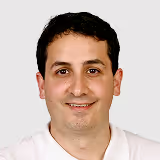
Marcel Kloos
Swiss-licensed dentist and founder of Medschool Experts
Marcel Kloos founded Medschool Experts while studying abroad; since then, over 500 study places have been secured. The Stuttgart-born dentist studied dentistry from 2015 to 2021 in Sofia and holds a Swiss dental licence.
Today he lives in Bern and runs Medschool Experts full-time as its owner.
More articles worth reading
Health Insurance for International Medical Students in Europe 2026
Scholarships and Funding for Medical Studies in Europe 2026
Medicine, Dentistry, Pharmacy or Veterinary Medicine? Choosing Your Degree Abroad in 2026

Ahmad
Sabrina

Rami

Noah
500+ students placed.
Now it's your turn!
No daydreaming, no empty promises. Just a clear plan — for the start of your medical degree.
40 minutes, no obligation