Studying Medicine and Dentistry in the Baltics: Riga, Kaunas, Vilnius and Tartu
17.09.2026

Four cities, one shared legal framework
Latvia, Lithuania and Estonia have been members of the European Union since 2004. For aspiring doctors and dentists, that means one thing above all: the minimum training requirements are the same across Europe. Directive 2005/36/EC on the recognition of professional qualifications requires, in Article 24, for basic medical training “a total of at least five years of study” and “at least 5,500 hours of theoretical and practical training provided by, or under the supervision of, a university”. For basic dental training, Article 34 requires “at least five years of study” and “at least 5,000 hours of full-time theoretical and practical training”. Annex V of the Directive lists the evidence of formal qualifications from the member states covered by this system.
All four universities profiled here go beyond these minimum values, with six years for human medicine and five years for dentistry. Riga, Kaunas and Tartu each list 360 ECTS for human medicine and 300 ECTS for dentistry – exactly the scope German faculties also set for a complete medical degree.
Riga: the largest address in the region
Riga Stradiņš University
Riga Stradiņš University (RSU) is the largest medical education hub in the Baltics. According to the university, it has 12,474 students, of whom 3,146 are international students from 87 countries of origin, and it offers 63 degree programmes, eight of which are taught in English. Around 700 further people are in specialist medical training.
The Medicine programme lasts six years, comprises 360 ECTS and leads to the title Medical Doctor (MD). According to the programme page, accreditation runs until 28 May 2030. Dentistry lasts five years with 300 ECTS and leads to the Doctor of Dental Surgery (DDS). Particularly relevant for German-speaking students: RSU states that more than 550 German students are enrolled, and offers the option of completing part of the clinical training in years four to six at the university's clinical branch campus in Stade, Germany, for at least one semester.
Tuition fees for the 2026/2027 academic year are, according to the official fee schedule, EUR 13,500 per year for human medicine and EUR 15,500 per year for dentistry, payable per semester – that is, EUR 6,750 and EUR 7,750 per semester respectively. A one-off registration fee of EUR 1,800 is added.
University of Latvia
The University of Latvia (Latvijas Universitāte) offers both Medicine and Dentistry at its Faculty of Medicine and Life Sciences in a Latvian-language and an English-language track. This makes Riga the only city in the region with two state universities offering English-language medicine and dentistry education in parallel.
Kaunas: the specialised health sciences university
The Lithuanian University of Health Sciences (LSMU) is the only dedicated health sciences university in the Baltics, bringing together human medicine, dentistry, veterinary medicine and pharmacy under one roof. The university states that it offers 20 English-language programmes, with 28 percent of students being international.
Human medicine lasts six years with 360 ECTS and leads to an MSc in Health Sciences with the professional qualification Medical Doctor. According to the university, fees are EUR 12,800 per year in study years one to three and EUR 13,300 per year in years four to six. Odontology covers five years and 300 ECTS and costs EUR 13,600 per year in years one to three and EUR 14,100 per year in years four and five, leading to an MSc in Health Sciences with the qualification Doctor Odontologist.
Clinical training takes place at what the university describes as the largest hospital in the Baltics, as well as at 32 accredited multi-profile hospitals across Lithuania; clinical courses run in groups of up to ten students. The Medicine programme holds international WFME accreditation.
Vilnius: the oldest university in the Baltics
Vilnius University, founded in 1579, also offers medicine and dentistry in English. The Medicine programme lasts six years and leads to the Doctor of Medicine (MD); the fee for non-state-funded places is EUR 14,100 per year. Dentistry is listed at EUR 15,000 per year.
Vilnius takes the most rigorous approach to the local language: according to the university, all students in medicine and dentistry take six consecutive semesters of Lithuanian and must demonstrate at least B2 level by the end, with language proficiency a prerequisite for the clinical courses and the final year. Anyone who reads this as merely extra effort underestimates the effect: speaking to patients in their own language means gathering far more independent examination experience than someone who relies on translation.
Tartu: small, research-focused, selective
The University of Tartu describes itself as the leading university in the Baltics, with around 15,200 students and 3,700 staff. The English-language Medicine programme lasts six years, comprises 360 ECTS and leads to a Degree in Medicine (MD). The fee is EUR 13,200 per year. The size of the year group stands out: the programme page lists 24 places, making Tartu the smallest and most selective of the four locations.
Here too, the local language is part of the curriculum. The university puts it this way: “To be able to communicate with local patients, knowledge of the Estonian language is required as well. Several Estonian courses are a compulsory part of the curriculum.” Clinical training takes place at Tartu University Hospital, the largest healthcare provider in Estonia.
Fees and cost of living at a glance
The table below summarises the figures published by the universities themselves. All fees refer to English-language programmes.
| Location | Human medicine | Dentistry | Fee, human medicine | Fee, dentistry |
|---|---|---|---|---|
| Riga, RSU | 6 years, 360 ECTS, MD | 5 years, 300 ECTS, DDS | EUR 13,500/year (2026/27) | EUR 15,500/year (2026/27) |
| Riga, University of Latvia | English-language track | English-language track | as stated by the university | as stated by the university |
| Kaunas, LSMU | 6 years, 360 ECTS, MD | 5 years, 300 ECTS | EUR 12,800 (yrs 1–3), EUR 13,300 (yrs 4–6) | EUR 13,600 (yrs 1–3), EUR 14,100 (yrs 4–5) |
| Vilnius, VU | 6 years, MD | integrated programme | EUR 14,100/year | EUR 15,000/year |
| Tartu, UT | 6 years, 360 ECTS, MD, 24 places | – | EUR 13,200/year | – |
When it comes to living costs, the Baltics sit noticeably below Western European levels. The official national study portals and the universities themselves cite the following ranges:
- Riga and Latvia in general: Study in Latvia puts average monthly living costs at EUR 450 to 700, depending on housing and lifestyle.
- Kaunas: LSMU publishes its dormitory prices; depending on the building, they range from EUR 81 to 117, EUR 101 to 144, and EUR 150 to 250 per person per month.
- Tartu and Estonia in general: Study in Estonia cites total monthly costs of around EUR 300 to 500, dormitory places between EUR 150 and 350, and private flats between EUR 350 and 750. A monthly public transport pass in Tartu costs EUR 7.67 with a student card.
- Vilnius: the capital is Lithuania's most expensive housing market. There is no official, consolidated monthly figure from the university, so deliberately no number is given here.
Clinical training: when do you start working with patients?
The practical component is the real point of difference between the locations. RSU states that students start working with patients from the third year, that years four and five are predominantly clinical, and that the sixth year consists of three rotation cycles – internal medicine, invasive medicine and a freely chosen elective. This is complemented by the Medical Education Technology Centre, which the university describes as the only simulation centre in Latvia and the largest in the Baltics.
In Kaunas, clinical training is spread across 32 accredited hospitals, with group sizes in clinical courses capped at ten students. Tartu concentrates training at the country's largest hospital. Vilnius ties clinical courses to proof of Lithuanian-language proficiency. Anyone looking for early, dense patient contact will find it in the Baltics in a form that is harder to organise elsewhere with very large year groups.
Recognition in Germany, Austria and Switzerland
Latvia, Lithuania and Estonia are EU member states. This means the system of automatic recognition applies to medical and dental qualifications from these countries. The EU portal Your Europe puts it this way: “as a doctor, nurse for general care, midwife, dental practitioner, pharmacist, architect and veterinary surgeon, you enjoy automatic recognition of your professional qualification.” The basis for this is Directive 2005/36/EC, with the minimum requirements from Article 24 and Article 34 already mentioned and the list of qualification evidence in Annex V.
For Germany, this means: the licence to practise (Approbation) is issued by the competent state authority, and a diploma earned in an EU state is treated as an equivalent qualification without being re-assessed on its content. Austria is also an EU member, where the same system applies through the relevant professional body. Switzerland is not an EU member; recognition of an EU medical or dental diploma there runs through the country's own federal procedure.
Which authority is responsible in your specific case, and what that means in practice, is something we work out individually – the easiest way is to arrange a free consultation.
Switching back to Germany during your studies
The option of transferring to a German faculty after a few semesters in the Baltics remains open. It depends on two things: the comparability of the coursework already completed, and available capacity in the relevant subject-semester. Because all four locations are structured around ECTS and their curricula align with the minimum requirements of Directive 2005/36/EC, the substantive comparability is generally easy to document. The decision on credit transfer lies with the relevant state examination office and the receiving university, not with the foreign university.
Important for planning purposes: switching back is an option, not an automatic entitlement, and it is not an argument against studying in the Baltics either. Many students we talk to start out with the switch-back in mind and end up staying, because the training holds up. Anyone who wants to work through the credit-transfer question for their own situation is best off discussing it in person; we go through the details in a free consultation.
International comparison: the Baltics, Poland, Hungary and Bulgaria
The Baltics are not in competition with Germany, but with the other established English-language education regions in the EU. The comparison is nuanced.
In Poland, the official government portal study.gov.pl cites an average of around EUR 2,000 per year for first-, second- and long-cycle programmes, with an overall range of EUR 2,000 to 6,000. Fees for the English-language medicine programmes, however, are set separately by each university through rectoral decree and lie well above that; the Medical University of Warsaw runs a six-year medicine and a five-year dentistry programme in its English Division. The Medical University of Poznań states it has around 8,000 students and more than 1,000 international students.
In Hungary, Semmelweis University lists General Medicine at USD 10,450 per semester, over six years, twelve semesters and 360 credit points, leading to the Doctor of General Medicine degree. That is the highest fee figure in this comparison.
In Bulgaria, the Medical University of Sofia lists EUR 9,950 per year for medicine in English and EUR 10,000 per year for dentistry in English – the most affordable of the options compared here.
A second, often overlooked indicator is a country's training output relative to its population. Eurostat's dataset hlth_rs_grd2 shows an EU-wide average of 15 medical graduates per 100,000 inhabitants for 2023. At the top are Malta with 32, Bulgaria with 31, Romania with 28 and Latvia with 27; most other EU states fall between 10.5 and 25.0. Relative to their population, Latvia and Bulgaria therefore train significantly more doctors than the EU average – evidence of how robust the training structures there are.
| Country and location | Human medicine fees (English-language) | Language of instruction | Size of international programmes | Medical graduates per 100,000 inhabitants (2023) |
|---|---|---|---|---|
| Latvia, Riga (RSU) | EUR 13,500/year | English, Latvian in curriculum | 3,146 international students from 87 countries | 27 |
| Lithuania, Kaunas (LSMU) | EUR 12,800–13,300/year | English, Lithuanian in curriculum | 28 percent international students, 20 programmes in English | no individual figure in the Eurostat text release |
| Lithuania, Vilnius (VU) | EUR 14,100/year | English, Lithuanian to B2 compulsory | Medicine and dentistry in English | no individual figure in the Eurostat text release |
| Estonia, Tartu (UT) | EUR 13,200/year | English, Estonian in curriculum | 24 places per year group | no individual figure in the Eurostat text release |
| Poland | set by each university via rectoral decree; general framework per study.gov.pl EUR 2,000–6,000/year | English, Polish in curriculum | large English Divisions, e.g. Warsaw (6-yr medicine, 5-yr dentistry), Poznań over 1,000 international students | no individual figure in the Eurostat text release |
| Hungary, Budapest (Semmelweis) | USD 10,450/semester | English, Hungarian in curriculum | established English-language faculty, 360 credit points | no individual figure in the Eurostat text release |
| Bulgaria, Sofia | EUR 9,950/year | English, Bulgarian in curriculum | long-established English-language programmes | 31 |
For context, one more figure from the same Eurostat data: in 2023, Austria had 551 and Germany 466 practising doctors per 100,000 inhabitants, compared with 336 in Latvia. The Baltic states therefore train strongly while also having ongoing need – a combination that makes English-language programmes viable both academically and economically.
This article reflects research as of 14 August 2026 and does not constitute legal advice. Binding information on recognition and licensing is provided exclusively by the competent authorities.
The author's view
I studied abroad myself, in Sofia, and today I work as a dentist. Looking at the four Baltic locations, one thing stands out to me above all: in a single decade, this region has built an education infrastructure that need not shy away from comparison. 3,146 international students from 87 countries at RSU alone, 28 percent international students in Kaunas, a simulation centre the university itself describes as the largest in the Baltics – these are not the numbers of a niche solution, this is a structure that has genuinely grown.
Two details stand out to me in particular. First, RSU's clinical branch campus in Stade: anyone who wants to can complete parts of the clinical years in Germany. That is an offer that barely exists anywhere else in this form, and it takes some of the weight off the question “how do I come back later?” Second, the consistent language policy in Vilnius and Tartu. Six semesters of Lithuanian up to B2, compulsory Estonian courses – on paper, that sounds like extra work. In practice, it is the reason these students are taking independent patient histories by their fourth year. In everyday clinical work, language is not a side subject, it is the tool.
What I like about the region is the honesty of the figures. The universities publish their fees, their place numbers, their accreditation data. EUR 13,500 per year in Riga, EUR 13,200 in Tartu, EUR 12,800 to 13,300 in Kaunas – you know where you stand and can do the maths. Combined with living costs of EUR 300 to 700 a month, that adds up to a budget you can actually plan around. In studying abroad, predictability is worth more than any promise.
And there is one more thing I have taken from the many conversations we have held with students abroad over the years, which we also share in our videos: location matters less than fit. Tartu with 24 places in the year group is a different experience from Riga with 620 international places in human medicine. Both work, but not for the same person. Anyone looking for a small, research-focused cohort is well placed in Estonia. Anyone who wants a large international community, German-speaking fellow students and the option of clinical semesters in Germany will find that in Riga. This decision should not be made by ranking tables, but by your own learning style. That is exactly what we most enjoy discussing in a consultation.
Conclusion
Riga, Kaunas, Vilnius and Tartu are strong options if you want an English-language medical or dental degree at a university with a clear European legal framework and well-documented figures. Whether one of these four is the right fit for you personally depends on your background, your budget and your learning style – and that is exactly what we look at together at Medschool Experts.
As the partner with the largest network of official partner universities, we assess individually for every student the highest possible year of entry, and in many cases entry is possible even in the final two years of the programme. Get in touch and book a free consultation to find out what is realistic in your case.
Frequently asked questions
How long does a medical degree in the Baltics take?
Six years. Riga (RSU), Kaunas (LSMU) and Tartu each list 360 ECTS. Dentistry in Riga and Kaunas takes five years with 300 ECTS.
Are the programmes fully taught in English?
Yes. The programme pages of RSU, LSMU, Vilnius and Tartu list English as the language of instruction. In addition, courses in the respective local language are part of the curriculum, because they are needed for patient contact.
How much of the local language do I need to learn?
In Vilnius, it is six consecutive semesters of Lithuanian aiming for B2 level. In Tartu, several Estonian courses are a compulsory part of the curriculum. In Kaunas, Lithuanian is embedded in the syllabus during the early years of study.
What does a year of study cost?
According to the official figures: RSU Riga EUR 13,500 (human medicine) and EUR 15,500 (dentistry) for 2026/2027, LSMU Kaunas EUR 12,800 to 13,300 (human medicine) and EUR 13,600 to 14,100 (odontology), Vilnius EUR 14,100 (medicine) and EUR 15,000 (dentistry), Tartu EUR 13,200.
How high are the living costs?
Study in Latvia cites EUR 450 to 700 per month, Study in Estonia EUR 300 to 500. LSMU dormitories in Kaunas cost between EUR 81 and 250 per person per month depending on the building, and a monthly public transport pass in Tartu costs EUR 7.67 with a student card.
Is the degree recognised in Germany?
Latvia, Lithuania and Estonia are EU member states; the system of automatic recognition under Directive 2005/36/EC applies to medical and dental diplomas. The licence to practise itself is issued by the competent state authority.
And in Austria and Switzerland?
Austria is an EU member, where the same system applies. Switzerland is not an EU member and runs its own national recognition procedure. What that means in an individual case is something we clarify in a free consultation.
Can I switch back to Germany later?
A switch is possible in principle. The state examination office and the receiving university decide on the transfer of credits already earned; available capacity in the target subject-semester is a prerequisite.
How international are the universities?
RSU has 3,146 international students from 87 countries out of 12,474 students in total, and states more than 550 German students. LSMU reports a share of 28 percent international students.
When does work with patients begin?
At RSU, according to the university, from the third year of study; years four and five are predominantly clinical, and the sixth year consists of three rotation cycles. In Kaunas, clinical courses run in groups of up to ten students, spread across 32 accredited hospitals.
Can I complete clinical semesters in Germany?
RSU offers the option of completing part of the clinical training in years four to six at its clinical branch campus in Stade, for at least one semester.
How does the Baltics compare with Poland, Hungary and Bulgaria?
On fees, Sofia is the most affordable at EUR 9,950 per year, and Semmelweis University the highest at USD 10,450 per semester; the Baltics fall in between. On training output per inhabitant, Eurostat's 2023 figures put Malta (32), Bulgaria (31), Romania (28) and Latvia (27) per 100,000 inhabitants at the top, against an EU average of 15.
What students say about Medschool Experts
Over 500 placements at more than 25 partner universities across 10+ countries. Read independent student reviews on Trustpilot.
About the author
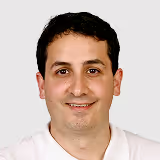
Marcel Kloos
Swiss-licensed dentist and founder of Medschool Experts
Marcel Kloos founded Medschool Experts while studying abroad; since then, over 500 study places have been secured. The Stuttgart-born dentist studied dentistry from 2015 to 2021 in Sofia and holds a Swiss dental licence.
Today he lives in Bern and runs Medschool Experts full-time as its owner.
More articles worth reading
Health Insurance for International Medical Students in Europe 2026
Scholarships and Funding for Medical Studies in Europe 2026
Medicine, Dentistry, Pharmacy or Veterinary Medicine? Choosing Your Degree Abroad in 2026
Ahmad
Sabrina
Rami
Noah
500+ students placed.
Now it's your turn!
No daydreaming, no empty promises. Just a clear plan — for the start of your medical degree.
40 minutes, no obligation