Studying Medicine and Dentistry in Italy: How the System Works and What It Costs
17.09.2026

Last reviewed: August 2026.
Two Systems in One Country
Italy runs two quite different routes into medicine side by side, and which one applies to you depends simply on the language you study in.
Italian-language programmes at state universities changed fundamentally from the 2024/25 academic year. The classic entrance test was abolished and replaced by the so-called Semestre filtro: instead of being filtered out before the degree begins, students are filtered during it. English-language programmes at the same universities kept the older arrangement, where selection happens before teaching starts, through the IMAT.
Both arrangements apply to medicine, dentistry and several other health science programmes.
What the Semestre filtro Means in Practice
The Semestre filtro is often presented as a relief: the barrier at the door has gone. The barrier itself has not gone anywhere, though — it has moved inside the building. Students begin a first semester of foundational science, and only afterwards does it become clear who continues in medicine and who does not, based on how that semester went and on a nationwide ranking. The number of places in the second semester stays capped, set by national demand for doctors.
The consequence is worth thinking through honestly. By the time the decision arrives, you have moved country, paid rent in an Italian city, and spent half a year of your life. That is a very different kind of risk from a decision that lands before you pack a suitcase.
There is a genuine consolation built into the system: the credits earned in that first semester are not lost. They transfer to related programmes such as the healthcare professions, biotechnology or pharmacy. Nobody walks away with nothing. But nobody who set out to be a doctor gets there that way either.
{{cta}}
The English-Language Route and the IMAT
Alongside it, the English-language programmes at state universities continue to select through the IMAT, the International Medical Admission Test. This is the older and more familiar shape: one selection, before the degree starts.
The competition here is easy to underestimate, because the IMAT is less talked about in German-speaking countries than the MedAT in Austria. Roughly 919 places were last available at state universities for EU applicants and for non-EU applicants resident in Italy, and the pool competing for them is drawn from across Europe and beyond. Studying in English does not make the route easier; it makes it international.
Where Medicine Is Taught in Italy
Numerous state universities offer human medicine, and many of them run an English-language programme alongside the Italian one. Among the best known are Bologna, Milan (Statale), Padua, Parma, Rome (Sapienza and Tor Vergata), Turin and Naples — faculties with centuries of history in cities people genuinely want to live in.
Alongside them, Italy has a set of private medical universities running their own separate processes. They cost considerably more and are correspondingly less crowded.
What a Medical Degree in Italy Costs
This is where Italy is genuinely remarkable. Tuition at state universities is income-based, calculated from the family's ISEE assessment, and at the lower end it starts at around 156 euros per year. At higher income levels it rises substantially, but the ceiling still sits far below what most of Europe charges international students.
Private universities are a different order of magnitude, ranging from roughly 3,200 to 23,000 euros per year depending on the institution and, again, on income. Living costs vary enormously between Milan and a smaller university city in the south, and are worth budgeting separately from tuition.
On language: an English-language programme does not remove Italian from your life. It becomes indispensable by the clinical years, when patients are in front of you. Many universities offer accompanying language courses, and students who take them seriously from the first year have a far easier clinical phase than those who postpone it.
How Do You Find the Right University — and Get In?
You will not find a checklist of documents, a test breakdown or a calendar of dates on this page, and that is deliberate. Those details differ from country to country and from university to university, they change from year to year, and a list copied off the internet is one of the most reliable ways for a good candidate to lose a place.
We work the other way round. Send us your profile — your school-leaving certificate, any study you have already completed, and the countries you could genuinely see yourself living in — and we come back with the concrete answer: which university, in which country, we can place you at, and where we can get you in on a timetable you can plan around. Behind that answer sits the largest selection of official partner universities for medicine, dentistry, pharmacy, nursing and veterinary medicine.
If you have already started a degree somewhere, we look for the highest possible point of entry; students frequently come in during the final two years of a programme rather than repeating what they have already passed.
Book a free consultation and we will tell you honestly where you fit — before you commit a year to finding out the hard way.
The author's view
The Semestre filtro is often sold as a relief — no test up front, everyone can start. In advising sessions I see the other side of it. The selection has not disappeared; it has simply moved to a point where failing costs far more. Half a year, a move to another country, a signed rental contract, and only then the answer. That is emotionally and financially riskier than a decision that arrives before you pack, even though it feels more relaxed at the outset.
With the English-language route, the competition is what gets underestimated, because the IMAT is less talked about here than the MedAT in Austria. A few hundred places spread across several cities sounds generous until you remember that applicants come from across Europe and well beyond. Studying in English does not soften the competition; it globalises it.
None of which is an argument against Italy. It is an argument for going in with a clear head, and for knowing what your alternatives actually are before you choose. That second part is the bit we can simply tell you, in one conversation, instead of leaving you to work it out from forums at two in the morning.
Conclusion
Italy is a beautiful place to study medicine, and for some students it is exactly right. For others, the shape of the route matters more than the postcard — and that is a judgement nobody can make from a website.
So let us make it with you. Tell us your results, any study you have already completed and the countries you are open to, and we will come back with which of our official partner universities can take you, in which country, and on what timetable — across medicine, dentistry, pharmacy, nursing and veterinary medicine. If you are already enrolled somewhere, we check the highest point of entry we can secure for you rather than sending you back to the beginning.
Book a free consultation. One conversation, no obligation, and a realistic picture of what is genuinely open to you.
Further Reading
- Studying Medicine in Germany: the system in direct comparison.
- Studying Medicine in Austria: how the Austrian route differs.
- Studying Medicine in France: PASS and L.AS compared with the Italian model.
- University Lexicon: detailed profiles of individual faculties and their key data.
- Studying Medicine in Hungary: the plannable NC-free neighbouring location.
Frequently Asked Questions About Studying Medicine in Italy
How is medicine in Italy structured?
Two routes run side by side. Italian-language programmes at state universities use the Semestre filtro, where selection happens during the first semester rather than before it. English-language programmes at the same universities select beforehand, through the IMAT. Both cover medicine, dentistry and several other health science degrees.
What is the catch with the Semestre filtro?
Not that it is unfair, but that the decision comes late. You have already moved country and spent half a year before it is settled whether you continue in medicine. The credits earned are transferable to related programmes such as the healthcare professions, biotechnology or pharmacy, so nothing is wasted — but it is not the same as a place you can plan around.
What does a medical degree at a state university in Italy cost?
Tuition is income-based and starts at around 156 euros per year at the lower end, rising substantially at higher income levels. Even so, Italian state tuition sits at the cheap end of Europe.
What does a medical degree at a private university in Italy cost?
Between roughly 3,200 and 23,000 euros per year, depending on the institution and on income.
Do I need Italian for the English-language programme?
Not to begin with, but yes in the end. Italian becomes indispensable by the clinical years and for contact with patients. Many universities offer accompanying language courses, and the students who take them seriously early have a far smoother clinical phase.
Does Medschool Experts place students at Italian universities?
No. What we do is place students at official partner universities elsewhere in Europe, on a route that is plannable and NC-free, for medicine, dentistry, pharmacy, nursing and veterinary medicine.
What do I need in order to get a place at one of your partner universities?
It depends on the university, the country and the year, which is why we do not publish a criteria list. Send us your profile and we will tell you which of our partner universities can take a candidate like you, in which country, and where we can get you in on a plannable timetable.
I have already started studying somewhere. Do I have to begin again?
Usually not. Where you have credits behind you we look for the highest possible point of entry, and students frequently join in the final two years of a programme rather than repeating work they have already passed. Send us your transcript and we will check what is realistic.
What students say about Medschool Experts
Over 500 placements at more than 25 partner universities across 10+ countries. Read independent student reviews on Trustpilot.
About the author
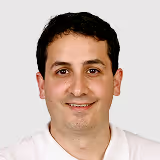
Marcel Kloos
Swiss-licensed dentist and founder of Medschool Experts
Marcel Kloos founded Medschool Experts while studying abroad; since then, over 500 study places have been secured. The Stuttgart-born dentist studied dentistry from 2015 to 2021 in Sofia and holds a Swiss dental licence.
Today he lives in Bern and runs Medschool Experts full-time as its owner.
More articles worth reading
Health Insurance for International Medical Students in Europe 2026
Scholarships and Funding for Medical Studies in Europe 2026
Medicine, Dentistry, Pharmacy or Veterinary Medicine? Choosing Your Degree Abroad in 2026
Ahmad
Sabrina
Rami
Noah
500+ students placed.
Now it's your turn!
No daydreaming, no empty promises. Just a clear plan — for the start of your medical degree.
40 minutes, no obligation