Examination Law in the Medicine Programme at RWTH Aachen: Resits, Absences, Basisprüfung
17.09.2026

The nationwide rules first: what the ÄAppO sets out for everyone
Before getting into the specifics for Aachen, here's the framework that applies at every German faculty. The Licensing Regulations for Physicians (Approbationsordnung für Ärzte, ÄAppO) govern the state examinations:
- Three attempts per section: the First Section (M1/Physikum), Second Section (M2) and Third Section (M3) can each be resat twice.
- Nationwide effect: if a section is finally failed, it's failed across all of Germany – transferring universities doesn't help.
- No fresh attempt after restarting: starting the medicine programme again doesn't unlock another attempt either.
- No retaking for a better grade: a passed exam or exam component may not be resat.
- Automatic summons: for a resit, the state examination office summons you to the next available date automatically.
Everything that comes before the state examinations – course certificates, course exams, credits, attendance – is regulated by each faculty individually. That's exactly why it's worth checking your own university's regulations.
What's different in Aachen: no Physikum, but the Ärztliche Basisprüfung
Aachen makes use of the model-programme clause in § 41 ÄAppO. Instead of the First Section of the state medical examination, the end of the sixth semester brings the Ärztliche Basisprüfung (ÄBP). It's recognised as equivalent to M1 and is a prerequisite for admission to the Third Section of study.
Structure of the Basisprüfung
- OSPE (Objective Structured Practical Examination): oral-practical, spread over two days, ten stations with 8 minutes each. Weighting: 60% of the overall grade.
- Multiple-choice exam: written, covering the content of the system blocks and cross-sectional modules. Weighting: 40%.
- The ÄBP is offered twice a year, during the lecture-free period.
Pass threshold
Both parts must be passed with at least 60% of the achievable points. Alternatively, the sliding scale clause applies: you also pass if your result falls no more than 22% below the average performance of first-time candidates who sat the exam within the minimum study period – though you must in every case reach at least 50%.
How many times can you resit the Basisprüfung?
The clear answer from § 32 of Aachen's regulations:
- The OSPE and the multiple-choice exam can each be resat twice – so three attempts per part.
- If only one part is failed, only that part needs to be resat. That's a real advantage over the standard programme.
- A resit is possible at the earliest after one semester, at the next scheduled exam date; the summons is issued automatically.
- After two unsuccessful resit attempts, you're considered to have finally failed across the whole of Germany. Admission to M1 under the ÄAppO, or to an equivalent exam at another model programme, is then no longer possible – not even after restarting the medicine programme.
Anyone who has already had three unsuccessful attempts at M1, or an equivalent model-programme exam, at another faculty won't be admitted to the ÄBP in Aachen at all (§ 26(2)).
If you're not sure how many attempts you have left in your specific case, let's look at it together – book your free consultation here.
Course exams and certificates: the little-known double limit
The situation is considerably more complex for the course exams that run alongside each semester. Aachen applies a double limit here (§ 19(7a)):
- A maximum of two course enrolments per mandatory module.
- A maximum of three exam attempts per course enrolment.
In theory that adds up to six attempts – but tied to only two course cycles. And because mandatory modules run on an annual cycle, every second enrolment costs you a full academic year.
First stage of study (1st and 2nd semester)
- First resit: at the latest by the start of lectures the following semester.
- Second resit: as a general resit shortly before the start of the second academic year.
- Anyone who fails, or doesn't sit, the general resit must repeat the mandatory module in full – only a year later.
Second and Third stage of study
- First and second resits at the latest by the start of lectures the following semester.
- After that, the module must likewise be repeated in full, again on an annual cycle.
- Exception for block placements in the Third stage: with regular attendance, only the exam needs to be resat, not the placement itself. Here, up to six exam attempts per subject are possible, and re-doing the placement block is excluded.
When does a course exam count as finally failed?
§ 19(10) puts it briefly: "A course exam is finally failed once the achievements required to pass can no longer be resat." In practice: when the second course enrolment ends with a third failed attempt.
{{cta}}
Mandatory attendance: the actual numbers
Attendance is mandatory for placements, practical exercises, patient demonstrations, seminars, PBL seminars, cross-sectional modules, and system blocks and clinical block placements. The limits (§ 19(4)):
| Module | Permitted absence |
|---|---|
| 10 or more sessions | maximum 10% of sessions |
| 4 to 10 sessions | maximum 1 session |
| Final clinical year (PJ) | 30 absence days total, max. 20 per trimester |
Exceeding these limits can be accepted in justified exceptional cases where making up the missed work is technically feasible – the examination board makes that decision.
Reporting sick: the 5-working-day rule
To postpone a course exam due to illness, you must call or email the model programme office before the exam begins and submit a doctor's certificate within five working days. Anyone who withdraws correctly must then sit the next available exam date.
For the Basisprüfung: withdrawing without giving a reason is only possible for a first-time application, and only up to four weeks before the exam date at the latest. After that, only a recognised valid reason counts – for illness, a specialist's certificate is required.
What else to keep in mind in Aachen
The Progress Test is mandatory
The Progress Test Medicine doesn't appear on any transcript – but attending it is mandatory and a prerequisite for admission to the next stage of study: two tests in the First stage, four in the Second, and three in the Third.
The voluntary-participation declaration and transferring elsewhere
One point that's easy to overlook during enrolment: every student signs a declaration of voluntary participation in the model programme. It states explicitly that transferring to another university cannot be guaranteed without losing credit and study time, because the programme's structure differs from the standard course.
That's not a minor detail. Anyone in Aachen who runs into difficulty and considers transferring faces a structurally harder path than someone on a standard programme. The faculty provides equivalence lists for this (Annex 12 of the regulations) – but the final decision on credit rests with the state examination office under § 12 ÄAppO.
Further key facts
- Studies begin exclusively in the winter semester.
- Nursing placement: 90 days total, 60 of which must be completed before the Second stage, the rest before the Basisprüfung.
- Clinical elective (Famulatur): 4 months, at the earliest after four theoretical-clinical system blocks.
- Elective credits: 14 credits before the Basisprüfung, 30 credits in total by the end of the Third stage.
- Full concurrent enrolment in two degree programmes within the same two semesters is not permitted.
If things come to a dead end in Aachen
The most important legal point first: finally failing the Ärztliche Basisprüfung closes off the medicine programme across the whole of Germany. The dean's office for studies is obliged to notify the state examination office.
What remains after that is the route via an EU country. A complete medicine degree at an EU university leads, via Directive 2005/36/EC, to automatic recognition and therefore to a German medical licence – without a knowledge exam. The key condition is that the degree must be completed entirely from scratch, with no credit carried over from the failed German programme.
We've laid out the details – including which locations are worth considering and what they cost – in our in-depth guide, Forced Deregistration in the Medicine Programme.
Your next step
Whether you're between your second and third attempt, or you're already holding the decision letter: we know the route into an EU country from having placed over 500 students, and we'll tell you honestly what's realistic in your situation. Book your free consultation here.
Author's opinion
What strikes me about Aachen's regulations is the voluntary-participation declaration. You sign, on enrolment, that transferring universities later won't be possible without losing credit – at a stage in life when transferring is the last thing on your mind.
That's legally sound and openly communicated. Even so, I'd advise every incoming student to actually read that sentence before signing. A model programme is often the better path pedagogically – but it leaves you less flexible if life gets in the way.
And one more thing from consultation practice: almost everyone who contacts us does so after their third failed attempt. The better moment is after the second. At that point you still have one attempt left in hand, and you can make a decision from a position of calm rather than a crisis.
Conclusion
Exam regulations like Aachen's can feel overwhelming when you're in the middle of them, but they don't have to be the end of the road. Get in touch with Medschool Experts – we have the largest network of official partner universities, and we assess individually where the highest possible year of entry lies for you. In many cases, entry is possible directly into the final two years of the programme. Book your free consultation and let's find the path that works for you.
How many times can you resit an exam at RWTH Aachen?
For course exams that run alongside each semester, a maximum of three exam attempts per course enrolment is allowed, with a maximum of two enrolments per mandatory module. Each of the two parts of the Ärztliche Basisprüfung can be resat twice, giving three attempts per part.
Is there a Physikum at RWTH Aachen?
No. In Aachen's model programme, the Ärztliche Basisprüfung at the end of the sixth semester replaces the First Section of the state medical exam. It's recognised as equivalent to M1.
How much can you miss during the medicine programme in Aachen?
For mandatory-attendance modules with ten or more sessions, a maximum of 10% of sessions may be missed. For modules with four to ten sessions, a maximum of one session may be missed. During the final clinical year (PJ), 30 absence days are allowed, with no more than 20 per trimester.
What happens if I finally fail the Ärztliche Basisprüfung?
You're then considered to have finally failed across the whole of Germany. Admission to M1 under the ÄAppO, or to an equivalent exam at another model programme, is no longer possible, even after restarting the medicine programme in Germany. The dean's office for studies reports this to the state examination office.
Do I have to resit both parts of the Basisprüfung?
No. If only one part is failed, only that part needs to be resat. A resit is possible at the earliest after one semester, at the next scheduled exam date.
How do I report sick for an exam in Aachen?
For course exams, you must notify the model programme office by phone or email before the exam begins. A doctor's certificate must follow within five working days. After that, you must sit the next available exam date.
Can I continue studying in an EU country after finally failing?
Yes. A complete medicine degree at an EU university is automatically recognised under Directive 2005/36/EC and leads to a German medical licence. The condition is that the degree is completed entirely from scratch, with no credit carried over from the failed German programme.
Does the model programme make it harder to transfer universities?
Yes, structurally. On enrolment, students sign a declaration stating that transferring is not guaranteed without losing credit and study time. The faculty provides equivalence lists, but the final decision on credit rests with the state examination office under § 12 ÄAppO.
What students say about Medschool Experts
Over 500 placements at more than 25 partner universities across 10+ countries. Read independent student reviews on Trustpilot.
About the author
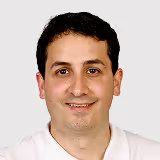
Marcel Kloos
Swiss-licensed dentist and founder of Medschool Experts
Marcel Kloos founded Medschool Experts while studying abroad; since then, over 500 study places have been secured. The Stuttgart-born dentist studied dentistry from 2015 to 2021 in Sofia and holds a Swiss dental licence.
Today he lives in Bern and runs Medschool Experts full-time as its owner.
More articles worth reading
Health Insurance for International Medical Students in Europe 2026
Scholarships and Funding for Medical Studies in Europe 2026
Medicine, Dentistry, Pharmacy or Veterinary Medicine? Choosing Your Degree Abroad in 2026
Ahmad
Sabrina
Rami
Noah
500+ students placed.
Now it's your turn!
No daydreaming, no empty promises. Just a clear plan — for the start of your medical degree.
40 minutes, no obligation