Studying Medicine in Croatia Without a Numerus Clausus: The German-Language Programme in Osijek
17.09.2026

The Osijek programme at a glance
The Faculty of Medicine in Osijek, part of Josip Juraj Strossmayer University, offers an international human medicine programme in cooperation with the AMEOS group. The programme started in the 2021 winter semester. The preclinical part takes place in Croatia, the clinical part at selected locations in Germany. The degree is recognised across the EU and internationally.
- Start of studies: winter semester
- Standard length: 6 years, that is 12 semesters
- Scope: 5,500 teaching units
- Language of instruction: German
- Semesters 1 to 5 and semester 12: study in Osijek, Croatia
- Semesters 6 to 11: study and bedside teaching at the AMEOS hospitals in Germany
- Year-group size: around 60 students
- Seminar and study groups: 5 to 10 students
- Tuition fees: EUR 8,000 per semester
- Admission: no numerus clausus
Converted, that is EUR 16,000 per academic year and around EUR 96,000 across the full standard period of twelve semesters. On top of that come living costs, which experience puts at EUR 500 to 700 a month in Osijek and therefore well below the level of major German cities.
Why so many school leavers go abroad
The situation in Germany is well known: some 9,000 study places in human medicine per winter semester regularly attract around 40,000 applications. In the top-grades quota the required average is between 1.0 and 1.2 depending on the federal state, and the former waiting-time quota was abolished in 2020. Anyone without a top school-leaving average is therefore up against a system that leaves very little room – or takes a different route.
That different route has long since become normal: around one in eleven German medical students is now enrolled at a university abroad. Studying in Osijek is one of several ways of taking it – with the particularity that the language of instruction is German.
Josip Juraj Strossmayer University in Osijek
The university is named after the theologian and politician Josip Juraj Strossmayer, who was born in Osijek, and was founded in 1975 – although the city's academic tradition reaches back to 1707. Today it is a modern European institution and a regional centre for science and research with around 20,000 students across 20 faculties.
The main building was constructed between 1724 and 1726 and stands in the historic city centre. It has four floors and houses administration, lecture halls and a canteen; there is a library on both the second and third floors. Together with the faculty libraries, the university library holds more than 550,000 volumes. The oldest book, „Die Neue Slavonische und Deutsche Grammatik“, dates from 1767.
A pleasing detail for German students: the university partnership with the University of Augsburg, established in 1978 by the ancient historian Günther Gottlieb, is the oldest international partnership Augsburg maintains at all. The link to Germany in Osijek is therefore almost 50 years old.
The Faculty of Medicine in Osijek
The Faculty of Medicine in Osijek was founded in 1998, making it the youngest in Croatia. Medicine could nevertheless be studied in Osijek as early as 1979 – at that time as a spun-off branch of the Faculty of Medicine at the University of Zagreb. The trigger was the expansion of medical care in the region at the end of the 1970s. Ideally, specialist training with AMEOS follows directly after the degree.
Where is Osijek? The city in figures
Osijek is the fourth-largest city in Croatia and lies in the east of the country on the banks of the Drava, in the heart of the historic region of Slavonia. The city consists of several formerly independent centres: the fortress or old town (Tvrđa), the lower town (Donji grad) and today's centre, the upper town (Gornji grad).
The first documentary mention, under the Hungarian name Eszék, dates from 1196. Before that the Celts marked the beginning of the settlement, and the Roman name of the city was Mursa. In 1809 Osijek received the status of a free royal city and by the end of the 19th century was among the largest economic and cultural centres in the Kingdom of Croatia, Slavonia and Dalmatia within the Austro-Hungarian monarchy. Under the influence of Budapest, Prague and Vienna, a distinctive local Secession style developed around 1900 – among the architectural highlights of that period is the Urania cinema, opened in 1912.
Always easy to reach
Osijek has an international airport around 20 kilometres south-east of the city, which in the summer season is also served directly from Germany. There is also a direct Flixbus connection from Germany via Austria whose final stop is Osijek. By car the city is reached via the Croatian national roads D2 and D7 (E 73), which intersect here.
Locally there is public transport with two tram lines and several bus routes, for which a discounted student ticket is available on application. Anyone living in the city centre or near the university can walk everywhere anyway. Cyclists will find around 40 kilometres of cycle paths within the city; Osijek also lies on the international Danube cycle route running from Germany via Austria and Hungary to Serbia, Romania and Bulgaria, and on EuroVelo 6, which runs from the Atlantic to the Black Sea.
Living in Osijek
Osijek offers a wide range of flats, mostly fully furnished. Rents are very comfortable compared with major German cities. Students find good listings on the Croatian portals njuskalo.hr (a kind of Croatian eBay) and index.hr/oglasi, as well as in Facebook groups. Your browser's translation function reliably helps here. A tip from the student body: with gas, water and electricity it is worth taking a second look at the terms agreed.
Food, sport and leisure
Eating out is considerably cheaper in Osijek than in Germany. With a student card, students eat at reduced prices in the faculty canteens and in three further restaurants. Delivery services such as Wolt, Glovo and Bolt are well established. Student favourites include Waldinger, Project 9, Lumiere, Ventidue, El Paso, Franz Koch, Lipov hlad, Strossmayer No. 2, the Hotel Osijek with its Pepe restaurant, and Café Roche.
The city is broadly equipped for sport: gyms such as Gyms4you, City Fitness, two Blue Gym Fitness sites and Central Dux Fitness, plus the Gradski Bazeni indoor pool with a student discount and the Bazeni Copacabana open-air pool. A running route follows the Drava, there is a sports ground opposite Tvrđa, and anyone who likes cycling trains on the international long-distance route „Amazon of Europe“. The range runs from aikido through badminton and bowling to volleyball and water polo. Osijek was one of the host cities of the 2009 Men's Handball World Championship, for which a new multi-purpose arena was built; there are also two basketball clubs and a football club.
Culturally the city offers the Croatian National Theatre, built in 1866, with drama, music theatre and ballet, a smaller theatre in the lower town with a comedy programme, the Museum of Slavonia and the archaeological museum. The zoo with its aquarium houses more than 100 animal species and is the largest zoo in Croatia by area. Every June the „Pannonian Challenge“ takes place, a festival of urban culture and extreme sport with BMX, skate and inline categories.
Nightlife traditionally happens on Thursdays. Popular venues are Franz Koch with English and Croatian music and usually free entry, the well-attended Q Club with Balkan folk music, and Exit and Epick. If you want more: Zagreb and Budapest are easily reached for a weekend trip.
The course structure: preclinical in Croatia, clinical in Germany
The structure is the real core of this model. Semesters 1 to 5 and the closing semester 12 take place in Osijek. Semesters 6 to 11 – that is, the clinical phase including bedside teaching – are completed by students in Germany at the AMEOS hospitals.
Six hospitals in Saxony-Anhalt are available as locations for bedside teaching:
- AMEOS Klinikum Aschersleben
- AMEOS Klinikum Bernburg
- AMEOS Klinikum Halberstadt
- AMEOS Klinikum Haldensleben
- AMEOS Klinikum Schönebeck
- AMEOS Klinikum Staßfurt
Group sizes are clearly structured: all 60 students in a year attend lectures together, seminars are held in two groups of 30 students each, and bedside teaching runs in ten small groups of six students each. That staff-to-student ratio is the big advantage of the model – six students per bed means in practice that everyone examines a patient themselves rather than merely watching.
{{cta}}
AMEOS: who is behind the clinical part?
The AMEOS group is a healthcare provider with around 18,500 employees and more than 100 facilities at over 50 locations in Switzerland, Austria and Germany. These include hospitals, polyclinics and rehabilitation, nursing and social-integration facilities, with an emphasis on regional care, particularly in rural areas.
The growth is well documented: in 2003 the group comprised 11 facilities, in 2005 there were 32, by 2011 already 50, in 2019 then 85, and finally 107 facilities in 2024. In parallel, the number of beds and places rose from around 1,000 in 2003 to around 11,000 in 2024. The name is an acronym of the German words for exceptional, humane, committed, open and social.
For students one thing above all is relevant: anyone who completes the clinical phase in these hospitals already knows the structures, the routines and the teams when it comes to specialist training. That makes the transition from degree to further training a short one.
How do you get a place – in Osijek or somewhere else?
We deliberately publish no checklists and no requirement tables here. What a faculty asks for differs from university to university and changes from one intake to the next, and a list that is correct today quietly stops being correct in the spring. What stays the same is that someone has to look at your case personally.
Send us your school-leaving certificate, any evidence of training or study you already have, and the countries you would consider. We go through it and then tell you clearly at which university, in which country, we can place you – and where we can get you in on a timetable you can actually plan around. Osijek is one option among many: through our network of official partner universities we place students in medicine, dentistry, pharmacy, nursing and veterinary medicine, which gives us the room to look for the route that fits you rather than the one that happens to be advertised.
Already studying somewhere and thinking about moving? Then we check the highest possible point at which you can join, rather than assuming you start again from scratch – in many cases that means entering in the later part of the course, often in the final two years. Arrange a free consultation and we will tell you honestly what is realistic for you.
Financing: scholarships and other routes
A medical degree is a large investment – six years of study, tuition fees and living costs all need planning. There are more routes to this than most applicants know. The following talent-support foundations also fund medical students:
- Studienstiftung des deutschen Volkes – Germany's most prestigious scholarship programme, with demanding selection criteria (studienstiftung.de)
- Friedrich-Ebert-Stiftung – for students with social and civic involvement, all fields (fes.de/studienfoerderung)
- Konrad-Adenauer-Stiftung – for able students with a focus on social responsibility, scholarship and international cooperation (kas.de)
- Hans-Böckler-Stiftung – funds, among others, students engaged in social and political issues, including medicine (boeckler.de)
- Heinrich-Böll-Stiftung – for students interested in environmental protection, human rights and social responsibility (boell.de)
- Cusanuswerk – the episcopal study-support organisation for Catholic students in all fields (cusanuswerk.de)
Beyond that, student loans, working as a student assistant or a side job during the semester breaks can all be used. A conversation with your bank about student-loan terms is worth having early rather than late.
Recognition: what the degree is worth
Croatia has been an EU member state since 1 July 2013. That means the EU Professional Qualifications Directive 2005/36/EC applies to the degree: a Croatian degree in human medicine is recognised automatically in all EU and EEA states, without an aptitude examination and without a case-by-case equivalence assessment. For the German medical licence (Approbation) that is the short, plannable route.
This is a point we stress again and again when advising on locations: an EU degree noticeably simplifies later recognition. Anyone who weights this aspect heavily will find several good options in Croatia, Bulgaria, Poland, Hungary, Slovakia, Romania and Malta.
What does a medical degree cost by European comparison?
So that you can place the EUR 8,000 per semester in context, here is a guide to locations we place students at (university tuition fees, as of 2026):
| Location | Language | Fees per year | EU |
| Osijek (Croatia) | German | EUR 16,000 | yes |
| Nicosia (Cyprus) | English | EUR 23,000 | yes |
| Budapest (Hungary) | English | EUR 18,000 | yes |
| Bratislava (Slovakia) | English | EUR 12,500 | yes |
| Varna (Bulgaria) | English | EUR 10,000 | yes |
| Novi Sad (Serbia) | English | EUR 7,000 | no |
| Niš (Serbia) | English | EUR 6,000 | no |
| Foča (Bosnia) | English | EUR 3,500 | no |
The range is wide – and it depends very heavily on a single variable: the language of study. Which brings us to the point I personally consider the most important in this whole article.
The author's view: the technical language of medicine is English
To be clear at the outset: a German-language medical degree is a strong offering. For some applicants it is exactly the right thing – for instance if someone never warmed to foreign languages at school, if the family is to stay closely involved, or if the clinical part is deliberately meant to take place in Germany. The Osijek model meets that wish cleanly and in a well-organised way.
Even so, I advise every prospective student to look seriously at an English-language degree before committing. For two reasons.
First: English is the language medicine happens in today
The international technical language of medicine is English. PubMed now holds around 38 million entries, and the overwhelming majority of medical papers worldwide appear in English. The major guidelines, the Cochrane Reviews, the standard textbooks such as Harrison’s or Gray’s Anatomy, practically every international congress, every study you will later read for your doctoral thesis – all in English. The clinical decision-support and AI systems currently moving into hospitals also work primarily on English-language evidence.
Which means: you will need this language in medicine anyway. The only question is whether you pick it up alongside your studies over five years or add it on top afterwards.
Second: studying in English really is achievable for anyone
This is the hurdle most people face – and it is smaller than it looks. Medical terminology is to a large extent Latin and Greek. „Musculus biceps brachii“ means exactly the same in Osijek, in Varna and at Harvard. You learn these terms afresh in whatever language you study – simply with English rather than German connective tissue around them.
On top of that: lectures on the English-language programmes are given for international students, not for native speakers. Teaching staff and fellow students speak clear, calm, functional English. In practice our students tell me almost uniformly the same thing: the first six to eight weeks are unfamiliar, and after that nobody thinks about it any more. Anyone who is unsure simply brushes up over the summer before starting – that is enough.
What English gives you later
- Clinical electives and rotations worldwide: an English-language degree opens up hospitals in the United Kingdom, Ireland, Scandinavia, Singapore, South Africa or the United States. That is an advantage in applications that stays with you.
- Research and doctoral work: publication is in English. Anyone who has internalised the language during their degree writes their first paper considerably faster.
- USMLE and international examinations: the route to the United States runs through English-language examinations. From an English-language degree that is a realistic goal.
- Specialist training abroad: Switzerland, Scandinavia and the Gulf region are actively recruiting doctors. English is the standard there in research and continuing education.
- More locations, more room on price: as the table above shows, the English-language programmes range from EUR 3,500 to EUR 23,000 a year. You simply have more choice and can combine location, cost and quality of life freely.
- An international network: in an English-language year group you sit with fellow students from 20 countries. That network carries you through your entire career.
My conclusion on this, and it is a personal one: I would treat the language of study not as a question of comfort but as a career decision. If you decide on German, do so deliberately and for good reasons – not out of respect for a hurdle that in practice disappears after two months.
Frequently Asked Questions about studying medicine in Osijek
Is there a numerus clausus for medicine in Croatia?
No. The international programme in Osijek does not allocate its places by a grade cut-off, which is precisely why it is on the radar of so many applicants whose school-leaving average would not be enough at home. What weight your own profile carries is something we look at with you individually.
How long does the medical degree in Osijek take?
Six years, or twelve semesters, with a scope of 5,500 teaching units.
What does the degree cost in total?
EUR 8,000 per semester, that is EUR 16,000 a year and around EUR 96,000 over the whole standard period. Living costs of roughly EUR 500 to 700 a month during the time in Croatia come on top.
Is the degree recognised in Germany?
Yes. Croatia has been an EU member state since 2013, the degree falls under EU Directive 2005/36/EC and is recognised automatically in Germany.
Do I need Croatian?
Not for the degree itself – teaching is in German. For everyday life, dealings with authorities and contact with patients, basic knowledge is nevertheless very helpful. Most students pick it up along the way.
What do I need to bring to get a place?
That depends on your certificate, your background and the university, and it is not the same from one year to the next – which is why we do not publish a general list. Send us your profile and we will tell you at which university, in which country, we can place you and where we can get you in reliably.
Can I move to a different university later?
A move within Europe is possible in principle, and how far into the course you can join depends on what you have already completed. We look at exactly that for you and aim for the highest possible entry point – frequently the last two years of the programme. Send us your transcript and we will tell you what is realistic.
How we support you
Medschool Experts places students at more than 25 accredited universities in over ten countries and has already secured places for more than 500 students. We look at your starting position – school-leaving average, budget, language level, life plans – and tell you honestly which location and which language of study suit you. From there we take care of the whole way to your place, and we stay reachable once you are on the ground.
If you want to know which route is the right one for you, get in touch: arrange a free consultation now.
Conclusion
The German-language programme in Osijek is a well-considered model, but it is only one option among many. Whether it is the right one for you personally is something we would rather work out for your specific case than in general terms – and that is exactly what we do together at Medschool Experts.
As the partner with the largest network of official partner universities, we assess individually for every student the highest possible year of entry, and in many cases entry is possible even in the final two years of the programme. Get in touch and book a free consultation to find out what is realistic in your case.
What students say about Medschool Experts
Over 500 placements at more than 25 partner universities across 10+ countries. Read independent student reviews on Trustpilot.
About the author
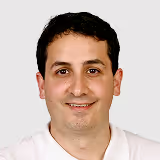
Marcel Kloos
Swiss-licensed dentist and founder of Medschool Experts
Marcel Kloos founded Medschool Experts while studying abroad; since then, over 500 study places have been secured. The Stuttgart-born dentist studied dentistry from 2015 to 2021 in Sofia and holds a Swiss dental licence.
Today he lives in Bern and runs Medschool Experts full-time as its owner.
More articles worth reading
Health Insurance for International Medical Students in Europe 2026
Scholarships and Funding for Medical Studies in Europe 2026
Medicine, Dentistry, Pharmacy or Veterinary Medicine? Choosing Your Degree Abroad in 2026
Ahmad
Sabrina
Rami
Noah
500+ students placed.
Now it's your turn!
No daydreaming, no empty promises. Just a clear plan — for the start of your medical degree.
40 minutes, no obligation