Studying Medicine in the Baltics: Riga, Kaunas and Vilnius at a Glance
28.08.2026

Why the Baltics
Three things make the region distinctive. First, language: almost nowhere in Europe is English as much a matter of course in everyday life as in Riga, Kaunas or Vilnius. If you study in English, there is barely any adjustment to make outside the university either. Second, the international outlook: at several locations a substantial share of students comes from abroad, and the programmes are correspondingly well practised. Third, modernity: the Baltic states have invested heavily in digitalisation and hospital infrastructure in recent years.
Latvia and Lithuania are EU member states. The degrees are listed in Annex V of Directive 2005/36/EC and are recognised in Germany, Austria and Switzerland without any additional examination.
Rīga Stradiņš University
The best-known medical address in the Baltics and one of the major locations for international medical students anywhere in Europe. Human medicine and dentistry are taught in English; fees are around EUR 6,750 per semester in human medicine and around EUR 7,750 in dentistry.
One detail that matters for a later transfer to Germany: at Rīga Stradiņš the subjects Latin, genetics and sociology have to be completed with a grade for the preclinical phase to be recognised in full. Anyone who plans for that from the start has no gap in their transcript later.
University of Latvia, Riga
The largest university in the country and, in human medicine, the most attractively priced location in the region: around EUR 6,138 per semester. Dentistry is well above that at around EUR 8,250. The campus is centrally located in Riga, and the city itself, with its Art Nouveau old town and good connections to Germany, is one of the most liveable in the Baltics.
Lithuanian University of Health Sciences, Kaunas
LSMU in Kaunas is the largest medical training location in Lithuania and runs one of the largest university hospitals in the region. Human medicine and dentistry are offered in English, at around EUR 6,450 and EUR 6,900 per semester respectively. Kaunas is smaller and quieter than Riga, and the cost of living is correspondingly lower.
Vilnius University
Founded in 1579 and therefore one of the oldest universities in Eastern Europe. The medical faculty is closely linked to the capital's large hospitals. Vilnius combines a historic old town with a very modern tech scene, which makes the city attractive to young people.
The locations at a glance
| University | Country | Human medicine | Dentistry |
|---|---|---|---|
| Rīga Stradiņš University | Latvia | approx. EUR 6,750 | approx. EUR 7,750 |
| University of Latvia | Latvia | approx. EUR 6,138 | approx. EUR 8,250 |
| LSMU Kaunas | Lithuania | approx. EUR 6,450 | approx. EUR 6,900 |
| Vilnius University | Lithuania | on request | on request |
All figures are per semester and are adjusted regularly. We clarify the current terms in a personal conversation.
Which location fits your own certificate, budget and timetable is best discussed case by case. If you would like to sort that out, you can arrange a free consultation with us.
Living in the Baltics
The cost of living runs to roughly EUR 600 to 800 a month, with Riga at the upper end. Places in halls of residence are considerably cheaper than private flats. Connections to Germany are good: there are direct flights from Riga and Vilnius to several German airports, with a flight time of around two hours.
Winter is longer and darker than in Central Europe, and that is worth taking into account when planning. In return the summers are bright and long, and the Baltic coast is on the doorstep.
The geographical situation in brief
A complete description of a location includes its geography. Latvia and Lithuania lie in the north-east of the EU and border Russia and Belarus. Both states are members of the European Union and NATO, and both are currently investing significantly in their security structures: Lithuania is raising its defence budget to more than five per cent of economic output in 2026, and under joint air-policing arrangements units from several alliance partners are permanently stationed in the region.
In day-to-day study this plays a subordinate role: the universities operate normally, semesters run to schedule, and the cities are among the safest and best organised in Europe. Anyone considering the region should nonetheless be aware of the situation and weigh it alongside the other criteria – fees, language, credit transfer, distance from home. That is exactly the kind of assessment we make individually.
How we currently advise
Our placement work currently concentrates on locations in Bulgaria, Serbia, Bosnia, Hungary, Croatia and Malta. That is expressly not a statement about the quality of the Baltic universities – Rīga Stradiņš and Kaunas are excellent addresses – but a question of our own partner network and of the locations where we can support students without gaps. The same EU recognition applies there too, in several cases at lower fees.
Which of these locations suits you is something we look at together. Book a free consultation via the registration page.
The author's view
Academically, the Baltics are among the strongest regions in Europe. Year groups are internationally mixed, the working language is English from the first lecture through to the conversation with a patient, and you leave these universities with a network that stretches across half of Europe. That is precisely why the region is described here in detail.
I studied abroad myself and am today a Swiss-licensed dentist; I run Medschool Experts from Bern. From that experience I know how much good support on the ground matters – and that is exactly what our offering is built around. We place students where we can accompany them personally over six years, currently above all in Bulgaria, Serbia, Bosnia, Hungary, Croatia and Malta. Anyone interested in the Baltics will find EU-recognised programmes of a high standard there as well. Which route suits whom is a very individual question, and that is best discussed in person.
Summary
The Baltics offer a consistently English-speaking environment and a strong international setting: Rīga Stradiņš as the best-known address, the University of Latvia as the most attractively priced in human medicine, Kaunas as the quieter alternative with a very good hospital network.
In our own placement work, other European locations with the same recognition are currently to the fore. You can read other students' experiences on Trustpilot. Which location suits you is something we clarify in a free consultation; book a slot on the registration page.
- Rīga Stradiņš University in Riga teaches human medicine and dentistry entirely in English and is the best-known medical address in the Baltics.
- The University of Latvia in Riga is the most attractively priced location in the region for human medicine, while its dentistry programme is well above that.
- The Lithuanian University of Health Sciences in Kaunas is the largest medical training location in Lithuania and offers human medicine and dentistry in English.
- Degrees from Latvia and Lithuania are listed in Annex V of Directive 2005/36/EC and are recognised in Germany, Austria and Switzerland without an additional examination.
- The cost of living in the Baltics runs to roughly EUR 600 to 800 a month, with Riga at the upper end of that range.
- In 2026 Medschool Experts places students mainly at locations in Bulgaria, Serbia, Bosnia, Hungary, Croatia and Malta, where we support students personally throughout.
Further reading
- Tuition fees in Europe: every location with costs per semester.
- Location comparison without a numerus clausus: the alternatives we currently place students at.
- Czechia and Slovakia: the cheaper alternatives in Central Europe.
- Transferring back to Germany: the credit-transfer values in detail.
- German medical licence (Approbation) and recognition: what an EU degree is worth.
Frequently Asked Questions about Studying Medicine in the Baltics
Are the degrees recognised in Germany?
Yes. Latvia and Lithuania are EU member states and the state medical universities are listed in Annex V of Directive 2005/36/EC. Recognition takes place without an aptitude examination (Kenntnisprüfung).
What language is used for teaching?
Entirely English. Latvian or Lithuanian is included as a course subject and is needed during the clinical phase.
What does a semester cost?
Between around EUR 6,138 at the University of Latvia and around EUR 8,250 for dentistry there. Rīga Stradiņš is around EUR 6,750 in human medicine, Kaunas around EUR 6,450.
How high is the cost of living?
Roughly EUR 600 to 800 a month. Riga is at the upper end, Kaunas and Vilnius somewhat below.
How good is credit transfer when moving back?
Good. At Rīga Stradiņš and the University of Latvia, four subject semesters are typically credited after four semesters. What matters here is that subjects such as Latin, genetics and sociology have been completed with a grade.
How will I manage with English in daily life?
Very well. The Baltics are among the regions of Europe with the highest levels of English in the population, particularly in the cities and among younger people.
Which location suits me?
That depends on budget, degree programme and any plans for transferring back. We work through that assessment together in the free consultation.
What students say about Medschool Experts
Over 500 placements at more than 25 partner universities across 10+ countries. Read independent student reviews on Trustpilot.
About the author
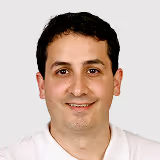
Marcel Kloos
Swiss-licensed dentist and founder of Medschool Experts
Marcel Kloos founded Medschool Experts while studying abroad; since then, over 500 study places have been secured. The Stuttgart-born dentist studied dentistry from 2015 to 2021 in Sofia and holds a Swiss dental licence.
Today he lives in Bern and runs Medschool Experts full-time as its owner.
More articles worth reading
Why Students Transfer from Medical University of Varna — Your Options
Why Students Transfer from Medical University of Warsaw — Your Options
Why Students Transfer from Masaryk University Faculty of Medicine — Your Options
Ahmad
Sabrina
Rami
Noah
500+ students placed.
Now it's your turn!
No daydreaming, no empty promises. Just a clear plan — for the start of your medical degree.
40 minutes, no obligation