Studying Medicine and Dentistry in Romania: Locations, Costs and Recognition
28.08.2026

What does studying medicine in Romania cost per academic year?
For their English- and French-language programmes in the academic years 2025/2026 and 2026/2027, the state medical universities in Romania charge between 8,000 and 10,000 euros per academic year. Timisoara and Iasi are at 9,000 euros, Cluj-Napoca and Targu Mures at 10,000 euros. The French-language tracks are cheaper at two locations. All amounts come from the universities' fee schedules and admissions pages.
| Location | Human medicine per year | Dentistry per year | Languages |
|---|---|---|---|
| Timisoara (Victor Babes) | 9,000 euros (EN), 8,000 euros (FR) | 9,000 euros (EN) | EN, FR, RO |
| Cluj-Napoca (Iuliu Hatieganu) | 10,000 euros | 10,000 euros | EN, FR, RO |
| Iasi (Grigore T. Popa) | 9,000 euros | 9,000 euros | EN |
| Bucharest (Carol Davila) | 10,000 euros (worked example from the finance department) | no official separate figure available | EN, FR, RO |
| Targu Mures (George Emil Palade) | 10,000 euros (EN), 8,000 euros (FR) | 10,000 euros (EN) | EN, FR, RO, HU |
The Timisoara fee schedule for 2025/2026 additionally states that the fee does not change during an academic year and remains stable until the end of the programme. That is a point hardly anyone mentions, and over a six-year commitment it is worth more than a thousand euros' difference in price. Bucharest does not publish a separate dentistry rate; the 10,000 euros come from a worked example produced by the finance department for EU citizens who pay in lei at the Romanian National Bank's exchange rate.
Many people overlook a second cost route. The Romanian-language programmes are considerably cheaper: in Targu Mures and Timisoara, the annual fee for fee-paying places in human medicine and dentistry is 15,000 lei, that is, in the low four-figure euro range. The price for this is time. Romanian at academic level means, in practice, a preparatory year, and that pushes the start of your professional life back by twelve months.
In consultations about Romania, almost always the same question comes first, and it is not the one about price: whether you can cope with daily life without speaking Romanian. My answer is always in two parts. In the lecture theatre, English or French is entirely sufficient. At the bedside, it is not. By the clinical phase at the latest, the patient speaks Romanian, and that is precisely why the universities teach the national language alongside the programme.
How long does the medical programme in Romania take?
Human medicine and dentistry in Romania normally take six years and comprise 360 ECTS credits each; pharmacy is designed for five years and 300 ECTS. Iuliu Hatieganu University in Cluj-Napoca sets out this structure in its programme listing, and the factsheet of Victor Babes University in Timisoara gives the same durations for its international programmes.
Romania therefore exceeds the European minimum. Article 24(2) of Directive 2005/36/EC requires, in its consolidated version, "a total of at least five years" of study and at least 5,500 hours of theoretical and practical training for basic medical education. Romania sets six years. The sixth is a clinically oriented practical year and ends with a state final examination.
On language proof, the locations agree: the Timisoara factsheet requires a B2 level in the language of instruction, and Cluj-Napoca names the same threshold for English and French.
In which languages can you study medicine in Romania?
Alongside Romanian, Romanian medical universities teach human medicine, dentistry and pharmacy in English and, at several locations, in French; in Targu Mures, Hungarian is added. This trilingualism is a distinctive feature in Central and Eastern Europe, because in Hungary, Bulgaria and Croatia the parallel programmes for international students are almost exclusively in English.
- Timisoara: human medicine (English, French), dentistry (English), pharmacy (English, French).
- Cluj-Napoca: human medicine (English, French, Romanian), dentistry (English, French), pharmacy (French).
- Iasi: human medicine, dentistry and pharmacy in English.
- Bucharest: human medicine and dentistry with their own English- and French-language tracks.
- Targu Mures: human medicine (English, French), dentistry (English), plus Romanian- and Hungarian-language programmes.
How robust these tracks are is shown by the internationalisation report of the University of Timisoara for 2023: 659 people were studying human medicine in English there, 206 human medicine in French, 211 dentistry in English and 144 pharmacy in French. In total, 1,501 international students were enrolled, compared with 1,375 in 2019. Anyone arriving there is not an exceptional case in a pilot programme but sits in a well-established year group.
An often overlooked advantage concerns the national language itself: Romanian is a Romance language. Anyone who already speaks French, Spanish or Italian recognises a large part of the vocabulary and accordingly makes rapid progress in the accompanying language courses. That is a head start which does not exist in the same way at Slavic-language locations.
I consider the French-language offering the most undervalued option in the whole of Eastern Europe. That is my assessment, no more. Many applicants from French-speaking Switzerland and from bilingual families bring very good French with them and simply do not know that it allows them to complete an entire medical degree in Cluj-Napoca, Timisoara or Targu Mures. In price terms, these tracks are at two locations even below the English-language ones.
Which medical universities are there in Romania?
Romania maintains five large state medical universities with international programmes: Victor Babes in Timisoara, Iuliu Hatieganu in Cluj-Napoca, Grigore T. Popa in Iasi, Carol Davila in Bucharest and George Emil Palade in Targu Mures. All run human medicine and dentistry over six years and maintain their own halls of residence.
Timisoara – Victor Babes
Timisoara lies in the Banat region in the west of the country, close to the Hungarian and Serbian borders, and with around 320,000 inhabitants it is a lively university city. The university bears the name of the bacteriologist Victor Babes and runs faculties of medicine, dentistry, pharmacy and nursing. Its international programmes operate under Type III accreditation. Getting there is a practical advantage: the international airport offers direct connections to the German-speaking countries; alternatively you are home within a few hours via Budapest or Vienna, and the Hungarian border is only a few hours away by car. In 2023 Timisoara was European Capital of Culture, which gave the city a visible push towards modernisation.
Cluj-Napoca – Iuliu Hatieganu
Cluj-Napoca is the academic centre of Transylvania and the country's largest university city, with a correspondingly large student scene and a growing technology sector. Iuliu Hatieganu University describes itself as the Romanian higher education institution with the most international students and as the country's only medical faculty accredited by the Association of Medical Schools in Europe. Added to this are certifications from the francophone faculty networks CIDMEF and CIDPharmEF. Cluj-Napoca also has an international airport with connections to Germany and Austria.
Iasi – Grigore T. Popa
Iasi is the large university city of the historic region of Moldavia in the northeast. For the academic year 2026/2027, Grigore T. Popa University lists 200 places in human medicine, 70 in dentistry and 50 in pharmacy within its English-language offering. That makes it one of the country's highest-capacity locations.
Bucharest – Carol Davila
Carol Davila is Romania's most tradition-rich medical institution and is organised into medicine, dentistry, pharmacy, and nursing and midwifery. For international students there are separate English- and French-language tracks. Bucharest is at the same time the most expensive city in the country, which noticeably changes the calculation.
Targu Mures – George Emil Palade
Targu Mures in the heart of Transylvania is traditionally multilingual and runs Hungarian-language programmes alongside Romanian ones. The official allocation of places for 2026/2027 names 150 places in human medicine in English, 100 in human medicine in French and 60 in dentistry in English. Alongside these are state-funded places in the Romanian-language programmes, around 172 in human medicine and 45 in dentistry.
I look at locations myself wherever possible, because on a fee table two universities can feel identical when on the ground they are not. What matters is more mundane: how far the lecture theatre is from the teaching hospital, whether there is a German-speaking community, how often and how expensively a flight home runs. Six years is a long time. In the end, these things decide more about academic success than a thousand euros' difference in fees per year.
Which of the five locations fits your school record, language level and life plans cannot be answered in general terms. That is exactly what the free consultation is for.
Is the Romanian intermediate examination recognised in Germany as the Physikum?
No. Since 2023, the German state examination authorities have no longer recognised the Romanian intermediate examination taken after the pre-clinical phase as the preliminary medical examination. Anyone who begins their degree in Romania and later wants to transfer to a German faculty has to take the Physikum in Germany. Anyone completing the degree in Romania is not affected.
For subject semesters, a rough rule of thumb applies according to the experience reported back to us from credit recognition procedures: after two semesters in Romania, German faculties usually credit one subject semester, and after three to four semesters, two. Only the decision of the receiving faculty is binding.
I mention this point deliberately, because it belongs to a complete picture. The source situation is thin: there is no central published statement one could link to, because responsibility lies with sixteen state authorities and each decides for itself. What is reliable is the practice as reported back to us from credit recognition procedures since 2023. Anyone firmly planning a return transfer should have the credit recognition confirmed in writing by the receiving faculty in advance and should not rely on a blog article, this one included.
For the great majority, this changes nothing. The Romanian diploma itself falls under Annex V of Directive 2005/36/EC and is automatically recognised in Germany. The point does not concern the end of the programme, only a transfer in the middle of it.
What does living as a medical student in Romania cost?
Romania is among the most affordable countries in the European Union. According to the Eurostat price level statistics, Romania stood at around 80 per cent of the EU average for food and non-alcoholic beverages in 2025. Rent, food and local transport are therefore noticeably lower than in German or Swiss university cities. The following calculation turns that into a total figure.
The table is our own compilation, as of August 2026. It assumes an annual fee of 9,000 euros and draws on experience from Medschool Experts placement practice for a mid-range location outside Bucharest. These are estimates, not official figures.
| Item | per month | per academic year | six years |
|---|---|---|---|
| Tuition fee | – | 9,000 euros | 54,000 euros |
| Room or share of a flat | 250 euros | 3,000 euros | 18,000 euros |
| Food, local transport, mobile phone | 350 euros | 4,200 euros | 25,200 euros |
| Books, lab coat, instruments | 40 euros | 480 euros | 2,880 euros |
| four flights home per year | – | 600 euros | 3,600 euros |
| Total | – | 17,280 euros | 103,680 euros |
Around 104,000 euros for six years, a good half of it tuition fees. Anyone enrolling in dentistry should additionally reckon with instrument costs in the four-figure range across the clinical years. This item almost never appears in location comparisons, even though it is real. I paid it myself during my own dentistry degree in Sofia between 2015 and 2021.
For context at the lower end: Medschool Experts places students at universities with semester fees from 1,750 euros. Romania is above that, other locations are clearly below it, and which framework suits which budget can be clarified in a twenty-minute conversation.
Is a Romanian medical degree recognised in Germany and in Switzerland?
Yes. Doctors and dentists are among the professions for which the European Union provides automatic recognition under Article 21 in conjunction with Annex V of Directive 2005/36/EC. The competent authorities must acknowledge receipt of the documents within one month and decide within three months.
In Germany, the federal states grant the German medical licence (Approbation). In North Rhine-Westphalia, the Münster district government has been the central recognition body for healthcare professions since 1 March 2020; the other states have designated their own state examination offices or district governments. The host state may require proof of language skills.
In Switzerland, the decision rests with the Medical Professions Commission MEBEKO at the Federal Office of Public Health. Diplomas in the medical professions from EU and EFTA states and from the United Kingdom can be recognised there; the basis is the Medical Professions Act, the bilateral agreements and the European professional qualifications directive. Entry in the medical professions register MedReg follows. I went down this route myself and am today a Swiss-licensed dentist; I run Medschool Experts from Bern. It is an administrative procedure with clear rules, not a matter of luck.
How does Romania compare with Hungary, Bulgaria and Croatia?
At 8,000 to 10,000 euros per academic year, Romania sits at the lower end of the southeastern European field, while the University of Zagreb charges 12,000 euros and Semmelweis University in Budapest 10,450 US dollars per semester. The Medical University of Sofia names 9,950 euros per year for human medicine. All four countries run six-year programmes with EU recognition.
| Country and example university | Human medicine per year | Languages of instruction | Access in principle |
|---|---|---|---|
| Romania (Timisoara, Cluj, Iasi, Targu Mures) | 8,000 to 10,000 euros | English, French, Romanian | predominantly assessment of documents, in part an examination |
| Hungary (Semmelweis Budapest) | 10,450 US dollars per semester | English, Hungarian, German | entrance examination in biology, chemistry, English |
| Bulgaria (MU Sofia) | 9,950 euros | English, Bulgarian | entrance examination in biology and chemistry |
| Croatia (Zagreb) | 12,000 euros | English, Croatian | written examination in biology, chemistry, physics |
The second difference is capacity, and it is larger than the price difference. Zagreb caps its English-language programme at a maximum of 60 students per year. Iasi alone opens 200 places in human medicine, Targu Mures 150 in English and 100 in French. A single Romanian location therefore awards more international places than Croatia in total.
On living costs, too, Romania sits in the lower part of the field: according to experience from placement practice, you can manage on around 400 to 550 euros per month in Timisoara and around 450 to 600 euros in Cluj-Napoca. By comparison, the corresponding amounts in Hungarian and Polish university cities tend to be between 450 and 850 euros.
How many doctors and dentists does Romania train?
According to the Eurostat dataset hlth_rs_grd2, Romania counted around 28 medical graduates per 100,000 inhabitants in 2023, compared with 15 in the EU average. In dentistry, Romania leads the EU with 9.9 graduates per 100,000 inhabitants in the reference year 2022, against an average of 3.2. The country therefore trains well above the European average in both professions.
Anyone placing the two sets of figures side by side comes across an apparent contradiction, and it can be explained. The Eurostat release of 5 August 2024 names an EU average of 15.5 medical graduates per 100,000 inhabitants for 2022, with Bulgaria at 29.5, Malta at 27.7 and Latvia at 27.5. The 2023 figures from the same dataset are slightly different, because the reference year differs and individual member states correct their reports retrospectively. The ranking remains stable in both years: Bulgaria, Malta, Romania and Latvia form the leading group, and the EU average is around 15.
This rate is no coincidence but the result of a deliberately broad system of five large state universities, multilingual parallel programmes and three-figure place numbers per location. Romania has also been training international students for decades, many of them from France, Israel and Germany. For comparison: in 2023 Eurostat counted around 1.98 million practising doctors in the EU, with Austria at the top on 551 per 100,000 inhabitants and Germany on 466.
Whether Romania is the right location depends in the end less on these figures than on your own circumstances. Anyone who would like to talk this through can arrange a free consultation with Medschool Experts.
This article reflects the state of research as of August 2026 and does not replace legal advice. Only the authorities named are responsible for recognition decisions.
The author's view
I moved to Sofia in 2015 to study dentistry and completed the degree in 2021. What nobody told me at the time: the first weeks abroad have almost nothing to do with the degree. They are about the registration office, a bank account, a SIM card, a flat, and about arriving in a city where you know nobody. That is the real hurdle. Once you have cleared it, the rest feels surprisingly normal.
What convinces me about Romania academically is above all the breadth. Five large state universities, English- and French-language parallel programmes with three-figure place numbers, plus figures such as the 1,501 international students in Timisoara in 2023. That is a grown structure, not an experiment.
Even so, I would advise nobody to base their choice of location on the fee table. Whether a city suits you, whether the hospital is within walking distance, whether flights home are affordable: over six years, these decide more than a thousand euros' difference. That is precisely why, at Medschool Experts, we have spent years talking on YouTube with real students abroad instead of handing out glossy brochures.
There is one point I like to address openly, because it belongs to a complete picture. The matter of the intermediate examination, which since 2023 no longer counts as the Physikum, concerns exactly the group planning Romania as a stopover. Anyone who intends from the outset to return to Germany should know this before enrolling, not in their third semester. Anyone completing the degree in Romania can skip this paragraph.
And one more thing from my own professional practice: the degree is the beginning, not the goal. The medical licence in Germany and MEBEKO recognition in Switzerland, which I went through myself, are administrative procedures with clear rules. Anyone who documents their studies properly and takes the language of their later country of work seriously has the hardest part behind them by the time they hold the diploma.
Summary
- Romania runs human medicine and dentistry as six-year programmes with 360 ECTS credits at five large state universities: Timisoara, Cluj-Napoca, Iasi, Bucharest and Targu Mures.
- The officially published tuition fees for the academic years 2025/2026 and 2026/2027 are between 8,000 and 10,000 euros per academic year; the Romanian-language programmes cost considerably less at 15,000 lei but require a preparatory year.
- Romanian universities teach in Romanian, English and French and require a B2 level in the language of instruction; as a Romance language, Romanian opens up particularly quickly to anyone with French, Spanish or Italian.
- Since 2023, the Romanian intermediate examination has no longer been recognised in Germany as the Physikum; a transfer to a German faculty requires the German Physikum, and experience shows that one subject semester is credited after two semesters and two subject semesters after three to four.
- Doctor and dentist fall under automatic recognition pursuant to Annex V of Directive 2005/36/EC, in Germany through the state authorities and in Switzerland through MEBEKO.
- Six years of study in Romania cost around 104,000 euros according to our own compilation of August 2026, including rent, living costs and flights home.
Further reading
- Tuition fees in Europe: all locations with costs per semester in direct comparison.
- Studying medicine in Hungary: the closest neighbouring market with a similar profile.
- Study transfer within Europe: up to which academic year a transfer is possible.
- Living costs during a medical degree: the country overview for putting the Romanian figures in context.
- Medicine with a subject-restricted school leaving certificate: which qualifications open access in Europe.
Frequently Asked Questions About Studying Medicine in Romania
How long does the medical programme in Romania take?
Human medicine in Romania normally takes six years and comprises 360 ECTS credits. Dentistry is likewise designed for six years and 360 ECTS, and pharmacy for five years and 300 ECTS.
What does an academic year in Romania cost?
The officially published annual fees are 9,000 euros in Timisoara and Iasi and 10,000 euros in Cluj-Napoca and Targu Mures. The French-language tracks in Timisoara and Targu Mures cost 8,000 euros.
What does the whole programme cost including living expenses?
According to our own compilation of August 2026, an annual fee of 9,000 euros produces around 17,280 euros per academic year and therefore about 104,000 euros over six years, including rent, food, study materials and four flights home per year.
In which languages can you study medicine in Romania?
Besides Romanian, several state universities offer complete programmes in English, and in Cluj-Napoca, Timisoara, Bucharest and Targu Mures additionally in French. In Targu Mures, Hungarian-language programmes are added.
What language level is required?
The University of Timisoara states in its factsheet that all students must demonstrate a B2 level in the language of instruction. Cluj-Napoca names the same threshold for English and French.
Do I have to learn Romanian if I study in English?
Not for the teaching, but yes for clinical daily life. From the clinical phase onwards, patients speak Romanian, which is why the universities teach the national language alongside the programme.
Is the Romanian intermediate examination recognised as the Physikum?
No. Since 2023, the German state examination authorities have no longer recognised the Romanian intermediate examination as the preliminary medical examination. Anyone who later wants to transfer to a German faculty must sit the Physikum in Germany. This has no bearing on the Romanian degree itself.
Are there also fee-free places?
State-funded places exist in the Romanian-language programmes. According to the admissions document of the University of Targu Mures, citizens of the EU, the EEA and Switzerland can apply under the same conditions as Romanian nationals. The prerequisite is Romanian at academic level.
Is a Romanian degree recognised in Germany?
Yes. Doctor and dentist are among the professions with automatic recognition pursuant to Annex V of Directive 2005/36/EC. The medical licence is granted by the competent state authorities, in North Rhine-Westphalia for example the Münster district government.
And in Switzerland?
The Medical Professions Commission MEBEKO at the Federal Office of Public Health is responsible. Diplomas in the medical professions from EU and EFTA states and from the United Kingdom can be recognised in Switzerland. Entry in the medical professions register MedReg follows.
How long does a recognition procedure take?
Under the requirements of Directive 2005/36/EC, the competent authorities acknowledge receipt of the documents within one month and decide within three months of receiving the complete certificates.
How expensive is life in Romania?
Romania is among the most affordable countries in the EU. According to the Eurostat price level statistics, Romania stood at around 80 per cent of the EU average for food and non-alcoholic beverages in 2025.
How does Romania compare with Hungary, Bulgaria and Croatia?
On price, Romania at 8,000 to 10,000 euros sits below Zagreb (12,000 euros) and Semmelweis Budapest (10,450 US dollars per semester) and roughly at the level of Sofia (9,950 euros). On capacity the gap is larger: Iasi alone awards more international places than Zagreb in total.
What students say about Medschool Experts
Over 500 placements at more than 25 partner universities across 10+ countries. Read independent student reviews on Trustpilot.
About the author
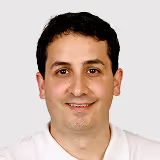
Marcel Kloos
Swiss-licensed dentist and founder of Medschool Experts
Marcel Kloos founded Medschool Experts while studying abroad; since then, over 500 study places have been secured. The Stuttgart-born dentist studied dentistry from 2015 to 2021 in Sofia and holds a Swiss dental licence.
Today he lives in Bern and runs Medschool Experts full-time as its owner.
More articles worth reading
Why Students Transfer from Medical University of Varna — Your Options
Why Students Transfer from Medical University of Warsaw — Your Options
Why Students Transfer from Masaryk University Faculty of Medicine — Your Options
Ahmad
Sabrina
Rami
Noah
500+ students placed.
Now it's your turn!
No daydreaming, no empty promises. Just a clear plan — for the start of your medical degree.
40 minutes, no obligation