Cost of Living for Medical Students in Europe 2026: Country Comparison
01.09.2026

Price levels instead of gut feeling: what the Eurostat data shows
The most robust starting point for comparing costs between countries is not the experience of individual students but Eurostat's price level index. It measures what an identical basket of goods costs in a country, converted into a common currency, with the EU27 average as base 100. For actual individual consumption, that is the basket closest to the daily life of private households, the 2024 values were as follows: Bulgaria 56.9, Romania 57.4, Hungary 68.3, Poland 70.2, Croatia 73.3, Latvia 77.2, Germany 109.1, Austria 119.7 and Switzerland 184.3 (Eurostat, dataset prc_ppp_ind).
In concrete terms these figures say: the same daily life costs a good half in Bulgaria of what it costs in Germany. It becomes clearer still with the largest single item. For the category of housing, water, electricity, gas and other fuels, Eurostat gives an index of 38.1 for Bulgaria and 113.1 for Germany for 2024. Housing in Bulgaria is therefore around a third as expensive as in Germany on paper. It is precisely this item that determines whether a study budget works, because it is the only one you can barely steer over the course of a month.
Important for context: the price level index is a national average. Capital cities lie above it, medium-sized university towns below. Sofia is more expensive than Plovdiv, Kraków than Lublin, Budapest than Pécs. Choosing a university town outside the metropolis shifts your budget noticeably downwards without changing anything about the degree itself.
Eight university cities, eight monthly budgets
The following overview summarises the monthly amounts we plan with in consultations. These are planning values from Medschool Experts's advisory practice, cross-checked against the 2024 Eurostat price levels and the universities' official figures. They describe a shared flat or an inexpensive one-room apartment near campus, self-catering with the occasional meal out, public transport with a discounted student card, private international health insurance and textbooks.
| University city | Rent | Utilities | Food | Transport | Insurance | Study materials | Total per month |
|---|---|---|---|---|---|---|---|
| Sofia (Bulgaria) | €300 | €70 | €200 | €15 | €30 | €25 | around €640 |
| Varna (Bulgaria) | €250 | €65 | €190 | €15 | €30 | €25 | around €575 |
| Plovdiv (Bulgaria) | €230 | €60 | €180 | €12 | €30 | €25 | around €540 |
| Pécs (Hungary) | €260 | €70 | €200 | €12 | €30 | €25 | around €600 |
| Debrecen (Hungary) | €280 | €75 | €210 | €15 | €30 | €25 | around €635 |
| Kraków (Poland) | €350 | €80 | €230 | €20 | €30 | €25 | around €735 |
| Riga (Latvia) | €330 | €90 | €240 | €20 | €30 | €25 | around €735 |
| Cluj (Romania) | €280 | €70 | €200 | €15 | €30 | €25 | around €620 |
An independent cross-check comes from the University of Debrecen itself. It puts the average monthly living costs of international students in Debrecen at around USD 800, expressly including shared private accommodation, food, study materials and public transport, and excluding tuition fees. That value is in the same order of magnitude as our planning figures and confirms the approach.
Which items really vary
- Rent. The only item with a three-figure spread. Between a place in halls, a room in a shared flat and your own apartment, the gap within the same city is often EUR 200 or more.
- Utilities. The heating season and the state of the building show through. In older buildings in Sofia, Pécs or Cluj the winter months are considerably more expensive than the annual average, while in summer the item almost disappears.
- Food. Anyone shopping at the weekly market and in local chains ends up noticeably below those who buy German branded goods from the import shelf.
- Transport. Discounted monthly passes for students are the cheapest single item of all in Central and Eastern Europe, usually in the low double digits.
- Insurance. Private international health insurance, or a policy preserving entitlements at home, is a mandatory part of any calculation. Anyone receiving BAföG can claim supplementary health insurance up to the amount of the health insurance supplement.
- Study materials. An anatomy atlas, dissection instruments, a lab coat and licences for learning platforms all fall together in the first semesters and decline afterwards.
Budget ranges for further study regions
Alongside the eight cities calculated individually, further locations regularly come up in consultations. The following overview summarises the ranges by region. The left-hand value describes housing costs for a place in halls or a room in a shared flat, the right-hand value the total budget including all ongoing items.
| Location | Rent, shared flat or halls | Total budget per month |
|---|---|---|
| Timișoara, Cluj | €150 to 300 | €400 to 600 |
| Sofia, Plovdiv, Varna | €200 to 350 | €450 to 650 |
| Pécs, Szeged, Debrecen | €200 to 350 | €450 to 650 |
| Brno, Olomouc, Košice | €250 to 400 | €500 to 700 |
| Łódź, Szczecin, Wrocław | €250 to 450 | €500 to 750 |
| Riga, Kaunas, Vilnius | €300 to 500 | €600 to 800 |
| Budapest, Prague, Bratislava | €350 to 600 | €700 to 900 |
| Malta | €450 to 750 | €800 to 1,100 |
The spread within a single location is wide, because it depends above all on the form of housing. A place in halls often costs less than half a private flat, but availability is limited. A shared flat sits in between and is the normal case. Anyone who considers location and housing together already holds the biggest lever in the whole budget.
One-off and annual costs that do not appear in a monthly budget
A monthly budget reflects ongoing daily life. Alongside it stand items that fall due once or annually and therefore deserve a line of their own in the calculation.
- Health insurance. Within the EU the European Health Insurance Card covers medically necessary treatment. For a degree lasting several years, additional international health insurance is worthwhile, costing between EUR 15 and 60 a month depending on the policy.
- Flights and trips home. With two to four trips a year, EUR 300 to 800 is realistic. Locations with direct connections to Germany have a clear advantage here. Auslands-BAföG additionally provides a travel allowance of EUR 250 for an outward and return journey within Europe.
- Deposit and initial set-up. On moving in, one to three months' rent is frequently required as a deposit, plus the basic equipment for the flat.
- Books and study materials. Around EUR 300 to 600 in the first year of study, considerably less afterwards.
- Language courses. At many locations the accompanying courses in the local language are included in the curriculum; at some they are billed separately.
- Instruments in dentistry. At many faculties abroad these are provided, which saves a four-figure amount compared with Germany.
The comparison with German university cities
The German reference figure comes from the Federal Statistical Office. According to it, in 2025 half of students running their own home had less than EUR 963 a month, and on average 54 per cent of disposable household income went on housing costs. Among students living alone it is 56 per cent. By comparison, the share across the population as a whole is 24 per cent. Arithmetically, that leaves many students in Germany with around EUR 440 a month for everything that is not housing.
It is precisely here that the cost logic of studying abroad turns. In Sofia, Pécs or Cluj, the housing share of a comparable budget is typically a third to a good 40 per cent, because the rent is lower in absolute terms and the other items fall with it. The total budget is lower and the freely disposable remainder is larger. Anyone who would have to finance a room in a shared flat in Munich, Frankfurt or Hamburg often plans elsewhere in Europe with a lower total while having more room to manoeuvre day to day.
Added to that is a structural difference no table captures: abroad, the study place is not tied to a school-leaving grade. There the cost calculation decides feasibility, not a tenth of a grade point. That makes planning more predictable, because it lies in the family's hands and does not depend on an allocation procedure.
International comparison: price levels and inflation in nine countries
The following table sets side by side the two Eurostat indicators that matter for a study budget: the general price level and the price level for housing and energy, in each case for 2024 with EU27 equal to 100. The average annual inflation rate for 2025 under the harmonised index of consumer prices is added.
| Country | Price level, total consumption (EU27 = 100) | Price level, housing and energy | Inflation 2025 (HICP, annual average) | Typical study budget per month |
|---|---|---|---|---|
| Bulgaria | 56.9 | 38.1 | 3.5 % | €540 to 640 |
| Romania | 57.4 | 52.0 | 6.8 % | €600 to 700 |
| Hungary | 68.3 | 61.1 | 4.4 % | €600 to 700 |
| Poland | 70.2 | 49.2 | 3.3 % | €700 to 800 |
| Croatia | 73.3 | 44.0 | 4.4 % | €650 to 800 |
| Latvia | 77.2 | 55.0 | 3.8 % | €700 to 850 |
| Germany | 109.1 | 113.1 | 2.3 % | median below €963 (Destatis) |
| Austria | 119.7 | 113.3 | 3.6 % | above the German level |
| Switzerland | 184.3 | 214.4 | 0.1 % | well above the German level |
Two observations matter for planning. First, the gap on housing is larger than on general consumption. Croatia sits at 73.3 overall but 44.0 on housing; Poland at 70.2 against 49.2. Anyone studying in these countries benefits disproportionately on the biggest budget item. Second, inflation does not close the gaps in the short term. Romania was at the upper end in 2025 with 6.8 per cent, Germany at 2.3 per cent. Even if that difference persisted for years, it would take a very long time to close a price-level gap of more than 50 points. Switzerland shows the reverse case: at 0.1 per cent almost no inflation, but a price level that on housing is more than five times the Bulgarian one.
Total costs across six years of study
A medical degree in Europe normally takes six years, and dentistry as a rule five to six. That makes it possible to project total expenditure cleanly, provided tuition fees and living costs are considered separately. The fees come from the universities' official figures for the 2026/2027 academic year.
| University | Tuition, human medicine per year | Fees over six years | Living costs over six years (planning value) | Overall range |
|---|---|---|---|---|
| Medical University of Sofia | €9,950 (BGN 19,460.51) | €59,700 | around €46,000 | around €106,000 |
| University of Pécs | USD 16,750 | USD 100,500 | around €43,000 | depends on the dollar rate |
| Rīga Stradiņš University | €13,500 | €81,000 | around €53,000 | around €134,000 |
Dentistry is slightly above that in each case: in Sofia the annual fee for the English-language dentistry programme is EUR 10,000, in Pécs USD 17,350, in Riga EUR 15,500. These amounts are not estimates but the fees published by the universities themselves.
Two worked examples to check the arithmetic
Anyone wanting to transfer the approach to any location works most easily with two model cases. First case, an inexpensive location with EUR 4,250 in tuition per semester and EUR 500 a month for living costs:
- Tuition per year: €8,500
- Living costs per year: €6,000
- Flights and other items: around €800
- Total per year: around €15,300
Second case, a mid-range location with EUR 7,500 per semester and EUR 650 a month for living costs: there the annual outlay is around EUR 23,600. Over six years of study the two cases produce an overall range of roughly EUR 92,000 to 142,000, depending on the choice of location and form of housing. The examples calculated above, Sofia at around EUR 106,000 and Riga at around EUR 134,000, sit exactly within that corridor.
The decisive thing about this calculation is its predictability. Tuition fees are fixed and known annually, living costs move within a narrow corridor, and both can be set year by year against the financing components. There is no unknown quantity in this calculation that escapes planning.
Financing components: Auslands-BAföG, loans, part-time work
Auslands-BAföG
The most important component is state student support under the BAföG. For education in the EU or Switzerland a special rule applies, according to bafoeg.de: the complete course of education can be supported from start to graduation, not only a year abroad. The legal bases are sections 5 and 16 of the BAföG. Added to that are benefits that do not exist domestically: a tuition-fee subsidy of up to EUR 5,600 per academic year, a travel allowance of EUR 250 for an outward and return journey within Europe, and a contribution to supplementary health insurance up to the amount of the health insurance supplement. The maximum rate of support most recently rose from EUR 934 to EUR 992 a month.
Anyone who draws the maximum rate and the full fee subsidy over six years arrives arithmetically at a solidly six-figure amount of support. Only a capped portion of it is repaid: the loan debt is limited to a maximum of EUR 10,010, it is interest-free, repayment begins five years after the end of the maximum support period and, since 1 April 2020, is normally EUR 130 a month. Anyone who has paid 77 instalments at the amount owed has the remaining debt written off. This cap is why Auslands-BAföG weighs so heavily in the overall calculation for a medical degree.
The federal education loan
In addition, the federal education loan (Bildungskredit) is available. It is granted independently of the income and assets of students or their parents, in instalments of EUR 100, 200 or 300 a month, up to a maximum of 24 instalments and therefore up to EUR 7,200; an advance of up to EUR 3,600 is additionally possible. Interest is charged at the six-month EURIBOR plus a surcharge of one per cent a year, and repayment begins four years after the first disbursement at EUR 120 a month. The loan can expressly also be granted for attending an educational institution abroad, provided it is equivalent to a domestic one.
Education funds and student loans
Education funds work with income-contingent repayment: instead of fixed instalments, an agreed share of income is paid over a fixed term after entering the profession. For future doctors the model is interesting, because income prospects after obtaining the medical licence are readily calculable. Classic student loans from development banks and commercial banks, by contrast, pay out fixed monthly amounts and charge interest on an ongoing basis. In both cases the same applies: terms differ widely, and comparing the effective total cost over the full term is worthwhile in every individual case.
Part-time work within reasonable limits
A side job is possible during a medical degree, but it should not crowd out the preclinical phase. The BAföG threshold offers a usable yardstick: under section 23 of the BAföG, your own income remains disregarded up to the mini-job threshold, which was EUR 556 a month and, since 1 January 2026, is EUR 603. In Sofia, Plovdiv or Pécs an amount like that already covers a substantial part of the monthly budget. Sensible options are work with a subject connection, for instance as a student assistant, in nursing during the semester breaks or as a tutor in the preclinical subjects.
Which components can be combined in a specific case, and what amount realistically comes together, is something we work through with you. Anyone who wants a robust calculation for their own situation can arrange a free consultation.
Exchange rates, inflation and the introduction of the euro in Bulgaria
Since 1 January 2026 Bulgaria has belonged to the euro area. The conversion rate was irrevocably fixed at 1.95583 lev to the euro. The effect can be read directly from the fees at the Medical University of Sofia: the annual fee for the English-language medical programme is given as EUR 9,950 and simultaneously as BGN 19,460.51, and dentistry as EUR 10,000 and BGN 19,558.30. Both are the same amount, converted exactly at the fixed rate.
According to the European Central Bank, lev and euro could be used side by side as cash for the first month after introduction, and dual price display in both currencies is being continued for a full year so that consumers can check conversions. The exchange of lev banknotes and coins was possible free of charge at banks and post offices until 30 June 2026, and at the Bulgarian central bank without a time limit and free of charge.
For German families this means a noticeable simplification: no conversion, no exchange fees, no fluctuation between the start of the semester and the payment date. In Hungary, Poland, Romania and Croatia the picture remains mixed. Croatia joined the euro back in 2023, while the forint, złoty and leu remain separate currencies. Where fees are quoted in US dollars, as in Pécs, the dollar rate comes into play as well. In such cases it is advisable to plan the annual amount with a safety margin rather than calculating at the day's rate.
Inflation in 2025 shows that price gaps move slowly: 2.3 per cent in Germany, 3.3 per cent in Poland, 3.5 per cent in Bulgaria, 3.8 per cent in Latvia, 4.4 per cent each in Hungary and Croatia, and 6.8 per cent in Romania (Eurostat, HICP, annual average). Anyone allowing for an annual increase in the living-cost budget of around three to four per cent in a six-year calculation is on the safe side.
How a robust calculation is built
A sound cost plan for a medical degree abroad consists of four blocks that should be kept separate:
- Fixed costs per academic year. Tuition, enrolment fees, insurance. These amounts are known in advance and change at most once a year.
- Ongoing monthly budget. Rent, utilities, food, transport, study materials. Here it is best to work with a range rather than a single figure.
- One-off start-up costs. Deposit, initial set-up, the journey there, the first year's textbook package. These items fall almost entirely within the first semester.
- The financing side. Auslands-BAföG, the family's contribution, an education loan, part-time earnings. Each component is entered with an amount and a date, not as a lump sum.
Anyone who sets these four blocks out cleanly once can see on a single page whether and from when the degree is financed. Experience shows the first year of study is the most expensive; after that, start-up costs fall considerably while the income side becomes more stable through the BAföG decision and, where applicable, part-time work. A buffer of ten to fifteen per cent on the monthly budget has proved its worth in advisory practice.
This article reflects the position as of 14 August 2026 and does not replace legal or tax advice in an individual case. The applicable versions of the legislation and the official information from the universities and student support offices are authoritative.
The author's view
When I decided to study dentistry in Sofia, the cost question was the first one on the table at home. Not the language, not the curriculum, not recognition. It was about whether the money would be enough. I calculated then with far cruder figures than are available today, and I remember well the feeling of building a six-year decision on an estimate.
That is precisely what is no longer necessary today, and therein lies the real good news of this article. Eurostat publishes price levels, the universities publish their fees, the Federal Statistical Office publishes how much German students actually have left, and the BAföG rules set out in black and white what support a degree elsewhere in the EU triggers. A family budget for six years of medical study can be laid out on a single page. That is no small thing. It turns a felt uncertainty into a table.
What convinces me most in these figures is the cap on BAföG repayment at EUR 10,010. In consultations I regularly find parents assuming a mountain of debt that grows in proportion to the support period. That is not the case. Someone supported for six years repays the same capped amount at the end as someone supported for two. Interest-free, in instalments of EUR 130, beginning five years after the end of the maximum support period. Measured against a doctor's salary, that is a figure which throws nobody off course.
I also consider the introduction of the euro in Bulgaria more important than it appears in public perception. Anyone who, like me, transferred semester fees in lev and compared exchange rates knows how much friction that involved. That friction has been gone since January 2026. A fee of EUR 9,950 is a fee of EUR 9,950, whatever day the transfer is made.
My practical advice from today's perspective: do not calculate with the cheapest conceivable monthly budget but with the upper end of the range, and plan the first year of study to be more expensive than those that follow. Anyone who calculates this way experiences positive rather than negative surprises during the degree. And anyone unsure which funding components apply in their own case should have it worked through before starting to worry. In almost every case I have seen, the result was better than the fear.
Summary
- In 2024 the price level was 56.9 per cent of the EU average in Bulgaria and 109.1 per cent in Germany; for housing it was 38.1 against 113.1.
- Realistic monthly budgets are around EUR 540 to 640 in Plovdiv, Varna and Sofia, and around EUR 735 in Kraków and Riga.
- By region, the range runs from EUR 400 to 600 in Timișoara and Cluj up to EUR 800 to 1,100 in Malta.
- Across six years of study, the overall range is roughly EUR 92,000 to 142,000 depending on the choice of location and form of housing; the worked examples of Sofia and Riga come to around EUR 106,000 and EUR 134,000 respectively.
- According to the Federal Statistical Office, students in Germany spend an average of 54 per cent of their disposable income on housing costs.
- Auslands-BAföG supports the complete course of education within the EU, pays a tuition-fee subsidy of up to EUR 5,600 a year and caps repayment at EUR 10,010.
- Since 1 January 2026 Bulgaria has belonged to the euro area, converted at a rate of 1.95583 lev to the euro; the exchange-rate risk therefore falls away.
The price level in Bulgaria is 56.9 per cent of the EU average, and for housing as low as 38.1 per cent, while Germany stands at 109.1 and 113.1 respectively. That difference is the core of the cost logic of studying abroad, and it is stable: even the higher inflation rates in Central and Eastern Europe will not close a gap of 50 points in a few years.
Realistic monthly budgets are between roughly EUR 540 and 640 in Plovdiv, Varna and Sofia, between EUR 600 and 640 in Pécs, Debrecen and Cluj, and around EUR 735 in Kraków and Riga. Against that stand a median income of under EUR 963 in Germany and a housing cost share of 54 per cent. Tuition fees are transparently stated at EUR 9,950 in Sofia, EUR 13,500 in Riga and USD 16,750 in Pécs per academic year, and can be planned exactly over six years.
On the financing side, Auslands-BAföG is an instrument that can support the complete course of education within the EU, provides a tuition-fee subsidy of up to EUR 5,600 a year and caps repayment at EUR 10,010. Supplemented by the federal education loan, education funds and part-time work up to EUR 603 a month, that produces a financing structure which works for a great many families. We put together the individual calculation in a free consultation.
Further reading
- Studying medicine abroad: a cost comparison with Germany – the comparison of total costs at a glance.
- Tuition fees for medicine in Europe – the fees at the main locations at a glance.
- Financing a medical degree abroad – every funding component explained in detail.
- Arriving in Bulgaria: housing, insurance, flights – the practical start-up costs of the first semester.
- Studying medicine in Hungary – locations, fees and living costs compared.
Frequently Asked Questions about Living Costs While Studying Medicine in Europe
How much money do I need each month as a medical student in Eastern Europe?
In advisory practice we plan with around EUR 540 to 640 in Bulgarian cities, EUR 600 to 640 in Hungary and Romania and around EUR 735 in Kraków and Riga. The University of Debrecen itself gives an average of around USD 800 a month for its international students, including accommodation, food, study materials and local transport.
How expensive is life in Bulgaria compared with Germany?
According to Eurostat's price level index, Bulgaria stood at 56.9 per cent of the EU average in 2024 and Germany at 109.1. For the housing, water and energy item, the index was 38.1 for Bulgaria and 113.1 for Germany.
What does a place in halls cost compared with your own flat?
A place in halls often costs less than half a private flat, and in Central and Eastern Europe sometimes less still. Places are limited, so it is worth settling this early. A room in a shared flat sits in between and is the normal case.
What costs arise once, at the start of the degree?
Above all the deposit and initial set-up, often one to three months' rent, plus the journey there and the first year's textbook package at around EUR 300 to 600. These items fall almost entirely within the first semester and do not recur later.
How much should I budget for flights and trips home?
With two to four trips home a year, roughly EUR 300 to 800, depending on the route and when you book. Locations with direct connections to Germany have a clear advantage here. Auslands-BAföG additionally provides a travel allowance of EUR 250 for an outward and return journey within Europe.
Do I need my own insurance alongside the European Health Insurance Card?
Within the EU the European Health Insurance Card covers medically necessary treatment. For a degree lasting several years, additional international health insurance is advisable, costing between EUR 15 and 60 a month depending on the policy.
What does a complete degree cost over six years?
Depending on the choice of location and form of housing, the overall range is roughly EUR 92,000 to 142,000 including living costs. The examples calculated in this article, around EUR 106,000 in Sofia and around EUR 134,000 in Riga, sit exactly within that corridor.
Is there BAföG for a complete medical degree elsewhere in the EU?
Yes. According to bafoeg.de, for education in the EU or Switzerland the complete course of education can be supported from start to graduation. The legal bases are sections 5 and 16 of the BAföG.
Are tuition fees covered by BAföG?
For education abroad the BAföG provides a tuition-fee subsidy of up to EUR 5,600 per academic year. Added to that are a travel allowance of EUR 250 for an outward and return journey within Europe and a contribution to supplementary health insurance up to the amount of the health insurance supplement.
How much of the BAföG do I have to repay?
Repayment is capped. For support granted from 1 September 2019, maximum repayment is EUR 10,010. The loan is interest-free, the standard instalment has been EUR 130 a month since 1 April 2020, and repayment begins five years after the end of the maximum support period.
What is the current maximum BAföG rate?
The maximum rate of support most recently rose from EUR 934 to EUR 992 a month. How much is granted in an individual case depends on the assessed needs rate and on creditable income and assets.
How much may I earn alongside my studies?
Under section 23 of the BAföG, your own income remains disregarded up to the mini-job threshold. That was EUR 556 a month, and since 1 January 2026 it is EUR 603.
Are there extra costs for instruments in dentistry?
At many faculties abroad the instruments are provided, which saves a four-figure amount compared with Germany. Tuition in dentistry is slightly above human medicine in each case: EUR 10,000 in Sofia, EUR 15,500 in Riga and USD 17,350 in Pécs per year.
What does the introduction of the euro in Bulgaria change for students?
Since 1 January 2026 Bulgaria has belonged to the euro area, converted at a rate of 1.95583 lev to the euro. Fees, rents and utilities are quoted in euros, and there is no longer an exchange-rate risk.
What tuition fees apply at the example universities?
The Medical University of Sofia gives EUR 9,950 a year for the English-language medical programme and EUR 10,000 for dentistry. Rīga Stradiņš University gives EUR 13,500 for medicine and EUR 15,500 for dentistry for 2026/2027, and the University of Pécs USD 16,750 for medicine and USD 17,350 for dentistry.
Are there other forms of state support besides the BAföG?
The federal education loan is granted independently of income and assets, in instalments of EUR 100, 200 or 300 a month, up to a maximum of 24 instalments and therefore up to EUR 7,200. Interest is charged at the six-month EURIBOR plus one per cent, and repayment begins after four years at EUR 120 a month. Education abroad can also be supported.
How much do costs rise through inflation?
On the 2025 annual average, inflation under the harmonised index of consumer prices was 2.3 per cent in Germany, 3.3 per cent in Poland, 3.5 per cent in Bulgaria, 3.8 per cent in Latvia, 4.4 per cent each in Hungary and Croatia and 6.8 per cent in Romania. For a six-year plan, an annual uplift of three to four per cent on the living-cost budget is a cautious assumption.
Is the cost comparison with Austria and Switzerland worthwhile?
It shows the range: in 2024 Austria stood at 119.7 on the price level and Switzerland at 184.3, and at 113.3 and 214.4 respectively for housing. A study budget in Switzerland therefore sits in an entirely different order of magnitude from Central and Eastern Europe.
What students say about Medschool Experts
Over 500 placements at more than 25 partner universities across 10+ countries. Read independent student reviews on Trustpilot.
About the author
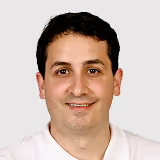
Marcel Kloos
Swiss-licensed dentist and founder of Medschool Experts
Marcel Kloos founded Medschool Experts while studying abroad; since then, over 500 study places have been secured. The Stuttgart-born dentist studied dentistry from 2015 to 2021 in Sofia and holds a Swiss dental licence.
Today he lives in Bern and runs Medschool Experts full-time as its owner.
More articles worth reading
Why Students Transfer from Medical University of Varna — Your Options
Why Students Transfer from Medical University of Warsaw — Your Options
Why Students Transfer from Masaryk University Faculty of Medicine — Your Options

Ahmad
Sabrina
Rami

Noah
500+ students placed.
Now it's your turn!
No daydreaming, no empty promises. Just a clear plan — for the start of your medical degree.
40 minutes, no obligation