Studying Medicine in Halberstadt: Costs, Structure, Recognition
28.08.2026

Halberstadt at a glance
The programme is a cooperation: the Faculty of Medicine of the University of Osijek is responsible for curriculum, examinations, and the degree; the AMEOS Group provides the hospitals for the clinical phase in Saxony-Anhalt. For you, this means a degree in two countries with a single language of instruction. The overview below summarises what matters for the decision.
| Feature | Details (as of 2026) |
|---|---|
| University | Josip Juraj Strossmayer University Osijek, Faculty of Medicine |
| Teaching base in Germany | AMEOS Hospital Halberstadt, Saxony-Anhalt |
| Degree programme | Medicine, integrated (bachelor and master in one) |
| Language of instruction | German, throughout |
| Tuition | 8,000 EUR per semester |
| Standard duration | 6 years, 12 semesters, 360 ECTS |
| Qualification | Doctor of Medicine from the University of Osijek |
| Selection process | Written test and motivational/aptitude interview |
| Entry requirement | General higher education qualification, no numerus clausus |
| Study intake | October |
| Recognition in Germany | Automatic under Directive 2005/36/EC |
The Abitur grade does not determine the place here. A general higher education qualification is required; after that, what counts is what you demonstrate in the entrance exam and interview. An overview of the Croatian context as a whole, what other faculties exist, and how Osijek compares, is covered in our guide Studying medicine without an NC in Croatia.
University and hospital
Josip Juraj Strossmayer University Osijek is the state university of eastern Croatia; its Faculty of Medicine is located at Josipa Huttlera 4 in Osijek's hospital district. It offers the German-language programme under the title "University Integrated Undergraduate and Graduate Study of Medicine in German" and lists it with six years, twelve semesters, and 360 ECTS credits (mefos.unios.hr, academic year 2026/2027). The academic degree you hold at the end is from a Croatian state university, regardless of where you spent your clinical years.
The German side of the cooperation is the AMEOS Group, a hospital operator with more than 60 sites in Germany, Austria, and Switzerland according to its own figures. AMEOS Hospital Halberstadt employs around 750 staff and treats approximately 50,000 patients per year on an outpatient and inpatient basis; it is a teaching hospital of Otto von Guericke University Magdeburg and additionally provides 28 training positions in nursing, anaesthesia, and operating theatre technology (ameos.de, as of August 2026). The hospital covers a broad spectrum: internal medicine, cardiology, and general surgery through to orthopaedics, neurosurgery, urology, and paediatrics.
What strikes me most about this arrangement is the following: clinical teaching does not take place in a facility built for teaching, but in a regular care hospital with an emergency department, occupancy pressures, and a catchment area extending beyond the city boundary. You learn medicine where it actually happens in the German system. Anyone aiming later for specialist training in Germany will already be familiar with documentation, billing logic, and ward handovers — not just from second-hand accounts.
The Osijek section has a different character. There, you sit within a classic faculty structure with a dissection course, institutes, and a year group navigating the pre-clinical examinations together. This combination of a Croatian faculty and a German hospital is the true distinctive feature of the programme.
What degree programmes are available and in which language?
This institution offers exactly one programme: medicine in German. Dentistry, pharmacy, or veterinary medicine are not available via Halberstadt. The degree programme is structured as an integrated course — there is no intermediate bachelor-level qualification and no second application after three years.
| Degree programme | Standard duration | Qualification | Language of instruction |
|---|---|---|---|
| Medicine (integrated) | 6 years, 12 semesters, 360 ECTS | Doctor of Medicine | German |
The fact that instruction is entirely in German is the greatest practical difference from English-language programmes abroad. You don't need a language certificate, and you learn medical terminology directly in the language in which you will later work. For the years in Osijek, though: a few words of Croatian for flat-hunting, shopping, and neighbourly life make daily life easier. For lectures and examinations, you don't need them.
How does the admissions process work?
The University of Osijek selects via a points system. According to the faculty's information, the higher education entrance examination result carries up to 200 points; the aptitude assessment — comprising a knowledge test, cognitive test, and interview — carries up to 500 points; and the evaluation of motivation and qualifications carries up to 300 points (mefos.unios.hr, academic year 2026/2027). The written section covers biology, chemistry, and general knowledge at upper secondary school level.
The emphasis therefore lies clearly on what you demonstrate in the process itself, not on the Abitur grade. That is exactly why this route works for many who narrowly miss out in the German process. But it also means preparation counts: underestimating the test throws away points that are hard to recover in the interview.
We prepare you for both parts — the subject-matter section in biology and chemistry, and the motivational and aptitude interview, in which you explain why you want to study medicine and why at this institution. As a contractual partner of this institution, we handle enrolment, application, and the organisation of the process for you; we take care of the documents. Participation is usually fully online; you don't need to travel to Osijek or Halberstadt for the test.
Study begins in October; there is no summer semester intake. Deadlines and exam dates are set by the university each year anew; which dates apply for your year and whether your educational background qualifies are things we assess individually in a free consultation. Because places are limited, starting the process early pays off.
What does the programme cost?
Tuition is the dominant item and is due per semester. It stands at 8,000 EUR and is billed in euros, so there is no exchange rate risk.
| Item | Amount | Period |
|---|---|---|
| Tuition | 8,000 EUR | per semester |
| Tuition | 16,000 EUR | per academic year |
| Total tuition | 96,000 EUR | 12 semesters standard duration |
Living costs also apply, at two locations in succession. For the Osijek years, studimed.de quotes 500 to 800 EUR per month; Numbeo lists 718 EUR per month for Osijek excluding rent and 365 EUR for a one-bedroom apartment outside the city centre (as of July 2026). For Halberstadt itself, Numbeo holds no data; the nearest recorded city is Magdeburg at 1,017 EUR excluding rent and 389 EUR for a one-bedroom apartment outside the city centre (as of July 2026). Halberstadt is significantly cheaper than large German university cities for accommodation, but reliable average figures for the city itself are not available to us.
My own projection over the full study duration, explicitly noted as an estimate: 96,000 EUR in fees plus around 700 to 1,000 EUR per month in living costs over 72 months — that's 50,400 to 72,000 EUR — comes to approximately 146,000 to 168,000 EUR in total. Add textbooks, trips home, and two moves between Croatia and Saxony-Anhalt. That is the one limitation that must be named honestly about this institution: the price sits at the upper end of what European medical programmes cost, and the total should be calculated and financed from the outset.
Compared with other institutions in our series, the positioning is as follows:
| Institution | Language of instruction | Medicine tuition per semester |
|---|---|---|
| Halberstadt, University of Osijek | German | 8,000 EUR |
| Pécs, Hungary | German | 7,500 EUR |
| Rijeka, Croatia | English | 6,000 EUR |
| Split, Croatia | English | 6,000 EUR |
The figures for the comparison institutions are from studimed.de, as of 2026. The premium over the English-language Croatian programmes buys you two things: instruction in your native language and six clinical semesters in a German hospital.
{{cta}}
How is the programme structured?
The split between the two locations is firmly anchored in the curriculum and non-negotiable. You begin in Osijek, move to Saxony-Anhalt at the midpoint of the programme, and return for the final semester.
| Phase | Semesters | Location | Focus |
|---|---|---|---|
| Pre-clinical | 1 to 4 | Osijek | Anatomy, physiology, biochemistry, histology, embryology |
| Transition | 5 | Osijek | Pathology, pharmacology, first clinical foundations |
| Clinical | 6 to 11 | Halberstadt | Internal medicine, surgery, paediatrics, gynaecology, neurology, psychiatry |
| Graduation | 12 | Osijek | Practically oriented final year and diploma examination |
The practically oriented final academic year corresponds in structure and demands to the German Practical Year (PJ). The move to Halberstadt comes at a point when many students are ready to catch their breath anyway: the major pre-clinical examinations are behind you, and the daily routine shifts from lecture theatre to ward.
What I appreciate about this structure is the clear separation of learning modes. In Osijek you learn systematically and in groups; in Halberstadt you learn at the patient's bedside and within a department team. Two moves and two living situations mean an organisational effort that a single-location programme doesn't have. Planning this early means you don't lose a semester to it.
Where can you practice medicine with this degree?
What matters is not where you sat in the lecture theatre, but which university issues the degree. That is the University of Osijek — a state institution in an EU member state. This means Directive 2005/36/EC on the recognition of professional qualifications applies; the Croatian medical degree is listed under item 5.1.1 in Annex V as amended by Delegated Decision (EU) 2023/2383 of 23 May 2023, applicable since 9 October 2023.
| Country | Route to professional licensure |
|---|---|
| Germany | Automatic recognition, medical licence via the state authority, proof of German language skills required |
| Austria | Automatic recognition, registration via the Austrian Medical Chamber |
| Switzerland | Recognition of the EU degree via the competent federal authority, followed by registration |
| Rest of EU and EEA | Automatic recognition under Directive 2005/36/EC, national registration required |
| United Kingdom | Registration with the General Medical Council; its own procedure since leaving the EU |
| USA | ECFMG certification and USMLE; since 1 January 2023 the faculty must be accredited by a WFME-recognised agency |
The last point requires clarification. The responsible national accreditation agency for Croatian programmes is the Agency for Science and Higher Education, known as ASHE. In the list published by WFME, ASHE is listed as of August 2026 as an agency that has applied for recognition but has not yet received recognition status. The German ASIIN and AMSE are also not listed there. For Germany, Austria, Switzerland, and the EU, this changes nothing. Anyone seriously considering the USA should clarify this point with ECFMG directly before applying.
Dentist, pharmacist, psychologist, veterinarian: the legal situation by profession
Dentist. No dentistry programme is offered via Halberstadt. In principle, dentistry is harmonised within the EU; Croatian degrees are listed in Annex V under item 5.3.2 and are therefore automatically recognised. If you want to study dentistry, we will find a suitable institution in our network for you.
Pharmacist. Pharmacy is also harmonised; the Croatian degree is listed in Annex V under item 5.6.2. The route runs via a separate five-year programme including a practical year, not via the medical degree. Halberstadt does not offer this.
Psychologist. Psychology and psychotherapy are not harmonised under European law. There is no Annex V entry and therefore no automatic recognition; each country decides under its own law. In Germany, the licence as a psychotherapist is governed by the Psychotherapeutengesetz. Anyone aiming for this profession needs to plan a completely different route from the outset.
Veterinarian. Veterinary medicine is harmonised and listed in Annex V under item 5.4.2. In Croatia, however, it is based at the University of Zagreb and is not part of the Halberstadt programme. For veterinary medicine, a different institution is the right choice.
Career paths after graduation
After the degree and medical licence, most graduates begin specialist training. Depending on the speciality, this lasts five to six years and takes place at hospitals or practices with authorisation to train. Legally, you are on the same footing as graduates of German faculties; the specialist training regulations of the competent state medical chamber apply equally to all.
This institution has one detail for the career entry that I think is underrated: you have spent six clinical semesters in a German hospital, often in the same departments where positions later need to be filled. Doctors who have seen you over months in the day-to-day ward routine can assess your work. That doesn't replace an application, but it changes its starting position. Saxony-Anhalt and the surrounding states are also visibly looking for medical recruits, particularly outside urban centres.
The degree, however, does not tie you to the region or even to Germany. With an EU degree, specialist training and employment are open to you across the entire internal market, plus pathways into research, public health, industry, or medical practice outside curative medicine. The options an EU medical degree opens up worldwide, and what to watch out for when moving across national borders, are described in detail in Career paths with an EU medical degree.
Lateral entry, transfer, and return transfer to Germany
A transfer to a German faculty during your studies is possible, but not automatic. It requires two things: a vacant place in a higher semester and the recognition of your previous credits by the receiving faculty. The credits office there decides on recognition based on content and scope of each subject, usually on a case-by-case basis.
This institution has a particularity that works in both directions: your clinical semesters were completed at a German hospital, but your examinations were taken under the Croatian curriculum. The documentation for this is provided by the transcript of records from the University of Osijek, which clearly lists ECTS credits and subjects. Keep these documents complete from the very first semester.
My advice is nonetheless the same as for all institutions: plan your studies so that you can finish them where you began. A transfer is an option, not a part of the plan. How credit recognition and return transfer work in detail is covered in our guide on returning to Germany.
Life in Halberstadt: city, distances, costs
Halberstadt has around 40,000 inhabitants and is the district capital of the Harz district. The cathedral, the half-timbered old town, and the Harz mountains on the doorstep define the picture; a curious and globally unique feature is the ORGAN2/ASLSP organ project by John Cage in the Burchardikirche, running since 2001 and designed to last 639 years. The city is a railway hub with hourly direct connections to Magdeburg, Halle an der Saale, and Goslar; Magdeburg and Braunschweig are about an hour away. You don't need a car for daily student life; for day trips into the Harz it's pleasant.
Distances are short, and in the clinical phase that's worth more than it sounds. Those who need to be at the morning ward round at six are glad when there's ten minutes between their flat and the hospital rather than a commute. Housing is available and cheap compared to Leipzig, Hamburg, or Munich; the Magdeburg reference figures of 389 EUR for a one-bedroom apartment outside the centre (Numbeo, as of July 2026) represent rather the upper limit of what you should budget for Halberstadt.
Halberstadt is not a university town in the conventional sense. There is no large campus, no dense network of student offerings, and Harz University of Applied Sciences, with its administration focus, is a different world. Year groups are small, people know each other, and those seeking nightlife take the train to Magdeburg. For the Osijek years, the opposite applies: Osijek, with over 100,000 inhabitants, is the largest city in Slavonia, has a lively student scene, and lies on the Drava. Both phases have their own rhythm.
Who this institution suits
This route suits you if you want to study medicine in German, see your professional future in Germany, and want to learn the clinical phase within the system you'll later work in. It suits you if your Abitur doesn't qualify for the German process, but you are willing to face an entrance exam and prepare for it. And it suits you if the financing of 96,000 EUR in tuition fees is in place — whether through personal funds, a student loan, family support, or a combination.
It is less suitable if you are looking for a large university city with a broad campus life, or if you have committed to dentistry, pharmacy, or veterinary medicine. Anyone planning a career in the USA should also clarify the accreditation status beforehand. In both cases, we have other institutions on our programme that fit better.
My assessment: Halberstadt is one of the most pragmatic routes into medicine that we have in our portfolio, because it combines two things that rarely come together — an EU degree without a numerus clausus, and a clinical routine in German. If you want to know whether your profile suits this institution, we can discuss it in a free consultation.
The author's view
I studied dentistry in Sofia from 2015 to 2021 and know very well from my own experience what it feels like to begin a degree in another country. For me, there was also the unfamiliar language; in Halberstadt and Osijek, that element falls away entirely. What remains is the feeling of the first few weeks: new city, new year group, a volume of material that initially overwhelms. That fades faster than you believe in the first week.
What convinces me about this institution is the consistency of the arrangement. An EU degree from a state university, instruction entirely in German, and six clinical semesters in a hospital providing standard routine care. I experienced during my studies how much time goes into learning medical terminology twice — once in the study country and once for working back home. That double loop is completely absent here, and that is a tangible advantage.
Honestly: the price is the point where I would advise everyone to calculate twice. 8,000 EUR per semester adds up over twelve semesters to 96,000 EUR in fees alone, plus living costs at two locations. That is a lot of money, and it doesn't become less because the training is good. Anyone who doesn't underpin this sum with a solid plan from the start ends up under financial pressure in year four or five — and that's exactly when the mind should be on medicine.
Today I run Medschool Experts in Bern full-time and sit regularly with families weighing up several institutions. Halberstadt comes into play for those who think pragmatically: as close to the German system as possible, as little friction loss in recognition as possible, at a higher price. Those who share these priorities and can handle the financing get one of the most direct routes to the medical profession that I know of.
Summary
- The programme belongs to the University of Osijek in Croatia; the teaching base for the clinical phase is AMEOS Hospital Halberstadt in Saxony-Anhalt.
- Six years, twelve semesters, 360 ECTS: semesters 1 to 5 in Osijek, 6 to 11 in Halberstadt, semester 12 back in Osijek.
- Teaching is conducted entirely in German; no language certificate is required.
- Tuition is 8,000 EUR per semester, amounting to 96,000 EUR over the standard study duration; estimated total costs are around 146,000 to 168,000 EUR.
- Selection is via a points system with a written test and a motivational/aptitude interview, not by the Abitur grade; study intake is in October.
- The degree is automatically recognised in Germany, Austria, and Switzerland under Directive 2005/36/EC, without a knowledge examination.
Conclusion
Halberstadt is the most unusual institution in our series, because it brings the study abroad halfway back to Germany. You study at a Croatian state university, attend your lectures in German, and learn the clinical routine in a German hospital with an emergency department, ward duties, and a real care mandate. For all those who see their professional future in Germany anyway, this is a remarkably friction-free path to the medical profession.
The price is real and should be planned for soberly, as should the location change at the midpoint of the programme. Everything else is well plannable: we prepare you for the selection process, we organise the application, and we take care of the documents. Whether this institution fits your profile and finances is best discussed personally in a free consultation.
Further reading
- Studying medicine abroad without an NC — overview of institutions, costs, and financing.
- Medical school tuition fees in Europe — what the individual countries and universities charge.
- Medical licensure and recognition — how the EU degree becomes the German medical licence.
- Monthly budget for studying abroad — realistic living costs month by month.
- Studying medicine without an NC in Croatia — the overview of the study country behind this institution.
Frequently asked questions about studying medicine in Halberstadt
Do I need a specific numerus clausus for Halberstadt?
No. A general higher education qualification is required, but the Abitur grade alone does not determine the place. The University of Osijek selects via a points system in which the written test and the motivational/aptitude interview carry the most weight. Those who narrowly miss out in the German process therefore still have a real chance here.
How does the University of Osijek's selection process work?
It consists of several components: the result of your higher education entrance examination, an aptitude assessment including a knowledge test and interview, and an evaluation of motivation and qualifications. The subject-matter section covers biology, chemistry, and general knowledge at upper secondary school level. We prepare you specifically for both parts.
What does the programme cost in total?
Tuition is 8,000 EUR per semester; over twelve semesters of standard study duration, that's 96,000 EUR. Together with living costs at both locations, our estimate puts the total at around 146,000 to 168,000 EUR over the entire programme. Billing is in euros, so there is no exchange rate risk. This is a sum you should work through honestly from the start.
What additional costs are there besides tuition?
Rent and living costs in Osijek and later in Halberstadt, plus textbooks and trips home. A particular feature of this programme is the two moves between Croatia and Saxony-Anhalt, which cost money, time, and organisation. Planning these early means no unpleasant surprises in your budget later. Insurance and a buffer for exam periods also belong in the calculation.
What language is used for teaching?
Entirely in German, both in the pre-clinical phase in Osijek and in the clinical phase at AMEOS Hospital Halberstadt. A language certificate is therefore not required. This distinguishes the programme from English-language degrees abroad, where you effectively have to acquire medical terminology twice — once for the degree and once for working in Germany.
Do I need to learn Croatian for the years in Osijek?
Not for admission, lectures, or examinations. Teaching is in German, and patient contact in the clinical phase takes place in Halberstadt. For everyday life in Osijek, basic Croatian is still useful — for shopping, dealings with authorities, or contact with neighbours and fellow students. Many students take a language course on site for this purpose.
How is the programme split between Osijek and Halberstadt?
Six years, two countries. Semesters 1 to 5 are spent at the Faculty of Medicine in Osijek covering anatomy, physiology, biochemistry, histology, and embryology. Semesters 6 to 11 are at AMEOS Hospital Halberstadt; the twelfth semester is back in Osijek, where the diploma examination also takes place.
Is the degree recognised in Germany even though it comes from Croatia?
Yes. The degree is awarded by Josip Juraj Strossmayer University Osijek, a state institution in the European Union. Under Directive 2005/36/EC, the medical degree is automatically recognised in Germany — without an equivalence assessment and without a knowledge examination. The fact that the clinical phase takes place in Halberstadt does not change this legal position. Austria and Switzerland also recognise the degree.
How do I obtain the German medical licence?
You apply to the licensing authority of the state in which you wish to work; for the region around Halberstadt, that is Saxony-Anhalt. Formal completeness is checked, not content equivalence. Proof of German language skills is required — which is straightforward after a German-language programme.
Do I receive ECTS credits and a transcript of records?
Yes. The programme encompasses 360 ECTS credits, and the University of Osijek documents your performance in the European credit transfer system. You will need the transcript of records later for the medical licence application, for job applications, and for any possible transfer. Keep all documents carefully from the first semester onward — preferably in digital and paper form. Obtaining them retrospectively is considerably more laborious.
When does the programme start, and when should I get in touch?
Study begins in October; there is no summer semester intake. Get in touch as early as possible in the year before your intended start, because places are limited and preparation for the selection process takes time. From the initial consultation onward, we handle the organisation; we take care of the documents.
Where do I live during the programme?
In two cities in succession: first in Osijek, then in Halberstadt from semester six onward. Halberstadt is manageable in size, distances between flat and hospital are short, and rent and living costs are significantly below the level of major German university cities. Take care of both sets of accommodation in good time, especially before the move to Saxony-Anhalt. We support you with the flat search at both locations.
How much practical experience do I get at AMEOS Hospital Halberstadt?
The entire clinical phase takes place there. The hospital employs around 750 staff and treats approximately 50,000 patients per year on an outpatient and inpatient basis. You learn internal medicine, surgery, paediatrics, gynaecology, neurology, and psychiatry at the patient's side; the final academic year corresponds to the German Practical Year. You therefore become familiar with German hospital procedures early on.
What students say about Medschool Experts
Over 500 placements at more than 25 partner universities across 10+ countries. Read independent student reviews on Trustpilot.
About the author
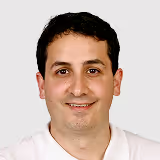
Marcel Kloos
Swiss-licensed dentist and founder of Medschool Experts
Marcel Kloos founded Medschool Experts while studying abroad; since then, over 500 study places have been secured. The Stuttgart-born dentist studied dentistry from 2015 to 2021 in Sofia and holds a Swiss dental licence.
Today he lives in Bern and runs Medschool Experts full-time as its owner.
More articles worth reading
Why Students Transfer from Medical University of Varna — Your Options
Why Students Transfer from Medical University of Warsaw — Your Options
Why Students Transfer from Masaryk University Faculty of Medicine — Your Options
Ahmad
Sabrina
Rami
Noah
500+ students placed.
Now it's your turn!
No daydreaming, no empty promises. Just a clear plan — for the start of your medical degree.
40 minutes, no obligation