Studying Medicine in Anguilla: Costs, Structure, Recognition
28.08.2026

Anguilla at a Glance
Anguilla is a British Overseas Territory in the north-eastern Caribbean with around 15,000 inhabitants. The island is flat, dry, and lives from tourism. George Hill, where New Anglia University has its campus, lies in the west near Clayton J. Lloyd Airport and a few kilometres from the island's capital, The Valley. Studying medicine here means studying not in a university city but on a small island with short distances and English as the official language.
| Feature | Detail (as of 2026) |
|---|---|
| University | New Anglia University, George Hill |
| Programme | Human Medicine, degree: Doctor of Medicine |
| Language of instruction | English |
| Standard duration | 4 years (Graduate Entry), 5 years with pre-med year |
| Tuition fee | USD 3,600 to USD 5,500 per term, depending on the section |
| Term length | 15 weeks |
| Intake dates | January, May, and September |
| Admission | No numerus clausus, no entrance examination |
| Accreditation | Government-licensed; listed in the World Directory of Medical Schools and with FAIMER; not accredited by ACCM or CAAM-HP |
| Clinical section | Partner hospitals in the United Kingdom, the USA, Germany, and Anguilla |
| Country | Anguilla, British Overseas Territory, approx. 15,000 inhabitants, official language English |
Two things distinguish this location from the European universities in our series: the billing cycle in USD terms instead of semesters, and the fact that Anguilla is not part of the European Union. Neither is an automatic exclusion criterion. Both, however, belong at the beginning of a decision — not at the end.
University and Hospital
New Anglia University is licensed as a higher education institution by the Government of Anguilla and runs an English-language MD programme on the North American model. Pre-clinical teaching takes place on campus in George Hill. For clinical training, the university does not rely on a university hospital of its own but on a network of partner hospitals in the United Kingdom, the USA, Germany, and Anguilla. This model is common in the Caribbean and has two sides — both of which you should know.
One side: during the clinical section you see several healthcare systems from the inside. Those who later want to work internationally gain experience here that a single-site location simply cannot provide. The other side: rotations at different places demand considerably more self-organisation. Travel, accommodation, and entry requirements are your responsibility — and they cost money that does not appear in any fee schedule.
On the topic of accreditation I want to be precise, because a great deal of confusion surrounds this point. New Anglia University is listed in the World Directory of Medical Schools and in the FAIMER database. These directories document that a faculty exists and is licensed in its country of location — they are not themselves an accreditation and say nothing about a curriculum quality review. The university does not hold accreditation from the Accreditation Commission on Colleges of Medicine (ACCM) or from the Caribbean Accreditation Authority for Education in Medicine and Other Health Professions (CAAM-HP). Both agencies carry the Recognition Status of the World Federation for Medical Education; the WFME lists ACCM with status until December 2026 and CAAM-HP until May 2033, and both are responsible for Anguilla. What follows from this is explained in the chapter on professional licensing below.
Which programmes are offered and in which language?
Through us, New Anglia University admits students to Human Medicine only, taught entirely in English. You do not need to learn a second national language, because the official language of Anguilla is English — in the lecture hall and in the supermarket alike. English proficiency from level B2 is required. Dentistry, pharmacy, and veterinary medicine are not offered at this location.
| Programme | Language | Standard duration | Degree |
|---|---|---|---|
| Human Medicine (Graduate Entry) | English | 4 years | Doctor of Medicine |
| Human Medicine with pre-med year | English | 5 years | Doctor of Medicine |
The difference between the two paths lies solely in the starting point. Those who already hold a BSc or 90 credit hours from a science-based prior degree enter directly into the MD programme. Those coming straight from school complete the pre-med year first and make up the science prerequisites there.
How does admission work?
There is no numerus clausus at New Anglia University, and there is no entrance examination at this location either. The institution decides on applications holistically. The basis is a general university entrance qualification; for direct entry into the MD programme, a BSc or 90 credit hours in a pre-med subject are added, along with English proficiency from level B2.
Registration, application, and the entire admission process are organised by Medschool Experts. This typically takes place entirely online, so you do not need to fly to the Caribbean to apply. We handle the paperwork; you provide the content. From the initial consultation to the offer, we guide the process.
We prepare you for every stage of the process. This includes the science foundation in biology and chemistry you will need for the pre-med section, as well as any motivation interview the university may schedule. Because no test score drives the decision, the overall picture of your application matters more here than elsewhere. Whether your academic background meets the prerequisites for Graduate Entry is something we assess individually in a free advisory consultation.
What does the programme cost?
New Anglia University does not bill by semester but by terms of 15 weeks each. The price per term rises with the section of study.
| Section | Fee per term | Term length |
|---|---|---|
| Pre-med | USD 3,600 | 15 weeks |
| Basic Sciences | USD 4,300 | 15 weeks |
| Clinical Sciences | USD 5,500 | 15 weeks |
These figures say little in isolation, because several terms fall within each academic year. I have therefore drawn up my own calculation. It assumes three terms per academic year — corresponding to the three intake dates in January, May, and September — and two years each for Basic Sciences and Clinical Sciences. This is an estimate, not a figure from the university; how many terms you actually complete depends on your course of study.
| Path | Terms (estimate) | Total tuition fees (estimate) |
|---|---|---|
| Pre-med year | 3 terms at USD 3,600 | USD 10,800 |
| Basic Sciences | 6 terms at USD 4,300 | USD 25,800 |
| Clinical Sciences | 6 terms at USD 5,500 | USD 33,000 |
| Graduate Entry, 4 years | 12 terms | approx. USD 58,800 |
| With pre-med year, 5 years | 15 terms | approx. USD 69,600 |
On top of this come application-related fees as well as textbooks, flights to the Caribbean, and visa and residence fees. Because the clinical section takes place at partner hospitals in multiple countries, travel and accommodation costs arise later at changing locations — the item most commonly missing from cost projections. And because billing is in US dollars, your burden in euros depends on the exchange rate. A 10 per cent shift in the rate moves the total over five years by several thousand euros.
| Location | Tuition fee | Standard duration | Annex V of Directive 2005/36/EC |
|---|---|---|---|
| Anguilla, New Anglia University | USD 3,600 to USD 5,500 per term | 4 to 5 years | not listed |
| Riga, Rīga Stradiņš University | EUR 6,750 per semester | 6 years | listed |
| Katowice, Medical University of Silesia | EUR 7,680 per semester | 6 years | listed |
| Pilsen, Charles University | EUR 8,064 per semester | 6 years | listed |
The comparison reveals the real argument for this location: calculated over the full course of study, tuition fees in Anguilla are considerably lower than those at the European universities in our series, because the programme is shorter and the per-term price is lower. What you do not receive in return stands in the last column.
{{cta}}
How is the programme structured?
The MD programme follows the North American model: first the scientific and theoretical foundations, then clinical training at the patient's bedside. Progress is measured in credit hours and terms, not in ECTS credits.
| Section | Academic years | Focus |
|---|---|---|
| Pre-med | Year 1 (omitted in Graduate Entry) | Biology, chemistry, physics, science fundamentals |
| Basic Sciences | First two years of the MD programme | Anatomy, physiology, biochemistry, pathology, pharmacology on campus in George Hill |
| Clinical Sciences | Final two years of the MD programme | Clinical rotations at partner hospitals in the UK, the USA, Germany, and Anguilla |
| Graduation | End of year 4 or 5 | Doctor of Medicine |
One aspect of this is unusual for German applicants: there is no Physikum and no Staatsexamen in the German sense. Progress is documented through passed courses and credit hours, and at the end there is a Transcript of Records. No fixed conversion of credit hours to ECTS credits exists; anyone who later wishes to have work credited in Europe presents their transcript to the relevant authority for individual assessment.
Where may you practise medicine with this degree?
This is the question that decides the case for this location. Anguilla is a British Overseas Territory and does not belong to the European Union. Directive 2005/36/EC on the recognition of professional qualifications — whose Annex V, in the version of Delegated Decision (EU) 2023/2383 of 23 May 2023, applicable since 9 October 2023, lists the automatically recognised medical training certificates under number 5.1.1 — does not include degrees from Anguilla. For you, this means: no automatism, but an assessment procedure — one that nonetheless leads to the Approbation.
| Country | Path to professional licensing |
|---|---|
| Germany | Application to the Approbation authority of the federal state; equivalency assessment under Section 3 of the Bundesärzteordnung; if equivalency is not established, a knowledge examination; thereafter the Approbation |
| Austria | Nostrification or recognition procedure at a medical university, followed by entry in the medical register |
| Switzerland | Individual case assessment by the competent federal authority; without a recognition agreement, an authorisation is subject to conditions |
| EU member states | No automatic recognition under Annex V; national individual case assessment, frequently with an aptitude or knowledge test |
| United Kingdom | Registration with the General Medical Council via the route for international graduates, usually with an examination and language proof |
| USA | ECFMG certification has, since 1 January 2023, required accreditation of the faculty by a WFME-recognised agency; this is currently not in place for New Anglia University |
The last row deserves a clear explanation, because Caribbean MD programmes are often marketed with the US route. Since 1 January 2023, the ECFMG requires that the medical faculty be accredited by an accreditation agency that itself carries the Recognition Status of the World Federation for Medical Education. For Anguilla, those agencies are ACCM and CAAM-HP. New Anglia University holds neither of these accreditations. As long as that remains the case, I cannot describe the route via USMLE and residency in the USA as a secured path for this location — and I therefore do not do so. If the USA is your firm goal, we will jointly examine locations for which this accreditation chain is demonstrably in place.
How the recognition of foreign qualifications in the healthcare professions works in practice, which authority is responsible, and how long the procedures take, we have described in a dedicated guide: Recognition of Foreign Qualifications in Healthcare 2026. Those going to Anguilla should have read this article before applying — not after the final examinations.
Dentist, pharmacist, psychologist, veterinarian: the legal position by profession
Dentist. New Anglia University does not train dentists. For the EU, Directive 2005/36/EC governs dental training certificates under number 5.3.2 of Annex V, and degrees from Anguilla are not listed there. Those wishing to study dentistry are better placed at our European locations, where automatic recognition applies.
Pharmacist. Pharmacy in the EU is harmonised under number 5.6.2 of Annex V. Anguilla does not offer this programme through us, and a non-European pharmacy degree would in any case be subject to individual assessment by the competent state authority. The difference in procedural complexity compared to an EU degree is considerable.
Psychologist. Psychology and psychotherapy are not harmonised under EU law — there is no Annex V entry for these professions, even within the EU. Recognition is always governed by national law: in Germany by the Psychotherapeutengesetz and the regulations of the individual Länder. A Caribbean psychology degree is therefore assessed individually, just as a Dutch one would be.
Veterinarian. Veterinary training in the EU is governed by number 5.4.2 of Annex V. Veterinary medicine is not offered at New Anglia University. For this subject we exclusively place students at European universities whose degrees are listed in Annex V.
Career paths after graduation
With the MD in hand, several directions are open to you, and they differ considerably in effort and predictability. The route to Germany goes through the Approbation authority of your federal state. It assesses the equivalency of your training; if equivalency is not established, a knowledge examination follows — an oral-practical examination covering the content of the German Staatsexamen. A temporary licence to practise (befristete Berufserlaubnis) is frequently possible beforehand, allowing you to work in a hospital and earn a salary. The Approbation — and with it access to specialist training — follows thereafter.
The route to the United Kingdom is more natural at this location than at others, because part of the clinical rotations takes place there. You will then already know the system from the inside, and the General Medical Council has an established procedure for international graduates. Anguilla itself is a British Overseas Territory, which is helpful for the practical organisation of your stay, but does not represent a shortcut for medical registration in the United Kingdom.
Which doors a medical degree opens internationally, what examinations are required in the various target countries, and how long the procedures take, we have compiled in a dedicated guide: Career paths with a medical degree worldwide. I recommend reading this chapter before choosing a location — not after — because the target country determines the right starting point.
Lateral entry, transfer, and returning to Germany
Lateral entry into this programme is easier than at many European universities. Those who have already completed a science degree with a BSc or 90 credit hours enter directly into the four-year Graduate Entry — a route that does not exist in Germany in this form. Timing is also flexible: with three intakes per year, you rarely wait more than four months after a decision.
Returning to a German faculty follows a different calculation. It is possible, but it is not automatic. German faculties decide on each credit transfer individually, and achievements from a credit-hour system are harder to map than those from the European ECTS framework. Places in higher semesters are scarce in any case. I say this openly: do not view Anguilla as a stepping stone on the way back; make a conscious decision in favour of this degree. How a credit transfer works in detail is explained in our guide on returning to Germany.
Life in George Hill: island, distances, costs
George Hill lies in the west of Anguilla, a few minutes from Clayton J. Lloyd Airport and a few kilometres from The Valley. The island is about 16 kilometres long, flat, and dry; you can reach any point in a short time. International connections run mostly through Sint Maarten, accessible by ferry or short flight. Accommodation consists of rented apartments or shared flats near the campus, and we assist you with finding housing on the ground.
On living costs, I must be honest: there are no reliable overall figures for Anguilla. Numbeo lists the island with explicitly thin data — as of 18 December 2025, the figures are based on 25 entries from three contributors, and rental prices are not shown at all. What the database gives at that date are individual prices in US dollars: USD 20 for a simple restaurant meal, USD 2.23 for a litre of milk, USD 4.80 for a dozen eggs, USD 1.85 for a litre of petrol. These are values at Western European to North American levels, explained by the fact that almost everything is imported.
On accommodation, there is a structural point I find myself explaining repeatedly in consultations: with around 15,000 inhabitants, the rental market is very small, and it competes with holiday lettings. Budget more generously than you would for a European location, and plan for a shared apartment to reduce costs noticeably. Daily life itself is quiet and distances are short. What is missing is the cultural offering of a large city — those who need that energy will not find it on Anguilla.
Who this location suits
Anguilla suits you if you have already completed a science degree and want to use the four-year Graduate Entry, if you want to study in English without learning a second national language, and if clinical rotations at multiple hospitals in different countries appeal to you more than six years at a single institution. The three intakes per year are also a genuine argument when your timing does not fit the European winter semester.
The location suits you less if you know early on that you want to work permanently in Germany or in the EU. In that case, a degree listed in Annex V of Directive 2005/36/EC is the simpler route, because it avoids the equivalency assessment and the knowledge examination. For almost every case we have a suitable partner university, and which one it is depends on your goal — not on your grade point average.
My assessment: Anguilla is a location for people with a clear, internationally minded plan and the willingness to incorporate the recognition procedure from the outset. Those who have that plan get a short, English-language programme at fees that are low compared to the other locations in our series. Those who do not yet have it should develop it first and then choose the location — and that is precisely what the free advisory consultation is for.
The author's view
From 2015 to 2021 I studied dentistry in Sofia. I therefore know from personal experience what it means to move to a country you do not know in your early twenties and to see a demanding programme through for six years. Anguilla is a different magnitude again: not a country on the other side of Europe, but an island with 15,000 inhabitants on the other side of the Atlantic. Those who have done something like that themselves see such a decision differently from someone who only looks at the fee schedule.
What convinces me about this location is the structure of the programme. Four years in the Graduate Entry track is a very direct path to the medical profession for someone who has already completed a science degree, and three intakes per year take a great deal of pressure out of planning. The fact that the clinical section takes place at partner hospitals in the UK, the USA, and Germany strikes me as a strong argument — that breadth is something you simply do not get at most European locations.
Honestly: the absence of accreditation from ACCM or CAAM-HP is the point at which this location ends for many applicants. Without it, the route via ECFMG certification into a US residency is not secured, and that is precisely the route most people associate with a Caribbean MD. I would rather say this in the first consultation than in the third year of study. Those whose firm goal is the USA should choose a location where this chain is demonstrably in place.
Today I run Medschool Experts in Bern full-time and sit on the other side of the table. I see families weighing their options and young people who already know exactly where they want to go. Anguilla is the right choice for a small, clearly defined subset of them — namely those who want a short English-language programme and are prepared to go through the recognition procedure consciously. For that subset, it is then a very good choice.
Summary
- New Anglia University in George Hill on Anguilla offers an English-language MD programme; the clinical section runs at partner hospitals in the United Kingdom, the USA, Germany, and Anguilla.
- The programme lasts four years in the Graduate Entry track and five years with a preceding pre-med year; billing is in terms of 15 weeks each.
- The tuition fee is USD 3,600 per term during the pre-med section, USD 4,300 during Basic Sciences, and USD 5,500 during Clinical Sciences.
- There is no numerus clausus and no entrance examination; requirements are a general university entrance qualification, a BSc or 90 credit hours for Graduate Entry, and English from level B2.
- Anguilla is not part of the EU: in Germany an equivalency assessment under Section 3 of the Bundesärzteordnung follows — or, if equivalency is not established, a knowledge examination — and thereafter the Approbation.
- The university is listed in the World Directory of Medical Schools and with FAIMER, but does not hold accreditation from ACCM or CAAM-HP; ECFMG certification has required such accreditation since 1 January 2023.
Conclusion
Anguilla is the shortest path to a medical degree in our programme and at the same time the location that requires the most explanation. Those who already hold a science degree can reach the Doctor of Medicine here in four years, in English, at total fees that are lower than those of the European universities in our series. The price for this is the absence of automatic recognition in the EU and of a secured US route.
Whether this path suits you depends on three things: your professional goal, your academic background, and your willingness to incorporate the recognition procedure from the outset. We go through these three points together in a free advisory consultation — openly and without detours.
Further reading
- Recognition of Foreign Qualifications in Healthcare 2026 — how equivalency assessments and knowledge examinations work and which authority is responsible.
- Tuition fees compared — all NC-free medical universities in our programme side by side with their fees.
- Financing your medical studies abroad — BAföG, education funds, and student loans at a glance.
- The monthly budget while studying abroad — what a study programme really costs beyond the fees.
- Studying medicine without NC abroad — all locations, costs, and financing options at a glance.
Frequently asked questions about studying medicine in Anguilla
What are the admission requirements for the MD programme at New Anglia University?
The basis is a general university entrance qualification. For direct entry into the MD programme, a BSc or 90 credit hours in a pre-med subject are additionally required, along with English proficiency from level B2. Those coming straight from school enter via the preceding pre-med year and study for five years in total. There is no numerus clausus.
How does the application to New Anglia University work?
Without an entrance test. The institution decides on applications holistically, and we organise the entire process for you — typically entirely online. We handle the paperwork; you provide the content. Because no test score drives the decision, the overall picture of your application matters particularly here.
What does the programme cost in Anguilla?
New Anglia University bills by terms of 15 weeks each: USD 3,600 per term during the pre-med section, USD 4,300 during Basic Sciences, and USD 5,500 during Clinical Sciences. Because several terms fall within each academic year, the total over four to five years adds up to a considerable sum. Billing is in US dollars.
What additional costs come on top of the tuition fee?
An application fee is due once; textbooks are an ongoing expense. On top of this come flights to the Caribbean and visa and residence fees for Anguilla. Because the clinical section takes place at partner hospitals in the UK, the USA, Germany, and Anguilla, travel and accommodation costs arise later at changing locations. This item is frequently overlooked.
How expensive is life in Anguilla?
Reliable overall figures are not available. Numbeo lists Anguilla as of 18 December 2025 with explicitly thin data and does not show rental prices; individual values given include USD 20 for a simple restaurant meal. Because almost everything is imported and the rental market is small, you should budget more generously than for Europe.
Is my English sufficient for studying at New Anglia University?
Instruction is conducted entirely in English; a minimum of level B2 is required. The official language of Anguilla is also English, so you will also use the language in everyday life. Those who have solid school English can manage. Medical terminology is something you learn from scratch during your studies in any case.
Do I need to learn a second language for patient contact?
Not in Anguilla, because English is the official language and there are no compulsory courses in a national language. The clinical rotations are a different matter: they are organised in part at partner hospitals in Germany, where you will speak with patients in German. For German-speaking students, this is rather an advantage.
How is the MD programme at New Anglia University structured?
With a pre-med year, the programme lasts five years; in the Graduate Entry track, four. The pre-med section covers the science foundations, followed by Basic Sciences on campus in George Hill. The clinical section takes place at partner hospitals in several countries. Teaching is in 15-week terms, and the programme concludes with the Doctor of Medicine.
Is the MD degree from Anguilla recognised in Germany?
Not automatically, because Anguilla is not part of the European Union and is not listed in Annex V of Directive 2005/36/EC. The competent state authority assesses equivalency under Section 3 of the Bundesärzteordnung; if equivalency is not established, a knowledge examination follows. Thereafter the Approbation is granted. This route is longer and less predictable than with an EU degree.
What accreditation does New Anglia University hold?
It is licensed as a higher education institution by the Government of Anguilla and is listed in the World Directory of Medical Schools and with FAIMER. These directories document the existence and national licensing of the faculty; they are not themselves an accreditation. The university does not hold accreditation from ACCM or CAAM-HP.
Can I achieve ECFMG certification for the USA with this degree?
Since 1 January 2023, the ECFMG requires that the medical faculty be accredited by an agency carrying the Recognition Status of the World Federation for Medical Education. For Anguilla, those agencies are ACCM and CAAM-HP. Because New Anglia University holds neither of these accreditations, the US route is currently not secured.
Do I receive ECTS credits and a Transcript of Records?
New Anglia University operates on the North American system with credit hours and terms, not ECTS. You will of course receive a Transcript of Records for the courses and grades you have completed; it forms the basis for any subsequent assessment of your training. Conversion, if required, is carried out by the authority to which you apply.
When can I begin studying in Anguilla?
Three times a year: in January, May, and September. These three entry points make the location flexible, because after school or a first degree you do not necessarily have to wait until the following autumn. Each intake follows the 15-week term rhythm. Which date is realistic for you is something we clarify individually.
What students say about Medschool Experts
Over 500 placements at more than 25 partner universities across 10+ countries. Read independent student reviews on Trustpilot.
About the author
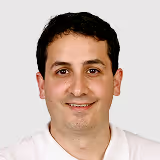
Marcel Kloos
Swiss-licensed dentist and founder of Medschool Experts
Marcel Kloos founded Medschool Experts while studying abroad; since then, over 500 study places have been secured. The Stuttgart-born dentist studied dentistry from 2015 to 2021 in Sofia and holds a Swiss dental licence.
Today he lives in Bern and runs Medschool Experts full-time as its owner.
More articles worth reading
Why Students Transfer from Medical University of Varna — Your Options
Why Students Transfer from Medical University of Warsaw — Your Options
Why Students Transfer from Masaryk University Faculty of Medicine — Your Options
Ahmad
Sabrina
Rami
Noah
500+ students placed.
Now it's your turn!
No daydreaming, no empty promises. Just a clear plan — for the start of your medical degree.
40 minutes, no obligation