Studying Medicine in Bratislava: Costs, Structure and Recognition
28.08.2026

Studying medicine in Bratislava at a glance
Comenius University Bratislava also teaches human medicine and dentistry in English, both programmes over six years. Human medicine costs 13,000 euros per academic year, dentistry 14,500 euros. Clinical training takes place at University Hospital Bratislava, the largest healthcare institution in Slovakia.
| Feature | Detail (as of 2026) |
|---|---|
| University | Comenius University Bratislava, founded 1919 |
| Faculty | Faculty of Medicine, the university's first faculty |
| Programmes in English | Human medicine (MUDr.), dentistry (MDDr.) |
| Duration | six years each |
| Fee, human medicine | 6,500 euros per semester (13,000 euros per year) |
| Fee, dentistry | 7,250 euros per semester (14,500 euros per year) |
| Access | science test in English (biology, chemistry) |
| Compulsory subject | Slovak for patient conversation |
| Recognition | automatic EU-wide, Directive 2005/36/EC Annex V |
| City | Bratislava, around 475,000 inhabitants, euro since 2009 |
Comenius University Bratislava: university and hospital
Comenius University goes back to Act No. 375 of 27 June 1919, which came into force on 11 July 1919. It has borne the name of the educator Jan Amos Comenius since 11 November 1919. Because of a shortage of money and staff, only the Faculty of Medicine operated at first.
Today Comenius University has 13 faculties, more than 23,000 students and around 4,000 employees. In the QS World University Rankings 2027 it stands at 662 and is thus the only Slovak higher education institution in the top thousand. For a country of 5.4 million inhabitants, that is a remarkable concentration: much of what has academic standing in Slovakia sits in Bratislava.
The Faculty of Medicine is in the city centre, at Špitálska 24. It teaches human medicine and dentistry in either Slovak or English, both as six-year full-time programmes. Teaching makes use of patient simulators, for which the faculty produces some parts itself by 3D printing. Through the European university alliance ENLIGHT it is connected with ten further universities, in addition to Erasmus+ and bilateral agreements.
The teaching hospital is Univerzitná nemocnica Bratislava. It consists of five hospitals across the city and is the largest healthcare institution in Slovakia. More than 1,400 doctors, 2,200 nursing professionals and around 6,000 employees in total work there. Each year the institution records more than 100,000 inpatient admissions and over 56,000 operations; in its three maternity clinics an average of 22 children are born each day. In short: case numbers are not lacking here.
Which programmes are available in Bratislava and in which language?
At the Faculty of Medicine of Comenius University there is human medicine and dentistry in English. Pharmacy runs at the Faculty of Pharmacy of the same university, likewise in English. Veterinary medicine is available in Slovakia only in Košice. Bratislava does not offer a German-language medical programme.
| Programme | Institution | Language and duration | Degree |
|---|---|---|---|
| Human medicine | Faculty of Medicine, Comenius University | English or Slovak, 6 years | MUDr. |
| Dentistry | Faculty of Medicine, Comenius University | English or Slovak, 6 years | MDDr. |
| Pharmacy | Faculty of Pharmacy, Comenius University | English, 5 years | Mgr. |
| Psychology | Faculty of Social and Economic Sciences, Comenius University | English, 3 years (bachelor) | Bc. |
| Veterinary medicine | UVLF Košice | English, 6 years | MVDr. |
Pharmacy at Comenius University concludes after at least five years with the Magister (Mgr.) and cost 7,500 euros in the academic year 2025/2026. The faculty admits 80 students per year group for it. The bachelor in social and work psychology at the Faculty of Social and Economic Sciences takes three years and is an undergraduate programme; it does not entitle the holder to provide psychotherapeutic treatment independently.
Veterinary medicine in Slovakia is studied at the University of Veterinary Medicine and Pharmacy in Košice, around 400 kilometres east of Bratislava. The English-language programme takes six years and costs EU citizens 10,000 euros per year.
What does studying medicine in Bratislava cost?
Human medicine at Comenius University costs 6,500 euros per semester, dentistry 7,250 euros. Over six years that adds up to 78,000 and 87,000 euros in tuition fees respectively. On top comes living in Bratislava, and that is well above the level of the Hungarian or Romanian locations.
For a room in a shared flat, around 450 euros is realistic in Bratislava; your own one-room flat in the centre costs 500 to 600 euros. Adding utilities, food, mobile phone, leisure and the monthly transport pass at around 40 euros, you arrive at roughly 850 euros per month. That is a Medschool Experts estimate, not an official figure.
| Item | Human medicine | Dentistry |
|---|---|---|
| Tuition fee per year | 13,000 euros | 14,500 euros |
| Total fees (6 years) | 78,000 euros | 87,000 euros |
| Living costs (850 euros x 72) | 61,200 euros | 61,200 euros |
| Study materials and trips home | 3,500 euros | 3,500 euros |
| Total (estimate) | around 143,000 euros | around 152,000 euros |
Compared with the other locations we have worked through in this series, Bratislava sits in the upper third. The difference arises less from the fees than from the rent: Bratislava is a prosperous capital on the Austrian border, and the housing market behaves accordingly.
| Location | Total costs, human medicine (estimate, 6 years) |
|---|---|
| Timisoara | around 100,000 euros |
| Cluj-Napoca | around 113,000 euros |
| Kaunas | around 126,000 euros |
| Bratislava | around 143,000 euros |
| Vilnius | around 143,000 euros |
| Debrecen | around 149,000 euros |
Which of these locations suits your budget and your school record is best looked at together. Book a free consultation for that.
{{cta}}How is the programme at Comenius University structured?
The medical programme in Bratislava is divided into three pre-clinical and three clinical academic years. The first years are dominated by anatomy, histology, physiology and biochemistry, plus medical terminology. From the fourth year, teaching moves to the hospitals of Univerzitná nemocnica Bratislava. At the end come the state examinations.
| Section | Academic years | Focus |
|---|---|---|
| Pre-clinical | 1 to 3 | Anatomy, histology, physiology, biochemistry, terminology, Slovak |
| Clinical | 4 to 6 | Internal medicine, surgery, gynaecology, paediatrics, neurology, psychiatry |
| Graduation | 6 | State examinations, titles MUDr. and MDDr. respectively |
Language is the point many prospective students underestimate. Slovak is a compulsory subject for students on the English-language programmes; it is taught at the faculty's Institute of Medical Terminology and Foreign Languages, which also offers the UNIcert I Slovak certificate for it. The reason is practical: patients in Bratislava speak Slovak, and without taking a history in the national language, clinical training does not work. Anyone who treats this as an additional qualification rather than a nuisance gets through considerably better.
Access to both programmes runs through a science test in English with questions from biology and chemistry. Whether your school record is sufficient for it, and what realistic preparation looks like, we assess individually in an initial consultation.
Where may you work as a doctor with a degree from Bratislava?
The Slovak degree MUDr. is listed in Annex V number 5.1.1 of Directive 2005/36/EC, in the version of Commission Delegated Decision (EU) 2023/2383 of 23 May 2023, applicable since 9 October 2023. Entry: "DIPLOM všeobecné lekárstvo doktor všeobecného lekárstva (MUDr.)", issuing body Univerzita, reference date 1 May 2004. No accompanying certificate is required.
That is the decisive difference from some neighbouring countries. Lithuania additionally requires the internship certificate, Poland the diploma, the LEK and a postgraduate placement. Slovakia does not: the diploma alone carries.
| Country | Route to professional licensing |
|---|---|
| Germany | German medical licence (Approbation) through the competent state authority, automatic recognition under Annex V 5.1.1 |
| Austria | Recognition plus entry in the register of doctors of the Austrian Medical Chamber |
| Switzerland | Recognition by MEBEKO, then a cantonal licence to practise |
| Rest of EU and EEA | automatic recognition under the same directive |
| United Kingdom | The GMC accepts the MUDr. diploma; for training begun on or after 1 May 2004, the diploma suffices |
| USA | ECFMG certification, USMLE, WDOMS listing; the Slovak agency SAAHE is WFME-recognised |
| Canada | Examinations of the Medical Council of Canada, access to residency through CaRMS |
| Australia | Examinations of the Australian Medical Council, registration with Ahpra |
For Germany there is an additional clarification that often gets lost: anyone who holds German citizenship or completed school or vocational training in Germany in German has to sit neither the general language examination nor the specialist language examination. Both apply to applicants without a German-language school or training background. In Switzerland the same applies by analogy to proof of language at level B2.
For the United Kingdom, the General Medical Council's country page names the Slovak certificates explicitly: the diploma for full registration, the "Diplom o špecializácii" for specialist registration and the "Diplom o špecializácii v odbore všeobecné lekárstvo" for GP registration. The basis is the state of the directive as at 31 December 2020.
For the route to the USA, what counts since 2023 is accreditation by an agency recognised by the World Federation for Medical Education. In Slovakia that is the Slovenská akreditačná agentúra pre vysoké školstvo, listed by the WFME as SAAHE. Its recognition for basic medical education runs until August 2034. The formal precondition for ECFMG certification is therefore met at the level of the national agency.
Dentist, pharmacist, psychologist, vet: the legal position by profession
Automatic recognition in the EU does not apply across the board to all healthcare professions but in each case through a separate number in Annex V of Directive 2005/36/EC. It applies to four of the five professions relevant here; not to psychologists.
Dentist. The Slovak degree MDDr. falls under Annex V number 5.3.2. Dentistry in Slovakia is a standalone programme, not built on the medical degree; the reference date, as for doctors, is 1 May 2004. In Germany the route runs through the licence as a dentist granted by the state authority, in Switzerland through federal recognition and the cantonal licence.
Pharmacist. The Magister of Pharmacy from Bratislava falls under Annex V number 5.6.2 and is likewise automatically recognised. The German licence as a pharmacist additionally requires the practical training under the licensing regulations; the language examinations are waived under the same conditions as for doctors.
Psychologist. Here there is no automatic recognition. Psychology does not appear in Annex V but runs through the general system with case-by-case assessment. Anyone who wants to work psychotherapeutically in Germany needs the route through the reformed Psychotherapists Act with its licensing programme. A three-year bachelor from Bratislava is a start for that, not a completion.
Vet. The Slovak degree MVDr. from Košice falls under Annex V number 5.4.2 and is automatically recognised in the EU. In Germany the licence as a veterinary surgeon from the competent state authority follows.
Career paths after graduating in Bratislava
With the MUDr. from Bratislava, the same routes are open as with any other EU medical diploma. Specialist training in Germany follows the model specialist training regulations of 2018 in the version of 3 July 2025: 48 months in theoretical subjects, 60 months as a rule, 72 months in the surgical subjects and in internal medicine with a specialty focus. The first year of specialist training in 2026 is paid at 5,792.90 euros per month under TV-Ärzte/TdL and 5,722.05 euros under TV-Ärzte/VKA.
For German-speaking EU graduates, Switzerland is the market with the greatest openness. The FMH statistics for 2025 count 44,612 practising doctors, 43 per cent of them with a foreign diploma; the OECD average is around 19.6 per cent. Austria shortened its basic training from nine to six months with effect from 1 August 2026, adopted in the National Council on 7 July 2026. And in 2024 the United Kingdom counted 328,149 licensed doctors according to the GMC workforce report, 138,405 of them internationally qualified. The demand is real.
Anyone aiming for the USA plans early. In the 2026 NRMP Match, 44,344 positions faced 53,373 registered applicants; the match rate was 70.0 per cent for US citizens with a foreign diploma and 56.4 per cent for non-US graduates with a foreign diploma. Bratislava has a practical advantage here over locations where teaching runs only in the national language: the programme is in English from the outset. Which routes specifically open up with an EU degree we have written up in detail in our guide Career paths with an EU medical degree worldwide.
Living in Bratislava: city, distances, costs
Bratislava has around 475,000 inhabitants, making it one of the smaller capitals in Europe. Slovakia has used the euro since 1 January 2009, so there is no exchange rate risk. The old town can be crossed on foot in twenty minutes, and the Faculty of Medicine sits right in the middle of it.
The location is the real argument. Vienna is 60 kilometres away and reachable by train in about an hour; Budapest and Prague are day trips. Anyone coming from southern Germany travels home not by plane but by train or car. That sounds incidental, but over six years it makes a difference to the budget and to how often you see your family.
On housing, you should calculate honestly. A one-room flat in the centre costs 500 to 600 euros, a room in a shared flat less. The monthly pass for bus, tram and trolleybus costs around 40 euros. Overall, Bratislava therefore sits at a level close to German university cities – well above Košice, Debrecen or Timisoara. Anyone wanting to compare their monthly budget for studying medicine abroad will find the figures for the other locations there.
Who Comenius University is the right choice for
Bratislava suits you if you want a university with a long history and a large hospital, want to study in English and value proximity to Germany and Austria. The combination of a faculty founded in 1919, five hospitals as a training base and an hour's train ride to Vienna is not found twice.
The location is less suitable if the budget is tight. On total costs, Bratislava is around 43,000 euros above Timisoara and around 30,000 euros above Cluj-Napoca. Anyone looking primarily at price will find cheaper routes to the same EU degree in Romania or Lithuania.
My assessment: Bratislava is a location for people who want to use the degree afterwards in Germany, Austria or Switzerland and for whom short distances matter more than the last euro saved. Anyone aiming instead for the USA benefits from teaching being in English throughout – but should know that the route there demands a great deal of independent work regardless of the study location. Which option suits your school record, your budget and your goal is something we clarify in a free consultation.
The author's view
I studied dentistry in Sofia from 2015 to 2021, in English, with Bulgarian as a compulsory subject alongside. You find exactly that constellation again in Bratislava, only with Slovak instead of Bulgarian. So I know what I am talking about when I say: the compulsory subject in the national language is the part that is annoying at the start and the most valuable at the end. In my third year I stood at the treatment chair with a patient who did not speak a word of English. That is where it becomes clear whether the vocabulary lessons were worth anything.
What I like about Bratislava is the proximity. From Bern it is a manageable journey, and from Munich or Stuttgart all the more so. During my own time as a student I learned how much it matters when family can come by without much planning. Six years is a long time. Anyone who travels home for a weekend every couple of months gets through the programme differently from someone who flies twice a year.
Honestly: the price is the point where Bratislava gets my attention. At around 143,000 euros over six years, the location is well above Timisoara or Cluj-Napoca, and the difference arises above all from the rent. I say this openly, because I do not want to see a family realising in the fourth year of study that the sums do not add up. Anyone planning with a tight budget should look at the Romanian and Lithuanian locations in parallel. Anyone who wants the proximity and the large hospital gets something in return in Bratislava.
Today I am a Swiss-licensed dentist and run Medschool Experts from Bern. The route there ran through a diploma from another EU country that was recognised in Switzerland. That is precisely the point I pass on to young people: the degree is an entry ticket that helps decide where you will live later. Bratislava issues such a ticket, from a faculty that has been doing so since 1919.
Summary
- Comenius University Bratislava teaches human medicine and dentistry in English, six years each, graduating as MUDr. and MDDr. respectively.
- Human medicine costs 6,500 euros per semester, dentistry 7,250 euros; pharmacy at the same university costs 7,500 euros per year.
- Both degrees appear in Annex V of Directive 2005/36/EC and are automatically recognised EU-wide, without an accompanying certificate.
- The Slovak accreditation agency SAAHE is recognised by the World Federation for Medical Education; its recognition runs until August 2034.
- Slovak is a compulsory subject; clinical training takes place at Univerzitná nemocnica Bratislava with its five hospitals.
- Estimated total costs over six years: around 143,000 euros for human medicine, around 152,000 euros for dentistry.
Conclusion
Bratislava is a location with history and with substance. A faculty that in 1919 was the first of its university to begin operating, a hospital with more than 100,000 inpatient admissions a year, and a degree that is recognised throughout the EU without detours – that is a solid package. Added to this is the location: an hour to Vienna, half a day to southern Germany.
The price belongs in an honest balance sheet. Bratislava is more expensive than the Romanian and Lithuanian locations, above all for housing, and Slovak comes on top of the specialist material as a compulsory subject. Whether this location suits your school record, your budget and your professional goal cannot be decided on a screen. Talk to us about it and book a free consultation.
Further reading
- Career paths with an EU medical degree worldwide – where you can work after graduating, from Switzerland to Australia.
- Studying medicine in the Czech Republic and Slovakia – the overview of all locations in both countries.
- Studying medicine at Charles University Prague – the largest neighbouring location in direct comparison.
- Tuition fees for medicine in Europe – all locations with semester prices side by side.
- Medical licensure and recognition of an EU medical degree – how the route to the German licence works in detail.
Frequently Asked Questions About Studying Medicine in Bratislava
What does studying medicine at Comenius University Bratislava cost?
Human medicine at Comenius University Bratislava costs 6,500 euros per semester, that is 13,000 euros per academic year. Dentistry is 7,250 euros per semester, or 14,500 euros per year. Over six academic years, the fees add up to 78,000 and 87,000 euros respectively.
Is the degree from Bratislava recognised in Germany?
Yes. The Slovak degree MUDr. appears in Annex V number 5.1.1 of Directive 2005/36/EC and is automatically recognised in Germany. The state authority where you live is responsible for the licence. Slovakia does not require an accompanying certificate as Lithuania or Poland do.
In which language do you study medicine in Bratislava?
Comenius University offers human medicine and dentistry in both Slovak and English. International students take the English-language programme. There is no German-language medical programme in Bratislava; Hungarian locations such as Budapest, Pecs or Szeged come into question for that.
Do I have to learn Slovak for the programme in Bratislava?
Yes, Slovak is a compulsory subject on the English-language programme. It is taught at the Faculty of Medicine's Institute of Medical Terminology and Foreign Languages, which also offers the UNIcert I Slovak certificate for it. The reason is practical: taking a history at the bedside happens in Slovak.
How long does the medical programme in Bratislava take?
Human medicine and dentistry at Comenius University Bratislava each take six years. The first three years are pre-clinical with anatomy, histology, physiology and biochemistry; the last three are clinical at the hospitals of Univerzitná nemocnica Bratislava. At the end come the state examinations.
Is there an entrance examination in Bratislava?
Access to human medicine and dentistry runs through a science test in English with questions from biology and chemistry. Whether your school qualifications are sufficient for it and what realistic preparation looks like we discuss individually in a free consultation.
What title do I receive after studying in Bratislava?
Graduates in human medicine hold the Slovak title MUDr., graduates in dentistry the title MDDr. Both are listed in Annex V of Directive 2005/36/EC, MUDr. under number 5.1.1 and MDDr. under number 5.3.2, each with the reference date 1 May 2004.
Can I work in Switzerland with a degree from Bratislava?
Yes. Switzerland recognises EU diplomas through MEBEKO; the canton then grants the licence to practise. This second step is often overlooked. The FMH statistics for 2025 count 44,612 practising doctors in Switzerland, 43 per cent of them with a foreign diploma.
Does Bratislava meet the requirements for the USA?
Since 2023, ECFMG certification requires accreditation by an agency recognised by the World Federation for Medical Education. In Slovakia that is the national agency SAAHE, whose recognition runs until August 2034. Added to this are the USMLE examinations and the WDOMS listing.
What does living in Bratislava as a student cost?
A one-room flat in the centre of Bratislava costs 500 to 600 euros, a room in a shared flat less. The monthly transport pass costs around 40 euros. In total we reckon with about 850 euros per month, which is above the level of Debrecen, Timisoara or Kaunas.
Can I study pharmacy in English in Bratislava?
Yes. The Faculty of Pharmacy of Comenius University offers an English-language pharmacy programme that concludes after at least five years with the Magister (Mgr.). In the academic year 2025/2026 the fee was 7,500 euros; the faculty admits 80 students per year group.
Is there veterinary medicine in Bratislava?
No. Veterinary medicine in Slovakia is studied exclusively at the University of Veterinary Medicine and Pharmacy in Košice. The English-language programme takes six years and costs EU citizens 10,000 euros per year. The degree MVDr. falls under Annex V number 5.4.2 and is recognised EU-wide.
As a German citizen, do I have to sit a language examination or specialist language examination?
No. Anyone who holds German citizenship or completed school or vocational training in Germany in German has to sit neither the general language examination nor the specialist language examination. Both examinations apply exclusively to applicants without a German-language school or training background. In Switzerland the same applies by analogy to the B2 proof.
What students say about Medschool Experts
Over 500 placements at more than 25 partner universities across 10+ countries. Read independent student reviews on Trustpilot.
About the author
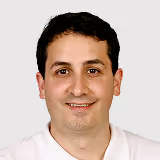
Marcel Kloos
Swiss-licensed dentist and founder of Medschool Experts
Marcel Kloos founded Medschool Experts while studying abroad; since then, over 500 study places have been secured. The Stuttgart-born dentist studied dentistry from 2015 to 2021 in Sofia and holds a Swiss dental licence.
Today he lives in Bern and runs Medschool Experts full-time as its owner.
More articles worth reading
Why Students Transfer from Medical University of Varna — Your Options
Why Students Transfer from Medical University of Warsaw — Your Options
Why Students Transfer from Masaryk University Faculty of Medicine — Your Options
Ahmad
Sabrina
Rami
Noah
500+ students placed.
Now it's your turn!
No daydreaming, no empty promises. Just a clear plan — for the start of your medical degree.
40 minutes, no obligation