Studying Medicine in Kragujevac (Serbia): Costs and Recognition
01.09.2026

Studying medicine in Kragujevac at a glance
The Faculty of Medical Sciences of the University of Kragujevac offers human medicine and pharmacy in English. Medschool Experts has been placing students at this location since 2021. The table below summarises what defines it as of August 2026.
| Feature | Details (as of 08/2026) |
|---|---|
| University | University of Kragujevac, Faculty of Medical Sciences, founded 17 November 1977 |
| Location | Kragujevac, Serbia, around 140 km south of Belgrade |
| In English | Human medicine 6 years, pharmacy 5 years |
| Fee, human medicine | 3,000 euros per semester, that is 6,000 euros per academic year |
| Fee, pharmacy | 1,500 euros per semester, that is 3,000 euros per academic year |
| Places 2026/2027 | 78 human medicine, 24 pharmacy (self-funding) |
| Living costs | around 400 to 500 euros per month |
| Placement through us | since 2021 |
| EU recognition | not automatic; Serbia is a third country |
| US recognition | the ECFMG route is open, since Serbia's accreditation agency received WFME recognition on 5 May 2025 |
What does studying medicine in Kragujevac cost?
Human medicine in English costs 3,000 euros per semester in Kragujevac, and pharmacy 1,500 euros per semester (as of 2026). Over an academic year that is 6,000 and 3,000 euros respectively. On top come living costs of about 400 to 500 euros a month.
| Item | Human medicine | Pharmacy |
|---|---|---|
| Fee per semester | 3,000 euros | 1,500 euros |
| Fee per academic year | 6,000 euros | 3,000 euros |
| Standard duration | 6 years | 5 years |
| Total fees | 36,000 euros | 15,000 euros |
Anyone who wants to know what the degree really costs has to add the fee to daily life. Our own estimate, as of August 2026, assumes 150 euros in rent, 250 euros in living costs, and 40 euros in study materials per month, plus 500 euros a year for trips home. That puts human medicine at around 70,700 euros over six years and pharmacy at around 43,900 euros over five years. For comparison: in Romania the fees alone are 8,500 to 10,000 euros per academic year. Kragujevac therefore comes in around 29 per cent below the cheapest Romanian location.
A note on figures circulating online: several agency websites still give 5,000 euros per academic year for Kragujevac. Those figures date from 2024 and 2025 and are out of date. The amount has been revised since. We give the 2026 figure here, and add that fees can change.
I studied in Sofia from 2015 to 2021 and learned there that the fee table is rarely the point at which study plans fail. It is the incidental costs nobody thought about in advance: the deposit, the flight at the start of the semester, health insurance, books. Anyone who includes these items from the outset avoids an unpleasant surprise in the third semester.
Who is behind the Faculty of Medical Sciences in Kragujevac?
The Faculty of Medical Sciences in Kragujevac was founded on 17 November 1977 and belongs to the University of Kragujevac. The university itself was established in 1976 and traces its roots to the Lyceum of the Principality of Serbia, founded in Kragujevac by Prince Miloš Obrenović on 1 July 1838. Today the university has around 20,000 students and 1,200 academic staff.
The faculty trains doctors, dentists, pharmacists, and nurses, and alongside teaching maintains a substantial research profile. It holds cooperation agreements with a number of European and non-European universities, among them the University of Bern, the Aristotle University of Thessaloniki, the University of Salerno, the University of the Algarve, and the University of Cyprus. Serbia has held programme country status in the Erasmus programme since 2019, which makes exchange semesters within Europe practically possible.
What characterises the location: anatomy is taught partly on plastinated specimens, the faculty has its own laboratories for practical courses, and the cohorts in the English-language programme are small. Seventy-eight places in human medicine is a manageable cohort. In pharmacy there are 24.
Which subjects are available in English, and which are not?
Human medicine and pharmacy can be studied in English in Kragujevac. Dentistry, psychology, and veterinary medicine are not offered there in English. Anyone looking for one of those subjects needs a different location.
| Subject | Available in English in Kragujevac? | Alternative |
|---|---|---|
| Human medicine | yes, 6 years | — |
| Pharmacy | yes, 5 years | — |
| Dentistry | no | Niš in Serbia offers dentistry in English |
| Psychology | no | other locations in Europe |
| Veterinary medicine | no | Bulgaria and the Czech Republic |
Within Serbia this produces a sensible division of labour. Kragujevac covers human medicine and pharmacy, while Niš adds dentistry. Which of the two locations fits your plans depends less on price than on your subject and your timetable. We clarify that in a free consultation.
{{cta}}How is the programme in Kragujevac structured?
Human medicine in Kragujevac is organised as an integrated programme over six years and twelve semesters, concluding with 360 ECTS. Pharmacy comprises five years and leads to the Master of Pharmacy. Both programmes are single-tier; there is no separate bachelor's stage.
| Stage | Focus |
|---|---|
| Years 1 and 2 | Anatomy, histology, physiology, biochemistry, microbiology |
| Year 3 | Pathology, pathophysiology, pharmacology, clinical propaedeutics |
| Years 4 and 5 | Internal medicine, surgery, paediatrics, gynaecology, neurology, psychiatry |
| Year 6 | clinical rotations, emergency medicine, general practice, final thesis |
Pharmacy is more strongly oriented towards later work in industry, regulatory authorities, and care provision. Alongside the classic subjects, the curriculum includes pharmacotherapy, treatment adherence in chronic conditions, biotechnological medicines, pharmacovigilance, and medical devices, plus bioethics, genetics, epidemiology, and clinical pathology.
What does Serbia's WFME recognition since May 2025 mean?
On 5 May 2025 the World Federation for Medical Education granted the Serbian accreditation agency NEAQA recognition status for ten years. For students in Serbia this is the most important development of recent years, and so far it is barely mentioned in guides written for a German-speaking audience.
The background: since 1 January 2023 the US body ECFMG has required the medical school to be accredited by an agency that is itself recognised by the WFME. Without that chain, the route to the USA stays closed. Serbia closed the chain in May 2025. Anyone who begins in Kragujevac today and graduates in the normal way can therefore in principle apply for ECFMG certification and thus for a residency post in the United States.
One caveat belongs with this: the recognition applies to the agency, not automatically to every individual faculty. What matters is that the specific programme is accredited and listed in the World Directory of Medical Schools. That is the norm at Serbian state faculties, but it should be checked before a decision, not afterwards.
Where may you work as a doctor with a degree from Kragujevac?
Serbia is not a member of the European Union. A Serbian medical degree therefore does not fall under the automatic recognition provided for in Annex V of Directive 2005/36/EC. Instead, a separate procedure applies in each destination country. The overview below shows which.
| Country | What applies | Route |
|---|---|---|
| Germany | not automatic | Equivalence assessment under the Federal Medical Practitioners Act; where substantial differences are found, a knowledge examination |
| Austria | not automatic | Nostrification at a medical university |
| Switzerland | effectively closed | only diplomas from EU and EFTA states and from the United Kingdom are recognised directly |
| Rest of the EU | not automatic | national procedure; after three years of professional practice in an EU state, Article 3(3) of Directive 2005/36/EC applies |
| United Kingdom | open | Registration with the General Medical Council, usually via the PLAB examinations |
| USA | open | ECFMG certification, underpinned by the WFME recognition since May 2025 |
| Canada | open | Medical Council of Canada procedure, subject to listing in the World Directory |
| Australia | open | Australian Medical Council examinations, registration with Ahpra |
One point that often worries German applicants and need not: language examinations. Anyone who holds German citizenship or completed their schooling or vocational training in German in Germany has thereby demonstrated their language skills. The general language examination and the specialist language examination are waived entirely in that case. They apply to applicants without a German-language school or training background.
The second point worth knowing is Article 3(3) of Directive 2005/36/EC. Under it, a diploma from a third country that an EU member state has already recognised can be treated in other member states like a European diploma, provided the person has subsequently practised medicine in that member state for three years. In this way, with time and an intermediate step, a third-country degree becomes European professional access. That is not automatic and takes time, but it is a route set out in law.
On Switzerland I will put it plainly, because I live there myself: I am a Swiss-licensed dentist and know the route via an EU diploma from my own experience. For diplomas from third countries this direct route does not exist. Anyone set on Switzerland from the outset should therefore choose an EU location, or plan a later move to the EU from the start. That is uncomfortable, but it is the truth, and it belongs before the decision rather than after it.
And as a pharmacist, dentist, psychologist, or veterinarian?
The same basis applies to pharmacy as to medicine: pharmacists are a sectoral profession in the EU under Annex V of Directive 2005/36/EC, but automatic recognition applies only to degrees from member states. A Serbian pharmacy degree therefore goes through an equivalence assessment in Germany. A specialist language examination is not added for German applicants if schooling or training was completed in Germany.
Dentistry is not offered in English in Kragujevac. Anyone wanting to study dentistry in Serbia will find the English-language programme in Niš; there too, the equivalence assessment applies rather than automatic recognition. Psychology and psychotherapy are not harmonised at European level at all; in Germany, access is governed solely by the Psychotherapists Act. Veterinary medicine is not available in Kragujevac; the most affordable locations for it are in Bulgaria and the Czech Republic, both within the EU and therefore with automatic recognition.
Career paths after graduation
A medical degree is an international entry ticket, and the figures show how heavily that is used. In Switzerland, around 43 per cent of practising doctors held a foreign diploma in 2025. In the United Kingdom, of 328,149 licensed doctors in the 2024 data year, 138,405 were internationally qualified, that is 42 per cent. Across the OECD, the share of foreign-trained doctors averages 19.6 per cent, and in Germany 15.0 per cent.
For the USA, the figures from the 2026 matching process are instructive: 44,344 posts against 53,373 registered applicants, with a match rate of 70.0 per cent for US citizens who studied abroad and 56.4 per cent for non-US graduates who studied abroad. Internal medicine, family medicine, and paediatrics take on the most internationally trained doctors. We have set out the individual country routes in detail in the article Career paths with a medical degree.
For Kragujevac this means, concretely: the route into the English-speaking world and into the USA has been clearly describable since May 2025. The route to Germany and Austria runs through a recognition procedure that is predictable but takes time. The route to Switzerland runs via a detour. Anyone who knows these three sentences before the first semester is making a deliberate decision.
Will Serbia really join the EU soon?
This question comes up in every consultation about Serbia, and it is a fair one, because accession would turn the recognition procedure into automatic recognition. Some information material about Serbian universities still says Serbia would conclude negotiations by the end of 2024 and join in 2025. That did not happen.
The position in August 2026: Serbia submitted its accession application on 22 December 2009, has been a candidate country since 1 March 2012, and has been negotiating since January 2014. Of 35 negotiating chapters, 22 have been opened and two provisionally closed. The Serbian government now itself names 2030 as its target, and the 2025 EU enlargement report records backsliding on democracy and the rule of law. Our assessment: anyone deciding on Kragujevac should do so on the basis of today's legal position, not on the basis of accession. If Serbia joins during your degree, that is a stroke of luck. It is not a basis for planning.
What is life in Kragujevac like?
Kragujevac is Serbia's fourth-largest city, the administrative seat of the Šumadija district, and lies on the Lepenica, surrounded by the Rudnik, Crni Vrh, and Gledić mountains. The 2011 census recorded 179,417 inhabitants. Belgrade is around 140 kilometres away.
Historically the city is more significant than its size suggests: Kragujevac was the first capital of modern Serbia, the first constitution in the Balkans was proclaimed here in 1838, and in the nineteenth century the country's first grammar school, first higher education institution, first theatre, first pharmacy, and first library were established here. The first newspaper printed in Serbia also came from here.
For students, what counts is daily life. According to the faculty, a furnished flat costs 120 to 150 euros a month and food around 150 euros. Realistically we budget 400 to 500 euros a month for everything together. The city is compact, distances are short, and the pace of life is calmer than in Belgrade. Anyone looking for a large metropolis will not be happy here. Anyone who wants to study affordably and with focus for six years will find good conditions.
Who is Kragujevac the right choice for?
Kragujevac suits you if you want to study human medicine or pharmacy in English, if a low price matters to you, and if your later goal is Germany, Austria, the United Kingdom, or North America. Pharmacy in particular stands out: 1,500 euros per semester is the lowest semester figure in our entire portfolio of locations.
Kragujevac is a less good fit if you want to study dentistry or veterinary medicine, if you are aiming for Switzerland from the outset, or if automatic EU recognition matters to you. In those cases an EU location is the more honest suggestion, and we say so even when it is more expensive.
What we can contribute from our own practice: we have been placing students in Kragujevac since 2021 and support them on the ground. The processes at the faculty, the level of supervision, and the path through the recognition procedure are therefore familiar to us first-hand and not only from documents. What nobody can promise in general terms is the individual case: recognition is always decided by the competent state authority. Whether Kragujevac fits your timetable and your career goal is something we assess together in a free consultation.
The author's view
Kragujevac first caught my attention because of pharmacy, not medicine. Fifteen hundred euros per semester for a state-run, English-language pharmacy degree is a figure I looked at twice to check I had not made a mistake. I had not.
We have been placing students in Kragujevac since 2021. That is why I know this location not from brochures but from the feedback of people who live their daily lives there: how the faculty is organised, how closely students are supervised, and what the recognition route to Germany actually feels like in practice.
My assessment: Kragujevac will develop over the coming years into an established location in the German-speaking market, carried by its price and by Serbia's WFME recognition. This assessment rests on the fee structure, the number of places, and our own placement practice since 2021. It is not a guarantee for the individual case — recognition is always decided by the competent state authority.
What I tell families in consultations: price is the weakest argument for a place of study and at the same time the one that speaks loudest. I studied in Sofia from 2015 to 2021, am today a Swiss-licensed dentist, and run Medschool Experts from Bern. Looking back, what mattered was not the fee but whether the degree took me where I wanted to go. That is the question that belongs at the start, not the table.
Summary
- The Faculty of Medical Sciences of the University of Kragujevac has offered human medicine in English since the 2025/2026 academic year, and pharmacy in English for rather longer.
- In 2026 the fees are 3,000 euros per semester in human medicine and 1,500 euros per semester in pharmacy, that is 6,000 and 3,000 euros per academic year respectively.
- By our own calculation, the whole medical degree in Kragujevac costs around 70,700 euros over six years, and pharmacy around 43,900 euros over five years.
- Serbia is not part of the EU: in Germany, authorisation runs through an equivalence assessment rather than automatic recognition under Directive 2005/36/EC.
- Since 5 May 2025, Serbia's accreditation agency NEAQA has been recognised by the World Federation for Medical Education, which opens the ECFMG route to the USA for graduates.
- For 2026/2027 there are 78 places in human medicine and 24 places in pharmacy in Kragujevac.
Kragujevac is a location that offers a great deal for little money, and whose weak point lies openly on the table: third-country status. Anyone who can handle that and plans the recognition step from the outset gets a solid state degree at a price hardly any EU location matches. You can find other students' experiences on Trustpilot. Whether Kragujevac suits you is something we clarify in a free consultation.
Further reading
- Medicine and dentistry in Niš: the second Serbian location, with dentistry in English.
- Career paths with a medical degree: where you may work after graduating.
- Approbation and recognition: how the route to professional authorisation works in detail.
- Tuition fees in Europe: all locations and costs compared.
- Monthly budget by location: what daily life abroad really costs.
What does studying medicine in Kragujevac cost?
Human medicine in English costs 3,000 euros per semester at the University of Kragujevac, that is 6,000 euros per academic year (as of 2026). Pharmacy costs 1,500 euros per semester, or 3,000 euros per academic year. On top come living costs of around 400 to 500 euros a month.
How long is the programme?
Human medicine in Kragujevac lasts six years and comprises twelve semesters with 360 ECTS. Pharmacy lasts five years and leads to the Master of Pharmacy. Both programmes are integrated; there is no separate bachelor's degree.
Do I receive the Serbian licence to practise directly after graduating?
No. In Serbia, international students complete a six-month internship after the degree; only then is the Serbian licence granted. That Serbian professional authorisation is a precondition for any decision on the German Approbation being possible at all. In Bosnia and Herzegovina this intermediate step does not apply.
Is teaching in English?
Yes. The Faculty of Medical Sciences in Kragujevac runs human medicine and pharmacy as separately accredited English-language programmes. Human medicine in English started in the 2025/2026 academic year, and pharmacy in English has been running for several years.
Do I have to sit a language or specialist language examination as a German applicant?
No. Anyone who holds German citizenship or completed their schooling or vocational training in German in Germany has thereby demonstrated their language skills. The general language examination and the specialist language examination are waived entirely in that case – they apply to applicants without a German-language school or training background.
Is the degree recognised in Germany?
Serbia is not an EU member state. Automatic recognition under Directive 2005/36/EC therefore does not apply; instead there is an equivalence assessment by the competent state authority. If substantial differences are found, a knowledge examination follows. What that means for your timetable is something we discuss openly in advance.
And in Switzerland?
Switzerland recognises medical diplomas from EU and EFTA states and from the United Kingdom directly. For diplomas from third countries such as Serbia, this direct route does not exist. Anyone with Switzerland as their goal should choose an EU location or plan a later move to the EU.
Can I go to the USA with a Serbian degree?
In principle yes. Serbia's accreditation agency NEAQA received recognition status from the World Federation for Medical Education on 5 May 2025, valid for ten years. Serbian graduates therefore meet the requirement to apply for ECFMG certification and subsequently for a residency post in the USA.
How many study places are there?
For the 2026/2027 academic year there are 78 places in English-language human medicine and 24 places in English-language pharmacy in Kragujevac, in each case for self-funding students. The cohorts are therefore considerably smaller than at many other overseas locations.
Is dentistry available in English in Kragujevac?
No. The Faculty of Medical Sciences in Kragujevac does train dentists, but not in English. Anyone wanting to study dentistry in English in Serbia will find the corresponding programme at the University of Niš.
What does living in Kragujevac cost?
According to the faculty, a furnished flat costs 120 to 150 euros a month and food around 150 euros. Realistically we budget 400 to 500 euros a month for everything together, including utilities, transport, and free time.
What does the whole degree cost including living costs?
By our own estimate as of August 2026, human medicine in Kragujevac costs around 70,700 euros over six years and pharmacy around 43,900 euros over five years. That includes tuition fees, rent, living costs, study materials, and trips home.
Is Serbia joining the EU?
Serbia has been negotiating EU accession since January 2014. Of 35 chapters, 22 have been opened and two provisionally closed; the government names 2030 as its target. Older statements that accession would take place in 2025 are out of date. Plan your degree on the basis of today's legal position.
Why do other tuition fees appear online?
Several agency websites still give 5,000 euros per academic year for Kragujevac. Those figures date from 2024 and 2025 and have been revised since. The 2026 figure is 6,000 euros per academic year in human medicine. Fees can change further.
Where is Kragujevac?
Kragujevac is Serbia's fourth-largest city and lies around 140 kilometres south of Belgrade in the Šumadija district. The 2011 census recorded 179,417 inhabitants. The city was the first capital of modern Serbia.
What students say about Medschool Experts
Over 500 placements at more than 25 partner universities across 10+ countries. Read independent student reviews on Trustpilot.
About the author
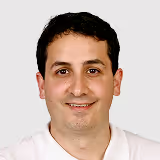
Marcel Kloos
Swiss-licensed dentist and founder of Medschool Experts
Marcel Kloos founded Medschool Experts while studying abroad; since then, over 500 study places have been secured. The Stuttgart-born dentist studied dentistry from 2015 to 2021 in Sofia and holds a Swiss dental licence.
Today he lives in Bern and runs Medschool Experts full-time as its owner.
More articles worth reading
Why Students Transfer from Medical University of Varna — Your Options
Why Students Transfer from Medical University of Warsaw — Your Options
Why Students Transfer from Masaryk University Faculty of Medicine — Your Options
Ahmad
Sabrina
Rami
Noah
500+ students placed.
Now it's your turn!
No daydreaming, no empty promises. Just a clear plan — for the start of your medical degree.
40 minutes, no obligation