Medical Studies in Russia: Locations, Costs and Recognition
01.09.2026

Which universities in Russia offer medicine in English?
The following overview is organized by region. It does not claim to be exhaustive — it maps the institutions that regularly appear internationally and whose English-language program can be traced.
Moscow
Sechenov University (First Moscow State Medical University), Pirogov University (RNIMU), RUDN University (Peoples' Friendship University), Moscow State University of Medicine and Dentistry (Yevdokimov), Lomonosov University with its Faculty of Fundamental Medicine.
St. Petersburg and Northwest
Pavlov University, Mechnikov University (North-Western State Medical University), St. Petersburg State Pediatric Medical University, St. Petersburg State University, Petrozavodsk, Arkhangelsk (Northern State Medical University).
Central Russia
Kursk, Voronezh (Burdenko), Smolensk, Tver, Ryazan (Pavlov), Yaroslavl, Ivanovo, Belgorod, Oryol, Tula.
Volga Region
Kazan — both Kazan State Medical University and Kazan Federal University —, Nizhny Novgorod, Samara, Saratov (Razumovsky), Ufa (Bashkir State Medical University), Izhevsk, Perm, Orenburg, Ulyanovsk, Volgograd, Astrakhan, Saransk (Ogarev), Cheboksary.
South and North Caucasus
Rostov-on-Don, Krasnodar (Kuban), Stavropol, Vladikavkaz (North Ossetia), Makhachkala (Dagestan), Nalchik (Kabardino-Balkaria).
Urals, Siberia and Far East
Yekaterinburg (Urals), Chelyabinsk (South Urals), Tyumen, Novosibirsk, Tomsk (Siberian State Medical University), Krasnoyarsk (Voino-Yasenetsky), Kemerovo, Omsk, Barnaul (Altai), Irkutsk, Chita, Ulan-Ude, Yakutsk, Vladivostok (Far Eastern Federal University and Pacific State Medical University), Khabarovsk, Blagoveshchensk.
{{cta}}
How much does medical school in Russia cost?
The range runs from approximately 2,600 to 15,300 US dollars per academic year. Part of this spread is real — Moscow and St. Petersburg are significantly above the regions — and part comes from inaccurate third-party information.
Directly verifiable from official sources include: Sechenov 1,300,000 rubles, Pirogov depending on faculty 900,000 to 1,300,000 rubles, Mechnikov 440,000 rubles, Kazan Federal University 468,000 rubles, Bashkir State Medical University Ufa 490,080 rubles, Far Eastern Federal University Vladivostok 440,000 rubles.
Because the ruble exchange rate fluctuates, conversions into euros or dollars are always a snapshot. Have every figure confirmed in writing by the university's International Office before making a decision — with a statement of whether dormitory, insurance, and registration are included.
Additionally, there are dormitory fees, health insurance, annual visa renewal, and living expenses. Students in the regions get by considerably cheaper than in the two metropolitan cities.
Language, admission, and program structure
The program lasts six years and concludes with a specialist degree. Many universities offer an English-language program, but this term must be read with caution: the pre-clinical phase takes place in English, but at the bedside at the latest, Russian is required. Russian language courses are therefore compulsory at virtually all locations.
Two points are regularly misrepresented on intermediary portals: Immanuel Kant Baltic Federal University in Kaliningrad teaches medicine in Russian, not English. And in Kazan, only the human medicine program is consistently taught in English — dentistry switches to Russian after two years.
Admission generally takes place without a numerus clausus through certificate review and an internal selection process, sometimes with a test in biology and chemistry. A preparatory year is possible at many institutions but not always required.
What is the degree worth in Germany?
This is the decisive point. Russia is not an EU member, so there is no automatic recognition. Anyone wishing to be licensed in Germany undergoes an equivalence assessment and as a rule the knowledge examination under Section 3 of the Federal Medical Licensing Act.
For WFME recognition — increasingly required internationally, for example for US ECFMG certification — only the agency IAAR is recognized for Russia, limited until 2028. Only Kazan State Medical University has verifiable accreditation so far. For every other university: check individually in the World Directory of Medical Schools before committing.
Regarding universities in Crimea, no reliable statement on international recognition can currently be made.
Who is suited for Russia
Russia can work if you are willing to learn Russian to a clinically functional level, if you choose a location with demonstrable accreditation, and if you factor in the recognition process in Germany from the beginning rather than pushing it to the end.
For those looking for a more straightforward path to medical licensing in Germany, our European partner locations are generally the clearer choice. An overview of all numerus clausus-free options can be found at Locations.
The author's view
Russia is usually addressed too quickly on this topic — either as a bargain or as a dead end. Both miss the mark. The quality of training at the major institutions is solid, that is undisputed.
What students underestimate is the combination of language requirements and the recognition pathway. Anyone who discovers after six years that their university is not listed in the World Directory has a problem that cannot be solved retrospectively. This one check takes ten minutes and determines the rest.
Summary
- Around 60 state universities, many with English-language programs.
- Tuition fees between approximately 2,600 and 15,300 US dollars per academic year, with metropolitan cities significantly more expensive.
- Russian is essential from the clinical phase onward — not optional.
- Not an EU member: in Germany, an equivalence assessment followed as a rule by a knowledge examination applies.
- WFME: only IAAR is recognized, with only Kazan verifiably accredited — check each university individually.
Russia offers a large, affordable, and academically serious medical education. However, it demands more personal responsibility than studying within the EU: regarding language, choice of location, and above all regarding what the degree will be worth later in Germany. Anyone who clarifies these three points before applying makes a good decision.
Further Reading
Frequently Asked Questions About Medical Studies in Russia
Is medical school in Russia numerus clausus-free?
Yes. Admission is based on certificate review and an internal selection process, sometimes with a test in biology and chemistry. A German Abitur grade is not a decisive factor.
Can I study medicine completely in English in Russia?
The pre-clinical phase yes, the clinical phase in practice no. Russian is needed at the bedside. Russian language courses are therefore compulsory at almost all locations.
Is the Russian degree recognized in Germany?
Not automatically. An equivalence assessment and as a rule a knowledge examination under Section 3 of the Federal Medical Licensing Act follows.
Which Russian universities are WFME-recognized?
Only the agency IAAR is WFME-recognized for Russia, valid until 2028. Only Kazan State Medical University has verifiable accreditation to date. Check each university individually in the World Directory of Medical Schools.
Why do the fee figures vary so widely?
Because many portals continue to use older figures and the ruble exchange rate fluctuates. Have the current amount confirmed in writing by the International Office, including a statement of what is included.
Can I transfer from Russia to a European university?
Yes, this is the most common route. How this works and which locations are suitable is described in our article on Study Transfer from Russia.
What students say about Medschool Experts
Over 500 placements at more than 25 partner universities across 10+ countries. Read independent student reviews on Trustpilot.
About the author
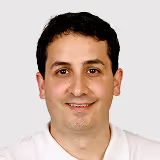
Marcel Kloos
Swiss-licensed dentist and founder of Medschool Experts
Marcel Kloos founded Medschool Experts while studying abroad; since then, over 500 study places have been secured. The Stuttgart-born dentist studied dentistry from 2015 to 2021 in Sofia and holds a Swiss dental licence.
Today he lives in Bern and runs Medschool Experts full-time as its owner.
More articles worth reading
Why Students Transfer from Medical University of Varna — Your Options
Why Students Transfer from Medical University of Warsaw — Your Options
Why Students Transfer from Masaryk University Faculty of Medicine — Your Options
Ahmad
Sabrina
Rami
Noah
500+ students placed.
Now it's your turn!
No daydreaming, no empty promises. Just a clear plan — for the start of your medical degree.
40 minutes, no obligation