Studying Medicine in Cluj: Costs, Structure and Recognition
01.09.2026

Studying medicine in Cluj at a glance
The Iuliu Hatieganu University of Medicine and Pharmacy in Cluj-Napoca has been training doctors since 1776 and today teaches around 9,000 students in Romanian, English and French. Human medicine takes six years and costs 10,000 euros per academic year. The key facts are gathered here.
| Feature | Detail |
|---|---|
| University | Iuliu Hatieganu, Cluj-Napoca (Romania) |
| Medical training since | 1776, Romanian faculty since 1919 |
| Programmes in English | Human medicine, dentistry, nursing |
| Duration, human medicine | 6 years, 12 semesters, 360 ECTS |
| Tuition | 10,000 euros per academic year |
| Entrance examination | none, selection on documents |
| Language certificate | English B2 |
| Compulsory subject | Romanian, years of study 1 to 3 |
| Living costs | around 700 euros per month (our own estimate) |
| Total costs over 6 years | around 113,000 euros (our own estimate) |
| Students | around 9,000, more than 3,300 of them international |
| EU recognition | Annex V number 5.1.1 of Directive 2005/36/EC |
Which university is behind the medical programme in Cluj?
The University of Cluj is a purely medical university with three faculties: medicine, dentistry and pharmacy. In the 2025/2026 academic year around 9,000 students were enrolled there, more than 3,300 of them international, from 96 countries. Germany is among the largest countries of origin alongside France, Switzerland and Italy.
The history goes back a long way. On 7 November 1776, Empress Maria Theresa ordered the founding of a medical faculty in Cluj, the first medical school in Transylvania. In 1817 it became the Medical-Surgical Institute, and in 1872 the university. After the union of Transylvania with Romania, the Romanian-language faculty was established in 1919; its first dean was Iuliu Hatieganu. The institution has borne his name since 1990. The English- and French-language programmes were added between 1997 and 2000.
The most important teaching hospital is the County Emergency Clinical Hospital Cluj-Napoca. The Romanian Ministry of Health lists it as the largest hospital unit in Transylvania: 1,542 inpatient beds, 100 day-clinic places, 43 clinical and non-clinical departments spread across 33 buildings. More than 3,500 staff work there, and each year it handles more than 50,000 inpatient cases and around 35,000 emergency admissions. Clinical teaching takes place at this hospital and at further specialised clinics in the city.
In the QS subject rankings of 26 March 2026, the University of Cluj sits in the 301 to 350 band in medicine and in the 351 to 400 band in pharmacy and pharmacology. In both subjects that is the best Romanian result. Rector Anca Dana Buzoianu commented on the outcome with the words: "Congratulations to the academic community of UMF Iuliu Hatieganu Cluj-Napoca on these results."
For later recognition, accreditation counts for more than the ranking. In the European Quality Assurance Register EQAR, the institutional evaluation by the Romanian agency ARACIS of 30 June 2021 is entered; the dentistry programme is recorded there with a programme accreditation of 24 February 2022 running until 24 February 2027. The university itself reports the highest level of confidence for the ARACIS evaluation. The medical programmes were internationally accredited from 2019 to 2024 by ASIIN and the Association of Medical Schools in Europe; the on-site visit for the follow-up accreditation by the Independent Agency for Accreditation and Rating took place from 20 to 22 May 2024, and the accreditation runs until 2029. That agency is recognised by the World Federation for Medical Education – which is exactly what the US ECFMG has required since 1 January 2023 of every medical faculty whose graduates want to apply in the USA.
Since the 2025/2026 academic year, the University of Cluj has also taught human medicine in English in Novara in northern Italy, 45 kilometres from Milan and with nine clinics on site. It is the first overseas branch of a Romanian medical faculty. In the same academic year, a military medicine programme and an English-language nursing programme began. Of the roughly 1,800 first-year students, around 680 came from abroad.
Which programmes does the University of Cluj offer, and in which language?
The University of Cluj runs human medicine, dentistry, pharmacy and nursing. Human medicine is taught in English, French and Romanian, dentistry in English and French, and pharmacy exclusively in French. There is no German-language programme in Cluj, nor at any other Romanian university.
| Programme | Language | Duration and ECTS |
|---|---|---|
| Human medicine | English, French, Romanian | 6 years, 360 ECTS |
| Dentistry | English, French | 6 years, 360 ECTS |
| Pharmacy | French | 5 years, 300 ECTS |
| Nursing | English | 4 years, 240 ECTS |
Two subjects are missing at the University of Cluj itself but are available in the city. Veterinary medicine is taught at the University of Agricultural Sciences and Veterinary Medicine Cluj-Napoca, six years, 360 ECTS, in English, French and Romanian, and accredited by the European Association of Establishments for Veterinary Education. Psychology belongs at Babes-Bolyai University, one of Romania's large comprehensive universities. That puts five medicine-related fields of study in the same city – rare among the locations we place students at.
The distribution of languages has an inconvenient side. Anyone wanting to study pharmacy in Cluj needs French at degree level, because there is no English-language pharmacy programme there. For international applicants without French, Cluj is therefore not a pharmacy location. Which alternative fits in that case is something we clarify in a free consultation.
What does a medical degree in Cluj cost?
The University of Cluj charges 10,000 euros per academic year, i.e. 5,000 euros per semester. The amount applies equally to human medicine, dentistry and pharmacy. EU citizens confirm their place with the first half of the annual fee. On top of that come living costs in a city that is among the most expensive in Romania.
| Item | Amount |
|---|---|
| Tuition, human medicine | 10,000 euros per year |
| Tuition, dentistry | 10,000 euros per year |
| Tuition, pharmacy | 10,000 euros per year |
| Room in a shared flat | 250 to 350 euros per month |
| Everyday costs excluding rent | 350 to 400 euros per month |
| Monthly public transport pass | 146 lei, around 28 euros |
| Study materials and trips home | around 500 euros per year |
Rents are the reason Cluj works out more expensive than other Romanian locations. For August 2026, Numbeo puts a one-bedroom apartment in the centre at 3,089 lei and outside the centre at 2,554 lei, so around 590 and 487 euros respectively. Anyone who wants to live alone pays as much in Cluj as in many a mid-sized German city. A room in a shared flat brings the amount down considerably.
Our calculation for six years of human medicine, flagged as an estimate: 60,000 euros in tuition, 50,400 euros in living costs at 700 euros a month, plus around 3,000 euros for study materials and trips home. That gives around 113,000 euros. Dentistry, with the same duration and the same fee, is at the same level; pharmacy, over five years, comes to around 95,000 euros.
| Location | Total costs over 6 years |
|---|---|
| Timisoara | around 100,000 euros |
| Cluj-Napoca | around 113,000 euros |
| Kaunas | around 126,000 euros |
| Vilnius | around 143,000 euros |
| Debrecen | around 149,000 euros |
Within Romania, then, Cluj is not the cheapest route. Against Timisoara the difference adds up over six years to about 13,000 euros, caused by annual fees 1,000 euros higher and by higher rents. Anyone making price the most important criterion should know that. Anyone looking at ranking, hospital size and city gets something in return.
{{cta}}
How is the medical programme in Cluj structured?
The 2025/2026 human medicine study plan of the University of Cluj distributes 360 ECTS across six years of study at 60 credits each, plus 10 ECTS for the final examination in the sixth year. The first two years are pre-clinical; from the third year, teaching at the bedside begins. Every year of study includes a 160-hour placement.
| Year of study | Focus | Distinctive feature |
|---|---|---|
| 1 | Pre-clinical foundations | Romanian 84 hours, 2 ECTS |
| 2 | Pre-clinical foundations | Romanian 84 hours, 2 ECTS |
| 3 | Entry into clinical work | Romanian, followed by an eliminatory test |
| 4 | Clinical subjects | Placement 160 hours |
| 5 | Clinical subjects | Placement 160 hours |
| 6 | Clinical rotations | Final examination, 10 ECTS |
Romanian teaching is not a formality. The study plan prescribes it for international students in the first three years of study, 84 hours each at three hours a week, concluded with a colloquium. After the third year comes a test with eliminatory effect. The reason is practical: from the clinical stage onwards, students face Romanian-speaking patients, and a patient history cannot be taken in English.
Where may you work as a doctor with this degree?
Romania has been an EU member since 2007. The Romanian medical diploma is listed in Annex V number 5.1.1 of Directive 2005/36/EC, in the version of Commission Delegated Decision (EU) 2023/2383 of 23 May 2023, applicable since 9 October 2023. The reference date entered is 1 January 2007, and the Annex does not require an accompanying certificate for Romania.
| Country | What applies | Basis |
|---|---|---|
| Germany | German medical licence (Approbation) without a knowledge examination | Annex V 5.1.1 |
| Austria | recognition plus registration in the medical register | Annex V 5.1.1 |
| Switzerland | federal recognition, then cantonal practice licence | Agreement on the Free Movement of Persons |
| Rest of the EU and EEA | automatic recognition | Annex V 5.1.1 |
| United Kingdom | case-by-case assessment by the GMC | rules since Brexit |
| USA | ECFMG certification, WFME-recognised agency | ECFMG requirement since 2023 |
| Canada | MCC examinations, match via CaRMS | national procedure |
| Australia | AMC examinations, registration with Ahpra | national procedure |
One point that is often misrepresented: the general language examination and the technical language examination do not apply if school or vocational training was completed in Germany in German. Both examinations concern applicants without a German-language school or training background. Anyone with German citizenship, or who went to school in Germany, applies for the Approbation without this intermediate step. For Switzerland, the language certificate at B2 level applies correspondingly.
Important for anyone planning a transfer to a German faculty: since 2023 the Romanian interim examination is no longer recognised in Germany as the preliminary medical examination. After two semesters, one subject semester is usually credited; after three to four semesters, two. Anyone completing the degree in Cluj is not affected by this.
Dentist, pharmacist, psychologist, veterinarian: what is the legal position?
Four of the five health professions are harmonised at European level; one is not. For dentists, pharmacists and veterinarians the same automatic route applies as for doctors, each via its own point in Annex V. Psychologists fall outside this system, because the profession is not regulated sectorally.
Dentistry: the Romanian diploma "Diploma de licenta de medic dentist" appears in Annex V number 5.3.2 with the reference date 1 October 2003 and is automatically recognised in Germany, Austria and Switzerland. The University of Cluj teaches dentistry in English and French, six years, 360 ECTS.
Pharmacy: pharmacy diplomas run via Annex V number 5.6.2 and are likewise recognised without an equivalence assessment. In Cluj this programme exists only in French, five years, 300 ECTS. For pharmacists too, the technical language examination does not apply if school or vocational training was completed in Germany in German.
Veterinary medicine: the diploma falls under Annex V number 5.4.2. In Cluj, the University of Agricultural Sciences and Veterinary Medicine runs the six-year programme in English and French, accredited by the European Association of Establishments for Veterinary Education.
Psychology: here there is no automatic recognition, because Directive 2005/36/EC does not treat the profession as a sectoral one. In Germany the route to licensure as a psychotherapist runs via the reformed Psychotherapists Act, and the state examination offices assess every foreign degree individually for equivalence. Anyone wanting to take this route should have the course content compared beforehand.
Career paths after graduation
A Romanian medical diploma is a European entry ticket, and the labour market for it is larger than Germany. According to FMH statistics, Switzerland counted 44,612 practising doctors in 2025, 43 percent of them with a foreign diploma. In Germany, around 446,000 doctors were practising at the end of 2025; by the OECD count, which is based on place of training, 15.0 percent completed their studies abroad. The OECD average for this share is 19.6 percent, in Norway 44.0 percent and in Ireland 43.4 percent.
Anyone staying in Germany begins specialist training under the model specialist training regulations of 2018 in the version of 3 July 2025: 48 months in the theoretical subjects, 60 months as the standard, 72 months in the surgical subjects. In the first year of specialist training, the collective agreement of the federal states provides for a basic salary of 5,792.90 euros per month from 1 April 2026. In Austria, the basic training period was shortened from nine to six months on 1 August 2026. In Sweden, since 1 July 2021 the Bastjänstgöring of at least six months has replaced the former AT phase, including for EU graduates with Swedish licensure.
Further afield it becomes more demanding but not impossible. For the USA the route runs via ECFMG certification with USMLE Step 1 and Step 2 CK; in the 2026 NRMP match, 44,344 posts faced 53,373 registered applicants, and the match rate for non-US graduates trained abroad was 56.4 percent. In Canada, the 2026 CaRMS match placed a total of 931 internationally trained doctors, up from 851 the previous year. According to the GMC workforce report, the United Kingdom registered 328,149 licensed doctors in 2024, 42 percent of them with a qualification obtained outside the United Kingdom. Which of these routes realistically fits your plan is set out in detail in the guide career paths with an EU medical degree worldwide.
What is student life like in Cluj-Napoca?
Cluj-Napoca has around 330,000 inhabitants, lies in the heart of Transylvania and is Romania's second-largest city after Bucharest. With Babes-Bolyai University, the Technical University and the medical university, Cluj is the country's densest university city. The average age in the city centre is correspondingly low.
Economically, Cluj lives from the IT sector, which is why the city is often described as Romania's technology hub. That has two consequences for students: a good range of cafés and coworking spaces, and precisely those high rents. Avram Iancu Airport handled its best year to that point in 2023, with 3,240,750 passengers, and connects Cluj directly with several German cities. A monthly pass for bus and tram costs 146 lei, around 28 euros.
Romanian is a Romance language. Anyone bringing French, Spanish or Italian from school progresses faster than expected in the compulsory courses, because a large part of the vocabulary feels familiar. That is an advantage of the location which becomes noticeable in everyday study – and on the ward at the latest.
Who is Cluj the right choice for?
Cluj suits applicants looking for an English-language EU degree without an entrance examination and willing to learn Romanian for three years. Anyone who also speaks French has more choice in Cluj than at almost any other location, because human medicine, dentistry and pharmacy also run in French.
There are three situations in which another location fits better. First, if budget is the decisive criterion: over six years Timisoara comes in around 13,000 euros lower. Second, if an early transfer to a German faculty is firmly planned, because since 2023 the Romanian interim examination no longer counts in Germany as the preliminary medical examination. Third, if pharmacy in English is the goal.
We have been placing students in Romania for years and know the difference between the locations from our students' feedback. Which of them fits your grades, your budget and your timetable is something we discuss in a free consultation.
The author's view
When I began my dentistry degree in Sofia in 2015, Bulgarian was a compulsory subject on the timetable, and at first I underestimated it. In the clinical stage at the latest, that changes. You sit opposite a patient who speaks no English and have to take a history. That is exactly why I consider the three years of Romanian in Cluj, including the test after the third year, to be right, even if in the first semester they feel like extra ballast.
What convinces me about Cluj is the scale of the clinical training. A teaching hospital with 1,542 beds and 43 departments means that over six years you see almost every specialty from the inside once. Add to that a faculty that moved up a whole band in medicine in the 2026 QS subject ranking. And the new branch in Novara shows that this university is not standing still.
One thing I say to everyone who asks me about Romania: Cluj is not the country's cheapest address. With a 10,000 euro annual fee and the highest rents in Romania, the location works out around 13,000 euros above Timisoara over six years. Anyone who has to count every euro should know that. And anyone with pharmacy in mind needs French in Cluj, because that programme exists there only in that language.
My assessment after ten years with this subject: the location determines less whether you become a doctor than how pleasant the six years leading there are. I run Medschool Experts from Bern today, am a Swiss-licensed dentist myself and see from our graduates how far a European diploma carries. For many, Cluj is the right compromise between standing, city and price – but it is a compromise, and one you should make deliberately.
Summary
- The Iuliu Hatieganu University of Medicine and Pharmacy in Cluj-Napoca charges 10,000 euros per academic year for human medicine, dentistry and pharmacy.
- Human medicine takes six years and comprises 360 ECTS; there is no entrance examination, selection is on documents, and English at B2 level is required.
- Romanian is a compulsory subject in the first three years of study with 84 hours each, and after the third year comes a test with eliminatory effect.
- The medical diploma appears in Annex V number 5.1.1 of Directive 2005/36/EC and is recognised in Germany, Austria and Switzerland without a knowledge examination.
- By our estimate, six years of human medicine in Cluj cost around 113,000 euros including living costs – around 13,000 euros more than in Timisoara.
- In the QS subject rankings of 26 March 2026, the University of Cluj sits in the 301 to 350 band in medicine, the best result among Romanian institutions.
Conclusion
Cluj-Napoca is the Romanian location with the greatest standing: the country's best placement in the 2026 QS subject ranking for medicine, a teaching hospital with 1,542 beds, around 3,300 international students from 96 countries and, since 2025, a branch of its own in northern Italy. Access runs without an entrance examination, teaching is in English or French, and the diploma opens the European labour market without detours.
The price for that is real: 10,000 euros a year, the highest rents in Romania and three years of Romanian lessons with an examination. Whether this location suits you better than Timisoara, Debrecen or Kaunas depends on your grades, your budget and your timetable. That is exactly what we sort through together: book a free consultation and we will work through your version in concrete terms.
Further reading
- Career paths with an EU medical degree worldwide: specialist training and career entry in nine countries.
- Studying medicine in Timisoara: the more affordable Romanian location directly compared.
- Studying medicine in Romania: an overview of both locations in the country.
- Tuition fees in Europe: all locations with costs per semester.
- Transferring back to Germany: how many semesters are credited to you.
Frequently Asked Questions about studying medicine in Cluj
What does a medical degree in Cluj cost per year?
The University of Cluj charges 10,000 euros per academic year, i.e. 5,000 euros per semester. The amount applies equally to human medicine, dentistry and pharmacy. Over six years of human medicine that gives 60,000 euros in tuition, before living costs.
What are the total costs for six years?
By our estimate, around 113,000 euros: 60,000 euros in tuition, 50,400 euros in living costs at 700 euros a month and around 3,000 euros for study materials and trips home. That puts Cluj about 13,000 euros above Timisoara and well below Vilnius or Debrecen.
Is there an entrance examination in Cluj?
No. The University of Cluj selects international applicants on the basis of the documents submitted; a committee assesses academic achievement and personal accomplishments. Proof of English at B2 level is part of that, unless teaching has already taken place in English.
Is the degree from Cluj recognised in Germany?
Yes. Romania has been an EU member since 2007, and the medical diploma appears in Annex V number 5.1.1 of Directive 2005/36/EC. Licensure follows without a knowledge examination. The competent body is the licensing authority of the federal state in which you wish to work.
Do I have to sit a technical language examination as a German applicant?
No. Anyone with German citizenship, or who completed school or vocational training in Germany in German, has to sit neither the general language examination nor the technical language examination. Both concern only applicants without a German-language school or training background.
In which language is teaching delivered in Cluj?
Human medicine runs in English, French and Romanian, dentistry in English and French, and pharmacy exclusively in French. There is no German-language medical programme at the University of Cluj, nor at any other Romanian university.
Do I have to learn Romanian?
Yes. The 2025/2026 study plan prescribes Romanian for international students in the first three years of study, 84 hours each at three hours a week. After the third year comes a test with eliminatory effect. The reason is the work with Romanian-speaking patients from the clinical stage onwards.
How long is the programme and how many ECTS are there?
Human medicine and dentistry each take six years in Cluj with 360 ECTS, pharmacy five years with 300 ECTS. Each year of study accounts for 60 ECTS, plus 10 ECTS for the final examination in the sixth year.
Can I work in the USA with a diploma from Cluj?
In principle yes, via ECFMG certification with USMLE Step 1 and Step 2 CK. Since 1 January 2023, the ECFMG has required accreditation by an agency recognised by the World Federation for Medical Education. The medical programmes of the University of Cluj are accredited accordingly until 2029.
Can I transfer to Germany later?
A transfer is possible but costs time. Since 2023 the Romanian interim examination is no longer recognised in Germany as the preliminary medical examination. After two semesters, one subject semester is usually credited; after three to four semesters, two. The scope is decided by the receiving university.
How expensive is accommodation in Cluj?
Cluj has the highest rents in Romania. For August 2026, Numbeo puts a one-bedroom apartment in the centre at 3,089 lei and outside the centre at 2,554 lei, so around 590 and 487 euros respectively. A room in a shared flat usually costs 250 to 350 euros per month.
Are veterinary medicine and psychology available in Cluj?
Not at the medical university, but in the same city. Veterinary medicine runs at the University of Agricultural Sciences and Veterinary Medicine Cluj-Napoca in English, French and Romanian, six years, 360 ECTS. Psychology belongs at Babes-Bolyai University.
What is the branch in Novara?
Since the 2025/2026 academic year, the University of Cluj has also taught human medicine in English in Novara in northern Italy, 45 kilometres from Milan and with nine clinics on site. It is the first overseas branch of a Romanian medical faculty.
How many international students are there in Cluj?
In the 2025/2026 academic year, around 9,000 students were enrolled, more than 3,300 of them international, from 96 countries. Of the roughly 1,800 first-year students, about 680 came from abroad. Germany is among the largest countries of origin alongside France, Switzerland and Italy.
What students say about Medschool Experts
Over 500 placements at more than 25 partner universities across 10+ countries. Read independent student reviews on Trustpilot.
About the author
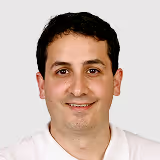
Marcel Kloos
Swiss-licensed dentist and founder of Medschool Experts
Marcel Kloos founded Medschool Experts while studying abroad; since then, over 500 study places have been secured. The Stuttgart-born dentist studied dentistry from 2015 to 2021 in Sofia and holds a Swiss dental licence.
Today he lives in Bern and runs Medschool Experts full-time as its owner.
More articles worth reading
Why Students Transfer from Medical University of Varna — Your Options
Why Students Transfer from Medical University of Warsaw — Your Options
Why Students Transfer from Masaryk University Faculty of Medicine — Your Options
Ahmad
Sabrina
Rami
Noah
500+ students placed.
Now it's your turn!
No daydreaming, no empty promises. Just a clear plan — for the start of your medical degree.
40 minutes, no obligation