Studying Medicine in Romania: Timișoara and Cluj as the Most Affordable EU Destinations
28.08.2026

Why Romania
Romania has been training international medical students for decades, many of them from France, Israel and Germany. As an EU member state, the country provides the decisive foundation: the state medical universities are listed in Annex V of Directive 2005/36/EC, and the degrees are recognised in Germany, Austria and Switzerland without any additional examination.
The strongest argument is the cost. At around 4,250 euros per semester, Timisoara is one of the most affordable established EU locations there is. Adding the low living costs, the overall budget sits well below that of many neighbouring countries.
Victor Babes University Timisoara
Timisoara lies in the west of the country, close to the Hungarian and Serbian borders, and with around 320,000 inhabitants it is a lively university city. Victor Babes University of Medicine and Pharmacy offers human medicine and dentistry in English, each at around 4,250 euros per semester.
Practically relevant: the international airport offers direct connections to Germany, and the drive to Hungary takes only a few hours. Timisoara was European Capital of Culture in 2023, which gave the city a marked push towards modernisation.
University of Cluj-Napoca
Cluj is Romania's largest university city and is regarded as the unofficial centre of Transylvania. Iuliu Hatieganu University of Medicine and Pharmacy offers human medicine and dentistry in English and French, at around 5,000 euros per semester. The city has a very large student scene and a growing tech sector.
Whether Timisoara or Cluj suits your situation better is something we clarify in a free consultation.
Costs compared
| Location | Fees per semester | Living costs per month |
|---|---|---|
| Timisoara | approx. 4,250 euros | approx. 400 to 550 euros |
| Cluj-Napoca | approx. 5,000 euros | approx. 450 to 600 euros |
| Hungary for comparison | approx. 7,090 to 9,340 euros | approx. 450 to 850 euros |
| Poland for comparison | approx. 7,460 to 8,845 euros | approx. 500 to 750 euros |
Over six academic years, the difference from the higher-priced locations adds up to a five-figure sum. That is why Romania always comes into the shortlist when the budget plays the leading role.
Credit recognition when transferring to Germany
Anyone planning from the outset to transfer to a German faculty after a few semesters should be aware of one circumstance: since 2023, the Romanian intermediate examination has no longer been recognised in Germany as the preliminary medical examination (Ärztliche Vorprüfung). Experience from credit recognition procedures shows that after two semesters one subject semester is credited, and after three to four semesters, two.
For everyone completing the degree in Romania, this makes no difference: the degree is recognised across Europe and leads directly to the German medical licence (Approbation). Those who firmly plan a transfer, by contrast, are well advised to align their choice of location with the respective credit recognition profile. These are exactly the trade-offs we work through in the consultation before a decision is made.
Everyday student life
Teaching takes place in internationally mixed year groups in English, and at individual locations also in French. Romanian language courses are part of the curriculum and are needed in the clinical phase. The university hospitals are large and cover a broad range of specialties.
Romanian is a Romance language. Anyone who already speaks French, Spanish or Italian finds the entry particularly easy. This is an often overlooked advantage of the location.
If you want to work through the budget and timeline for six years, arrange a free consultation.
The author's view
Romania is the location where the arithmetic works out most clearly. Anyone who studies six years in Timisoara pays less in total than they would in two years at some universities. For families financing the degree out of their own pocket, that is a very weighty argument.
I also point out what matters in the planning: anyone working towards a transfer to a German faculty from the start should factor the credit recognition profile into their choice of location; Szczecin and Pécs are well suited for that. Those who are determined to complete the degree abroad and then apply for the medical licence, by contrast, get the recognised European degree in Romania at very favourable overall costs. This decision should be made deliberately and early, not only in the third semester.
Summary
Romania is the answer to a very specific question: how do I study in the EU at the lowest overall cost? Timisoara and Cluj offer recognised degrees at fees well below the European average, with equally low living costs. Anyone planning to complete their degree abroad will find very good value for money here.
You can read other students' experiences on Trustpilot. Whether Romania fits your plans is something we clarify in a free consultation; book an appointment via the registration page.
- Romania is an EU member state, the state medical universities are listed in Annex V of Directive 2005/36/EC, and the degrees are recognised in Germany, Austria and Switzerland without any additional examination.
- Victor Babes University in Timisoara offers human medicine and dentistry in English and is the most affordable established EU location.
- Iuliu Hatieganu University in Cluj-Napoca teaches human medicine and dentistry in English and French.
- Since 2023, the Romanian intermediate examination has no longer been recognised as the German Physikum; experience shows that one subject semester is credited after two semesters and two subject semesters after three to four semesters.
- Living costs in Romania are around 400 to 600 euros per month.
- Romanian is a Romance language, so prior knowledge of French, Spanish or Italian makes the start easier.
Further reading
- Tuition fees in Europe: all locations with costs per semester.
- Cost comparison, abroad and Germany: what a degree really costs.
- Why Bulgaria: the other affordable location in the southeast.
- Transferring back to Germany: why the credit recognition profile matters here.
- Financing medical studies abroad: BAföG, education funds and scholarships.
Frequently Asked Questions About Studying Medicine in Romania
Is the degree recognised in Germany?
Yes. Romania is an EU member state, and the state medical universities are listed in Annex V of Directive 2005/36/EC. Recognition takes place without a knowledge examination.
What does a semester cost?
Around 4,250 euros in Timisoara and around 5,000 euros in Cluj. These are very low fees among the established EU locations.
How high are the living costs?
Around 400 to 600 euros per month. That places Romania, alongside Bulgaria, among the most affordable destinations in Europe.
What language is used for teaching?
The international programmes run in English, and at individual locations also in French. Romanian language courses are part of the curriculum.
What about transferring back to Germany?
Experience shows that one subject semester is credited after two semesters and two after three to four semesters. Since 2023, the Romanian intermediate examination has no longer been recognised in Germany as the preliminary medical examination. Anyone firmly planning a transfer should discuss this beforehand.
Who is Romania particularly suited to?
To everyone aiming to complete their degree abroad and for whom the budget plays the central role. Anyone planning an early transfer to a German faculty from the outset should factor the credit recognition profile of the respective location into their choice.
How easy is the journey?
Timisoara and Cluj have international airports with direct connections to Germany and Austria. Timisoara is also only a few hours' drive from Hungary.
What students say about Medschool Experts
Over 500 placements at more than 25 partner universities across 10+ countries. Read independent student reviews on Trustpilot.
About the author
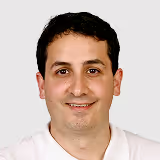
Marcel Kloos
Swiss-licensed dentist and founder of Medschool Experts
Marcel Kloos founded Medschool Experts while studying abroad; since then, over 500 study places have been secured. The Stuttgart-born dentist studied dentistry from 2015 to 2021 in Sofia and holds a Swiss dental licence.
Today he lives in Bern and runs Medschool Experts full-time as its owner.
More articles worth reading
Why Students Transfer from Medical University of Varna — Your Options
Why Students Transfer from Medical University of Warsaw — Your Options
Why Students Transfer from Masaryk University Faculty of Medicine — Your Options
Ahmad
Sabrina
Rami
Noah
500+ students placed.
Now it's your turn!
No daydreaming, no empty promises. Just a clear plan — for the start of your medical degree.
40 minutes, no obligation