Studying Medicine in Pleven: Costs, Structure, Recognition
01.09.2026

Pleven at a Glance
| Feature | Detail (as of 2026) |
|---|---|
| University | Medical University Pleven, state university |
| City and country | Pleven, northern Bulgaria, EU member state |
| Programme and degree | Human medicine, 360 ECTS over six years |
| Language of instruction | English, plus Bulgarian courses from the first year |
| Standard duration | 6 years: 2 years pre-clinical, 3 years clinical, 1 practical year |
| Tuition fee | 4,500 EUR per semester, 9,000 EUR per academic year |
| Entry route | no Numerus clausus; we check your profile individually |
| Start date | summer semester |
| Living costs | approx. 400 to 600 EUR per month |
| Rent, 1-bedroom apartment in the city centre | approx. 300 EUR per month (Numbeo, as of 19 June 2026) |
| Recognition | automatic under Directive 2005/36/EC |
Pleven has around 100,000 inhabitants and lies in the plain of the Danube tributaries, approximately 170 kilometres from Sofia — about two hours by road. The city is manageable, and it is strongly shaped by the university and its hospital. For you, that means short distances between accommodation, lecture hall and ward, a quiet environment, and a cost of living well below the Bulgarian metropolitan areas.
Within Bulgaria, Pleven is the smallest of our locations and also the most affordable. How it compares with the larger cities is shown in the article Studying Medicine in Sofia and in the comparison Sofia or Plovdiv.
University and Hospital
The Medical University Pleven is a state university which, according to its official profile (August 2026), is organised into the faculties of Medicine, Pharmacy, Public Health and Healthcare, a Faculty of Veterinary Medicine, a Medical College and a dedicated research institute. For you as a human medicine student, the Medical Faculty with its English-language programme is the most relevant.
The clinical backbone is the University Hospital Dr. Georgi Stranski, the largest hospital in the region and the university's teaching hospital. Clinical rotations and the concluding practical year take place there. Another distinguishing feature is the telemedicine and endoscopy centre, through which procedures are transmitted live into lecture theatres and seminar rooms. Together with virtual anatomy and the large simulation centre, this creates a training profile that places greater emphasis on technology and practical exercise than on passive listening. The facilities also include a da Vinci surgical robot (Studimed.de location profile, August 2026).
What strikes me about Pleven is how closely the faculty and hospital are linked — both physically and organisationally. In larger cities, teaching is spread across several hospitals; here, almost everything comes together in one place. For day-to-day study, that is a practical advantage: no time lost in transit, and the lecturers who examine you in seminars are the same people you see on the ward in the afternoon.
What programmes are available and in which language?
Through us, Pleven offers the English-language programme in human medicine. The university also offers bachelor programmes in nursing and health sciences. The following overview shows what this means for language, duration and degree.
| Programme | Language | Standard duration | Scope |
|---|---|---|---|
| Human medicine | English | 6 years | 360 ECTS |
| Nursing and health sciences | Bachelor programmes | 3 years | undergraduate |
| Bulgarian as an accompaniment to study | Bulgarian | from the first year | compulsory courses |
Lectures, course materials and examinations are in English throughout, right up to graduation. Good school-level English is sufficient as a starting point, because medical terminology is new to everyone. More important than a perfect certificate is the willingness to speak up in oral examinations.
Bulgarian is added alongside — and this is not a minor matter. From the first year of study, language courses are a compulsory element of the programme, because during the clinical phase you conduct patient histories at the university hospital in Bulgarian. The Cyrillic script is new to most students. This is additional work alongside anatomy and biochemistry, and those who let it slip will face a problem on the ward later. Those who take it seriously find it considerably easier to engage with patients from the third year onwards.
How do you find the right university — and get a place?
We deliberately do not publish entry criteria, checklists or dates for Pleven. They differ from university to university and they change from one intake to the next, and nothing costs more time than preparing against information that was accurate a year ago.
What works better is the other way round. Send us your profile — your school-leaving certificate, any university records you already have, and the countries you could imagine living in for six years. We then look at where we can actually place you: at which university, in which country, and where the route is plannable rather than a gamble. Pleven is one option in a network of official partner universities that also covers dentistry, pharmacy, nursing and veterinary medicine, so the question is never simply yes or no, but which door opens most reliably for you.
You will hear from us what fits your profile, not a standard answer. Book a free consultation and we will go through it together.
What does the programme cost?
The tuition fee is 4,500 EUR per semester, placing it at the lower end of our location network. The Medical University Pleven fee schedule lists the rates for the 2026/2027 academic year; the following figures are taken from the Studimed.de location profile as of August 2026; the rental values come from Numbeo as of 19 June 2026.
| Item | Amount | Period |
|---|---|---|
| Tuition fee, human medicine | 4,500 EUR | per semester |
| Tuition fee, human medicine | 9,000 EUR | per academic year |
| Total tuition fees | 54,000 EUR | twelve semesters |
| University hall of residence place | under 200 EUR | per month |
| Rent, 1-bedroom apartment in the city centre | approx. 300 EUR | per month |
| Rent, 1-bedroom apartment outside the city centre | approx. 153 EUR | per month |
| Total living costs | 400 to 600 EUR | per month |
From this, the full duration of study can be calculated. The following calculation is my estimate and is not a figure from the university: I take living costs at 500 EUR per month, the midpoint of the range, and add a flat sum for study materials, insurance and the trips to Bulgaria.
| Item | Basis | Total over six years |
|---|---|---|
| Tuition fees | 9,000 EUR times six academic years | 54,000 EUR |
| Living costs | 500 EUR times 72 months | 36,000 EUR |
| Textbooks, materials, insurance | approx. 100 EUR per month | 7,200 EUR |
| Travel to northern Bulgaria | four trips per year at 250 EUR each | 6,000 EUR |
| Total (estimate) | – | approx. 103,200 EUR |
Travel costs appear in most calculations not at all, even though over six years they add up to an entire semester's worth of fees. For context, I have placed the fees for several locations in our network side by side.
| Location | Fee per semester | Total fees | Living costs per month |
|---|---|---|---|
| Pleven, Medical University | 4,500 EUR | 54,000 EUR | 400 to 600 EUR |
| Sofia, Medical University | 4,975 EUR | 59,700 EUR | 500 to 800 EUR |
| Varna, Medical University | 5,000 EUR | 60,000 EUR | 500 to 800 EUR |
| Kaunas, LSMU | 6,400 EUR | 76,800 EUR | 500 to 650 EUR |
| Riga, Rīga Stradiņš University | 6,750 EUR | 81,000 EUR | 650 to 850 EUR |
Pleven thus sits at the affordable end of the scale, and the gap arises doubly: through the fee and through the lower cost of living. Study abroad grants (Auslands-BAföG) are in principle available for Bulgaria as an EU state and cover a larger proportion here than at more expensive locations. What is realistic in your case depends on income and family circumstances; the article on financing below provides an overview of the available routes.
{{cta}}
How is the programme structured?
The programme lasts six years and follows the classic European pattern of pre-clinical, clinical and practical year. Teaching follows the principle of problem-based learning in a block system, so examinations are distributed across the semester rather than clustering at the end (Studimed.de location profile, August 2026).
| Phase | Academic years | Focus |
|---|---|---|
| Pre-clinical phase | 1 to 2 | Anatomy, physiology, biochemistry, histology, embryology, Bulgarian courses |
| Clinical phase | 3 to 5 | Internal medicine, surgery, paediatrics, gynaecology, neurology, psychiatry |
| Simulation and telemedicine | throughout the programme | Examination techniques, emergency procedures, virtual anatomy |
| Practical year | 6 | Ward rotations at the university hospital, equivalent to the German Praktisches Jahr |
The first two years are the most theoretically intensive. Anatomy and biochemistry set the pace, and those who take the preparation seriously will have considerably less catching up to do in the third year. From the clinical phase, the emphasis shifts towards the ward: taking histories, examining patients, interpreting findings.
The simulation centre is more than a showpiece. Examination techniques and emergency procedures are practised there until they are reliable, before being applied to patients. I noticed in my own training how much confidence this intermediate step provides — a step that did not exist in this form during my time as a student. The sixth year consists of rotations and is equivalent to the German Praktisches Jahr. Clinical placements (Famulaturen) can often be completed in Germany during semester breaks; recognition is confirmed in advance with the receiving hospital.
Where can you work as a doctor with this degree?
Bulgaria is a member state of the European Union, and the Medical University Pleven is listed in Annex V of Directive 2005/36/EC. The relevant version is that of Delegated Decision (EU) 2023/2383 of 23 May 2023, applicable from 9 October 2023; for the basic medical qualification, point 5.1.1 applies. This means automatic recognition without an equivalency or knowledge test.
| Country | Path to professional registration |
|---|---|
| Germany | Approbation through the state authority, automatic recognition under 2005/36/EC, proof of German language skills at specialist level required |
| Austria | Entry in the register of the Austrian Medical Chamber, automatic recognition, followed by basic training |
| Switzerland | Recognition under the rules of the Agreement on the Free Movement of Persons with the EU, then registration in the medical register |
| Rest of EU and EEA | Recognition under 2005/36/EC, registration with the medical chamber of the respective country |
| United Kingdom | Registration with the General Medical Council; since leaving the EU, generally through the aptitude test PLAB with proof of English |
| USA | ECFMG certification, since 1 January 2023 with accreditation requirement for the faculty |
The USA requires a caveat you should know about. Since 1 January 2023, the ECFMG requires that the faculty be accredited by an agency recognised by the World Federation for Medical Education. The Bulgarian agency NEAA lists the WFME in its overview as an agency in the recognition process — not as a recognised agency (as of August 2026). Those who have definite plans for the USA should check this status before making their decision; for Germany, Austria, Switzerland and the EU, this is irrelevant.
For German medical registration (Approbation), you approach the authority in the federal state where you wish to work. Processing times vary from state to state. You can then train in any specialty, at hospitals and practices with training authorisation, on the same footing as graduates of German faculties.
Dentist, pharmacist, psychologist, veterinarian: the legal position by profession
Dentist. Dentistry is harmonised under Directive 2005/36/EC, point 5.3.2 of Annex V; a Bulgarian dental degree is therefore also automatically recognised. We do not offer dentistry in Pleven; within Bulgaria we offer it at the Sofia and Varna locations. Which suits you is something we clarify in a free consultation.
Pharmacist. For pharmacists, point 5.6.2 of Annex V applies; automatic recognition within the EU likewise applies here. The Medical University Pleven has its own Faculty of Pharmacy. Through our programme, Pleven offers the English-language human medicine programme; for pharmacy we look at other locations in our network.
Psychologist. Psychology and psychotherapy are not harmonised under the Directive. There is therefore no automatic recognition but an individual assessment by the competent state authority, which compares course content and scope against German requirements. Those wishing to pursue this path should factor in the licensing requirements under the German Psychotherapists Act from the outset, since they shape the structure of study from the beginning.
Veterinarian. Veterinary medicine is listed under Annex V, point 5.4.2 and is therefore also automatically recognised. The Medical University Pleven has a Faculty of Veterinary Medicine; however, through our programme Pleven offers human medicine. For veterinary studies we look at suitable locations together.
Career paths after graduation
With the diploma from Pleven, you apply for a junior doctor position — in Germany, Austria, Switzerland or another EU country. The specialty is your choice, and the place of study does not appear in any job advertisement. What counts are your grades, your clinical placements and what you demonstrate in the interview.
Three paths are most commonly taken by graduates from Bulgaria. The first is direct entry into specialist training in Germany, usually at a hospital where a clinical placement or practical year rotation was already completed. The second leads to Switzerland or Austria, where demand for junior doctors is high and the EU degree opens the same door. The third remains initially in Bulgaria, often for one or two years at the university hospital, before the move follows.
Pleven has a profile that pays dividends later. Those with an interest in the digital side of medicine leave with a foundation in telemedicine and virtual anatomy that is increasingly sought after in German hospitals — for example in teleradiology or digital emergency care. This does not replace specialist qualifications, but it is a talking point in interviews that not every applicant has.
The options a recognised EU degree opens up worldwide — from specialist training to research to practice outside Europe — are set out in our overview Career paths with an EU medical degree worldwide.
Lateral entry, transfer and return to Germany
A transfer from Pleven to a German faculty is possible but not automatic, and you should not build your programme around it. Free places in higher semesters are scarce and competition for them is high, and the receiving faculty alone decides what it recognises. Those who wish to explore this route nonetheless will find the background in the article returning to Germany.
An important point for context: Bulgaria has no intermediate examination that would be recognised in Germany as the equivalent of the Ärztliche Vorprüfung. What you bring is your Transcript of Records with the subjects you have passed, grades and ECTS credits. From this, a German faculty reads what it can recognise, and the licensing authority later reads what you have completed. Collect your semester documents from the very first day — digitally and on paper.
Lateral entry in the other direction is more straightforward, and it is the direction we can actually plan for. Those who have already studied a science subject or come from a healthcare profession benefit above all in terms of content: biochemistry and physiology are then familiar territory. If you are already partway through a programme somewhere else, send us your transcript — we check the highest possible point of entry, and in many cases that is considerably further along than people expect. More realistic than any transfer planning is completing the degree in Bulgaria and then working in Germany. The qualification is the same, and the Approbation stands at the end of both paths.
Living in Pleven: city, distances, costs
Pleven is a medium-sized city with around 100,000 inhabitants — quiet, green and strongly shaped by the hospital and university. Student life takes place in a close-knit environment; many people know each other and distances are short. Those looking for a metropolis with a wide cultural offering will miss it here. Those looking for a focused learning environment without distractions will find it.
For accommodation, you have two options: the university halls of residence, which according to Studimed.de cost under 200 EUR per month, or the private rental market. Numbeo (as of 19 June 2026) puts a one-bedroom apartment in the city centre at approximately 300 EUR per month and outside the centre at approximately 153 EUR. Divided between two or three people, little of that remains, which is exactly why many students end up at the lower end of the 400 to 600 EUR range. The furnishings of older apartments do not always meet German standards, but more of the budget is left over for textbooks and travel.
| Cost item | Amount per month | Source |
|---|---|---|
| Hall of residence place | under 200 EUR | Studimed.de, August 2026 |
| 1-bedroom apartment, city centre | approx. 300 EUR | Numbeo, 19 June 2026 |
| 1-bedroom apartment, outside centre | approx. 153 EUR | Numbeo, 19 June 2026 |
| Total living costs | 400 to 600 EUR | location data, 2026 |
Sofia is approximately 170 kilometres away — about two hours by bus or train. The capital's airport is therefore the connection to Germany, Austria and Switzerland, and it is close enough for a long weekend in the capital. Those looking for a comparison with life on the Black Sea coast will find it in the article Varna: curriculum, city and safety.
Who this location suits
Pleven suits you if the budget plays a role in the decision and you are willing to go to a smaller city for it. At 54,000 EUR in tuition fees over six years and living costs of 400 to 600 EUR per month, this location is one of the most affordable routes to an EU-recognised English-medium medical degree that we have in our network. Those who need to manage the cost of their training carefully gain tens of thousands of euros here compared with locations in the Baltic states or central Europe.
The location also suits you if technology in medicine interests you. The simulation centre, telemedicine and virtual anatomy are not footnotes in the programme — they shape the teaching. And it suits you if a manageable environment appeals, where you encounter the same people in the lecture hall, the library and on the ward.
It is a less good fit if you need the life of a large city to feel at home. In that case, Sofia or Varna are the more natural choices, with more to offer and a slightly higher cost level. That is not a question of training quality but of day-to-day life over six years.
My assessment: Pleven is the location for those who plan pragmatically and want to focus on their studies. I repeatedly observe that it is precisely the small university towns that produce the most stable academic progress — because less gets in the way, and support is more personal. Whether this is the right path for you is something we can best establish directly: book a free consultation.
The author's view
I studied dentistry in Sofia from 2015 to 2021, so I know fairly precisely what the start in Bulgaria feels like: an unfamiliar script, an unfamiliar administration, a study plan that moves at pace from day one. What I underestimated at the time was the language. What I overestimated was the importance of the city's size. After the first semester, the only thing that counted for me was whether the route between accommodation, library and hospital ward was short. In Pleven, it is short.
What I find convincing about this location is the combination of price and facilities. At 4,500 EUR per semester for an English-medium medical degree in the EU, the cost is very low — and yet there is no sense that corners have been cut: a simulation centre, telemedicine, a large university hospital right next door. The combination of simulation-based practice and early ward experience is exactly what makes the transition into specialist training smoother.
Honestly: Bulgarian is compulsory, and that is more work than most expect. The language courses run from the first year, and by the clinical phase at the latest, you are conducting patient histories in Bulgarian — in Cyrillic script with medical vocabulary. It is manageable, but not something you can pick up in the week before an examination. Those who accept this early have an easier time of it later.
Today I run Medschool Experts in Bern full-time and sit on the other side of the table when someone is thinking about a study place. My impression from many conversations: the decision rarely comes down to rankings — almost always to the budget and the gut feeling about the city. Pleven wins clearly on budget, and on gut feeling it helps to be honest about what matters to you in everyday life.
Summary
- The Medical University Pleven offers human medicine in English, six years, 360 ECTS, starting in the summer semester.
- The tuition fee is 4,500 EUR per semester, 9,000 EUR per academic year and approximately 54,000 EUR over the standard duration.
- Living costs are 400 to 600 EUR per month, making Pleven one of the most affordable locations in our network.
- There is no Numerus clausus, so your school-leaving grade does not decide your place — which university fits your profile is something we check individually.
- The degree is automatically recognised under Directive 2005/36/EC; no equivalency or knowledge test is required.
- Bulgarian courses are part of the programme from the first year, because patient histories during the clinical phase are conducted in Bulgarian.
Conclusion
Pleven is one of several routes to an English-medium medical degree in the EU, and it is a strong one for anyone who has to calculate carefully. Which of them is genuinely open to you is not something a checklist can answer — it depends on your profile, and that is exactly what we look at.
Send us your certificates and tell us which countries you could imagine, and we will tell you at which university and in which country we can place you, and where the route is plannable. Our partner network covers medicine, dentistry, pharmacy, nursing and veterinary medicine, so there is usually more than one door. Book a free consultation and we will find yours.
Further reading
- Studying Medicine in Sofia — the main Bulgarian location compared with Pleven.
- Sofia or Plovdiv — two Bulgarian locations placed side by side.
- Varna: Curriculum, City and Safety — what studying on the Black Sea coast is like.
- Tuition fees for medicine in Europe — all locations and costs in one overview.
- Financing medical studies abroad — study abroad grants, loans and scholarships at a glance.
Frequently asked questions about studying medicine in Pleven
What does studying medicine in Pleven cost in total?
The tuition fee is 4,500 EUR per semester — over twelve semesters, approximately 54,000 EUR. If you add living costs of 500 EUR per month, study materials, insurance and the trips to Bulgaria, my estimate puts the total at approximately 103,200 EUR for the full six years. That is a substantial sum, but less than at most English-medium locations in Europe.
How high are the living costs in Pleven?
For rent, food, public transport and insurance, 400 to 600 EUR per month usually suffices in Pleven. A one-bedroom apartment in the city centre costs, according to Numbeo as of 19 June 2026, approximately 300 EUR per month, and outside the centre approximately 153 EUR. University hall of residence places cost under 200 EUR. Those sharing an apartment end up at the lower end of the range.
Is there a Numerus clausus in Pleven?
No. The Medical University Pleven has no Numerus clausus, so your school-leaving grade does not decide your study place. What exactly a given university looks at differs from place to place and from year to year, which is why we do not publish criteria — send us your profile and we will tell you where we can place you.
How do I find out whether Pleven is right for me?
Send us your school-leaving certificate, any university records you already have and the countries you could imagine living in. We look at your profile individually and tell you at which university and in which country we can realistically place you — and where the route is plannable rather than a gamble. That conversation is free and non-binding.
When does the programme start in Pleven?
The programme begins in the summer semester. How much lead time you should give yourself depends entirely on your profile, so get in touch early rather than late: the sooner we know where you stand, the more calmly everything else — including the search for an apartment — can be arranged.
What language is used for teaching?
The programme runs entirely in English, from lectures and course materials to examinations. Good school-level English is sufficient as a starting point, since medical terminology is new to everyone — including the local fellow students. What matters most is the willingness to speak up in oral examinations.
Do I have to learn Bulgarian?
Yes. Bulgarian courses are a compulsory part of the programme from the first year, because during the clinical phase you conduct patient histories at the university hospital in Bulgarian. The Cyrillic script is also part of this. It is real work alongside anatomy and biochemistry, but very manageable if you start early.
How is the programme in Pleven structured?
Human medicine lasts six years. Two years of pre-clinical study cover anatomy, physiology, biochemistry, histology and embryology. This is followed by three years of clinical phase with internal medicine, surgery, paediatrics, gynaecology, neurology and psychiatry. The sixth year consists of ward rotations and is equivalent to the German Praktisches Jahr. In total, you accumulate 360 ECTS credits.
How practical is the training?
The university is closely linked — spatially and organisationally — with the University Hospital Dr. Georgi Stranski, and is known for its large simulation centre. There you practise examination techniques and emergency procedures until they are reliable, before applying them to patients. Telemedicine and virtual anatomy are further specialisations of the institution. Clinical placements can often be completed in Germany during semester breaks.
Is the degree from Pleven recognised in Germany?
Yes. Bulgaria belongs to the European Union, so the degree is automatically recognised under Directive 2005/36/EC — in Germany as well as in Austria and Switzerland. An equivalency or knowledge test is entirely dispensed with. After the programme you follow the standard route via the Approbation and can then train in any specialty.
How does the Approbation process work after graduation?
The competent authority is the licensing body (Approbationsbehörde) in the federal state where you wish to work. It requires proof of your German language skills at specialist level. Processing times differ from state to state, so allow some time. All specialties are then open to you, on the same footing as graduates of German faculties.
Can I work in the USA with this degree?
For the USA you need ECFMG certification, which since 1 January 2023 requires accreditation of the faculty by a WFME-recognised agency. The Bulgarian agency NEAA lists the WFME as an agency in the recognition process — not as a recognised agency. Those who have definite plans for the USA should check the current status in advance.
How does accommodation work in Pleven?
There are university hall of residence places and an affordable private rental market, mostly apartments near the hospital and faculty. Many students share a flat and thus end up at the lower end of the cost range. Older apartments do not always meet German standards in terms of furnishings, but that leaves more of the budget available for other things.
What students say about Medschool Experts
Over 500 placements at more than 25 partner universities across 10+ countries. Read independent student reviews on Trustpilot.
About the author
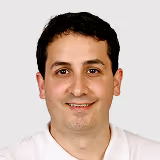
Marcel Kloos
Swiss-licensed dentist and founder of Medschool Experts
Marcel Kloos founded Medschool Experts while studying abroad; since then, over 500 study places have been secured. The Stuttgart-born dentist studied dentistry from 2015 to 2021 in Sofia and holds a Swiss dental licence.
Today he lives in Bern and runs Medschool Experts full-time as its owner.
More articles worth reading
Why Students Transfer from Medical University of Varna — Your Options
Why Students Transfer from Medical University of Warsaw — Your Options
Why Students Transfer from Masaryk University Faculty of Medicine — Your Options
Ahmad
Sabrina
Rami
Noah
500+ students placed.
Now it's your turn!
No daydreaming, no empty promises. Just a clear plan — for the start of your medical degree.
40 minutes, no obligation