One in Eleven German Medical Students Is Enrolled Abroad
17.09.2026

The figures: 8,821 Germans study medicine abroad
According to Federal Statistical Office data for the 2023/24 winter semester, at least 8,821 Germans were enrolled in a human medicine programme abroad. By way of comparison: in the 2024 winter semester a total of 103,176 German students were enrolled in human medicine at German universities. That means a good one in eleven German medical students is studying abroad.
An important qualification: the CHE itself points out that the data is incomplete. For several countries – Romania, Croatia or Slovakia, for instance – there are no reliable figures at all. And the statistics cover human medicine only. Dentistry, veterinary medicine and pharmacy abroad do not appear in them at all.
Gero Federkeil, Head of International Rankings at the CHE, puts it succinctly: studying medicine abroad has long since ceased to be an exception and is a real alternative for many – precisely because the number of study places in Germany remains limited.
Our estimate: closer to one in nine than one in eleven
The official figure is a lower bound, not a full account. Entire destination markets are missing from the statistics altogether: Bosnia and Herzegovina, Serbia, North Macedonia, Albania, Georgia, Ukraine – and, depending on the survey year, Romania, Croatia and Slovakia too. Yet those are exactly where the locations that have grown fastest in recent years sit, because they are the cheapest.
There is a second gap on top of that: anyone who enrols abroad and is not deregistered or recorded anywhere in Germany appears in no statistics. And anyone who moves abroad only in their third or fifth year of study is likewise not cleanly counted in many surveys.
My estimate after ten years in this market: realistically it is closer to one in nine German medical students studying abroad – not one in eleven. That is an estimate, not a statistic, and I know the limits of an estimate. But it rests on what we see in applicant numbers, at the universities and in our own placement figures – including in exactly those countries that simply do not appear in the official statistics.
Where the Germans go
The most popular destination country is Austria by some distance. After that come the classic locations in Central and South-Eastern Europe:
| Destination country | German students (human medicine) |
|---|---|
| Austria | 2,563 |
| Hungary | 1,930 |
| Bulgaria | 1,131 |
| Switzerland | 802 |
Around half of all German medical students abroad are enrolled in the host country's regular national degree programmes – that is, alongside local students and in the local language. The other half study in dedicated international programmes, predominantly in Eastern and South-Eastern Europe, mostly in English and at some locations in German.
A third variant is growing as well: cooperation models in which the preclinical phase is completed abroad and the clinical part in German hospitals – in Nuremberg, Hamburg, Kassel or Coburg, for example. The degree is awarded by the foreign institution.
The cost item: up to EUR 29,800 a year
The point at which the CHE guide is most emphatic: tuition fees of up to EUR 29,800 a year are possible on international programmes. Application, entrance or enrolment fees frequently come on top.
That range is real – but it is a range, not a price tag. Between the most expensive and the cheapest reputable location in Europe there is a difference of well over EUR 100,000 in tuition fees alone over six years. Anyone who knows the field does not study medicine in Europe for EUR 30,000 a year.
To put the EUR 29,800 in context: at the Faculty of Medicine in Foča (University of East Sarajevo), tuition for human medicine is around EUR 1,790 per semester, and dentistry around EUR 3,500 per year. At the Medical University of Varna it is around EUR 5,000 per semester. Calculated over six years, that is a six-figure difference – with a recognised degree in both cases.
English-language does not mean without the local language
One point from the CHE guide that we expressly endorse: even though many programmes advertise teaching in English, knowledge of the local language remains important in practice. By the clinical phase at the latest, in direct contact with patients, you will need it.
That is not an argument against studying abroad – it is an argument for planning the language course in from the start. Anyone who puts in four to six hours a week in the first year of study stands on the ward relaxed in the third.
{{cta}}
The surge since 2024 – and what is driving it
The CHE data relates to the 2023/24 winter semester. What has happened since appears in no statistics: since 2024 we have been seeing a surge unlike anything we knew before. And the motives have shifted markedly.
1. The labour market is being changed by AI
Many of those who write to us today are not coming straight from school. They are people in their early to mid-thirties, often with a completed degree and several years of work behind them – from marketing, IT, consulting, administration, media. Their reasoning is almost always the same: they see how quickly AI is taking over precisely the tasks they have been doing, and they want to move into a profession that cannot be automated away.
The medical profession is the most obvious example of that: physical examination, procedures on patients, personal responsibility, a statutory licence requirement. AI will change medicine – but it will not take responsibility for a diagnosis and will not operate on a patient.
2. Economic uncertainty in the private sector
The German and European private sector is in a difficult phase: job cuts in industry, hiring freezes, restructuring. Anyone living through that assesses job security differently than they did five years ago.
3. The public sector is no longer automatically regarded as secure either
The answer to economic uncertainty used to be the civil service. That too is now being questioned more sharply: the question of a leaner state is on the political agenda. In March 2026 the AfD parliamentary group introduced a motion in the Bundestag entitled „A lean state instead of a cost explosion – reducing civil-servant numbers and pension liabilities“; at state level, several AfD programmes contain calls for a lower state expenditure ratio and the cutting of established posts. Whether and how anything of the kind would ever be implemented is open – and other parties set different priorities. But the debate alone is enough for „a civil-service career equals security“ to be no longer taken for granted.
4. Medicine as a safe harbour
That leaves medicine. The shortage of doctors in Germany, Austria and Switzerland is structural and demographic in origin: the population is ageing, a large share of doctors in private practice will retire over the next few years, and demand is rising. That is not the business cycle, it is demography – and demography cannot be cut away.
That is why in consultations we now hear the sentence „I want to do something that will still be needed in twenty years“ more often than „I always wanted to be a doctor“.
In fairness, the other side belongs with it: medicine is a demanding route. Six years of study, then five to six years of specialist training, shift work, high responsibility. Someone starting in their early thirties will be a specialist in their mid-forties. Anyone taking this route should really want it.
Students abroad and the shortage of doctors
Perhaps the politically most interesting part of the CHE analysis: German medical students abroad are a relevant pool for future medical care. Anyone talking about a shortage of doctors should factor them in.
At the same time, the CHE concedes that there is no reliable official data on this. Individual institutions report that the majority of their German graduates return – that cannot be generalised. From our own experience: the great majority of those we place want to return to Germany, Austria or Switzerland. For them, studying abroad is not an emigration project but a route to the same goal.
What Medschool Experts has contributed to these figures
We will say it without false modesty: we have a significant share in this development. To date, Medschool Experts has placed more than 500 medical study places for clients from Germany, Austria and Switzerland – at more than 25 universities across Europe.
At least as important was the educational work. On the largest German-language YouTube channel on the subject – Medizinstudium im Ausland – we have for years explained free of charge which universities exist at all, what they really cost, how recognition works in Germany and Switzerland, and what matters when choosing. Much of what now counts as common knowledge about studying medicine abroad was first said there.
Why this affects us personally
For me this statistic is not an abstract figure. I was one of them myself.
I began my dentistry degree in 2015 at the Medical University of Sofia in Bulgaria – without a numerus clausus, in English – and completed it with the state examination in 2021. Today I am a Swiss-licensed dentist and live in Bern.
I therefore know both sides: the uncertainty at the start, when nobody in the family can say whether this is a good idea – and the feeling at the end, when the diploma is in your hand and the question about your school-leaving grade is never asked again.
Which location suits you?
We work through your starting position in a free consultation: destination country, tuition fees, recognition and timetable – including if you are changing career and already working. Book a free consultation here.
The author's view
For me these figures show one thing above all: the concept works. A whole cohort of young people is refusing to let its chosen profession founder on a decimal point in a school-leaving certificate – and year after year there are more of them.
That this has become a matter-of-course route also has something to do with our work over recent years. Medschool Experts was the first agency to give free insights on YouTube, in near-daily videos and in interviews with real medical students abroad: which universities exist, what day-to-day study there really looks like, how recognition works and what the route costs. That groundwork is what made the big step possible for many people in the first place. It is genuine pioneering work – and we are proud of it.
What has surprised me most is the shift of the past two years: it is no longer only the school leaver with middling grades who comes to us. Increasingly it is the 32-year-old with a master's degree and five years of work experience who is deliberately choosing something that lasts.
The real question is no longer whether studying medicine abroad is an option, but which location suits you. Between EUR 3,500 and EUR 29,800 in tuition fees a year lie worlds – and the expensive location is not automatically the better one. That is exactly where it pays to do the sums calmly beforehand.
Conclusion
Whatever your situation, you don't have to figure out the best path alone. At Medschool Experts, we work with the largest network of official partner universities, and we individually assess the highest possible year of entry for every student. In many cases, entry is even possible in the final two years of medical studies. Book a free consultation with our team and let's map out your personal path together.
Frequently Asked Questions about German Medical Students Abroad
How many Germans study medicine abroad?
According to the figures analysed, 8,821 – which corresponds to around one in eleven German medical students. Since several popular destination countries do not appear in the statistics at all, our own market observation puts the real figure closer to one in nine.
Why is the actual figure higher?
Because the survey does not capture several locations outside the EU – precisely those that have grown fastest in recent years, because they are the cheapest. Anyone who knows the market sees German-speaking year groups growing there annually.
What is the maximum a medical degree abroad costs?
On international programmes, tuition fees of up to EUR 29,800 a year are possible. But that is the upper end: at the Faculty of Medicine in Foča the fee for human medicine is around EUR 1,790 per semester, and dentistry around EUR 3,500 per year. Over six years that produces a six-figure difference – with a recognised degree in both cases.
Does an English-language degree mean I do not need the local language?
No. Teaching runs in English, but in the clinical phase you speak to patients in the local language. That is why it is a compulsory subject in the first years of study at practically every location.
Why has demand risen so sharply since 2024?
Because the labour market is changing: artificial intelligence and automation are reshaping many office professions, the private sector has become less certain, and many regard medicine as a safe harbour. What stands out is the share of career changers in their early thirties coming from stable jobs.
Do graduates return to Germany?
Most do. After graduating they apply for the German medical licence (Approbation) and work in Germany, Austria or Switzerland. Students abroad therefore make a visible contribution against the shortage of doctors.
Is a degree from abroad recognised?
Within the EU, automatically under Directive 2005/36/EC. For locations outside the EU, recognition runs through the equivalence assessment by the competent State Examination Office (Landesprüfungsamt), which is standard for accredited faculties.
What students say about Medschool Experts
Over 500 placements at more than 25 partner universities across 10+ countries. Read independent student reviews on Trustpilot.
About the author
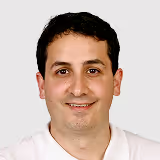
Marcel Kloos
Swiss-licensed dentist and founder of Medschool Experts
Marcel Kloos founded Medschool Experts while studying abroad; since then, over 500 study places have been secured. The Stuttgart-born dentist studied dentistry from 2015 to 2021 in Sofia and holds a Swiss dental licence.
Today he lives in Bern and runs Medschool Experts full-time as its owner.
More articles worth reading
Health Insurance for International Medical Students in Europe 2026
Scholarships and Funding for Medical Studies in Europe 2026
Medicine, Dentistry, Pharmacy or Veterinary Medicine? Choosing Your Degree Abroad in 2026
Ahmad
Sabrina
Rami
Noah
500+ students placed.
Now it's your turn!
No daydreaming, no empty promises. Just a clear plan — for the start of your medical degree.
40 minutes, no obligation