The dissection course in medical school: real body donors abroad?
01.09.2026

Do students abroad dissect real body donors during medical school?
Yes. At medical faculties in Bulgaria, Romania, Hungary, Poland and the other EU states, students of human medicine and dentistry work on real body donors in the dissection course, exactly as in Germany. The basis is Directive 2005/36/EC: it prescribes the same minimum content for medical degrees across Europe, and gross anatomy on the cadaver is part of it.
I compiled the following overview from my own studies in Sofia and from the course descriptions of German anatomical institutes. It shows where the differences actually lie — and where there are none.
| Feature | Germany | Elsewhere in the EU (Sofia) |
|---|---|---|
| Dissection course with body donors | compulsory course | compulsory course |
| Legal framework | ÄApprO 2002, ZApprO 2021 | Directive 2005/36/EC, Annex V |
| Group at the dissection table | varies by faculty, often 6 to 10 | seminar group of no more than 10 students |
| Preservation | usually formaldehyde-based | usually formaldehyde-based |
| Form of assessment | sign-offs on the specimen | oral sign-offs on the specimen |
| Language | German, nomenclature in Latin | English, nomenclature in Latin |
What was my first day in the dissection hall in Sofia like?
I wrote this section in January 2018 on my student blog at the time, marcel-in-bulgarien.de, after a reader put exactly this question to me. I am leaving it here as it was written.
For me, the dissection course was above all fascinating. The first day with the body donor was exciting, and after a few weeks in the dissection hall it had become an entirely ordinary, still fascinating part of everyday study life. Nobody in my group was sick. Some fellow students felt unwell at the beginning, and they told me so openly. After a short time everyone really did cope with it.
What stays with you is the smell. Formaldehyde is caustic; it burns in the eyes and the nose. That is why face masks and an extraction system are part of the course.
And then the sentence I ended the 2018 post with, and which I would write exactly the same way today: thank you to the body donors who, by donating their bodies, made an essential contribution to training new doctors and dentists.
Why does the dissection hall smell of formaldehyde, and how dangerous is it?
Formaldehyde preserves the tissue and prevents decomposition. The International Agency for Research on Cancer, IARC, has listed formaldehyde in Group 1 since 2004, that is, as carcinogenic to humans; in the EU the substance is classified as Carc. 1B and Muta. 2. Handling it is therefore strictly regulated in Germany.
Specifically: until 31 December 2004, TRGS 900 set an occupational exposure limit of 0.5 ppm. After the IARC reclassification, this value was withdrawn. Only in 2015 did the Committee on Hazardous Substances set a new occupational exposure limit of 0.3 ppm, or 0.37 mg/m³ — around 40 per cent below the old figure. In practice that means extraction directly at the dissection table, room ventilation, face masks, gloves and a lab coat.
An estimate of my own on this, because the question keeps coming up in advisory sessions: with two dissection sessions a week of four hours each, over two semesters of around 15 course weeks each, a student accumulates roughly 240 hours in the dissection hall. That is an estimate based on my own timetable, not an average across all faculties.
To be honest, this belongs here too: how well the extraction really works in any individual hall is not a question of the country but of the system installed at that particular institute. Anyone looking at a location should ask about the ventilation in the dissection hall. That tells you more than any glossy brochure.
{{cta}}Where do the body donors come from, and how many are there?
Body donation means that a person stipulates in writing during their lifetime that after death their body will be available to an anatomical institute for teaching and research. The declaration is strictly personal, can be revoked at any time and is not remunerated. Relatives cannot make it on someone's behalf.
The institutes accept only a limited number of donations, because their capacity is limited. The Anatomical Institute of Goethe University Frankfurt uses around 60 body donations a year; the Anatomy Centre of the University of Cologne and the anatomy department of the Charité were each at around 100 in 2020. There are geographical limits too: the Charité accepts donors only from Berlin and the surrounding area, University Medical Center Hamburg-Eppendorf asks for prior consultation at distances over 50 kilometres, and Heidelberg restricted its catchment area to specific postcode zones as of 1 January 2025 and requires a minimum age of 50.
My own rough calculation on this: with around 100 body donations a year and an intake of about 300 students of human medicine and dentistry at a large faculty, that works out at three students per specimen. In Sofia we were in a seminar group of at most ten people — though there the group shares supervision by one instructor, not necessarily a table. The two figures therefore do not measure the same thing, which is exactly why they do not work as a ranking.
After the course, the body is cremated and interred, in Munich for instance in the burial plot of the Anatomical Institute at the Waldfriedhof cemetery. At the end of the dissection course the students arrange a memorial service there, to which relatives are invited. I consider that the most important appointment of the entire course.
What is different about the dissection course abroad compared with Germany?
Three points stand out from my student days. First, group size: in Sofia we were taught in groups of no more than ten students per instructor, in anatomy too. Second, the language: teaching was in English, and anatomical nomenclature is in Latin anyway. Once you have learned musculus sternocleidomastoideus, you know it in any language. Third, the form of assessment: sign-offs were taken orally on the specimen, not as a multiple-choice paper.
What is not different, on the other hand: the material. Anatomy is a subject with no shortcuts, and the course is demanding at every location.
If you want to know how anatomy teaching is organised at a specific location, it is best clarified in person — you can get free advice on this at any time.
Does a dissection course taken abroad count towards recognition in Germany?
Yes. Directive 2005/36/EC governs the medical profession in Annex V under 5.1.1 and the dental profession under 5.3.2 as sectoral professions: a qualification obtained in one EU member state is automatically recognised in the others, without an individual review of content. Anatomy is one of the prescribed foundational subjects — which is why the dissection course exists everywhere.
The case is different when transferring back to Germany in the middle of a degree. It is then not about the final qualification but about credit for individual course results, and the receiving university decides on that case by case. How much of the dissection course is credited cannot be stated in general terms.
How do you prepare for your first day of dissection?
It sounds banal, but it helps: eat something beforehand. Anyone who feels unwell in the dissection hall is more likely to on an empty stomach than a full one. Wear clothes you can wash afterwards, and expect the smell to stay in your hair for a while. Face masks and gloves are standard, and simple safety glasses help against the burning in your eyes.
And the real advice: go in with the awareness that in front of you lies a person who decided during their lifetime that you may learn from them. In my course that thought steadied more nerves than any technical preparation.
The author's view
I went to Sofia in 2015 because I did not get a study place in Germany. In the dissection hall that question settled itself for the first time. Nobody stands at that table with a school-leaving grade; you stand there with a scalpel and have to find the facial nerve.
My assessment: the dissection course is the point at which it becomes clear whether someone wants to study medicine or only wanted a study place. This is based on my own year group in Sofia and on the more than 500 students we have since placed — it is an observation from practice, not a study. It cannot be proven.
What I can say with certainty today, as a Swiss-licensed dentist: no other course shaped my professional understanding the way this one did. And my gratitude towards the people who made it possible has, if anything, grown over the years.
Summary
- Students of medicine and dentistry elsewhere in the EU dissect real body donors, exactly as in Germany.
- The basis is Directive 2005/36/EC, which prescribes the same minimum content for the degree across Europe.
- Formaldehyde is classified by the IARC in Group 1; in Germany an occupational exposure limit of 0.3 ppm, or 0.37 mg/m³, has applied since 2015.
- German anatomical institutes work with limited numbers: around 60 body donations a year in Frankfurt, and about 100 each in Cologne and at the Charité (as of 2020).
- In Sofia I was taught in groups of no more than ten students per instructor, in English, with oral sign-offs on the specimen.
- The degree is automatically recognised within the EU; credit transfer when moving in the middle of a degree is decided by the receiving university.
If you are considering starting a degree in medicine or dentistry abroad, look closely at the anatomy teaching at each location. Which location suits you is something we are happy to discuss in person — the free advisory session comes with no obligation.
Further reading
- Studying medicine in Sofia: the main guide — where the dissection course sits in everyday study life at MU Sofia, with costs and recognition.
- The structure of medical studies in Bulgaria — where anatomy sits in the course of the degree and what comes after it.
- My view of my professors (archive 2018) — a second post from the same period of study.
- Why Bulgaria? — the reasons that speak for this place of study.
- More than just plan B — how I judge studying abroad today.
- Recognition and the German medical licence (Approbation) after an EU degree — what Annex V of Directive 2005/36/EC means in practice.
Frequently Asked Questions about the dissection course in medical school
Do medical students in Bulgaria dissect real cadavers?
Yes. The dissection course with body donors is a compulsory part of preclinical training at the Medical University of Sofia, as at all medical faculties in the EU.
Is the dissection course abroad shorter than in Germany?
No. Directive 2005/36/EC prescribes the same minimum content and a minimum duration for medical degrees across Europe. Gross anatomy is part of it in every member state.
Do people feel sick in the dissection hall?
Some do, especially in the first sessions. Nobody was sick in my course in Sofia, but several fellow students reported feeling strongly unwell at the start. After a few weeks everyone coped.
Is formaldehyde in the dissection hall dangerous?
Formaldehyde is classified by the IARC in Group 1 and labelled in the EU as Carc. 1B and Muta. 2. In Germany an occupational exposure limit of 0.3 ppm has applied since 2015. Extraction, ventilation and face masks are therefore standard in the course.
Why does the dissection hall smell so strongly?
Formaldehyde preserves the tissue and prevents decomposition. The substance is caustic and irritates the eyes and nose. A face mask and a working extraction system reduce exposure considerably.
How many hours do you spend in the dissection course?
By my own estimate, based on my timetable in Sofia, two sessions a week of four hours each over two semesters add up to around 240 hours. The figure varies by faculty.
Where do the body donors come from?
Body donors stipulate in writing during their lifetime that their body will be available to an anatomical institute. The declaration can be revoked at any time and is not remunerated.
How many body donations are there in Germany each year?
The institutes accept only a limited number. Goethe University Frankfurt uses around 60 body donations a year; the University of Cologne and the Charité were each at around 100 in 2020.
What happens to the body after the dissection course?
The body is cremated and interred, often in the institute's own burial plot. At LMU Munich the students arrange a memorial service at the end of the course, to which relatives are invited.
How large are the groups in anatomy teaching in Sofia?
At the Medical University of Sofia I was taught in seminar groups of no more than ten students per instructor. Sign-offs were taken orally on the specimen.
What language is the dissection course taught in abroad?
On the English-language programmes, teaching is in English. Anatomical nomenclature is in Latin anyway and is therefore identical internationally.
Is a dissection course taken abroad recognised in Germany?
The final qualification is automatically recognised under Annex V of Directive 2005/36/EC. When transferring in the middle of a degree, the receiving German university decides case by case on credit for individual course results.
What students say about Medschool Experts
Over 500 placements at more than 25 partner universities across 10+ countries. Read independent student reviews on Trustpilot.
About the author
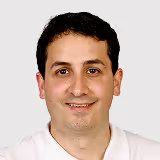
Marcel Kloos
Swiss-licensed dentist and founder of Medschool Experts
Marcel Kloos founded Medschool Experts while studying abroad; since then, over 500 study places have been secured. The Stuttgart-born dentist studied dentistry from 2015 to 2021 in Sofia and holds a Swiss dental licence.
Today he lives in Bern and runs Medschool Experts full-time as its owner.
More articles worth reading
Why Students Transfer from Medical University of Varna — Your Options
Why Students Transfer from Medical University of Warsaw — Your Options
Why Students Transfer from Masaryk University Faculty of Medicine — Your Options
Ahmad
Sabrina
Rami
Noah
500+ students placed.
Now it's your turn!
No daydreaming, no empty promises. Just a clear plan — for the start of your medical degree.
40 minutes, no obligation