Practical courses in a dentistry degree: from the phantom head to prosthodontics
01.09.2026

How is practical training in a dentistry degree structured?
The practical courses in a dentistry degree follow a clear sequence: first instruments and models in the laboratory, then work on the phantom head, then treating patients under supervision. In Sofia the degree lasts five and a half years and ends with a six-month clinical placement; the practical courses run from the second year of study through to graduation.
| Stage | Course | Work is done on |
|---|---|---|
| Foundations | technical propaedeutics | wax, plaster, instruments |
| Preparation | dental prosthetics, prosthodontics | phantom head and model |
| Clinical | conservative dentistry | patient under supervision |
| Clinical | surgery, periodontology | patient under supervision |
| Final stage | six-month clinical placement | more independent treatment |
What happens in the phantom head course?
The phantom head is a model with jaws and interchangeable teeth, mounted in a real treatment chair. You are therefore already sitting in the posture that will define your working day later on, using the same instruments — only without consequences for a human being.
I learned more about my own hands in the phantom head course than in any lecture. Preparing a cavity that is correct in depth and wall configuration is a matter of tenths of a millimetre, and you only notice that when the instructor inspects the work under magnification.
What do you do in prosthodontics?
Prosthodontics is dental replacement: crowns, bridges, partial dentures and full dentures. The course has two sides. In the laboratory you produce impressions, plaster models, wax-ups and the work of mounting them in the articulator. In the clinic, the try-in and fitting on the patient follow later.
This is the part of the degree that surprises many. Anyone who chooses dentistry because they want to work with people spends a great deal of time alone with a model in the first few years. If that does not appeal to you, it is worth knowing before you enrol.
{{cta}}What do you do in conservative dentistry?
Conservative dentistry is the course that comes closest to everyday practice later on: caries diagnostics, cavity preparation, restorative treatment, root canal treatment. This is where you move from the phantom head to the patient, and under direct supervision.
Your first patient of your own is a moment no curriculum can capture. What helps is the preparation: anyone who worked cleanly in the phantom head course does the same on a person, only more slowly.
How are the practical courses assessed?
On your own work. The preparation, the wax-up or the filling is graded, often combined with an oral subject examination. That is what sets dentistry apart from purely theoretical subjects: you can have understood a subject and still fail the course, because your hand is not yet there.
That is precisely why group size matters more in practical courses than in any lecture. In Sofia it was a maximum of ten students per instructor. Correction happens there and then on the piece of work, not two weeks later in a list of grades.
Do you need manual talent for dentistry?
A basic feel for it helps, but it is no substitute for training. In my own year, the progress between the first and the third practical semester was clearly visible in almost everyone — including those who were uncertain at the start.
To put it honestly: there are students for whom the manual side remains harder than the theoretical one, and the practical examination component cannot be predicted either by school-leaving grades or by a science aptitude test. Anyone who wants to know whether dentistry suits them should therefore observe in a practice beforehand — and get free advice on the locations.
The author's view
You can rescue an oral examination by talking well. You cannot rescue a cavity. Either the preparation is right or it is not, and the instructor sees which in ten seconds.
My assessment: anyone who develops a liking for the phantom head course will be happy in the profession. Anyone who merely endures it should be honest with themselves early on. This is based on my own studies in Sofia between 2015 and 2021 and on conversations with students we have placed — I am not aware of a study that proves it.
As a Swiss-licensed dentist, what I see above all today is this: the manual techniques I learned in those courses have stayed the same. The technology around them has changed; the millimetres have not.
Summary
- Practical training in a dentistry degree moves in three stages from the instrument via the phantom head to the patient.
- Technical propaedeutics, dental prosthetics and prosthodontics shape the early years; conservative dentistry and surgery shape the clinical ones.
- Assessment is based on your own work, often combined with an oral subject examination.
- In Sofia the practical courses run in groups of no more than ten students per instructor.
- Manual talent helps, but training over several semesters is what makes the difference.
- The degree there lasts five and a half years plus a six-month final placement; the qualification is recognised across the EU under Annex V 5.3.2.
If you want to know how practical training is organised at a specific location, we can clarify that in a free advisory session.
Further reading
- Studying medicine in Sofia: the main guide — where the practical courses sit in the overall picture of universities, costs and recognition.
- Studying dentistry: am I suited to it? — the self-assessment test.
- Dentistry or human medicine? — a decision aid.
- Dentistry without a numerus clausus abroad — an overview of the locations.
- From law student to dentist — my own path.
- The dissection course with body donors — the first major practical course of the preclinical years.
Frequently Asked Questions about practical courses in a dentistry degree
When do you work on a patient for the first time in a dentistry degree?
After the phantom head courses, usually from the third year of study. Before that, you practise on the phantom head and in the laboratory.
What is a phantom head?
A workstation model with jaws and interchangeable teeth, mounted in a real treatment chair. You work in it with the same instruments you will later use on patients.
What is technical propaedeutics?
The first practical course: handling instruments, wax modelling, impressions, plaster models. This is where it becomes clear how quickly your hand develops a feel for millimetres.
What do you do in conservative dentistry?
Caries diagnostics, cavity preparation, restorative treatment and root canal treatment. It is the course that comes closest to everyday practice later on.
What do you do in prosthodontics?
Dental replacement: crowns, bridges, partial and full dentures — from the impression through the wax-up to fitting, with a laboratory component and a clinical one.
How much laboratory work is there in the degree?
Considerably more than most people expect. A large part of the first years of study consists of work on models, not on people.
How are practical courses assessed?
Through sign-offs on your own work: the preparation, the wax-up or the filling is graded, often combined with an oral examination in the subject.
Do you need manual talent?
A basic feel for it helps. The larger part, though, is training: in my year, the progress between the first and the third semester was clear in almost everyone.
How large are the groups in the practical courses?
At the Medical University of Sofia, up to ten students per instructor. In practical courses that is the decisive factor, because correction happens directly on the piece of work.
How long does the dentistry degree in Sofia take?
Five and a half years, followed by a six-month final clinical placement.
Is the dentistry degree recognised in Germany?
Yes. Dentist is a sectoral profession under Annex V 5.3.2 of Directive 2005/36/EC, and the qualification is automatically recognised across the EU.
What if I want to transfer in the middle of my studies?
With practical subjects, credit transfer is trickier than with theoretical ones, because course results are graded on the piece of work. We will look at your case in the free advisory session.
What students say about Medschool Experts
Over 500 placements at more than 25 partner universities across 10+ countries. Read independent student reviews on Trustpilot.
About the author
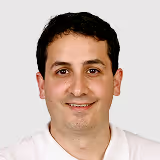
Marcel Kloos
Swiss-licensed dentist and founder of Medschool Experts
Marcel Kloos founded Medschool Experts while studying abroad; since then, over 500 study places have been secured. The Stuttgart-born dentist studied dentistry from 2015 to 2021 in Sofia and holds a Swiss dental licence.
Today he lives in Bern and runs Medschool Experts full-time as its owner.
More articles worth reading
Why Students Transfer from Medical University of Varna — Your Options
Why Students Transfer from Medical University of Warsaw — Your Options
Why Students Transfer from Masaryk University Faculty of Medicine — Your Options
Ahmad
Sabrina
Rami
Noah
500+ students placed.
Now it's your turn!
No daydreaming, no empty promises. Just a clear plan — for the start of your medical degree.
40 minutes, no obligation