Studying Dentistry: Am I Suited? A 12-Question Self-Test
17.09.2026

Am I suited to studying dentistry?
Being suited to studying dentistry means bringing five things to the table: steady fine motor control down to the millimetre, spatial awareness, stamina to last five to six years, patience with anxious patients, and the ability to correct your own mistakes calmly. According to the research, your school-leaving grade doesn't belong on this list.
Each of these five points can be checked individually, before committing to six years of study. I put together the following table from the requirements that dental programmes genuinely test – in Sofia just as much as at any German faculty.
| Requirement | How you'll recognise it in everyday life | Where it counts during your studies |
|---|---|---|
| Fine motor skills | You enjoy working on small, fiddly things and grow calmer rather than tense while doing so | Pre-clinical simulation course, tooth preparation, root canal treatment |
| Spatial reasoning | You can picture objects rotated in space and work in a mirror without frustration | Anatomy, prosthetics, reading X-rays |
| Stamina | You keep studying even when the material bores you | Pre-clinical years, oral exams, state examinations |
| Working with people | You stay calm when someone in front of you is afraid | Patient treatment courses from the third year onward |
| Tolerance for mistakes | You can discard work that's nearly finished and start again | Every crown, every denture, every filling |
One thing stands out here: four of the five requirements have nothing to do with school grades.
The self-test: twelve questions on your suitability for dentistry
The self-test consists of twelve yes/no questions on fine motor skills, spatial ability, stamina and patient contact. Each "yes" earns one point. It isn't an admissions procedure or a psychological instrument – it's a structured self-assessment, exactly the kind of thing most prospective students have never actually done before deciding.
- Can you work in concentrated focus on something small and fiddly for more than 30 minutes without growing restless?
- Have you ever built, repaired or modelled something with your hands – and felt enjoyment rather than impatience while doing it?
- Do you work cleanly, even when no one is watching?
- Can you picture what an object looks like from the other side without turning it?
- Are you comfortable working from a mirror image, such as reverse parking or drawing in a mirror?
- Can you discard a piece of work that's 90 percent good but doesn't fit?
- Are you comfortable with close physical proximity, smells and saliva?
- Do you stay calm when the person in front of you is afraid and takes that fear out on you?
- Do you keep studying even when the material doesn't interest you right now?
- Are you prepared to live with a full timetable for five to six years, including mandatory attendance and practical courses?
- Does the idea of one day deciding for yourself what your working day or your own practice looks like appeal to you?
- Can you still picture yourself in this profession in 25 years, once you set aside status and income?
How to read your result
9 to 12 points: Your profile matches what the programme demands. The next sensible step isn't another test – it's genuine contact with the field: a day shadowing in a practice, or a conversation with someone in the middle of the programme.
5 to 8 points: This is the most common range, and it's nothing to worry about. Look at which questions you answered no to. If it's manual skill you're missing, that can be trained. If it's patience with people, that's a more honest question to sit with.
0 to 4 points: Then it's worth looking at human medicine or another field in healthcare. Anyone who chooses dentistry mainly for the professional image rather than the hands-on work tends to notice by the first pre-clinical simulation course at the latest.
One caveat belongs here: this test isn't a validated instrument. It bundles together requirements that are demonstrably part of the programme, but it doesn't predict a grade. Score 12 points and don't study, and you still won't pass an exam.
Does your school-leaving grade say anything about your suitability for dentistry?
In dentistry, your final school grade says less than most people assume. Arnold and colleagues reported moderate correlations in 2011 in the European Journal of Dental Education between German school-leaving grades and exam performance: r = 0.34 for the preliminary science exam, r = 0.27 for the preliminary dental exam, and r = 0.27 for the state examination.
Translated into variance: the school-leaving grade explains 12 percent of the difference in performance in the preliminary science exam, and 7 percent each in the preliminary dental exam and the state examination. To put that in perspective: at 7 percent, 93 percent of the difference between two students comes down to something other than their school grade – study habits, motivation, preparation, manual skill.
It becomes even clearer with the practical component. The selection-procedures working group at Hamburg-Eppendorf University Medical Centre (Kothe, Hissbach and Hampe, GMS Journal for Medical Education, published 15 November 2013) studied four cohorts of dental students. The prosthodontics exam involves four practical simulation exercises, and the authors found that neither the school-leaving grade nor the science aptitude test was a suitable predictor of performance on these.
The Test for Medical Studies (TMS) lands in the same range: a meta-analysis by Hell and colleagues pools eight primary studies covering a total of 5,871 students and arrives at a corrected validity of 0.35 – around 12.4 percent of explained grade variance.
What's genuinely shaky about this: the Hamburg regression models are based on just 32 to 55 participants per cohort, the data comes from the 2006–2010 intakes, and the selection procedures have since changed. The overall direction is well supported; the exact percentages are not.
What does the HAM-Man wire-bending test measure – and what doesn't it measure?
The HAM-Man is a wire-bending test that the University of Hamburg has used exclusively for dentistry admissions since 2010. Applicants have 45 minutes to bend wire with pliers to match a template. It's scored on how closely the result matches the drawing and how flat it sits. It's the only one of Hamburg's tests to remain alongside the new TMS-Nat.
It measures a snapshot of fine hand movement under time pressure. It doesn't measure whether that same movement holds up after four weeks of practice. That's exactly the difference between selection and training.
My take: fine motor skill is largely trainable; patience with people much less so. If you're weak on the manual-skill questions in the self-test, that's a practice problem. If you hesitate on questions 7 and 8, that's a career question. This assessment is based on my own time as a student and on consultation conversations, not on a controlled study.
{{cta}}How do you tell, once you're actually in the programme, whether you're suited to it?
Very early on, which is the good news. I studied dentistry in Sofia from 2015 to 2021. The pre-clinical simulation course comes early, long before a patient ever sits in the chair. In my sixth semester I made my first complete denture and my first crown for an actual patient, and restorative dentistry involved root canal treatments on extracted teeth. Teaching happened in small groups of no more than ten students per instructor.
What I learned from this: the moment you find out whether this work suits you isn't the exam. It's the third repetition of the same preparation. Some people grow calmer doing it. Others realise they'd rather diagnose than model – and switch to human medicine, which is entirely feasible in the first years of study.
I see both groups in consultations. What stands out is that almost no one fails because of the academic material. When someone stops, it's almost always for a different reason: expectations about the profession that didn't match reality.
What if you're suited to the profession but your grades aren't good enough?
Studying abroad is then the direct route – not a fallback. European universities offer dentistry without a numerus clausus, with semester fees starting from around €1,750. As a sectoral profession under Annex V, item 5.3.2 of Directive 2005/36/EC, the qualification is automatically recognised within the EU; in Switzerland, recognition runs through MEBEKO, just as it did for me.
We work out individually which location fits which profile and when a realistic start date would be – that's exactly what the free consultation is for. Medschool Experts has since supported more than 500 students across more than 25 universities, from the first conversation through to launching their careers.
Author's opinion
I wrote this piece in 2019 as a student, in the middle of the clinical stage of my dentistry degree in Sofia. Seven years on, I'm a qualified dentist, and I see the question of suitability differently than I did back then.
At the time, I thought suitability was something you either had or didn't. Today I'd say it's largely a decision you keep making, day after day. Your hands learn. Patience with anxious people can be practised. What barely changes is the basic question of whether the work still interests you the twentieth time it's the same.
What still bothers me is the order in which many people approach this: grades first, then the question of whether the subject actually fits. I think it should be the other way round. Anyone who knows dentistry is right for them finds a way there – in Germany through the admissions process, in Europe through one of the many universities that admit students without a numerus clausus.
Conclusion
Whatever your self-test result, your path into dentistry doesn't have to stop at a single number or a single grade. Get in touch with Medschool Experts – we have the largest network of official partner universities, and we assess individually where the highest possible year of entry lies for you. In many cases, entry is possible directly into the final two years of the programme. Book your free consultation and let's map out the right way forward together.
Frequently asked questions about suitability for studying dentistry
Do you need manual talent to study dentistry?
You need fine motor skill and spatial awareness, not talent in the sense of an innate gift. Most of the movements involved are practised over weeks in the pre-clinical simulation course. Anyone who repeats them patiently generally reaches the required level.
How can I find out before starting whether dentistry is right for me?
Three approaches tend to work well: shadowing at a dental practice, talking to students in the clinical stage of the programme, and an honest self-test like the one in this article. What matters most is seeing the practical work up close at least once.
Does your school-leaving grade say anything about success in dental studies?
Something, but not much. Arnold and colleagues reported correlations in 2011 ranging from r = 0.34 (preliminary science exam) to r = 0.27 (state examination) – equivalent to 12 and 7 percent of explained performance variance respectively. It doesn't predict the practical exam component at all.
What is the HAM-Man?
The HAM-Man is the University of Hamburg's wire-bending test, part of the dentistry admissions process since 2010. Candidates have 45 minutes to bend wire to match a template, scored on how closely it matches and how flat it sits. It remains in place even after the switch to the TMS-Nat.
Can fine motor skill be trained?
Yes. Modelling, drawing, crafts, playing a musical instrument and working from a mirror all measurably improve hand steadiness and coordination. This is exactly what the pre-clinical simulation course builds on, drilling the movements systematically and without patients.
Is dentistry harder than human medicine?
It's different. The pre-clinical material overlaps heavily, but dentistry also requires practical work that gets graded. Anyone who enjoys working with their hands finds that a relief; anyone who'd rather diagnose finds it an extra burden.
Can I switch from dentistry to human medicine?
A switch is entirely feasible in the first years of study, since the pre-clinical subjects overlap substantially. How much gets credited is decided case by case by the receiving university; we check this with you during your free consultation.
How many years does a dentistry degree take?
In Germany it takes five years and six months; at most European universities, five to six years. The minimum duration and content are set EU-wide by Directive 2005/36/EC.
Is a dentistry degree earned abroad in Europe recognised in Germany?
Yes. Dentist is a sectoral profession under Annex V, item 5.3.2 of Directive 2005/36/EC. Degrees from listed EU universities are automatically recognised; in Switzerland, recognition is granted by MEBEKO.
What does a dentistry degree abroad in Europe cost?
Semester fees start from around €1,750 and can run considerably higher depending on the location. We discuss individually which university fits your budget and profile during your free consultation.
What students say about Medschool Experts
Over 500 placements at more than 25 partner universities across 10+ countries. Read independent student reviews on Trustpilot.
About the author
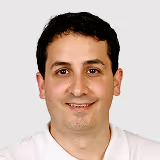
Marcel Kloos
Swiss-licensed dentist and founder of Medschool Experts
Marcel Kloos founded Medschool Experts while studying abroad; since then, over 500 study places have been secured. The Stuttgart-born dentist studied dentistry from 2015 to 2021 in Sofia and holds a Swiss dental licence.
Today he lives in Bern and runs Medschool Experts full-time as its owner.
More articles worth reading
Health Insurance for International Medical Students in Europe 2026
Scholarships and Funding for Medical Studies in Europe 2026
Medicine, Dentistry, Pharmacy or Veterinary Medicine? Choosing Your Degree Abroad in 2026
Ahmad

Sabrina
Rami
Noah
500+ students placed.
Now it's your turn!
No daydreaming, no empty promises. Just a clear plan — for the start of your medical degree.
40 minutes, no obligation