Studying Medicine in Debrecen: Costs, Structure and Recognition
17.09.2026

Studying Medicine in Debrecen at a Glance
The University of Debrecen trains doctors, dentists and pharmacists in English. Human medicine takes twelve semesters and costs 7,250 EUR per semester, dentistry ten semesters at 7,500 EUR, and pharmacy ten semesters at 3,430 EUR. The degree is automatically recognised in all EU member states under Directive 2005/36/EC.
| Feature | Detail for Debrecen |
|---|---|
| University | University of Debrecen (Debreceni Egyetem), roots to 1538, university status since 1912 |
| Programmes in English | Human medicine (12 semesters), dentistry (10), pharmacy (10) |
| Language of instruction | English, with Hungarian as a compulsory subject |
| Tuition fee, human medicine | 7,250 EUR per semester |
| Tuition fee, dentistry | 7,500 EUR per semester |
| Tuition fee, pharmacy | 3,430 EUR per semester |
| Cost of living | 700 to 900 EUR per month |
| Clinical centre | 3,400 beds, three campuses, over 4 million patients per year |
| Accreditation | Hungarian Accreditation Committee (MAB), WFME-recognised, valid until 22 April 2030 |
| Study start | September, one intake per year |
| Degree, human medicine | M.D., listed in Annex V of Directive 2005/36/EC |
The University and Its Clinical Centre: What Stands Behind Studying in Debrecen
The University of Debrecen has twelve faculties and around 20,000 students, nearly 6,000 of them from abroad. According to its 2025/2026 programme bulletin, the Faculty of Medicine comprises 38 institutes in total, including 21 clinical departments with more than 1,800 beds. Added to that is the Kenézy Gyula Hospital with around 1,400 beds.
The hospital network is what really sets this location apart. The Clinical Centre of the University of Debrecen operates 3,400 beds, 400 outpatient clinics, 42 dental treatment units and 69 imaging and laboratory facilities. It employs more than 7,000 people, including around 1,700 doctors and nearly 4,800 healthcare professionals. More than four million patients are treated each year across 62 inpatient and 102 outpatient specialties, spread across the Nagyerdei and Kenézy Gyula campuses in Debrecen and the campus in Berettyóújfalu. Students in Debrecen therefore encounter rare cases not just in the textbook, but next door.
In academic terms, Debrecen sits in the international mid-field. In the QS World University Rankings 2025, the university is placed 574th. In the QS subject rankings 2025, medicine sits in the 351–400 band, pharmacy also in the 351–400 band, and life sciences and medicine in the 401–450 band. The Times Higher Education World University Rankings place Debrecen in the 801–1000 band.
The point that matters most for international students is a different one. In June 2022, the university announced that the Hungarian Accreditation Committee had accredited its medical education following an 18-month process — the first medical education programme in Hungary to be accredited at all, valid for eight years until 22 April 2030. The committee is recognised by the World Federation for Medical Education. Since 2024, only graduates of accordingly accredited programmes have been able to register for the US licensing exam, the USMLE. László Mátyus, Dean of the Faculty of Medicine, said of the accreditation: "This accreditation increases the value of the degrees our students receive and represents a competitive advantage." Attila Jenei, Head of the Coordination Centre for International Education, called the process "absolutely necessary to ensure the continued recognition of medical education in the USA."
Which Programmes Debrecen Offers, and in Which Language
Debrecen offers three medicine-related programmes in English: human medicine over twelve semesters, dentistry over ten semesters and pharmacy over ten semesters. There is no German-language medicine programme here. Students who want to study in German will find that option in Hungary at Semmelweis University in Budapest, in Pécs and in Szeged.
| Programme | Duration | Language | Degree |
|---|---|---|---|
| Human medicine | 12 semesters | English | M.D. |
| Dentistry | 10 semesters | English | D.M.D. |
| Pharmacy | 10 semesters | English | Pharm.D. |
| Basic Medicine Course | 1 to 2 semesters | English | Preparatory certificate |
Admission is not based on a school-leaving grade average but on an entrance exam in biology and chemistry or physics. Alternatively, the Basic Medicine Course leads into the main programme. Which of the two routes is faster in an individual case depends on prior education — something we look at together in a free consultation.
Veterinary medicine is not offered in Debrecen. In Hungary as a whole, only the University of Veterinary Medicine Budapest trains vets, over 5.5 years and likewise in English or German.
What Studying Medicine in Debrecen Costs
Human medicine costs 7,250 EUR per semester in Debrecen, dentistry 7,500 EUR and pharmacy 3,430 EUR. On top of that comes 700 to 900 EUR in monthly living costs. By our calculation, six years of human medicine adds up to around 149,000 EUR in total — tuition and everyday living combined.
| Item | Amount | Period |
|---|---|---|
| Tuition fee, human medicine | 7,250 EUR | per semester |
| Tuition fee, dentistry | 7,500 EUR | per semester |
| Tuition fee, pharmacy | 3,430 EUR | per semester |
| Cost of living, including accommodation | 700 to 900 EUR | per month |
| Study materials and trips home | around 750 EUR | per year (estimate) |
Our overall estimate, clearly marked as such and calculated with 800 EUR in monthly living costs: human medicine in Debrecen comes to around 87,000 EUR in tuition fees, around 57,600 EUR in living costs and around 4,500 EUR for books, coats, instruments and trips home, for a total of around 149,000 EUR. Dentistry comes to around 127,000 EUR over five years, pharmacy to around 86,000 EUR.
One caveat applies, and it concerns your budget. Debrecen sits at the upper end of tuition fees among Hungarian locations, and the university calculates its fees in US dollars. The euro amount therefore depends on the exchange rate and can shift from one academic year to the next. Anyone planning for six years should build in a buffer of five to ten percent on fees. Those focused primarily on price will find noticeably cheaper routes to the same EU-recognised degree in Romania or Bosnia.
How the Programme in Debrecen Is Structured
The human medicine programme is divided into theoretical foundations in the first two years, pre-clinical subjects in the third year, clinical subjects in the fourth and fifth years, and a practical sixth year. The 2025/2026 programme bulletin puts the theory-to-practice ratio at 30 to 70 and the training at more than 5,500 contact hours.
| Section | Academic year | Content |
|---|---|---|
| Theoretical foundations | Years 1 and 2 | Anatomy, biochemistry, physiology, Hungarian |
| Pre-clinical subjects | Year 3 | Pathology, pharmacology, microbiology |
| Clinical subjects | Years 4 and 5 | Internal medicine, surgery, gynaecology, paediatrics |
| Practical year | Year 6 | At least 47 weeks of rotations |
| Graduation | after year 6 | Hungarian state exam, M.D. title |
The sixth year rotates through internal medicine, paediatrics, surgery, gynaecology and obstetrics, neurology and psychiatry. The faculty requires at least 47 weeks for this but allows a window of up to 24 months — so students who fit in an elective placement abroad during the practical year, or who fall ill, do not automatically lose an entire academic year. The Hungarian state exam comes at the end.
Hungarian is part of the compulsory curriculum. Teaching is in English, but conversations with patients on the ward are not: Hungarian patients speak Hungarian, and the language courses in the early years of the programme prepare students specifically for that. This is the uncomfortable part of studying in Hungary, and it is easy to underestimate. Hungarian is not an Indo-European language, so its vocabulary does not connect to anything familiar from German, English or Latin.
{{cta}}How to Finance Studying in Debrecen
For a full degree programme in Hungary, overseas BAföG applies under Section 5(2)(3) of the BAföG Act. For Hungary, the responsible office is Studentenwerk Chemnitz-Zwickau. The maximum rate is 992 EUR per month, half as a grant and half as an interest-free loan.
On top of that comes a tuition fee subsidy of up to 5,600 EUR, paid as a grant with no repayment. The catch: it is paid for a maximum of twelve months. With an annual fee of 14,500 EUR in Debrecen, it therefore covers a good third of one academic year, once only, and nothing after that. Travel costs are calculated at 250 EUR per trip; there is no overseas supplement within the EU. On 12 August 2026, the federal cabinet approved the 30th BAföG Amendment Act; under it, the housing cost allowance rises from 380 to 440 EUR from the summer semester of 2027.
The education loan from the Federal Office of Administration pays 100 to 300 EUR per month, up to a maximum of 7,200 EUR, at an effective annual interest rate of 3.53 percent (as of 1 April 2026), though only during the final 24 months of study. The KfW student loan 174 is not an option for Debrecen: a full degree programme abroad is excluded under the November 2023 fact sheet. On tax matters: for a first degree, only special expenses of up to 6,000 EUR are deductible, with no loss carry-forward — the Federal Constitutional Court confirmed this rule on 19 November 2019 (2 BvL 22/14). Anyone who has already completed vocational training beforehand can claim the costs without limit as income-related expenses.
Where Can You Practise Medicine with a Degree from Debrecen?
The Hungarian medical degree is listed in Annex V of Directive 2005/36/EC under number 5.1.1. This means it is automatically recognised in every EU and EEA member state: no equivalence examination, no knowledge examination. Outside the EU, separate procedures apply that vary by destination country.
| Country | Route to licensure | Note |
|---|---|---|
| Germany | Approbation, automatic recognition | Annex V No. 5.1.1, EU conformity certificate from Hungary |
| Austria | automatic recognition | plus registration with the Austrian Medical Chamber's register of doctors |
| Switzerland | recognition by the responsible federal authority | followed by a cantonal practice licence, B2 language proof required |
| Rest of EU and EEA | automatic recognition | national registration with the responsible chamber |
| United Kingdom | registration with the GMC | case-by-case review since Brexit |
| USA | ECFMG certification, USMLE | Debrecen is WFME-accredited until 22 April 2030 |
| Canada | MCC exams, CaRMS match | separate position pools for IMGs and Canadian graduates |
| Australia | AMC exams, Ahpra registration | the accelerated pathway applies only to the UK, Ireland and New Zealand |
One point on language requirements, because it is often misrepresented: anyone who holds German citizenship, or who completed school or vocational training in Germany in German, needs to sit neither the general language exam nor the specialist language exam. Both apply exclusively to applicants without a German-language school or training background. In Switzerland, the B2-level language proof applies in a similar way.
The USA is the reason the 2022 accreditation is worth more than a line in the university's marketing material. Since 2023, the ECFMG has required that the medical school be accredited by a WFME-recognised agency and listed in the World Directory of Medical Schools with a sponsor note for the relevant graduation year. Debrecen meets this condition for every cohort graduating by 2030 — in other words, for anyone starting today.
Dentist, Pharmacist, Psychologist, Vet: the Legal Position by Profession
Automatic recognition under Directive 2005/36/EC does not apply uniformly to all healthcare professions; each is covered by its own entry in Annex V. For dentists, that is number 5.3.2, for pharmacists number 5.6.2, and for vets number 5.4.2. Psychologists are not included.
A dentistry degree from Debrecen leads to the Approbation in Germany via number 5.3.2, and in Switzerland via the responsible federal authority followed by cantonal approval. Pharmacy is covered under number 5.6.2; here too, the language exams are waived for applicants with a German-language school background. Veterinary medicine is not offered in Debrecen, since the programme does not exist there; Hungarian veterinary degrees from Budapest fall under number 5.4.2 with the same automatic recognition.
Psychology is the special case. A psychology degree from elsewhere in the EU is not automatically recognised in Germany, because the profession is not among the sectoral professions covered by the directive. Anyone who wants to work as a psychotherapist goes through Germany's reformed Psychotherapists Act and its associated licensing programme; foreign coursework is assessed individually in that process. This is why we treat psychology and medicine as strictly separate matters in consultations.
Career Paths After Graduation
A degree from Debrecen opens more doors than the German job market alone. Switzerland counted 44,612 practising doctors in 2025 according to FMH statistics, 43 percent of them with a foreign diploma — well above the OECD average of 19.6 percent. In Austria, around 53,353 doctors were listed on the register of physicians as of 31 December 2025, with around 18 percent of first-time registrations held by non-Austrian citizens, the largest group being German. Austria's basic training period was shortened from nine to six months by parliamentary decision on 7 July 2026, effective 1 August 2026, which noticeably speeds up entry there.
For those wanting to go further afield, Debrecen offers a practical advantage. The GMC Workforce Report 2025 lists 328,149 licensed doctors in the UK, of whom 138,405 — 42 percent — qualified internationally. In the 2026 NRMP Match in the USA, 44,344 positions were available to 53,373 registered applicants; the match rate was 70.0 percent for US citizens who studied abroad and 56.4 percent for non-US graduates, with internal medicine, family medicine and paediatrics the most accessible specialities. In Canada, 931 internationally trained doctors matched in the 2026 CaRMS process, up from 851 the year before and 671 in 2024.
On the question of quality, there is a solid answer. Tsugawa and colleagues, writing in the BMJ in 2017 (356:j273), analysed 1,215,490 hospital admissions treated by 44,227 internists: adjusted 30-day mortality was 11.2 percent among internationally trained doctors versus 11.6 percent among US-trained doctors (OR 0.95). The difference is small and plausibly a selection effect. It does not prove that studying abroad produces better-trained doctors — but it does refute the assumption that it produces worse-trained ones. We cover in detail the paths a European medical degree opens worldwide in our guide to Career Paths with an EU Medical Degree.
Returning to Germany: Credit Transfer and Switching Universities
Switching to a German faculty after a few semesters in Debrecen is possible and happens regularly. The State Examination Offices are responsible, assessing under Section 12 of the Approbationsordnung für Ärzte which credits are equivalent. What matters is not the country but the content of the individual course certificates.
Debrecen's thorough pre-clinical curriculum works in students' favour here. Whether you end up in the third or the fifth clinical semester depends on the federal state, the faculty and your own transcript. We review such transcripts regularly and tell you honestly what is realistically creditable — in a free consultation, without any sales pressure.
Living in Debrecen
With 202,130 residents (as of January 2025), Debrecen is Hungary's second-largest city and lies around 30 kilometres west of the Romanian border, in the Great Hungarian Plain. Around 30,000 students shape the cityscape. Living costs run at 700 to 900 EUR per month, including accommodation and food.
The campus sits by the Nagyerdő, the Great Forest in the north of the city, between a thermal bath, a park and a stadium. Two tram lines connect it to the city centre, the M35 motorway leads to Budapest, and Debrecen Airport offers scheduled and charter flights. Since 2016, the city has held the title European City of the Reformation — the Great Reformed Church in the centre stands in the same tradition as the 1538 college from which the university grew.
Economically, Debrecen has become the country's second-largest industrial hub in recent years. By the end of 2025, BMW had invested more than two billion euros in vehicle and battery production and is building its Neue Klasse there. For students, this mainly means one thing: more international demand for housing and stronger rent growth than in smaller Hungarian university towns. Those who start looking early pay less.
Who Debrecen Is the Right Choice For
Debrecen suits you well if you want to study in English, are looking for a large clinical centre with high patient volumes, and want to keep the door to the USA open. WFME accreditation until 2030 is a concrete requirement for that, not just a label. Anyone still deciding between human medicine, dentistry and pharmacy will also find all three paths at a single university here.
The location is a less good fit if you want to study in German; for that, Budapest, Pécs and Szeged are the right addresses. And if your budget is tight, it is worth looking at more affordable EU locations, since Debrecen sits at the upper end on fees. Anyone who only decides in spring should also know: there is only one intake per year, in September.
The Author's View
I studied dentistry in Sofia between 2015 and 2021, entirely in English. Anyone hearing for the first time that a whole degree runs in a foreign language often flinches. In my experience, that is exactly the underrated advantage: the specialist language of medicine is English anyway, and textbooks, guidelines and studies appear there first. After six years, you read a paper in the New England Journal without even noticing the language.
What I underestimated at the time was the local language. Bulgarian was compulsory, and at first I dismissed it as a nuisance. That changed the moment I was on the ward: the patient in front of me did not speak English, and nobody translates for you indefinitely. Anyone heading to Debrecen should take Hungarian seriously from day one. It is harder than Bulgarian, because it connects to nothing you know from school German. Six months of honest vocabulary practice in the first year saves a lot of frustration in the fourth.
And then there is the price, plainly put. At 7,250 EUR per semester, Debrecen is one of the pricier addresses in Hungary, and the university calculates in US dollars, which makes the euro amount move. Anyone working with a tight budget can get the same EU-recognised degree for considerably less in Romania or Bosnia. My assessment, clearly marked as an opinion: the premium is worth it if you genuinely make use of the large clinical centre and the WFME accreditation — in other words, if you spend a lot of time on the ward or have the USA in mind. For someone who ends up starting out at a small hospital back home, it is harder to justify.
My own diploma from Sofia was recognised without complication thanks to the EU framework of Directive 2005/36/EC; without that framework, the path would have looked completely different. That is the point I most like to pass on to young people: a medical or dental degree from an EU country is not a fallback option, but an entry ticket that helps decide which country you go on to work and live in. As a father, I notice every day how much that decision was worth.
Conclusion
Debrecen is a strong option if you want an English-language medicine degree at a university with an unusually large clinical network and a clear path toward international recognition. Whether it is the right fit for you specifically depends on your background, your budget and your goals — and that is exactly what we look at together at Medschool Experts.
As the partner with the largest network of official partner universities, we assess individually for every student the highest possible year of entry, and in many cases entry is possible even in the final two years of the programme. Get in touch and book a free consultation to find out what is realistic in your case.
Frequently Asked Questions About Studying Medicine in Debrecen
How much does studying medicine in Debrecen cost?
Human medicine at the University of Debrecen costs 7,250 EUR per semester, dentistry 7,500 EUR and pharmacy 3,430 EUR. On top of that comes 700 to 900 EUR in monthly living costs. By our calculation, that adds up to around 149,000 EUR for six years of human medicine, including books, instruments and trips home.
Can you study medicine in German in Debrecen?
No. The University of Debrecen teaches human medicine, dentistry and pharmacy in English. German-language medicine programmes exist in Hungary at Semmelweis University in Budapest, the University of Pécs and the University of Szeged. Which location suits you better depends mainly on your English proficiency.
Is the Debrecen degree recognised in Germany?
Yes. The Hungarian medical degree is listed in Annex V, number 5.1.1 of Directive 2005/36/EC and is automatically recognised in Germany. There is neither an equivalence exam nor a knowledge exam. The Approbation is issued by the responsible authority in the federal state where you want to work.
Do I need a specific school-leaving grade average for Debrecen?
No, there is no numerus clausus in Hungary. The University of Debrecen selects students through an entrance exam in biology and chemistry or physics. Anyone who still needs to build up their science foundation can enter via the preparatory Basic Medicine Course.
How long does studying medicine in Debrecen take?
Human medicine takes twelve semesters, or six years, and ends with the Hungarian state exam and the M.D. title. Dentistry takes ten semesters, and so does pharmacy. The sixth academic year consists of at least 47 weeks of clinical rotations across six specialties.
Do I have to learn Hungarian to study in Debrecen?
Yes. Teaching is in English, but Hungarian is part of the compulsory curriculum in the early years of the programme. The reason is practical: on the ward, Hungarian patients speak Hungarian. Without a basic vocabulary, taking a patient history becomes noticeably harder in the fourth and fifth years.
Can I work in Switzerland with a degree from Debrecen?
Yes. The responsible federal authority recognises EU diplomas directly. You then also need a practice licence from the canton where you work, plus proof of language proficiency at B2 level. Switzerland had around 44,612 practising doctors in 2025, 43 percent of them with a foreign diploma.
Does studying in Debrecen open the door to the USA?
The requirement for that is met. Since 2023, the ECFMG has required accreditation by a WFME-recognised agency; Debrecen's medical education is accredited accordingly until 22 April 2030. After that come the USMLE Step 1 and Step 2 CK exams, plus ECFMG certification.
Are dentistry and pharmacy also offered in Debrecen?
Yes, both programmes are taught in English. Dentistry takes ten semesters and costs 7,500 EUR per semester; pharmacy also takes ten semesters, at 3,430 EUR. Both degrees are automatically recognised in the EU under Annex V of Directive 2005/36/EC.
Can I study veterinary medicine in Debrecen?
No. Veterinary medicine in Hungary is taught exclusively at the University of Veterinary Medicine Budapest, over 5.5 years, in English or German. The degree falls under Annex V, number 5.4.2 of Directive 2005/36/EC and is likewise automatically recognised.
What are living costs like in Debrecen?
Budget for 700 to 900 EUR per month, including accommodation and food. With 202,130 residents (January 2025), Debrecen is Hungary's second-largest city; recent industrial investment has pushed rents up faster than in smaller Hungarian university towns. Looking for housing early pays off.
Can I get overseas BAföG for Debrecen?
Yes, a full degree programme in Hungary is eligible for funding under Section 5(2)(3) of the BAföG Act; the responsible office is Studentenwerk Chemnitz-Zwickau. The maximum rate is 992 EUR per month. The tuition fee subsidy of up to 5,600 EUR is a genuine grant, but it is paid for a maximum of twelve months.
Can I switch to Germany after a few semesters?
Yes, that is possible and happens regularly. The State Examination Offices assess under Section 12 of the Approbationsordnung für Ärzte which credits from Debrecen are equivalent. Which academic year you land in depends on the federal state, the faculty and your individual course certificates.
What students say about Medschool Experts
Over 500 placements at more than 25 partner universities across 10+ countries. Read independent student reviews on Trustpilot.
About the author
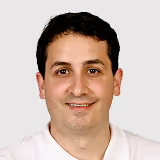
Marcel Kloos
Swiss-licensed dentist and founder of Medschool Experts
Marcel Kloos founded Medschool Experts while studying abroad; since then, over 500 study places have been secured. The Stuttgart-born dentist studied dentistry from 2015 to 2021 in Sofia and holds a Swiss dental licence.
Today he lives in Bern and runs Medschool Experts full-time as its owner.
More articles worth reading
Health Insurance for International Medical Students in Europe 2026
Scholarships and Funding for Medical Studies in Europe 2026
Medicine, Dentistry, Pharmacy or Veterinary Medicine? Choosing Your Degree Abroad in 2026
Ahmad
Sabrina
Rami
Noah
500+ students placed.
Now it's your turn!
No daydreaming, no empty promises. Just a clear plan — for the start of your medical degree.
40 minutes, no obligation