Studying Medicine in Poland: Szczecin, Wrocław, Łódź and Poznań at a Glance
17.09.2026

Why Poland
Three arguments speak for Poland. First, distance: no other destination without a numerus clausus lies this close to Germany, and several locations are reachable by car or train within a few hours. Second, the curriculum, which structurally resembles the German set-up and can therefore be credited well in the event of a later transfer. Third, the long experience with international year groups: some of the English-language programmes at Polish universities have been running for decades.
As an EU member state, Poland supplies the legal basis as well: the state medical universities are listed in Annex V of Directive 2005/36/EC, and the degree is recognised in Germany, Austria and Switzerland without any additional examination.
Pomeranian Medical University in Szczecin
The location with the shortest journey: Szczecin lies around 150 kilometres from Berlin. For students from northern and eastern Germany, a weekend visit home is therefore straightforward.
Academically, Szczecin is interesting above all because of its credit-transfer profile: experience shows that one subject semester is credited there after a single completed semester, and the entire preclinical phase after four. That makes Szczecin the location where an early transfer back to Germany costs the least time.
Wrocław Medical University
Wrocław is one of Poland's largest student cities, with a lively old town and good transport connections. The medical university offers human medicine and dentistry in English. For a transfer back, experience points to two credited subject semesters after three semesters abroad and four after the complete preclinical phase.
Medical University of Łódź
Łódź is among the most attractively priced locations in the country. Tuition fees are around EUR 7,460 per semester in human medicine and around EUR 8,320 in dentistry. The city is centrally located and the cost of living is among the lowest of the large Polish university cities.
Which Polish location fits your situation is something we clarify in a free consultation.
{{cta}}
Poznań University of Medical Sciences
Poznań is one of the best-known locations for international medical students in Poland, with a correspondingly large international community. Fees are around EUR 8,735 per semester in human medicine and around EUR 8,845 in dentistry.
Medical University of Białystok
This location in the east of the country offers human medicine in English at around EUR 7,860 per semester. Białystok is smaller and quieter than the western cities, and the cost of living is correspondingly low.
The locations at a glance
| University | Human medicine | Dentistry | Distinguishing feature |
|---|---|---|---|
| Szczecin | yes | yes | 150 km from Berlin, best credit-transfer profile |
| Wrocław | yes | yes | large student city, good connections |
| Łódź | approx. EUR 7,460 per semester | approx. EUR 8,320 per semester | attractively priced, centrally located |
| Poznań | approx. EUR 8,735 per semester | approx. EUR 8,845 per semester | large international community |
| Białystok | approx. EUR 7,860 per semester | – | quiet location, low cost of living |
| Katowice | yes | yes | large hospital network in the Upper Silesian conurbation |
Fees at individual locations are adjusted annually and are sometimes staggered by year of study. We clarify the current terms, and the question of which location fits your profile, in a personal conversation.
Day-to-day study
Teaching is in English, in internationally mixed year groups. Polish courses are part of the curriculum and are needed by the clinical phase at the latest, when contact with patients begins. The university hospitals are large and cover a broad range of specialties, which means a great deal of hands-on practice in the clinical years in particular.
The cost of living runs to roughly EUR 500 to 750 a month depending on the city. Places in halls of residence are considerably cheaper than private flats, but availability is limited.
If you want to work through costs, housing and timing early on, arrange a free consultation.
The author's view
Poland is the location I recommend when two things come together: the wish to stay close to Germany and the intention to transfer back later. In that constellation Szczecin is hard to beat. Anyone who starts there loses practically no time in an early transfer, and the weekend trip to Berlin takes less time than many journeys within Germany itself.
What I will say honestly alongside that: Poland is not the cheapest country on tuition fees, and the cost of living is above Bulgaria or Romania. To some extent you are paying here for the proximity. Whether that premium is worth it is a very personal question, and often comes down simply to how close the ties back home are. Both answers are legitimate; they should just be given deliberately.
Conclusion
Whatever your situation, you don't have to figure out the best path alone. At Medschool Experts, we work with the largest network of official partner universities, and we individually assess the highest possible year of entry for every student. In many cases, entry is even possible in the final two years of medical studies. Book a free consultation with our team and let's map out your personal path together.
Frequently Asked Questions about Studying Medicine in Poland
Is the degree recognised in Germany?
Yes. Poland is an EU member state and the state medical universities are listed in Annex V of Directive 2005/36/EC. Recognition takes place without an aptitude examination (Kenntnisprüfung).
What language is used for teaching?
The international programmes run entirely in English. Polish courses are part of the curriculum and are needed for contact with patients during the clinical phase.
Why is Szczecin considered particularly interesting?
Because of its proximity to Berlin and because of its credit-transfer profile: experience shows that the first year of study is credited there in full, which makes an early transfer to Germany easier.
How high is the cost of living?
Roughly EUR 500 to 750 a month depending on the city. Smaller locations such as Białystok and Łódź sit at the lower end, while Poznań and Wrocław tend to be above that.
How long does the degree take?
Six years for human medicine, five years for dentistry. At 5,500 hours, the scope meets the European requirements.
Is there a Physikum?
Not in the German form. Examinations are held semester by semester, and the preclinical phase is assessed as a whole once it has been completed in full.
Which location suits me?
That depends on budget, the city you want, your language preference and whether a later transfer to Germany is planned. We work through that assessment together in the free initial consultation.
What students say about Medschool Experts
Over 500 placements at more than 25 partner universities across 10+ countries. Read independent student reviews on Trustpilot.
About the author
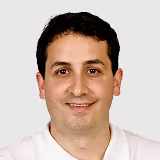
Marcel Kloos
Swiss-licensed dentist and founder of Medschool Experts
Marcel Kloos founded Medschool Experts while studying abroad; since then, over 500 study places have been secured. The Stuttgart-born dentist studied dentistry from 2015 to 2021 in Sofia and holds a Swiss dental licence.
Today he lives in Bern and runs Medschool Experts full-time as its owner.
More articles worth reading
Health Insurance for International Medical Students in Europe 2026
Scholarships and Funding for Medical Studies in Europe 2026
Medicine, Dentistry, Pharmacy or Veterinary Medicine? Choosing Your Degree Abroad in 2026
Ahmad
Sabrina
Rami
Noah
500+ students placed.
Now it's your turn!
No daydreaming, no empty promises. Just a clear plan — for the start of your medical degree.
40 minutes, no obligation