Studying Medicine in Rzeszów: Costs, Structure and Recognition
17.09.2026

Rzeszów at a Glance
Rzeszów lies in south-eastern Poland in the valley of the river Wislok and has around 200,000 inhabitants. The city is a regional higher education and technology centre, and its population is correspondingly young. For a medical degree, however, the hard facts matter most, and they are set out compactly in this overview.
| Feature | Detail (as of 2026) |
|---|---|
| University | University of Rzeszów, state institution, founded 2001 |
| Programme | Human medicine, English-language programme |
| Language of instruction | English |
| Standard duration | 6 years, twelve semesters |
| Tuition fee | 7,250 EUR per semester, 14,500 EUR per academic year |
| Start of studies | October |
| Admissions process | entrance test and interview, in Germany or online |
| Numerus clausus | none; the school-leaving grade does not decide the place |
| Access requirement | general higher education entrance qualification and English at level B2 |
| Recognition | automatic within the EU under Directive 2005/36/EC |
| University hospital | Fryderyk Chopin, more than 730 beds |
Two entries deserve a second look. First the fee: 7,250 EUR per semester is a lot of money by Eastern European standards, more on that below. Second the admissions process, which assesses performance in the test and motivation rather than a number on a school certificate. Those who want to compare the University of Rzeszów with other Polish locations will find the overview under Studying medicine in Poland.
University and Hospital
The University of Rzeszów was created in 2001 from the merger of several predecessor institutions; the founding act dates from 7 June 2001. It is therefore a young university, but it has quickly developed into the academic centre of the Subcarpathian Voivodeship. The medical programme started in the 2015/2016 academic year with 120 places, and demand was considerable from the outset: at the time there were around 63 applications for each full-time place. That figure says less about the difficulty of the programme than about the shortage of study places across Europe.
The clinical foundation is the real gain of recent years. At the end of December 2022 the Fryderyk Chopin hospital was transferred from the voivodeship to the university and has since carried the name university hospital. It brings a general hospital, the Subcarpathian Centre for Lung Diseases and the Subcarpathian Oncology Centre together under one roof, has more than 730 beds, 17 inpatient clinics, six day clinics and 25 specialist outpatient departments, and employs more than 1,800 people. A hospital of this scale covers the entire range of specialties you need to see during the clinical phase.
At locations like this, the first thing I notice is the ratio of cohort size to hospital capacity. Where a single large university hospital trains a manageable cohort, you get to see more at the bedside than in a conurbation where several faculties share the same wards. In the international rankings, the University of Rzeszów appears in the QS World University Rankings 2025 in the 1201 to 1400 band. Do not focus on that too much: for your later Approbation in Germany the ranking position is irrelevant; what counts is the state recognition of the degree.
What programmes are available and in which language?
The University of Rzeszów offers human medicine in two variants: as an English-language programme for international students and as a Polish-language programme. The English-language variant is the relevant one for you, because it is accessible without Polish. Dentistry, pharmacy and veterinary medicine are not part of the English-language offering at this location.
| Programme | Language | Duration | Degree |
|---|---|---|---|
| Human medicine, English-language | English | 6 years | medical degree, EU-recognised |
| Human medicine, Polish-language | Polish | 6 years | medical degree, EU-recognised |
| Dentistry | not offered | – | – |
| Pharmacy and veterinary medicine | not offered | – | – |
English at level B2 or above is required. That sounds like a hurdle at first, but rarely is in practice: solid upper-secondary English is enough as a starting point, and you build the medical vocabulary from scratch in the first semesters anyway, in both languages at once. Those who want to study dentistry or veterinary medicine need a different location; which one fits is something we clarify individually in a free consultation.
How does admissions work?
The University of Rzeszów does not select on the basis of school-leaving grades. Instead there is a subject-based entrance test and a personal interview. The test covers upper-secondary school material in biology and chemistry; the university describes it for international applicants as an online test with 20 single-choice questions, ten each from biology and chemistry, to be completed in 30 minutes. In the interview, what counts is why you want to study medicine and whether you feel ready for six years of English-language study abroad. Rote learning does not take you far in that part.
Both are generally possible entirely online; alternatively, the test and interview take place in Germany. You therefore do not need to travel to Poland for the application. The university has opened admissions for the 2026/2027 academic year until 25 September 2026, but allocates appointments in order of receipt, which is why an early start is almost always the better choice.
Registration, application and the entire scheduling are handled by Medschool Experts. We take care of the documents, so you do not have to work your way through Polish portals. Our real work comes before that: we prepare you for the subject-based part in biology and chemistry and work through the motivation interview with you until you know what you want to say. Whether your certificate and your background fit Rzeszów is something we assess individually in a free consultation.
What does the programme cost?
The fees are publicly documented. Annex 1 to Regulation No. 34/2026 of the Rector of the University of Rzeszów states 14,500 EUR per academic year for the six-year medical programme in English, payable in two semester instalments as well.
| Item | Amount (2026/2027 academic year) |
|---|---|
| Tuition fee per semester | 7,250 EUR |
| Tuition fee per academic year | 14,500 EUR |
| Tuition fee over twelve semesters | 87,000 EUR |
That covers the fee alone. Because prospective students regularly ask me for the total, I have worked it out for the full duration of study. The following breakdown is an estimate: only the fees are documented, and the remaining items derive from the living-cost data further below and from experience.
| Item | Six academic years (estimate) |
|---|---|
| Tuition fees, twelve semesters | 87,000 EUR (documented) |
| Living costs, 72 months at around 900 EUR | around 64,800 EUR |
| Textbooks, coat, instruments | around 3,000 EUR |
| Trips home, insurance, registrations | around 6,000 EUR |
| Total | around 161,000 EUR |
A figure of that magnitude does not need dressing up. It is spread over six years, can be combined with study abroad grants, an education loan and family support, and stands at the end against a profession that is economically dependable. How Rzeszów compares with other locations in our series is shown in the following table.
| Location | Country | Human medicine in English, fee per semester |
|---|---|---|
| Rzeszów | Poland | 7,250 EUR |
| Wrocław | Poland | 7,950 EUR |
| Katowice | Poland | 7,680 EUR |
| Bialystok | Poland | 7,550 EUR |
| Kielce | Poland | 6,250 EUR |
The comparison figures come from studimed.de, as of 2026. Rzeszów therefore sits in the middle of the Polish field, below Wrocław and Katowice and clearly above Kielce. What really makes the difference is rarely the fee alone, but the combination of fee, living costs and accessibility.
{{cta}}
How is the programme structured?
The structure follows the classic European pattern: first the scientific and theoretical foundations, then the clinical subjects, and a practical year at the end. All results are recorded in the European ECTS system, so you receive a Transcript of Records with subjects, credits and grades. That document is later the basis for credit recognition and for the Approbation procedure.
| Phase | Academic years | Focus |
|---|---|---|
| Pre-clinical phase | 1 to 2 | Anatomy, physiology, biochemistry, histology, embryology |
| Clinical phase | 3 to 5 | Internal medicine, surgery, paediatrics, gynaecology, neurology, psychiatry |
| Practical year | 6 | practically oriented final year at the bedside |
| Placements | throughout the programme | may be completed at a German teaching hospital |
The last row is the most important for German students. Placements and practical training phases can be completed at a German teaching hospital, which achieves two things: you stay anchored in German specialist language, and you build a network during your studies in the country where you later want to work. You still have to agree these phases with the university in advance. Teaching takes place in small groups, which becomes noticeable in the clinical phase, because you are standing at the bedside rather than in the third row.
Where can you work as a doctor with this degree?
Poland is a member of the European Union, and the Polish medical degree is listed in Annex V of Directive 2005/36/EC under point 5.1.1. The relevant version is that of Delegated Decision (EU) 2023/2383 of 23 May 2023, applicable since 9 October 2023. That means automatic recognition in all member states, without an equivalency assessment and without a knowledge examination.
| Country | Path to professional registration |
|---|---|
| Germany | automatic recognition; German medical licence (Approbation) from the authority in your federal state, with proof of German at specialist level |
| Austria | recognition by the Austrian Medical Chamber and entry in the medical register |
| Switzerland | recognition of the diploma and subsequent registration in the register of medical professions |
| Rest of EU and EEA | automatic recognition under Annex V point 5.1.1, in each case with national proof of language |
| Poland | the LEK state examination and the 13-month practical year, Staż |
| United Kingdom | registration with the General Medical Council, generally via PLAB and proof of English |
| USA | ECFMG certification and the USMLE examinations |
One point comes up repeatedly with Poland and needs clarifying: the Polish state examination LEK and the 13-month practical year Staż are prerequisites for professional registration in Poland. They are not required for the German Approbation. So if you go straight to Germany after graduating, you apply to the licensing authority of your federal state and provide proof of German at specialist level. Processing times differ from state to state.
For the USA an additional condition has applied since 1 January 2023: ECFMG certification requires the medical faculty to be accredited by an agency recognised by the World Federation for Medical Education. For Poland that is the Polska Komisja Akredytacyjna, which received this WFME recognition on 15 September 2025 for ten years. The route to the USA is therefore formally open, even if it remains long by way of the USMLE examinations.
Dentist, pharmacist, psychologist, veterinarian: the legal position by profession
Dentist. Dentistry is not offered in English in Rzeszów; for completeness, the legal position nonetheless: a dental degree from an EU state is listed in Annex V of Directive 2005/36/EC under point 5.3.2 and is likewise automatically recognised. Those who want to study dentistry therefore need a different location in our network; we have suitable universities for almost every case.
Pharmacist. Pharmacy is also harmonised; here Annex V point 5.6.2 applies. A pharmaceutical degree from an EU member state is recognised in Germany without an equivalency assessment, and the licence to practise as a pharmacist is granted by the competent state authority. At the University of Rzeszów, pharmacy is not part of the English-language programme.
Psychologist. Psychology and psychotherapy are not harmonised at EU level. There is no Annex V entry and therefore no automatic recognition. Each member state decides for itself under what conditions a foreign qualification permits practice; in Germany the respective state authority assesses the individual case. Anyone planning this route should settle the recognition question before starting the programme, not afterwards.
Veterinarian. For veterinarians, Annex V point 5.4.2 applies; this profession is also harmonised EU-wide and automatically recognised. Veterinary medicine is not part of the English-language offering in Rzeszów. Poland has English-language veterinary programmes at other institutions; which of them suits you is something we discuss in a free consultation.
Career paths after graduation
After the sixth year, the same range is open to you as to graduates of German faculties. The most common route leads straight into specialist training: you apply to a hospital or practice with training authorisation, and the rules are set by the respective state medical chamber. Whether internal medicine, surgery, anaesthesia or general practice, your Polish diploma opens the same doors. You do not need LEK and Staż for that.
If you stay in Poland, you take both and start your training there, which makes particular sense if you learned Polish during your studies and built contacts at the university hospital. A third route leads to another EU state, for instance Switzerland or Scandinavia, where doctors are in demand and recognition is regulated. Beyond the hospital, research, the public health service, the pharmaceutical industry and medical technology are open to you.
How each of these directions works, which deadlines apply and what to watch for when choosing, we have described in detail in our overview of career paths with an EU medical degree worldwide. My observation from many conversations: those who decide by the fifth year at the latest in which country they want to begin their training have the calmer transition. The formalities do not take long; finding the right hospital does.
Lateral entry, transfer and returning to Germany
A study place in Rzeszów is not a staging post but a full programme with a full degree. Even so, the question of transferring to a German faculty comes up regularly. It is possible, but it cannot be promised to anyone: German faculties assess every credit individually, compare course content and contact hours, and award places in a higher semester only when some become free. The Transcript of Records with your ECTS credits is your most important document for that.
In the other direction, lateral entry works well. Those who have already accumulated semesters in a science subject or in nursing in Germany bring prior knowledge that helps in the entrance test. It is not automatically credited, but it makes the start noticeably easier. A transfer from another location abroad to Rzeszów is also conceivable if course content and language match.
My advice in all three cases is the same: plan so that you finish the programme where you begin it. A transfer may be a welcome addition, but not the basis of the plan. Those who start with the firm intention of returning after two years lose time and money if it does not work out. Which credit recognition is realistic in your case is something we assess individually in a free consultation.
Living in Rzeszów: city, distances, costs
With around 200,000 inhabitants, Rzeszów is a manageable city where you have no long commutes. The campus is central, and the usual options are university halls of residence or rooms in shared flats near the campus. The city is regarded as a technology hub with a young population, and the Carpathians are easily reachable for hiking or skiing. Payment is in złoty, so your everyday budget in euros varies with the exchange rate; the European Central Bank published a reference rate of 4.3068 złoty to the euro on 14 August 2026.
| Item | Amount in złoty | Converted into euros |
|---|---|---|
| One-bedroom apartment in the centre | 2,802.50 | around 650 EUR |
| One-bedroom apartment outside the centre | 1,926.00 | around 450 EUR |
| Living costs for one person excluding rent | 2,872.80 | around 670 EUR |
| Meal in an inexpensive restaurant | 45.00 | around 10 EUR |
| Monthly public transport pass | 120.00 | around 28 EUR |
The figures come from Numbeo with a data date of 13 August 2026 and are converted at the reference rate named. They describe a single-person household, not a student budget: those who live in a hall of residence or a shared flat and cook for themselves come in noticeably below. My estimate for a realistic monthly budget including rent is around 900 EUR, and that is exactly the figure I used in the total calculation above.
Travel changed in 2026. From Rzeszów-Jasionka airport, Lufthansa has flown twice daily to Frankfurt am Main since 28 March 2026, replacing the previous connection to Munich. That improves accessibility from Germany considerably, because via Frankfurt you can reach practically any German airport. Even so, Rzeszów remains geographically far from the German border, and spontaneous weekend trips by car are not an option here.
Who this location suits
Rzeszów suits you if you want to study human medicine in English, prefer a manageable environment to a big-city one and value being able to complete practical phases in Germany. The location also suits you if your school-leaving average is not enough for a German study place but you are academically secure: the entrance test rewards exactly that.
The location is less suitable if you want to study dentistry or veterinary medicine, if frequent trips home matter to you, or if you have not yet worked through the financing. Those looking for big-city student life will also find more of it in Warsaw or Wrocław.
My assessment: the combination of its own university hospital with more than 730 beds, small learning groups and the option of completing placements in Germany is strong for a location of this size. The fee is the price for it, and whether that price is right for you cannot be answered in the abstract but only with your figures and your timetable. That is exactly what we do in a free consultation.
Author's opinion
I studied dentistry in Sofia from 2015 to 2021 – six years abroad myself, in a language that wasn't my mother tongue, in a city I had only known from photos beforehand. That experience still shapes how I judge locations today. What I underestimated at the time wasn't the coursework, but how much hands-on practice I would actually get to see by the end. That's exactly what I look at first with Rzeszów.
Three things stand out to me here. First, the university's own hospital with more than 730 beds and three merged centres, covering a full range of specialties. Second, the small study groups, which make a real difference in the clinical years because you're standing at the bedside and being asked questions directly. Third, the option to complete placements at a German teaching hospital. Anyone planning to work in Germany later never fully loses touch with German medical terminology this way.
The price is the point I spend the most time on with prospective students. €7,250 per semester adds up to €87,000 in fees alone over twelve semesters, and that is a sum you need to have worked out in advance, not in your third year of study. There are European locations that cost significantly less. But if your financing is solidly in place, Rzeszów gives you a lot of clinical substance for your money.
Most of what I do day to day is help people at Medschool Experts find the location that fits their life, not the one that is advertised the loudest. Rzeszów is exactly right for a certain type of student: academically confident, ready to study in English, with a clear financing plan. If that sounds like you, the conversation is worth having.
Summary
The University of Rzeszów offers a well-established, English-language medical programme with its own university hospital, small study groups and a selection process built around aptitude and motivation rather than a single exam grade. Degree recognition across the EU is straightforward and well documented.
At Medschool Experts we maintain the largest network of official partner universities in Europe, and we assess every applicant individually to determine the highest possible year of entry – in many cases, entry is possible directly into the final two years of the programme. Our team supports you at every step, from application to settling in.
Whether Rzeszów is the right fit for your background, budget and timeline is easiest to work out in a conversation. Book a free consultation and find out where you stand.
Frequently asked questions about studying medicine in Rzeszów
Is a degree from the University of Rzeszów recognised in Germany?
Yes, automatically. Poland is an EU member state, and the Polish medical degree is listed in Annex V, point 5.1.1 of Directive 2005/36/EC. There is no equivalence assessment and no aptitude test. You apply for your licence to practise (Approbation) with the authority in your federal state and demonstrate German at a professional working level. The same recognition applies in Austria and Switzerland.
Do I need LEK and Staż for German licensure?
No. The Polish state exam LEK and the 13-month practical year Staż are required to practise in Poland. German authorities do not require either for the Approbation. You only need to take LEK and Staż if you want to work as a doctor in Poland or start your specialty training there.
Do I need a specific school-leaving grade (Numerus clausus) for Rzeszów?
No. The University of Rzeszów does not select based on your school-leaving grade, but through a subject-specific entrance test and a personal interview. You need a general higher education entrance qualification and English at B2 level. Both parts of the process can be completed in Germany or online – you do not need to travel to Poland to apply.
What does the selection process involve?
It consists of two parts: a subject test covering upper-secondary-level biology and chemistry, and a personal interview about your motivation. Because the exact format can change from year to year, we prepare our students individually for both parts – book a free consultation to find out what to expect for the current intake.
What does the programme cost per semester in Rzeszów?
Tuition is €7,250 per semester, i.e. €14,500 per academic year, as set out in Annex 1 to Rector's Ordinance No. 34/2026 for the 2026/2027 academic year. Over twelve semesters that comes to €87,000 in fees alone, not including living costs, textbooks or travel.
How much does it cost to live in Rzeszów?
Living costs are well below German levels. As of 13 August 2026, Numbeo lists a one-room apartment outside the city centre at 1,926 złoty, around €450. We estimate a student's monthly budget including rent at around €900. Rent and daily expenses are paid in złoty, so the exchange rate plays a role.
Can I get German foreign study grants (Auslands-BAföG) for a degree in Poland?
Poland is an EU member state, so an application is possible in principle. Whether you receive funding, and how much, depends on your personal circumstances. At €7,250 per semester, BAföG alone will not cover the programme. Most students combine family support, an education loan and a part-time job alongside their studies.
Is my English good enough for the programme?
The programme is taught entirely in English, and B2 level is required. Solid upper-secondary-school English is enough as a starting point. Teaching takes place in small groups, so you can ask questions instead of getting lost in a large lecture hall. You will build up medical terminology from scratch in the first semesters anyway.
Do I need to learn Polish?
Teaching is in English, but Polish is the everyday language in the hospital and around the city. Patients in Rzeszów rarely speak English. If you don't pick up the language, you will depend on help with translation during patient histories and ward rounds. Starting a course early in your first year saves a lot of effort later.
How is the programme in Rzeszów structured?
Six years, taught in English. In years one and two you complete the pre-clinical stage with anatomy, physiology, biochemistry, histology and embryology. From year three onward comes the clinical stage with internal medicine, surgery, paediatrics, gynaecology, neurology and psychiatry. The sixth year is practice-oriented and corresponds to the German Praktisches Jahr.
Can I do placements in Germany?
Yes. Placements and practical training sections can be completed at a German teaching hospital. For many students this is a major reason to choose this location, since it lets you build a network in Germany early on and keep up your German medical terminology. Each placement needs to be coordinated with the university in Rzeszów beforehand.
When does the programme start and when should I apply?
The academic year begins in October; there is no second intake in spring. Places are limited and allocated as applications come in, so applying early gives you the best chance of a spot. Our team handles your application and appointment scheduling for you – book a free consultation to get started in good time.
How do I get from Germany to Rzeszów?
Since 28 March 2026, Lufthansa flies twice daily from Rzeszów-Jasionka Airport to Frankfurt am Main, replacing the earlier connection to Munich. From Frankfurt you can reach almost any German airport. Rzeszów is located in south-eastern Poland, though, so spontaneous trips home by car are uncommon.
What students say about Medschool Experts
Over 500 placements at more than 25 partner universities across 10+ countries. Read independent student reviews on Trustpilot.
About the author
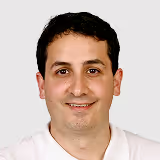
Marcel Kloos
Swiss-licensed dentist and founder of Medschool Experts
Marcel Kloos founded Medschool Experts while studying abroad; since then, over 500 study places have been secured. The Stuttgart-born dentist studied dentistry from 2015 to 2021 in Sofia and holds a Swiss dental licence.
Today he lives in Bern and runs Medschool Experts full-time as its owner.
More articles worth reading
Health Insurance for International Medical Students in Europe 2026
Scholarships and Funding for Medical Studies in Europe 2026
Medicine, Dentistry, Pharmacy or Veterinary Medicine? Choosing Your Degree Abroad in 2026
Ahmad
Sabrina
Rami
Noah
500+ students placed.
Now it's your turn!
No daydreaming, no empty promises. Just a clear plan — for the start of your medical degree.
40 minutes, no obligation