Studying Medicine in the South: Malta, Cyprus and Spain at a Glance
17.09.2026

What does studying medicine in Malta, Cyprus and Spain cost?
In 2026 tuition fees lie between EUR 14,500 and EUR 24,000 per academic year. MediCampus Europeo in Malta charges EUR 14,500 for payment in a single instalment, Universidad CEU Cardenal Herrera in Valencia EUR 15,900 in academic fees, and the University of Nicosia in Cyprus EUR 24,000. All three additionally levy one-off or annual ancillary fees.
The following table sets the three locations side by side with their official ancillary costs for the first time. The total for six years is our own calculation, as of August 2026; it assumes living costs of EUR 1,000 a month in Malta, EUR 950 in Nicosia and EUR 900 in Valencia.
| Location | Tuition fee per year | Ancillary costs per the institution | Six years including living costs |
|---|---|---|---|
| MediCampus Europeo, Malta | EUR 14,500 (single payment) or EUR 15,500 in two instalments | EUR 500 enrolment, once in the first year | around EUR 159,500 |
| University of Nicosia, Cyprus | EUR 24,000 | EUR 1,500 administration, EUR 60 application, liability and accident insurance, EUR 3,500 refundable place reservation | around EUR 216,600 |
| CEU Cardenal Herrera, Valencia | EUR 15,900 in academic fees | EUR 2,000 place reservation, EUR 3,700 enrolment, EUR 750 file set-up in the first year | around EUR 166,700 |
The gap between Malta and Cyprus over six years comes to around EUR 57,000. That is not a rounding error but a decision about half a mortgage. For context at the other end: Medschool Experts places students at universities with semester fees starting at EUR 1,750. The Mediterranean locations are deliberately the upper end.
What does MediCampus Europeo in Malta offer?
Since 2024, MediCampus Europeo in Il-Furjana has run a six-year English-language human medicine programme worth 360 ECTS credits, that is 60 ECTS per academic year. The clinical phase begins in the third year of study. The institution is licensed by the Maltese authority MFHEA under licence number 2024-020. The institution gives 22 and 23 August 2026 as the next intake.
There is one particularity you need to understand before signing. The degree „Doctor of General Medicine“ is not awarded by a Maltese university but, under a franchise model, by the Bulgarian Trakia State University in Stara Zagora. For recognition purposes that is a good thing: behind the diploma stands a state EU university whose evidence of formal qualification is listed in Annex V of Directive 2005/36/EC. You should simply be aware that in the recognition procedure Bulgaria, not Malta, appears as the issuing state.
That is exactly the question that comes up reliably in consultations about Malta: whether a franchise degree is worth less. My answer is short. Legally no, because what counts is the issuing university. In practice, though, you should expect HR departments to ask, and have the answer ready.
The second point in Malta's favour is language. English there is not only the language of instruction but an official language. Public authorities, hospitals, landlords, everyday life. That is rare among European medical locations, and it removes a whole category of worry. I studied in Sofia from 2015 to 2021 and spent the first weeks mainly on the registration office, a bank account and an unfamiliar alphabet. Anyone living abroad for an extended period for the first time regularly underestimates that part.
Why does the University of Nicosia cost more than is often stated?
On its financial information page, as of April 2026, the University of Nicosia states a tuition fee of EUR 24,000 per academic year for the six-year MD programme. Widely circulated overviews, by contrast, give around EUR 11,000 per semester, that is EUR 22,000 per year. Both figures are explicable; they come from different points in time.
We carried the lower value ourselves for a long time and correct it here. The difference arises because semester amounts from earlier academic years were carried forward while the university raised its annual fee. More important than the EUR 2,000 difference, however, are the items that no semester figure contains:
- EUR 1,500 administrative fee
- EUR 60 application fee, one-off and non-refundable
- EUR 3,500 place reservation, refundable according to the university
- EUR 300 liability insurance per year in study years one to four, thereafter EUR 600 to 1,250
- EUR 50 accident insurance per year
- EUR 3,000 per year surcharge for clinical training periods in Germany or Switzerland in study years five and six, EUR 6,000 for the United Kingdom or the United States
The last point is notable, and it is rarely quoted. Anyone who deliberately wants to complete their clinical years in Germany or Switzerland pays the University of Nicosia an additional EUR 3,000 a year for it. That can make sense if you intend to return there anyway. But it belongs in the budget, not in the surprises department of the fifth year of study.
If you want to set this calculation out cleanly for your own situation, we go through it with you item by item in a free consultation.
{{cta}}
What does medicine cost at the CEU university in Valencia?
For new students in the 2026/2027 academic year at its Valencia campus, Universidad CEU Cardenal Herrera states EUR 15,900 in academic fees for the Grado en Medicina, payable in monthly instalments of EUR 1,766.67. In the first year, EUR 2,000 for place reservation, EUR 3,700 for enrolment and EUR 750 for file set-up are added. That brings the total for the first year of study to EUR 22,350.
The programme is run bilingually, in Spanish and English. That is appealing and demanding at the same time, because Spanish is indispensable in day-to-day clinical work. Anyone who goes to Valencia with Spanish only as a holiday language should plan the first year accordingly.
On credit transfer, Spain is more restrained than Central Europe. According to our own experience from placement work, no subject semester is usually credited after two semesters, and one after three. That is an estimate drawn from individual cases and not an official rule, but anyone planning an early transfer should reckon with it.
What limitations should you know about the southern locations?
In 2026 the three Mediterranean locations come with four limitations that rarely appear in promotional copy: no dentistry programme in Malta, the franchise model behind the Maltese degree, higher living costs than in Eastern Europe, and restrained credit transfer in Spain. None of these is a reason to rule a location out. All of them belong in the decision.
On dentistry there is one figure that makes the picture clear immediately. The Eurostat release of 5 August 2024 records fewer than 0.1 dentistry graduates per 100,000 inhabitants in Malta for the reference year 2022, against an EU average of 3.2 and a Romanian peak of 9.9. Malta effectively does not train in this subject. Anyone who wants to study dentistry is at the wrong address in the Mediterranean and should look to Romania, Bulgaria or Slovakia.
The cost question remains the biggest objection. Around EUR 216,600 in Nicosia against around EUR 104,000 for six years in Romania is more than a doubling. I would rather see someone studying at ease in Timișoara than under strain in Nicosia. But if the budget is there and the calculation is done in advance rather than in the third year, the south is a very good choice.
Are degrees from Malta, Cyprus and Spain recognised?
Yes. Malta, Cyprus and Spain are member states of the European Union, and evidence of formal medical qualification falls under Article 21 in conjunction with Annex V of Directive 2005/36/EC among the automatically recognised qualifications. In the case of MediCampus Europeo, Bulgaria appears as the issuing state, because Trakia State University awards the degree.
In Germany, the state authorities grant the German medical licence (Approbation); in Switzerland the Medical Professions Commission MEBEKO at the Federal Office of Public Health decides, after which entry follows in the medical professions register MedReg. I went through this route myself and am today a Swiss-licensed dentist; I run Medschool Experts from Bern. The host state may require proof of language ability, and as a rule it does.
Who is the higher price in the south worth it for?
The premium of the Mediterranean locations over Eastern Europe comes to EUR 55,000 to 110,000 over six years. It is worth it above all for students who are living abroad for an extended period for the first time, who depend on a consistently English-speaking environment, or who benefit from a mild climate and short distances between campus, hospital and home.
Malta is a special case here, because the island is so compact that campus, teaching hospital and home are rarely more than half an hour apart. That sounds like a side issue. Over six years it amounts to hundreds of hours not spent on the bus.
My assessment, and expressly labelled as such: anyone who chooses a location on climate alone is choosing wrongly. Anyone who chooses it on language is often choosing rightly. The language question determines how quickly someone settles into day-to-day clinical work, and it is the one point where Malta structurally offers something no other European location can.
Terms change every year, and the three institutions have most recently adjusted their figures at different speeds. What applies today, and which location fits your own situation, is something we clarify in a free consultation.
The author's view
Malta is the location where I am most likely to understand someone paying more. English as an official language removes a whole category of worry: no unfamiliar alphabet, no trips to public offices in a language you first have to learn, no break between lecture hall and life on the ward. I moved to Sofia in 2015 and still remember how much energy the first weeks alone cost. Anyone living abroad for an extended period for the first time should take that item seriously.
What I will still say: the price difference to Romania over six years runs to a solidly five-figure amount, and in the case of Nicosia even to a six-figure total. Anyone taking this route should have the financing set out in advance rather than hoping it will sort itself out in the third year. I would rather see someone studying at ease in Timișoara than under strain in Malta.
The research for this article corrected me on one point. We gave around EUR 11,000 per semester for Nicosia for a long time, because that figure circulates in many sources. The university itself gives EUR 24,000 per year plus ancillary costs. Discrepancies like that arise when figures are passed from page to page instead of being checked at source. I think it is more important to correct that openly than to leave a prettier number standing.
And one last thought, as a father and as a dentist: six years is a long time in a life. The question is not only where you can study most cheaply, but where you want to spend those six years without asking yourself every month how the next instalment will come together. Anyone who weighs both honestly against each other will make a good decision, whichever way it goes.
Conclusion
Whatever your situation, you don't have to figure out the best path alone. At Medschool Experts, we work with the largest network of official partner universities, and we individually assess the highest possible year of entry for every student. In many cases, entry is even possible in the final two years of medical studies. Book a free consultation with our team and let's map out your personal path together.
Frequently Asked Questions about Studying Medicine in Malta, Cyprus and Spain
What does studying medicine in Malta cost?
MediCampus Europeo charges EUR 14,500 per academic year for payment in a single instalment, or EUR 15,500 in two semester instalments, plus a one-off enrolment fee of EUR 500 in the first year.
What does studying medicine at the University of Nicosia cost?
The University of Nicosia states EUR 24,000 per academic year for the six-year MD programme, plus an administrative fee of EUR 1,500, an application fee of EUR 60 and insurance. That makes Cyprus the most expensive of the three locations.
Why do many overviews give EUR 11,000 per semester for Nicosia?
Because that value was carried forward from earlier academic years. In its financial information as of April 2026, the University of Nicosia gives an annual fee of EUR 24,000. We carried the older figure ourselves for a long time and have corrected it here.
What does medicine cost at CEU in Valencia?
For the 2026/2027 academic year at its Valencia campus, Universidad CEU Cardenal Herrera gives EUR 15,900 in academic fees, payable in monthly instalments of EUR 1,766.67. In the first year, EUR 2,000 for place reservation, EUR 3,700 for enrolment and EUR 750 for file set-up are added.
Is teaching in English?
At all three locations the international programmes run in English, and in Valencia bilingually with Spanish. In Malta, English is additionally an official language, which makes dealings with authorities and day-to-day hospital work considerably simpler.
Who awards the degree in Malta?
The Bulgarian Trakia State University in Stara Zagora, under a franchise model with MediCampus Europeo. In the recognition procedure Bulgaria therefore appears as the issuing state, and its evidence of formal qualification is listed in Annex V of Directive 2005/36/EC.
Is a franchise degree worth less?
Not legally, because what counts for recognition is the issuing university, and Trakia State University is a state EU institution. In practice you should expect HR departments to ask about it.
Is dentistry available in Malta too?
Not at MediCampus Europeo, which offers human medicine exclusively. According to the Eurostat release of 5 August 2024, Malta recorded fewer than 0.1 dentistry graduates per 100,000 inhabitants in 2022. Anyone who wants to study dentistry should look at other countries.
Are the degrees recognised in Germany and Switzerland?
Yes. Malta, Cyprus and Spain are EU member states, and evidence of formal medical qualification falls under automatic recognition per Annex V of Directive 2005/36/EC. In Germany the state authorities grant the Approbation; in Switzerland MEBEKO decides.
How high is the cost of living?
Mediterranean, and higher than in Eastern Europe. Our calculation of August 2026 assumes EUR 1,000 a month in Malta, EUR 950 in Nicosia and EUR 900 in Valencia. These are estimates from placement practice, not official figures.
What does the whole degree cost over six years?
By our own calculation of August 2026, around EUR 159,500 in Malta, around EUR 166,700 in Valencia and around EUR 216,600 in Nicosia, in each case including tuition fees, ancillary costs and living costs.
When does the programme start?
MediCampus Europeo gives 22 and 23 August 2026 as the next intake. Entry from the second year of study is possible for transfer students under certain conditions; we check that case by case in the free consultation.
What students say about Medschool Experts
Over 500 placements at more than 25 partner universities across 10+ countries. Read independent student reviews on Trustpilot.
About the author
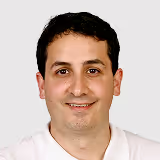
Marcel Kloos
Swiss-licensed dentist and founder of Medschool Experts
Marcel Kloos founded Medschool Experts while studying abroad; since then, over 500 study places have been secured. The Stuttgart-born dentist studied dentistry from 2015 to 2021 in Sofia and holds a Swiss dental licence.
Today he lives in Bern and runs Medschool Experts full-time as its owner.
More articles worth reading
Health Insurance for International Medical Students in Europe 2026
Scholarships and Funding for Medical Studies in Europe 2026
Medicine, Dentistry, Pharmacy or Veterinary Medicine? Choosing Your Degree Abroad in 2026
Ahmad
Sabrina
Rami
Noah
500+ students placed.
Now it's your turn!
No daydreaming, no empty promises. Just a clear plan — for the start of your medical degree.
40 minutes, no obligation