Studying Medicine in Timișoara: Costs, Structure and Recognition
17.09.2026

Victor Babeș University Timișoara at a glance
Victor Babeș University of Medicine and Pharmacy Timișoara is a state medical university in western Romania. It teaches human medicine, dentistry and pharmacy in English, costs €9,000 per year in all three subjects for 2026/2027, and leads to a degree that is automatically recognised across the entire EU.
| Feature | Details |
|---|---|
| Founded | Decree-Law No. 660 of 30 December 1944; teaching began in July 1945 |
| Named after (since 2001) | Victor Babeș (1854–1926), bacteriologist from the Banat region |
| Students | 8,310, including 1,684 international students from 47 countries (2025) |
| Faculties | Medicine, Dentistry, Pharmacy |
| Programmes in English | Human medicine, Dentistry, Pharmacy |
| Fees 2026/2027 | €9,000 per year in all three subjects |
| Standard duration | Medicine and dentistry: 6 years (360 ECTS); pharmacy: 5 years (300 ECTS) |
| Cost of living | approx. €600 per month (Medschool Experts' own estimate) |
| Total cost, medicine | approx. €100,000 over six years (our own calculation) |
| EU recognition | Annex V, item 5.1.1 of Directive 2005/36/EC, reference date 1 January 2007 |
| International accreditation | IAAR since 27 January 2023, recognised by the WFME |
| Mandatory language | Romanian, for clinical teaching with patients |
| City | Timișoara, approx. 319,000 residents, European Capital of Culture 2023 |
Which university is behind the medical programme in Timișoara?
The medical school in Timișoara was founded at the end of the Second World War: King Michael I signed Decree-Law No. 660 on 30 December 1944, and teaching began in July 1945 with two years of study initially on offer. Since 2001, the university has borne the name of Victor Babeș, a bacteriologist from the Banat region after whom the parasite genus Babesia is named. More than 25,000 graduates have completed their studies there since.
Today, the university is organised into three faculties: Medicine, Dentistry and Pharmacy. The Faculty of Medicine also includes nursing, balneophysiotherapy, radiology and nutritional science. Clinical training takes place at more than 25 teaching hospitals across the city; the largest is the "Pius Brînzeu" County Emergency Clinical Hospital, named Romania's Hospital of the Year in 2020. The university's research history includes Romania's first kidney transplant from a deceased donor and the country's first in-vitro fertilisation.
Two quality credentials matter in practice for prospective students. First, the Romanian state agency ARACIS: its institutional evaluation of the university dates from 26 May 2022 and runs until 26 May 2027, and the English-language dentistry programme has been programme-accredited since 13 July 2023 until 13 July 2028 (register entries in the European Quality Assurance Register). Second, international accreditation from the Independent Agency for Accreditation and Rating (IAAR), granted on 27 January 2023. At the time, Rector Prof. Dr Octavian Crețu called it "the result of the teamwork and cohesion of the entire academic community." The IAAR grants its accreditations for five years and is the agency through which Romania is recognised by the WFME (FAIMER Directory of Organizations that Recognize Medical Schools).
What programmes does Victor Babeș University offer?
Timișoara teaches human medicine in English, French and Romanian, dentistry in English and Romanian, and pharmacy in English, French and Romanian. There is no German-language programme. All three English-language courses cost the same amount for 2026/2027: €9,000 per year.
| Programme | Languages | Duration and ECTS | Degree |
|---|---|---|---|
| Human medicine | English, French, Romanian | 6 years, 360 ECTS | Diploma de licență de doctor medic |
| Dentistry | English, Romanian | 6 years, 360 ECTS | Diploma de licență de medic dentist |
| Pharmacy | English, French, Romanian | 5 years, 300 ECTS | Diploma de licență de farmacist |
| Nursing, balneophysiotherapy, nutrition | Romanian | 3 to 4 years, 180 to 240 ECTS | Bachelor's degree |
Veterinary medicine and psychology are not part of Victor Babeș University's offering. Both are available in the same city, however: the "King Michael I" University of Life Sciences in Timișoara has trained veterinarians since 1945, over twelve semesters, in Romanian, English and French. Psychology is taught at the West University of Timișoara.
How does admission to Victor Babeș University work?
The university selects candidates for its English-language programmes through its own entrance test. For applicants from the EU, this consists of 50 multiple-choice biology questions, plus proof of English proficiency at B2 level. There is no interview, and no specific school-leaving grade average is required.
Romanian is not required for admission, but it does become relevant later, on the wards: the university's examination regulations explicitly state that teaching takes place in a foreign language, but clinical placements are conducted in Romanian. That's why Romanian appears on the timetable from day one. Anyone with a background in French, Spanish or Italian from school has a noticeably easier time with it — Romanian is the only Romance language in Eastern Europe.
Which documents you'll need for your specific situation, when the test takes place and how realistic your profile is — we'll cover all of that in a free consultation. We'll take this part off your hands.
How is the medical programme in Timișoara structured?
Human medicine in Timișoara spans six years of study and 360 ECTS credits. The first two years are pre-clinical; from the third year onwards, teaching with patients begins, and the sixth year consists largely of clinical rotations. The programme concludes with the Romanian state examination, the Licență, which has a written and a practical component.
| Phase | Years | Content |
|---|---|---|
| Pre-clinical | 1–2 | Anatomy, histology, biochemistry, physiology, biophysics, Romanian |
| Transition | 3 | Pathology, pharmacology, semiology, first ward work |
| Clinical | 4–5 | Internal medicine, surgery, paediatrics, gynaecology, neurology, psychiatry |
| Practical year | 6 | Rotations at teaching hospitals, concluding with the Licență |
Dentistry follows the same six-year framework with 360 ECTS, but shifts the practical component considerably earlier, into pre-clinical simulation courses and the dental treatment unit. Pharmacy takes five years and 300 ECTS.
What does studying medicine in Timișoara cost?
Tuition fees for the 2026/2027 academic year for human medicine, dentistry and pharmacy in English are €9,000 per year, or €4,500 per semester, for each subject. This figure is set out in the university's fee schedule, Annex 1, approved by the Senate on 29 January 2026, and applies equally to EU and non-EU students.
| Item | Human medicine | Dentistry | Pharmacy |
|---|---|---|---|
| Fees per year | €9,000 | €9,000 | €9,000 |
| Standard duration | 6 years | 6 years | 5 years |
| Total fees | €54,000 | €54,000 | €45,000 |
| Total cost of living | €43,200 | €43,200 | €36,000 |
| Trips home, study materials | €3,000 | €3,000 | €2,500 |
| Total (estimate) | approx. €100,000 | approx. €100,000 | approx. €84,000 |
We calculate cost of living at €600 per month. This figure is Medschool Experts' own estimate, made up of approximately €220 for a room in a shared flat, €60 for utilities and internet, €250 for food and daily expenses, €30 for local transport and €40 for study materials. For comparison, real market prices: a one-room flat in central Timișoara costs 2,545 lei, and 1,696 lei outside the centre; a monthly public transport pass costs 160 lei (Numbeo, June 2026). At the ECB reference rate of 15 August 2026 of 5.2427 lei per euro, that's €485, €324 and €31 respectively.
The figure becomes interesting when compared with the other locations in this series. All figures are Medschool Experts' own calculations, following the same method: university fees plus cost of living plus trips home.
| Location | Total fees | Total cost, medicine |
|---|---|---|
| Timișoara | €54,000 | approx. €100,000 |
| Kaunas | €78,300 | approx. €126,000 |
| Vilnius | €84,600 | approx. €143,000 |
| Debrecen | €87,000 | approx. €149,000 |
The gap is substantial. Studying in Timișoara costs around €49,000 less over six years than in Debrecen — for a degree that is treated exactly the same under the law.
{{cta}}How can you finance your studies in Timișoara?
Romania is an EU member, so international BAföG applies for a full degree programme under Section 5(2) No. 3 BAföG. The maximum rate is €992 per month, half of which is a grant and half an interest-free loan. On top of that, a tuition fee subsidy of up to €5,600 is available as a full grant, though only for a maximum of twelve months. Travel costs are covered at €250 per trip.
Two further points are worth knowing. The education loan from the Federal Office of Administration (Bundesverwaltungsamt) pays out €100 to €300 per month, up to a total of €7,200, at an effective annual interest rate of 3.53% (as of 1 April 2026) — and it is explicitly intended for study abroad as well. The KfW student loan 174, on the other hand, excludes a full degree programme abroad, as stated in KfW's information sheet from November 2023. On taxes: a first degree can only be claimed as a special expense up to €6,000, with no loss carryforward; the Federal Constitutional Court confirmed this rule on 19 November 2019 (2 BvL 22/14). Anyone who has already completed vocational training beforehand can claim the costs without limit as income-related expenses.
Where can you practise as a doctor with this degree?
The "Diploma de licență de doctor medic" awarded by Victor Babeș University is listed in Annex V, item 5.1.1 of Directive 2005/36/EC; the issuing bodies are the universities and the Romanian Ministry of Education, and the reference date is 1 January 2007. This means it is automatically recognised in all EU and EEA states, without a Kenntnisprüfung (aptitude test) or equivalence assessment.
| Country | Path to professional licensure |
|---|---|
| Germany | Automatic recognition; Approbation via the relevant state authority |
| Austria | Automatic recognition plus entry in the physicians' register of the Austrian Medical Chamber |
| Switzerland | MEBEKO recognises the diploma; the cantonal authority then issues the practising licence |
| Rest of EU/EEA | Automatic recognition under the same directive |
| United Kingdom | Registration with the GMC, assessed case-by-case since Brexit |
| United States | ECFMG certification, USMLE Step 1 and Step 2 CK, listing in WDOMS with a sponsor note |
| Canada | Medical Council of Canada examinations, followed by the CaRMS match |
| Australia | Australian Medical Council examinations, registration with Ahpra |
The legal basis is Commission Delegated Decision (EU) 2023/2383 of 23 May 2023, applicable since 9 October 2023. It revised items 5.1.1 to 5.1.4, 5.2.2, 5.3.2, 5.3.3 and 5.4.2 of Annex V. Anyone who wants to know whether a degree is automatically recognised should check exactly this list — it's the deciding factor, not a ranking and not a university's reputation.
There's a common misunderstanding around language exams: anyone with German citizenship, or who completed school or training in Germany in German, does not need to sit either the general language exam or the specialist language exam. Both only apply to applicants without a German-language school or training background. In Switzerland, the equivalent applies to proof of language proficiency at B2 level.
Dentist, pharmacist, psychologist, veterinarian: the legal position by profession
Not every healthcare profession follows the same logic. Four cases, four paths.
Dentist. The Romanian degree "Diploma de licență de medic dentist" is listed in Annex V, item 5.3.2 of Directive 2005/36/EC; the corresponding professional title is "Medic dentist," with a reference date of 1 October 2003. Recognition in Germany, Austria and Switzerland is automatic. I took this path myself with a Bulgarian degree — the procedure is the same.
Pharmacist. Pharmacy falls under item 5.6.2 of Annex V and is likewise automatically recognised. Here too, the exemption from language exams applies to anyone who completed their schooling in Germany in German.
Psychologist. Psychology is excluded from automatic recognition. In Germany, the path to Approbation runs through the reformed Psychotherapist Act, with study content assessed individually. Victor Babeș University doesn't offer psychology in any case.
Veterinarian. Veterinary medicine falls under item 5.4.2 and is automatically recognised EU-wide. In Timișoara, the "King Michael I" University of Life Sciences trains veterinarians over six years, in English among other languages.
Career paths after graduation
A Romanian medical degree is not a regional matter. In Switzerland, of the 44,612 practising physicians in 2025, 43% were registered with a foreign degree (FMH statistics 2025) — the highest rate among German-speaking countries and well above the OECD average of 19.6% for foreign-trained doctors (OECD 2025, data years 2021–2023). In the United Kingdom, the share of internationally qualified doctors stood at 42% of 328,149 licensed doctors in 2024 (GMC Workforce Report 2025). Recognition is one part of the picture; the other is that these healthcare systems are actively recruiting.
In Germany, specialist training under the 2018 model training regulations, as amended on 3 July 2025, takes between 48 and 72 months depending on the specialty. Since 1 April 2026, the first year of specialist training is paid €5,792.90 per month under the TV-Ärzte/TdL collective agreement, or €5,722.05 under TV-Ärzte/VKA, before allowances. In Austria, basic training was shortened from nine to six months as of 1 August 2026. In Switzerland, the path runs through SIWF and FMH and takes five to six years.
Anyone looking to go further afield should plan early. In the 2026 NRMP Match in the US, 44,344 positions were available against 53,373 registered applicants; the match rate was 70.0% for US citizens who studied abroad and 56.4% for international graduates without US citizenship. In Canada, the 2026 CaRMS match placed 931 internationally trained doctors, up from 851 the year before. And on the frequently asked question of quality, there is solid data: Tsugawa and colleagues, writing in the BMJ in 2017 (356:j273), analysed 1,215,490 hospital admissions and found an adjusted 30-day mortality rate of 11.2% for internationally trained internists compared with 11.6% for US-trained internists. All the paths are covered in detail in our article on career paths with an EU medical degree worldwide.
Switching into Timișoara and transferring back to Germany
Switching to a German faculty after a few semesters in Romania is possible, but it requires planning. One point is worth stating plainly: since 2023, the Romanian Zwischenprüfung (intermediate exam) is no longer recognised in Germany as the Ärztliche Vorprüfung (first state examination). Based on experience with credit transfer procedures, one clinical semester is typically credited after two semesters completed, and two after three to four semesters.
For anyone completing their degree in Timișoara and then applying for Approbation, this doesn't matter at all. It only becomes relevant if a switch is firmly planned from the outset. In that case, it's worth choosing your location with that in mind — and making that decision early, not in your third semester. In a free consultation, we'll talk you through both scenarios.
What is life like in Timișoara?
Timișoara is located in the Banat region, close to the Hungarian and Serbian borders, and is Romania's third-largest city with around 319,000 residents. It was European Capital of Culture in 2023, which gave the city centre a visible modernisation boost. The three main squares — Piața Victoriei, Piața Unirii and Piața Libertății — are just a few minutes' walk apart.
One curiosity that hardly anyone in Germany knows: Timișoara's mayor since 30 October 2020 is Dominic Fritz, born in 1983 in Lörrach and raised in the Black Forest. He first came to the city in 2003 for a voluntary social year and was re-elected in 2024. The city has a long German-speaking tradition, and it shows in everyday life.
Practically speaking: Traian Vuia International Airport is around twelve kilometres from the city centre and has direct flights from German airports. Hungary is just a few hours away by car. Prices are low — a monthly public transport pass costs 160 lei, or a good €30 (Numbeo, June 2026).
Who Victor Babeș University is right for — and who it isn't
Timișoara is a good fit when budget plays the central role. At around €100,000 for six years of medicine including living costs, it's the lowest figure among the established EU locations we work with. It's also a good fit if you want to study in English, enjoy Romance languages, and are looking for a city close to Central Europe.
Timișoara is less suited to two situations. First, if you want to study in German: there is no German-language programme in Romania — Hungary and Serbia are the places for that. Second, if you're firmly planning to switch to a German faculty after two to three years — given how the intermediate exam is credited, there are better-suited locations for that. Neither is a matter of good or bad, just of fit.
Author's opinion
When I started my dentistry degree in Sofia in 2015, Bulgarian was a mandatory subject — and at the time, I genuinely thought it was a formality. It wasn't. In my third year, I found myself in the treatment chair with a patient who didn't speak a word of English, and I had to take the medical history in the local language. That's exactly what awaits you in Timișoara, in Romanian. Anyone who takes the language courses seriously in the first two years has an easier time of it from year three onwards than everyone else. Anyone who lets them slide notices it on the ward, at the latest.
I consider the cost calculation for Timișoara the strongest argument for this location. Around €100,000 for six years including living costs — that's a figure I walk many families through during consultations, and it noticeably changes the conversation. The same six years cost around €149,000 in Debrecen, by our calculation. The degree is treated identically under the law; both are listed in Annex V. The difference lies in the price, not in the legal standing.
Still, I want to state one limitation clearly, because it has real consequences in practice: anyone planning from the very start of their studies to switch to a German faculty after two or three years will find it harder with Romania than with other locations. Since 2023, the Romanian Zwischenprüfung no longer counts in Germany as the Ärztliche Vorprüfung. For anyone planning to complete their degree abroad, this makes no difference at all — but for those planning to switch, it's the decisive point. This choice belongs before enrolment, not in the third semester.
What personally convinces me about locations like Timișoara is the reach of the degree. A European medical or dental diploma doesn't just determine whether you can work in your profession — it also has a say in where you end up living. That's worth more than any ranking position.
Conclusion
Studying medicine at Victor Babeș University in Timișoara is well worth exploring with the right guidance behind you. Medschool Experts maintains the largest network of official partner universities in Europe, and we individually assess the highest possible year of entry for every student based on their academic background — entry into the final two years of the programme is often possible. Reach out to Medschool Experts to find out where you stand, and book a free consultation to take the next step.
Frequently asked questions about studying medicine in Timișoara
What does studying medicine at Victor Babeș University Timișoara cost?
Human medicine, dentistry and pharmacy in English each cost €9,000 per year for the 2026/2027 academic year, or €4,500 per semester. This figure is set out in the university's fee schedule, Annex 1, approved by the Senate on 29 January 2026, and applies equally to EU and non-EU students.
What are the total costs for six years?
By our own calculation, around €100,000: €54,000 in tuition fees, €43,200 in living costs at €600 per month, and around €3,000 for trips home and study materials. That makes Timișoara the most affordable established EU location in the Medschool Experts network.
Is the degree from Timișoara recognised in Germany?
Yes, automatically. The degree "Diploma de licență de doctor medic" is listed in Annex V, item 5.1.1 of Directive 2005/36/EC, with a reference date of 1 January 2007. Approbation is granted by the relevant state authority; no Kenntnisprüfung or equivalence assessment is required.
As a German citizen, do I need to take a language exam or specialist language exam?
No. Anyone with German citizenship, or who completed school or training in Germany in German, is exempt from both the general language exam and the specialist language exam. Both only apply to applicants without a German-language school or training background.
What language is teaching conducted in at Timișoara?
Human medicine and pharmacy are taught in English, French and Romanian, dentistry in English and Romanian. There is no German-language programme at Victor Babeș University, or anywhere in Romania. Romanian is a mandatory subject on the timetable.
Why do I have to learn Romanian if I'm studying in English?
Because clinical placements from the third year onwards involve direct patient contact, and Romanian patients generally don't speak English. The university's examination regulations therefore require Romanian for placements. Anyone who already speaks French, Spanish or Italian picks it up considerably faster.
How does admission work?
For EU applicants, the entrance test for the English-language programmes consists of 50 multiple-choice biology questions, plus proof of English proficiency at B2 level. There is no interview, and no specific school-leaving grade average is required. We'll cover everything else in a free consultation.
How long does the programme in Timișoara take?
Human medicine and dentistry each take six years with 360 ECTS credits, pharmacy five years with 300 ECTS. The programme concludes with the Romanian state examination, the Licență, consisting of a written and a practical component.
Can I study veterinary medicine or psychology in Timișoara?
Not at Victor Babeș University. Veterinary medicine is offered in the same city by the "King Michael I" University of Life Sciences, over twelve semesters, in English and French among other languages. Psychology is taught at the West University of Timișoara.
Can I work in the US with this degree?
The path runs through ECFMG certification with USMLE Step 1 and Step 2 CK. This requires accreditation by an agency recognised by the WFME. Victor Babeș University was accredited on 27 January 2023 by the Independent Agency for Accreditation and Rating, which holds exactly that status.
How high are living costs in Timișoara?
We calculate around €600 per month, including a room in a shared flat, utilities, food, local transport and study materials. For context: a one-room flat in the centre costs 2,545 lei and a monthly transport pass 160 lei (Numbeo, June 2026), which at the ECB rate of 15 August 2026 comes to €485 and €31 respectively.
Can I get international BAföG for Romania?
Yes. For a full degree programme in the EU, Section 5(2) No. 3 BAföG applies. The maximum rate is €992 per month, half as a grant and half as an interest-free loan, plus a tuition fee subsidy of up to €5,600 as a full grant for a maximum of twelve months.
Can I switch to a German faculty later?
It's possible, but not simple: since 2023, the Romanian Zwischenprüfung is no longer recognised in Germany as the Ärztliche Vorprüfung. Based on experience, one clinical semester is typically credited after two semesters completed, and two after three to four semesters. Anyone firmly planning a switch should discuss it before enrolling.
What students say about Medschool Experts
Over 500 placements at more than 25 partner universities across 10+ countries. Read independent student reviews on Trustpilot.
About the author
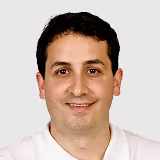
Marcel Kloos
Swiss-licensed dentist and founder of Medschool Experts
Marcel Kloos founded Medschool Experts while studying abroad; since then, over 500 study places have been secured. The Stuttgart-born dentist studied dentistry from 2015 to 2021 in Sofia and holds a Swiss dental licence.
Today he lives in Bern and runs Medschool Experts full-time as its owner.
More articles worth reading
Health Insurance for International Medical Students in Europe 2026
Scholarships and Funding for Medical Studies in Europe 2026
Medicine, Dentistry, Pharmacy or Veterinary Medicine? Choosing Your Degree Abroad in 2026
Ahmad
Sabrina
Rami
Noah
500+ students placed.
Now it's your turn!
No daydreaming, no empty promises. Just a clear plan — for the start of your medical degree.
40 minutes, no obligation