Studying Medicine in Vilnius: Costs, Structure and Recognition
17.09.2026

Studying medicine at Vilnius University at a glance
The table below summarises the key figures that matter for a decision in 2026. All figures refer to the English-taught programmes at the Faculty of Medicine of Vilnius University.
| Feature | Figure for Vilnius |
|---|---|
| University | Vilniaus universitetas, founded 1579 |
| Medicine | 6 years, 360 ECTS, English, Medical Doctor |
| Dentistry | 5 years, English, dental qualification |
| Medicine tuition | €7,050 per semester (€14,100 per year), 2026 |
| Dentistry tuition | €7,500 per semester (€15,000 per year), 2026 |
| Compulsory language | Lithuanian, 6 semesters to B2, free of charge |
| Teaching hospital | Santaros Klinikos, over 8,000 staff |
| Accreditation | WFME recognition via SKVC, October 2023 |
| Cost of living | €650–850 per month |
| Recognition | Automatic across the EU, Annex V 5.1.1 |
| Not offered in Vilnius | Pharmacy and veterinary medicine (in Lithuania: Kaunas) |
How is Vilnius University positioned?
According to the national portal Study in Lithuania, Vilnius University has more than 24,000 students from over 100 countries and runs 140 bachelor's and 140 master's programmes plus doctoral studies across 29 fields. 75 programmes are taught in English. Alongside its main campus in the capital, the university has additional sites in Kaunas and Šiauliai. It belongs to both the Coimbra Group and the Arqus Alliance.
In the QS World University Rankings 2027, Vilnius University placed 465th out of 1,504 ranked universities; QS says it assessed close to 9,000 universities from 106 countries for that edition. Its strongest single score is Employment Outcomes, ranked 107th worldwide — essentially, what becomes of its graduates. On faculty-student ratio, Vilnius ranks 275th, and on employer reputation the university climbed 96 places to rank 400th in 2026. Among the five ranked Lithuanian universities, it leads on almost every indicator.
The Faculty of Medicine is located on Čiurlionio Street and is organised into six units: the Institute of Biomedical Sciences, with departments of anatomy, genetics, pathology, physiology and radiology; the Institute of Clinical Medicine, with 14 clinics ranging from anaesthesiology to psychiatry; the Institute of Dentistry, including a Centre for Paediatric Dentistry; the Institute of Health Sciences, covering midwifery, nursing, public health and rehabilitation; the Institute of Translational Health Research; and the Biobank of the Lithuanian population and rare diseases.
The affiliated Santaros Klinikos university hospital employs more than 8,000 people and is organised into seven clinical groups: surgery, internal medicine, diagnostics, heart and vessels, mother and child, outpatient care, and clinical services. It also runs 35 specialised medical centres. The hospital performs heart, liver, kidney and pancreas transplants, carries out corneal and stem-cell transplants, and uses CAR-T cell therapy, robotic surgery and interventional radiology. Santaros Klinikos is a full member of twelve European Reference Networks for rare diseases and an associate member of six more. Lithuania's National Cancer Centre is affiliated with it.
Which programmes does Vilnius offer in English?
The Faculty of Medicine at Vilnius University runs two integrated programmes in English. Both are regulated professions under EU law, which makes their duration and scope comparable across Europe.
| Programme | Duration and scope | 2026 tuition | Qualification |
|---|---|---|---|
| Medicine | 6 years, 360 ECTS | €14,100 per year | Medical Doctor, Master in Health Sciences |
| Dentistry | 5 years | €15,000 per year | Dental qualification, Master in Health Sciences |
| Pharmacy | Not offered in Vilnius | – | In Lithuania: Kaunas, 5 years |
| Veterinary medicine | Not offered in Vilnius | – | In Lithuania: Kaunas, 6 years |
Anyone wanting to study pharmacy or veterinary medicine in English will find both in Lithuania at the Lithuanian University of Health Sciences in Kaunas. There, pharmacy costs €5,600 per year in years one to three and €5,700 in years four and five for the 2026/2027 academic year, while veterinary medicine costs €9,200 and €10,700 respectively. The two cities are around a hundred kilometres apart and connected by roughly an hour's train ride.
The language of instruction in Vilnius is English throughout, and applicants need to prove B2 level, for example IELTS Academic 6.5 or above or TOEFL iBT 81 points or above. Lithuanian runs alongside it: six consecutive semesters up to B2 level, free of charge and fixed in the timetable. Vilnius University ties admission to clinical courses to this requirement and also points to later licensing in the country. This is the most demanding language requirement among the major English-taught medical destinations in Eastern Europe, and it is the clearest trade-off at this location: Vilnius asks more here than Riga, Kaunas or Sofia.
How does admission to Vilnius work?
Vilnius University admits students to medicine and dentistry through its own entrance assessment rather than by school-leaving grades alone, and it recognises a number of internationally established qualifications and partner pathways as alternatives to that standard route. Because eligibility and which exemptions apply differ from one applicant profile to the next, the reliable way to find out exactly where you stand is to talk it through with us directly rather than trying to match your own certificate against a general description.
This is exactly where working with us makes the difference compared with applying on your own. We look at your certificates, your options and how realistic your profile is for Vilnius, individually, in a free consultation — and from there we guide you through the right route for your specific case.
How is the medicine programme in Vilnius structured?
The six years are divided into two pre-clinical years, three clinical years and one practical year. This structure follows the classic European pattern, and its 360 ECTS credits match exactly what German faculties require for a complete medical degree.
| Stage | Years | Focus |
|---|---|---|
| Pre-clinical | 1–2 | Anatomy, physiology, biochemistry, histology, genetics |
| Clinical | 3–5 | Internal medicine, surgery, paediatrics, gynaecology, neurology, psychiatry |
| Practical year | 6 | Rotations at Santaros Klinikos and other teaching hospitals |
| Lithuanian | 1–3 | Six semesters to B2, required for clinical courses |
In dentistry, the clinical share increases every year. Vilnius University describes the structure as one where pre-clinical work on models gradually gives way to independent patient treatment, which takes up most of the week by the final semesters. The Institute of Dentistry runs its own Centre for Paediatric Dentistry for this purpose; oral and maxillofacial surgery is affiliated with Santaros Klinikos.
What does studying in Vilnius cost overall?
Vilnius University charges €7,050 per semester for medicine and €7,500 for dentistry in 2026. On top of that come a €100 application fee and a one-off €200 entrance-exam fee. Cost of living in Vilnius, based on experience, runs at €650–850 per month; a single place in student housing costs around €90–130, and a private flat in the centre around €500 including bills.
| Item | Medicine | Dentistry |
|---|---|---|
| Tuition per semester | €7,050 | €7,500 |
| Total tuition | €84,600 (12 semesters) | €75,000 (10 semesters) |
| Cost of living | €54,000 (€750 × 72) | €45,000 (€750 × 60) |
| Study materials and trips home | approx. €4,500 | approx. €3,800 |
| Total (our estimate) | approx. €143,000 | approx. €124,000 |
This total is our own estimate at Medschool Experts, based on 2026 fees and an average monthly budget of €750. It shows two things. First, living costs make up around 38 percent of the total in Vilnius, compared with over 90 percent for a state-funded degree in Germany, where tuition falls away. Second, Vilnius sits in the upper third on price among English-taught EU destinations. Anyone looking purely at the semester fee will find cheaper options in Kaunas, Riga or Bulgaria. Anyone weighing hospital size, research links and ranking gets something for that price in Vilnius.
{{cta}}
How can studying in Vilnius be financed?
Lithuania is an EU member state, so a full degree in Vilnius qualifies for German foreign study grants (Auslands-BAföG) under Section 5(2)(3) of the BAföG Act. The maximum rate is €992 per month, half as a grant and half as an interest-free loan. On top of that comes a tuition-fee subsidy of up to €5,600 as a full grant with no repayment, though only for a maximum of twelve months. Travel costs are covered at €250 per trip, and health and long-term-care insurance at €102 and €35. There is no additional allowance for studying abroad within the EU.
The German federal cabinet approved the 30th BAföG Amendment Act on 12 August 2026. Under it, the housing allowance rises from €380 to €440 from the 2027 summer semester, and the basic rate of €475 rises in stages to €503 and then, by 2029, to €563. For anyone starting in Vilnius in autumn 2026, that means the first year still runs on the old rate, and funding improves from the second year onward.
Two further building blocks matter. The Bildungskredit education loan from the Federal Office of Administration pays €100–300 per month, up to a maximum of €7,200, at an effective annual rate of 3.53 percent (as of 1 April 2026), and only during the final 24 months of study; studying abroad is explicitly eligible. The KfW Studienkredit 174, on the other hand, excludes a full degree abroad under its information sheet from November 2023 — anyone planning around it is planning against the facts. On tax: for a first degree, only special expenses up to €6,000 are deductible, with no loss carry-forward (Federal Constitutional Court, decision of 19 November 2019, 2 BvL 22/14); after completed vocational training, deductible costs as income-related expenses are unlimited.
Where can you practise as a doctor with this qualification?
Lithuania has been an EU member state since 1 May 2004. Medical diplomas from Vilnius therefore qualify for automatic recognition under Directive 2005/36/EC. The relevant designations appear in Annex V, point 5.1.1, most recently set out in Commission Delegated Decision (EU) 2021/2183 of 25 August 2021: “Aukštojo mokslo diplomas, nurodantis suteiktą gydytojo kvalifikaciją” or “Magistro diplomas (medicinos magistro kvalifikacinis laipsnis ir gydytojo kvalifikacija),” issued by a Universitetas, accompanied by the certificate “Internatūros pažymėjimas.” The decision names 1 May 2004 as the reference date.
| Country | Route to practising | Additional exam |
|---|---|---|
| Germany | Full licence (Approbation) via the state authority | No knowledge exam |
| Austria | Recognition plus entry in the Ärzteliste register | None |
| Switzerland | MEBEKO recognition, then cantonal authorisation | None, but B2 language certificate required |
| Rest of the EU and EEA | Automatic recognition under Annex V | None |
| United Kingdom | GMC registration, case-by-case assessment since Brexit | PLAB currently not required for EU qualifications |
| United States | ECFMG certification, WFME-recognised agency, WDOMS listing | USMLE Step 1 and Step 2 CK |
| Canada | MCC process, matching via CaRMS | MCCQE |
| Australia | Ahpra and Medical Board | AMC exams |
For Germany, automatic recognition means the relevant state authority grants full licensure (Approbation) without re-assessing the substance of the diploma. Anyone with German citizenship, or who completed school or training in Germany in German, does not need to sit either the general language exam or the specialist language exam. Both procedures apply only to applicants without a German-language school or training background. In Switzerland, the equivalent applies to the B2 language certificate.
One detail that's often overlooked with Lithuania: for full registration, the UK's General Medical Council explicitly lists the “Internatūros pažymėjimas” certificate alongside the diploma, the “Rezidentūros pažymėjimas” for specialist registration, and the “Šeimos gydytojo rezidentūros pažymėjimas” for general practice. Anyone considering the UK later on should keep track of these documents from the start.
For the US, WFME recognition is decisive. Since 1 January 2023, the ECFMG has only accepted graduates of faculties whose programme is accredited by a WFME-recognised agency. Lithuania's agency, SKVC, holds that status; it accredits existing programmes for six years and new ones for three. Prof. Dalius Jatužis, Dean of the Faculty of Medicine, said in the university's 2023 announcement that without this recognition, the number of international students would have fallen sharply, because diplomas would no longer have been accepted in the US.
Dentist, pharmacist, psychologist, vet: the legal position by profession
Automatic recognition doesn't apply across the board to all health professions, but to four specifically named ones. Dentists appear in Annex V, point 5.3.2, vets in 5.4.2, and pharmacists in 5.6.2. For Lithuania, Commission Delegated Decision (EU) 2021/2183 lists, for dentists, “Aukštojo mokslo diplomas, nurodantis suteiktą gydytojo odontologo kvalifikaciją” or “Magistro diplomas (odontologijos magistro kvalifikacinis laipsnis),” issued by a Universitetas, also with a reference date of 1 May 2004.
For vets, the same decision names the Lietuvos veterinarijos akademija and the Lietuvos sveikatos mokslų universitetas as issuing institutions — both in Kaunas. Vilnius does not train vets. Pharmacy in Lithuania also runs through Kaunas; that qualification falls under the same automatic recognition as in Germany. For pharmacists, the same language rule applies to German licensure as for doctors: anyone who completed school or training in Germany in German sits neither the language nor the specialist-language exam.
Psychology falls outside this system. It is not one of the sectoral professions under Directive 2005/36/EC, and its qualifications are not automatically recognised. Anyone wanting to work as a psychotherapist in Germany takes the route via the reformed Psychotherapeutengesetz, with a bachelor's and master's that meet licensing requirements; the relevant state authority assesses the equivalence of a foreign degree on a case-by-case basis. This is the most important difference among the five professions — and the reason psychology can never be planned with the same certainty as medicine or dentistry.
Career paths after graduation
A diploma from Vilnius opens more doors than most people realise when they start their degree. In Germany, around 446,000 doctors were practising as of 31 December 2025; the German Medical Association (Bundesärztekammer) recorded 5,448 new registrations that year by people without German citizenship. Under the OECD's classification, which measures where training took place rather than nationality, 15.0 percent of doctors working in Germany were trained abroad (data years 2021–2023). Specialist training generally takes 60 months under the 2018 model training regulations as amended on 3 July 2025, 48 months in theoretical specialties and 72 in surgical ones. In 2026, the first year of specialist training is paid €5,792.90 per month under the TV-Ärzte/TdL pay agreement, or €5,722.05 under TV-Ärzte/VKA.
Switzerland is the single most attractive destination for German-speaking EU graduates. The 2025 FMH statistics record 44,612 practising doctors, 43 percent of them with a foreign diploma — against an OECD average of 19.6 percent. In 2024, 49.4 percent of those foreign diplomas came from Germany. In Austria, the Basisausbildung foundation training was shortened from nine to six months on 1 August 2026, because its content overlapped with the clinical practical year; the Ärzteliste register counted 53,353 entries at the end of 2025, against an annual replacement need of 1,836 posts.
Outside Europe, the WFME question is what matters most, and for Vilnius it has been settled since October 2023. In the 2026 NRMP Match, 44,344 positions faced 53,373 registered applicants; the match rate was 70.0 percent for US citizens with a foreign diploma and 56.4 percent for non-US graduates. In Canada's 2026 CaRMS process, 931 internationally trained doctors matched, up from 851 the year before and 671 in 2024. On the frequently cited question of quality, there's a solid answer: Tsugawa and colleagues, writing in the BMJ in 2017, found an adjusted 30-day mortality rate of 11.2 percent among internationally trained internists across 1,215,490 hospital admissions, against 11.6 percent for US-trained internists. We've covered which of these routes fits your life in detail in a separate guide on career paths with an EU medical degree worldwide.
Transferring into Vilnius and switching back to Germany
Both directions are possible, and both depend on the same two questions: are the credits earned comparable in substance, and is there a free place in the target semester? Because the Vilnius curriculum is structured around ECTS and meets the minimum requirements of Article 24 of Directive 2005/36/EC — at least five years of study and 5,500 hours of theoretical and practical training —, comparability is generally easy to document.
When switching back to Germany, it's the state examination office and the receiving faculty that decide on credit transfer, not Vilnius University. One caveat belongs here: anyone who transfers after the third year of study will have completed the full Lithuanian language programme without being able to use it in Germany. That's lost time, and it belongs in the decision. Anyone planning a return to Germany from the outset should work through that with us before committing to Vilnius.
What is it like to live in Vilnius?
Vilnius had around 602,430 residents in 2024, making it Lithuania's largest city. Its old town has been a UNESCO World Heritage Site since 1994 and is one of the largest surviving baroque old towns in Eastern Europe — you don't live on a campus on the edge of town here, but in the middle of a city that has been a university town for four hundred years. The Faculty of Medicine sits together with the hospital in the north of the city, well connected to public transport.
Lithuania has used the euro since 2015, so there's no exchange-rate risk. Cost of living, at €650–850 per month, is above Kaunas and well above Bulgaria or Serbia, but below Vienna, Munich or Zurich. The biggest item is rent: Vilnius is the country's most expensive housing market. A student-housing place at €90–130 makes a real difference to the monthly budget here.
Two things are worth planning for realistically. Winter is long and dark; in December, it starts getting dark in Vilnius around half past three in the afternoon. Summers, on the other hand, stay light well into the night. Flight connections to Germany are good but vary by season — anyone planning to go home regularly should factor that into their budget.
Who Vilnius University is the right choice for
Vilnius suits you if you value a research-strong university with international visibility and are willing to learn a language for it. Rank 465 in the QS Rankings 2027, rank 107 for Employment Outcomes, a hospital with 8,000 staff, and full membership in twelve European Reference Networks — that's a different league from a pure training programme. Anyone aiming for research later, or a specialist career at a large hospital, will find an environment here that fits.
Vilnius is less of a fit if your budget is tight. €14,100 in tuition plus a capital-city housing market add up to a total roughly €30,000 above comparable destinations in Bulgaria or Serbia. The six semesters of Lithuanian to B2 level are also not a side subject, but a real requirement alongside anatomy and physiology. And anyone firmly planning a return to Germany loses part of that effort at this specific point.
What helps in both cases is an honest read on your own profile before money and time are committed. That's exactly what we do in a free consultation: we look at your certificates, your budget and your goals, and tell you whether Vilnius is the right destination or another location suits you better.
The author's view
I studied dentistry in Sofia from 2015 to 2021, with Bulgarian as a compulsory subject alongside anatomy and physiology. That's why I read Vilnius's language requirement differently from most people: six semesters of Lithuanian to B2 level sound, at first, like a hurdle you'd rather avoid. In practice, that exact subject was the reason I could take my own patient histories in my fourth year, instead of standing next to an interpreter. If you speak the language of the country where you're learning on patients, you build far more cases of your own in the same amount of time.
What convinces me professionally about Vilnius is the connection between the university and the hospital. Santaros Klinikos isn't a teaching hospital on the side; it's the hospital where hearts, livers and kidneys are transplanted in Lithuania, with full membership in twelve European Reference Networks for rare diseases. A student rotating there in their sixth year sees cases they'd never encounter at a smaller location. That shows later in interviews, in Germany just as much as in Switzerland.
One limitation I'll state plainly, because it belongs in every calculation: Vilnius is expensive. €14,100 in annual tuition plus a capital-city housing market add up, by my estimate, to around €143,000 over six years. In Kaunas, Riga or Bulgaria, you can manage with considerably less, under the same automatic EU recognition. Anyone working with a tight budget shouldn't argue that away, but should factor it into the choice of location. The qualification, in the end, is the same legal instrument: Annex V, point 5.1.1.
What I take from that path above all is how much the choice of location shapes what comes after, not just the six years of study themselves. A diploma from Vilnius is an international ticket: automatically recognised across the EU, and since October 2023 also WFME-recognised, which makes it ECFMG-eligible. Only a handful of locations had that combination ten years ago. Choosing one today also means choosing which country you wake up in afterwards.
Conclusion
Vilnius shows just one of the many routes into a medical or dental degree that fit different budgets, profiles and ambitions — and finding the right one for you is exactly what we're here for. At Medschool Experts, we work with the largest network of official partner universities, which lets us individually assess the highest year of entry realistically open to you, and entry is often possible as late as the final two years of the programme.
Wherever you're starting from, get in touch and book a free consultation with Medschool Experts — we'll look at your profile and show you the options open to you.
Frequently asked questions about studying medicine in Vilnius
What does studying medicine at Vilnius University cost?
Vilnius University charges €7,050 per semester for medicine in 2026, or €14,100 per academic year. For dentistry, it's €7,500 per semester, or €15,000 per year. On top of that come a €100 application fee and a one-off €200 entrance-exam fee.
How long does the programme in Vilnius take?
Medicine at Vilnius University takes six years and comprises 360 ECTS credits, split into two pre-clinical years, three clinical years and one practical year. Dentistry takes five years. Both programmes end with a Master in Health Sciences alongside the professional qualification.
Is a Vilnius degree recognised in Germany?
Yes. Lithuania has been an EU member state since 1 May 2004, and its diplomas are listed in Annex V, point 5.1.1 of Directive 2005/36/EC. The relevant state authority grants full licensure without re-assessing the substance of the degree. No knowledge exam is required.
Do I need to take a language or specialist-language exam as a German citizen?
No. Anyone with German citizenship, or who completed school or training in Germany in German, needs to sit neither the general language exam nor the specialist-language exam. Both procedures apply only to applicants without a German-language school or training background. In Switzerland, the same principle applies to the B2 certificate.
How much Lithuanian do I need to learn?
Vilnius University requires all students on its English-taught programmes to complete six consecutive semesters of Lithuanian up to B2 level. The courses are free of charge and built into the timetable. Without this certificate, clinical courses are not released.
Is there a German-language medicine programme in Vilnius?
No. Vilnius University teaches medicine and dentistry in English and in Lithuanian; there is no German-language programme. A B2-level English certificate is required, for example IELTS Academic 6.5 or above or TOEFL iBT 81 points or above.
How does the entrance assessment work?
Vilnius University assesses applicants through its own process rather than by school grade average alone, and it recognises certain routes via partner organisations as alternatives. Because eligibility and exemptions depend on your individual profile, the best way to find out exactly what applies to you is a free consultation with us.
Do I need a specific school-leaving grade average?
No. Vilnius University does not allocate places by grade average, but through its entrance assessment and your overall application profile. Whether your certificate is sufficient for Vilnius is something we look at individually in a free consultation.
Can I study pharmacy or veterinary medicine in Vilnius?
No, both subjects are only available in Lithuania at the Lithuanian University of Health Sciences in Kaunas. There, pharmacy costs €5,600 per year in years one to three and €5,700 afterwards for 2026/2027, and veterinary medicine €9,200 and €10,700 per year respectively.
Can I work in the US with a diploma from Vilnius?
Yes, that route is open. The World Federation for Medical Education recognised the medicine programme in October 2023 via the Lithuanian agency SKVC. Since 1 January 2023, the ECFMG has only accepted graduates of such faculties. USMLE Step 1 and Step 2 CK are also required.
What are living costs like in Vilnius?
Based on experience, they run at €650–850 per month. A single place in student housing costs around €90–130, and a private flat in the centre around €500 including bills. Vilnius is Lithuania's most expensive housing market, but still below Vienna or Munich.
What does the whole programme in Vilnius cost?
By our estimate, around €143,000 for six years of medicine: €84,600 in tuition, €54,000 in living costs at €750 per month, and around €4,500 for study materials and trips home. For five years of dentistry, the total comes to around €124,000.
Can I switch back to Germany later?
A transfer is possible. The state examination office and the receiving faculty decide on credit transfer, and a free place in the target semester is required. Because Vilnius is structured around ECTS, comparability is generally easy to document. However, you won't be able to use the Lithuanian language classes once back in Germany.
What students say about Medschool Experts
Over 500 placements at more than 25 partner universities across 10+ countries. Read independent student reviews on Trustpilot.
About the author
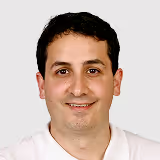
Marcel Kloos
Swiss-licensed dentist and founder of Medschool Experts
Marcel Kloos founded Medschool Experts while studying abroad; since then, over 500 study places have been secured. The Stuttgart-born dentist studied dentistry from 2015 to 2021 in Sofia and holds a Swiss dental licence.
Today he lives in Bern and runs Medschool Experts full-time as its owner.
More articles worth reading
Health Insurance for International Medical Students in Europe 2026
Scholarships and Funding for Medical Studies in Europe 2026
Medicine, Dentistry, Pharmacy or Veterinary Medicine? Choosing Your Degree Abroad in 2026
Ahmad
Sabrina
Rami
Noah
500+ students placed.
Now it's your turn!
No daydreaming, no empty promises. Just a clear plan — for the start of your medical degree.
40 minutes, no obligation