Studying Medicine in Zagreb: Costs, Structure and Recognition
17.09.2026

Zagreb at a Glance
Zagreb is the capital of Croatia, has around 770,000 residents, and is thus the country’s largest city. The University of Zagreb’s Faculty of Medicine sits in the Šalata district, above the city centre and directly next to the university hospitals. Before we go into detail, here are the key facts of the English-language programme at a glance.
| Feature | Detail (as of 2026) |
|---|---|
| University | University of Zagreb, School of Medicine |
| Programme | Human Medicine, Medical Studies in English |
| Language of instruction | English |
| Standard duration | 6 years, 12 semesters, 360 ECTS credits |
| Degree | Doctor of Medicine |
| Tuition fee | 12,000 EUR per academic year |
| Places per year | 60 (2026/2027 faculty admissions) |
| Admission procedure | Written test in biology, chemistry and physics |
| Programme start | Winter semester |
| Cost of living | approx. 700 to 1,000 EUR per month |
| Recognition in Germany | Automatic under Directive 2005/36/EC |
These figures paint a clear picture: a six-year EU programme with a manageable class size, a fixed fee per academic year, and an admissions process built on subject knowledge rather than school grades. I work through how the fee compares with other locations further below.
University and Teaching Hospital
The University of Zagreb dates back to 1669, making it Croatia’s oldest university. The Faculty of Medicine was founded in 1917. The English-language programme, Medical Studies in English, has run since 2009; by 2025, according to the faculty, 466 students had completed it. This is deliberately not a mass-enrolment operation, but a small international cohort that stays together across all six years. In parallel, the faculty also teaches a Croatian-language programme; the same rules for teaching and examinations apply to both.
Practical training takes place at the affiliated university hospitals, above all at Zagreb Clinical Hospital Centre, the country’s largest hospital. It has 2,110 beds – around 1,720 at the main Rebro site and 180 at the Šalata site directly next to the faculty – and employs around 7,540 people, including roughly 945 doctors and specialists. For you, this means: the cases you see from the clinical phase onward come from a tertiary-care hospital that accepts referrals from across the whole of Croatia.
What strikes me in consultations is how late the question of the teaching hospital tends to come up. Yet it’s exactly this that determines how broad your practical training ultimately becomes. The short distances between lecture hall and ward in Šalata are one of this location’s quiet advantages.
Which Programmes Are Offered, and in Which Language?
For international applicants, human medicine in English is the main focus in Zagreb. Alongside it, the university also offers an English-language dentistry programme. Both last six years and both start in the winter semester.
| Programme | Language and duration | Fee |
|---|---|---|
| Human Medicine (Medical Studies in English) | English, 6 years, 360 ECTS | 12,000 EUR per academic year |
| Dentistry | English, 6 years | 5,100 EUR per semester |
Croatian still matters, though. Alongside the pre-clinical years, you take language courses, because from the third year onward you speak with patients at the university hospitals. These courses are part of the programme and demand real effort alongside anatomy and biochemistry. Taking them seriously pays off noticeably on the ward; letting them slide leaves you struggling during patient histories.
The English-language programme isn’t a translated curriculum. The faculty describes it as an independently modernised programme with small-group teaching and problem-based learning, aligned with reformed medical faculties across Europe.
How Does Admission Work?
The Croatian system doesn’t have a numerus clausus. What’s required is a general higher education entrance qualification, plus good English skills, since the programme runs entirely in English. Places are awarded based on a written entrance test in biology, chemistry and physics.
The faculty is transparent about the format: 120 questions, 40 per subject, drawn from upper-secondary school material. A pass requires at least 15 correct answers per subject and 61 correct answers overall. The faculty explicitly does not use school-leaving averages as a selection criterion, because grading systems vary too much between countries of origin. According to the faculty, roughly one in four applicants is admitted, and the test has been administered online since 2020.
At Medschool Experts, we organise your registration, application and entrance test for you. Participation is usually possible entirely online, so you don’t need to travel to Croatia for the selection process. We take care of the paperwork.
On the subject matter, we prepare you across all three subjects. You get a study plan that sensibly distributes preparation across biology, chemistry and physics, with an emphasis on physics, since this subject tends to demand the most from applicants. We also go through the personal interviews around the application with you, so you can put your motivation into clear words. What applies specifically in your case is something we assess individually in a free consultation.
For up-to-date application deadlines and test dates, we’re happy to walk you through the current timeline in a free consultation – the exact windows shift from year to year, so starting early simply gives you more time for biology, chemistry and physics.
What Does the Programme Cost?
The fee for human medicine is 12,000 EUR per academic year. The faculty’s 2026/2027 admissions also list an instalment option: 12,200 EUR, payable in two instalments of 6,100 EUR each. Paying in one lump sum therefore saves you 200 EUR per year.
| Item | Amount | As of |
|---|---|---|
| Human Medicine, single payment | 12,000 EUR per academic year | 2026/2027 |
| Human Medicine, two instalments | 12,200 EUR (2 x 6,100 EUR) | 2026/2027 |
| Fees across the full programme | 72,000 EUR | 6 academic years |
| Dentistry | 5,100 EUR per semester | 2026 |
| Cost of living | approx. 700 to 1,000 EUR per month | 2026 |
From this, you can build a full picture. It’s an estimate, not a university calculation, meant to give you a sense of scale. Over six years, fees add up to 72,000 EUR. For living costs, I calculate 72 months at 700 to 1,000 EUR, which is 50,400 to 72,000 EUR. Add incidental costs for the application and entrance test, travel, textbooks, materials and insurance, which I estimate at around 3,000 EUR across the whole programme. In total, you land at around 125,000 to 147,000 EUR – roughly 136,000 EUR in the middle. This order of magnitude should be clear before you apply, not after.
Compared with other locations in our series, Zagreb does well on fees. The table below converts every figure to a full academic year so the numbers are comparable.
| Location | Human Medicine fee per academic year | Language of instruction |
|---|---|---|
| Zagreb (Croatia) | 12,000 EUR | English |
| Bratislava (Slovakia) | 13,000 EUR | English |
| Riga (Latvia) | 13,500 EUR | English |
| Pécs (Hungary) | 14,400 to 15,000 EUR | English or German |
| Osijek (Croatia) | 16,000 EUR | German |
The second Croatian location in our programme is Osijek, where the programme runs in German. If language matters more to you than price, take a look at the German-language route in Osijek. Both degrees carry equal status in Germany.
A programme like this is rarely financed from a single source. Croatia has been an EU member since 2013, so studying there can generally be funded through foreign study grants (Auslands-BAföG); the responsible office depends on your destination country. Education loans, scholarships and family support are also options. That decision is made independently by the relevant body, regardless of your offer from Zagreb.
{{cta}}
How Is the Programme Structured?
The programme is an integrated six-year degree with 360 ECTS credits, following the same rules as the Croatian-language medicine programme. The faculty works with small groups and problem-based learning, and the final year consists mainly of clinical rotations.
| Stage | Years | Focus |
|---|---|---|
| Pre-clinical stage | Years 1–2 | Anatomy, physiology, biochemistry, histology and embryology, alongside Croatian language courses |
| Clinical stage | Years 3–5 | Internal medicine, surgery, paediatrics, gynaecology, neurology and psychiatry, with placements at the university hospitals |
| Final year | Year 6 | Mainly practical work in clinical rotations, comparable to the German “Praktisches Jahr” |
| Total scope | Years 1–6 | 360 ECTS credits, Doctor of Medicine degree |
You can complete the final year’s rotations at Croatian institutions or abroad, depending on where your career is heading. If you’re planning to return to Germany, this year is a popular choice for placements at German hospitals. The Croatian language courses are paced so that, by the start of the clinical stage, you can conduct a simple patient history.
Where Can You Work as a Doctor With This Degree?
Croatia has been a member of the European Union since 2013. This means the University of Zagreb’s Doctor of Medicine falls under Directive 2005/36/EC on the recognition of professional qualifications, Annex V point 5.1.1 for the medical profession, as amended by Delegated Decision (EU) 2023/2383 of 23 May 2023, applicable since 9 October 2023.
| Country | Path to professional licensing |
|---|---|
| Germany | Automatic recognition under Directive 2005/36/EC, licence issued via the competent state authority; no equivalence check or aptitude test |
| Austria | Recognition and registration through the Austrian Medical Chamber, followed by basic training |
| Switzerland | Recognition of the EU diploma via the competent federal authority, entry in the medical professions register |
| Other EU/EEA | Automatic recognition under Annex V point 5.1.1, registration with the national medical authority |
| United Kingdom | No automatic recognition since Brexit; registration with the General Medical Council, usually via the PLAB exam |
| United States | ECFMG certification and USMLE; since 1 January 2023, the faculty must be accredited by a WFME-recognised agency |
On that last point, one factual clarification: for Croatia, the Agency for Science and Higher Education (ASHE) handles accreditation. As of August 2026, it’s listed in WFME’s recognition process, though recognition itself hasn’t yet been granted. If you’re specifically planning to work in the US, check the current status in good time. For Germany, Austria, Switzerland and the rest of the EU, this point is irrelevant – there, the Directive alone decides, and how long the authority needs to process your licence application depends on the federal state.
Dentist, Pharmacist, Psychologist, Veterinarian: The Legal Position by Profession
Dentist. The University of Zagreb also offers dentistry in English, at a fee of 5,100 EUR per semester. Recognition falls under Annex V point 5.3.2 of Directive 2005/36/EC: the Croatian degree is automatically recognised in Germany, and the dental licence is issued by the competent state authority.
Pharmacist. Pharmacy is likewise harmonised across Europe, under Annex V point 5.6.2. A pharmacy degree earned in Croatia is therefore automatically recognised in Germany, and the licensing procedure follows the same path as for doctors.
Psychologist. Here it’s different. Psychology and psychotherapy aren’t harmonised across the European Union, and Annex V has no entry for these professions. A degree from Croatia is therefore assessed case by case, and the relevant chamber or authority decides which coursework it recognises.
Veterinarian. Veterinary medicine is harmonised under Annex V point 5.4.2 and is therefore likewise recognised automatically. The University of Zagreb has its own Faculty of Veterinary Medicine with an English-language programme; according to studimed, the fee there is 5,500 EUR per semester, with around 35 places per year.
Career Paths After Graduation
With your licence, the same paths are open to you as to graduates of German faculties. The classic route leads into specialist training at hospitals and practices authorised to provide it, taking five to six years depending on the specialty. Whether internal medicine, surgery, anaesthesiology or general practice, your Croatian degree carries equal status.
The English-language programme brings a second advantage. If you’ve studied medicine in English for six years, you read scientific literature without a detour, can take part in international studies, and can apply in Ireland, the Netherlands or Scandinavia without starting from zero. A path into research, the pharmaceutical industry or public health is also open.
We’ve covered in detail which options an EU medical degree opens up worldwide, and which exams stand in the way in which countries, in our overview of Career Paths With an EU Medical Degree.
I regularly see the same pattern among graduates of English-language programmes: settling into a German hospital has less to do with medicine itself than with the first weeks of documentation, discharge letters and ward-level language. That eases within a few weeks if you expect it going in. A placement during the sixth year at a German hospital takes away almost all of this hurdle in advance.
Lateral Entry, Transfer and Returning to Germany
Transferring from Zagreb to a German faculty is possible, but not guaranteed. It requires an available place in a higher semester, and the receiving faculty independently decides which coursework it credits. This assessment is based on your Transcript of Records, the official record of your subjects, grades and ECTS credits. Get this document after every academic year, so it’s ready when you need it.
The scope of 360 ECTS credits matches that of a German medicine programme, which makes things easier. Even so: some students do transfer, but many stay in Zagreb through to graduation. Approach the programme as though you’ll finish it in Croatia. Keeping one eye on Germany from day one tends to cost you time in year one that’s better spent on anatomy.
The reverse case – switching to Zagreb from another degree or another university abroad – follows the same admissions process as first-time applicants. What can be credited from prior study is something we assess individually in a free consultation. Since admission depends solely on the subject test, it doesn’t matter how long ago you finished school.
Living in Zagreb: City, Distances, Costs
Zagreb sits at the foot of the Medvednica mountains, has around 770,000 residents, and is well connected to Central Europe by rail, coach and its international airport. Trips home are manageable, which matters more in the first year than most people expect beforehand. As a university city with several tens of thousands of students, Zagreb offers a broad cultural scene, plus dormitory places and shared flats near the university.
For your budget, plan on around 700 to 1,000 EUR per month. As the capital, Zagreb sits above the level of smaller locations. For context on rents: Numbeo lists, as of 17 August 2026, a one-bedroom flat in Zagreb’s city centre at 765.62 EUR and outside the centre at 582.50 EUR, on monthly average. Sharing a flat or securing a dormitory place pushes this item well below these figures, and that’s exactly what decides whether you land at the lower or upper end of the range.
The Šalata district, home to the faculty and the university hospitals, is the natural anchor point for your housing search. Start looking as soon as your offer arrives, not in September. Within the city, tram and bus get you everywhere, and the distances between Šalata, the city centre and the other hospital sites are short.
Who This Location Suits
Zagreb suits you if you want to study medicine in English, if a subject-based entrance test appeals to you rather than putting you off, and if having a major university hospital right next to the lecture hall matters to you. It also suits you if price matters: at 12,000 EUR per academic year, it’s the most affordable of the English-language EU locations in our series.
Zagreb is a less good fit if you want to study in German – within Croatia, that route leads to Osijek instead. And if you dismiss the Croatian language courses as an annoying formality, you’ll struggle on the ward from the third year onward. Equally, the location doesn’t suit you if you’d rather avoid a subject test altogether: in Zagreb, it’s the sole deciding factor, and physics is no minor subject within it.
My assessment: Zagreb is one of the most coherent locations in the programme, because three things come together here that rarely do: a faculty with over a hundred years of history, the country’s largest teaching hospital within walking distance, and a fee that stays moderate by European standards. Whether your profile fits the entrance test is best clarified in conversation. Book a free consultation for that.
Author's Opinion
Between 2015 and 2021, I studied abroad myself – dentistry in Sofia – and I know the moment of standing in an unfamiliar city with two suitcases, not yet knowing where the nearest supermarket is. What helped me back then wasn’t perfect planning, but a programme with a clear structure and a year group small enough that everyone knew each other within two weeks. I find that same combination in Zagreb.
What convinces me about this location is how close teaching sits to the clinic. A university hospital with 2,110 beds, whose Šalata site borders the faculty directly, is a real asset for the clinical years. Add to that an admissions process that’s transparent about what it tests: 120 questions, 40 each in biology, chemistry and physics. I value processes you can actually prepare for, because they’re fair.
The Croatian language courses are not a side issue. They run alongside the pre-clinical years, they take time, and they’re compulsory, because from the third year onward you talk with patients at the university hospitals. Anyone who expects this gets through it well. Anyone who thinks an English-language programme means six years without the local language will find that frustrating.
Today, running Medschool Experts is my main profession, and I sit on the other side of the table. I see which applicants end up thriving in Zagreb: the ones who treat the test as a sporting challenge and take the six years for what they are – a fully-fledged medical education within the European Union. For these applicants, Zagreb is one of the best locations we work with.
Conclusion
Zagreb shows how a clear, well-structured EU medical degree can look – but the right university for you depends entirely on your own profile. At Medschool Experts, we maintain the largest network of official partner universities for medicine, dentistry and veterinary medicine, and for every student we individually assess the highest possible year of entry. In many cases, entry is even possible in the final two years of study.
Let’s talk through your situation together and find the location that’s the best fit for you. Book a free consultation with Medschool Experts.
Frequently Asked Questions About Studying Medicine in Zagreb
Do you need a specific school-leaving average for Zagreb?
No. The Croatian system doesn’t have a numerus clausus, and the faculty explicitly does not use school-leaving averages as a selection criterion, because grading systems vary too much between countries of origin. You need a general higher education entrance qualification and good English skills. Places are decided solely by the written entrance test.
How does the entrance test in Zagreb work?
The test covers 120 questions drawn from upper-secondary school material, 40 each in biology, chemistry and physics. A pass requires at least 15 correct answers per subject and 61 correct answers overall. The test has been administered online since 2020, so you don’t need to travel to Croatia for the selection process.
What does the medicine programme in Zagreb cost per year?
The fee for human medicine is 12,000 EUR per academic year when paid in one lump sum. The 2026/2027 admissions alternatively list 12,200 EUR in two instalments of 6,100 EUR each. Dentistry in Zagreb costs 5,100 EUR per semester. All figures apply per academic year or per semester, not as a one-off for the whole programme.
What should I budget for across all six years?
Fees alone add up to 72,000 EUR. Add 72 months of living costs at 700 to 1,000 EUR, plus around 3,000 EUR for application, travel, textbooks and insurance, and you land at an estimated 125,000 to 147,000 EUR. This order of magnitude should be clear before you apply.
How many study places are there per year?
For the 2026/2027 academic year, the School of Medicine is offering 60 places in the English-language programme. According to the faculty, roughly one in four applicants is admitted. That keeps the cohort small and internationally mixed, which shows clearly in the small-group teaching and clinical placements. Places are correspondingly limited.
Do I need to learn Croatian to study in Zagreb?
Yes. Alongside the pre-clinical years, you take Croatian language courses, because from the third year onward you speak with patients at the university hospitals. These courses are a fixed part of the programme and demand real effort alongside anatomy and biochemistry. Taking them seriously pays off noticeably from the clinical stage onward.
Is school English enough for Medical Studies in English?
The programme is taught entirely in English, and proof of English is required. Solid upper-secondary school English is a perfectly good starting point. You’ll learn medical terminology from scratch in the first year anyway, just like your Croatian classmates. If you’re unsure, work on listening comprehension and subject vocabulary beforehand.
When does the programme in Zagreb start?
In the winter semester – there’s no second start date. Admission timelines and deadlines shift from year to year, so we’re happy to walk you through the current dates in a free consultation. Starting your preparation early simply gives you more time for biology, chemistry and physics.
Where does practical training take place?
At the affiliated university hospitals, above all at Zagreb Clinical Hospital Centre, with 2,110 beds and around 7,540 staff. The Šalata hospital site sits directly next to the faculty. From the third year onward, clinical subjects each come with placements there, from internal medicine to psychiatry. In the sixth year, practical work dominates.
How is the programme structured?
Six years, twelve semesters, 360 ECTS credits. The first two years form the pre-clinical foundation with anatomy, physiology, biochemistry, histology and embryology. From the third year, clinical subjects take centre stage, and the sixth year consists mainly of clinical rotations. The degree awarded is Doctor of Medicine.
Is a degree from the University of Zagreb recognised in Germany?
Yes. Croatia has been an EU member since 2013, so Directive 2005/36/EC applies, with Annex V point 5.1.1 for the medical profession. The Doctor of Medicine is automatically recognised in Germany, Austria and Switzerland. No equivalence check or aptitude test is required, regardless of which federal state you go on to work in.
How do I get my medical licence afterwards?
You apply for it with the competent authority of the federal state where you want to work. Your Croatian degree, along with your health and personal suitability, is reviewed. No aptitude test applies to an EU degree. How long processing takes depends on the federal state and can’t be stated as a blanket figure.
How expensive is life in Zagreb?
Budget around 700 to 1,000 EUR per month. As of 17 August 2026, Numbeo lists a one-bedroom flat in Zagreb’s city centre at 765.62 EUR and outside the centre at 582.50 EUR. Sharing a flat or getting a dormitory place near campus pushes this item down noticeably, and ultimately decides whether you land at the lower or upper end of the range.
What students say about Medschool Experts
Over 500 placements at more than 25 partner universities across 10+ countries. Read independent student reviews on Trustpilot.
About the author
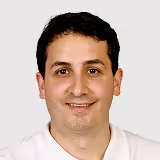
Marcel Kloos
Swiss-licensed dentist and founder of Medschool Experts
Marcel Kloos founded Medschool Experts while studying abroad; since then, over 500 study places have been secured. The Stuttgart-born dentist studied dentistry from 2015 to 2021 in Sofia and holds a Swiss dental licence.
Today he lives in Bern and runs Medschool Experts full-time as its owner.
More articles worth reading
Health Insurance for International Medical Students in Europe 2026
Scholarships and Funding for Medical Studies in Europe 2026
Medicine, Dentistry, Pharmacy or Veterinary Medicine? Choosing Your Degree Abroad in 2026

Ahmad

Sabrina

Rami

Noah
500+ students placed.
Now it's your turn!
No daydreaming, no empty promises. Just a clear plan — for the start of your medical degree.
40 minutes, no obligation