TMS 2026: Structure, Scoring and What the New TMSnat Changes From 2027
17.09.2026

What the TMS is and why it matters
The Test for Medical Studies, commonly known as the "Medizinertest," doesn't test subject knowledge - it tests aptitude for studying: spatial reasoning, concentration, memory, reading comprehension and handling scientific relationships. That's exactly what makes it so effective: unlike your school-leaving grade, it can be improved significantly through targeted training.
In Germany's place-allocation process, the TMS counts in two of the three admission quotas. In the Additional Aptitude Quota, where the school-leaving grade explicitly plays no role, it's often the deciding factor. In universities' own selection procedures, it's weighted heavily at many faculties and can noticeably offset a weaker grade.
The structure
The test takes a full day and consists of several task groups. The best-known include:
- Pattern Matching and Tube Figures: spatial reasoning under time pressure
- Basic Medical and Scientific Understanding: word problems with a scientific context
- Quantitative and Formal Problems: calculations drawn from everyday medical scenarios
- Diligence and Concentration: an endurance test lasting many minutes
- Memory for Figures and Memory for Facts: memory tested through a learning phase and a recall phase
- Reading Comprehension and Charts and Tables: extracting information from technical texts and data
Scoring
Wrong or skipped answers aren't scored negatively - they simply earn no points. So guessing doesn't hurt you. Your raw score is converted into a standard score on a scale from 70 to 130. The mean is 100, with a standard deviation of 10. Scores from around 110 upward are considered above average, and top scores reach around 130. The results report also shows a percentile rank.
This standardisation keeps results comparable across different test sittings, regardless of how difficult any single sitting was.
Dates, cost and retaking the test
| Point | Details |
|---|---|
| Frequency | twice a year, spring and autumn |
| Autumn 2026 date | 7 and 8 November 2026 |
| Registration fee | €100, payable at registration |
| Test centres | almost 30 centres nationwide; your preferred centre isn't guaranteed |
| Retaking | possible; the better result counts |
| Validity | unlimited |
Registration details and deadlines change from year to year, so if you'd like help planning around them, feel free to book a free consultation with us.
{{cta}}
Important for 2026: the TMS is being phased out
The autumn sitting on 7 and 8 November 2026 is the last round of the classic TMS. From 2027 it will be replaced by the TMSnat, a nationally standardised test that combines the TMS's cognitive task groups with the scientific content previously tested in the HAM-Nat. The first sitting is planned for 8 and 9 May 2027.
For applicants, that means: if you can still sit the test in 2026, you'll be taking a test whose format and prep material are well known. If you're only starting out in 2027, get familiar early with the scientific task groups, since the share of subject content is increasing. Any TMS result you've already achieved remains valid.
How to prepare effectively
- Start early. Three to six months of regular practice gets you further than four weeks of cramming.
- Practise under time pressure. Most points are lost not through lack of knowledge, but through pace.
- Run full simulations. Getting through an entire test day is a feat of concentration in itself, and it needs training too.
- Prioritise your weakest task groups. The standard score comes from your overall result, and the biggest gains come from wherever you're currently weakest.
We're happy to talk through how the test fits into your personal timeline - book a free consultation with us.
And what if it still isn't enough?
A good score significantly improves your chances, but it doesn't guarantee a place, because the number of study places remains limited. That's why it's worth exploring the route via a university in the EU alongside it. There, admission is usually decided by the university's own entrance exam, and the degree is recognised in Germany, Austria and Switzerland under Directive 2005/36/EC. We'll help you work out which locations fit your profile in a free initial consultation.
The author's opinion
In my view, the TMS is the fairest element in the entire admissions process. It doesn't ask how good you were at civics three years ago - it asks how you think under time pressure. And it's trainable, which makes it the one criterion you can actually change something about in the short term.
My advice remains the same: take the test, but don't make your life plans depend on a single result. Over the past few years, I've seen too many people wait two or three years for a place. Nobody gets those years back, and in the end they cost more than any tuition fee. So the smartest combination is this: take the TMS, apply in Germany, and at the same time have us check which EU location fits you. That way, you end up choosing between real options, rather than between waiting and giving up.
Conclusion
The TMS is a great opportunity if you're ready to prepare for it - and it's just one of several paths into medical school. At Medschool Experts, we work with the largest network of official partner universities, and we individually assess the highest possible year of entry for every student - entry is often possible even in the final two years of the programme. Get in touch and book a free consultation to explore every route open to you.
Frequently asked questions about the TMS
Is the TMS mandatory?
No, taking part is voluntary. However, many universities weight the result so heavily that it has effectively become the standard.
When does the TMS take place?
Twice a year, in spring and autumn, each on a weekend. The autumn 2026 sitting is on 7 and 8 November.
What does it cost to take part?
The registration fee is €100 and is paid directly at registration. Only after that can you select your preferred test centre.
Can I retake the TMS?
Yes, retaking it is possible. For your application, the better result always counts, so you can't make things worse by retaking it.
What counts as a good standard score?
The mean is 100, with a standard deviation of 10. Scores from around 110 upward are considered above average, and top scores reach around 130.
What is the TMSnat?
The successor test from 2027 onward. It combines the cognitive task groups of the previous TMS with scientific content. The first sitting is planned for May 2027.
Does the TMS help with studying abroad?
It isn't required for admission at most EU universities abroad, where admission is usually decided by the university's own entrance exam instead. The TMS still holds value, though, if you're applying in Germany at the same time.
How long is the result valid?
It's valid indefinitely and can be used in any later application process, so keep your results report somewhere safe.
What students say about Medschool Experts
Over 500 placements at more than 25 partner universities across 10+ countries. Read independent student reviews on Trustpilot.
About the author
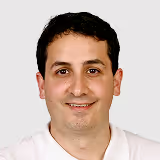
Marcel Kloos
Swiss-licensed dentist and founder of Medschool Experts
Marcel Kloos founded Medschool Experts while studying abroad; since then, over 500 study places have been secured. The Stuttgart-born dentist studied dentistry from 2015 to 2021 in Sofia and holds a Swiss dental licence.
Today he lives in Bern and runs Medschool Experts full-time as its owner.
More articles worth reading
Health Insurance for International Medical Students in Europe 2026
Scholarships and Funding for Medical Studies in Europe 2026
Medicine, Dentistry, Pharmacy or Veterinary Medicine? Choosing Your Degree Abroad in 2026

Ahmad

Sabrina

Rami

Noah
500+ students placed.
Now it's your turn!
No daydreaming, no empty promises. Just a clear plan — for the start of your medical degree.
40 minutes, no obligation