Transferring Universities in Europe: How to Switch
17.09.2026

What Is a Study Transfer Within Europe?
A study transfer is a move from one university to another during an ongoing degree, in which semesters and exams already completed are recognised at the new university. Within Europe this works particularly well in medicine, dentistry, pharmacy and veterinary medicine, because these programmes are structured comparably across the continent.
This is based on EU Directive 2005/36/EC. It sets minimum requirements for study duration and content for exactly these four professions – six years for human medicine, five years for dentistry, five years for pharmacy, five years for veterinary medicine. Anyone studying in Sofia, Varna or Valletta learns essentially the same content as in Munich or Vienna, just in a different place.
It's exactly this comparability that makes a transfer possible. At Medschool Experts, we assess which location is the best fit for your academic history so far, and handle the coordination with the receiving university.
Up to Which Year of Study Is a Transfer Possible?
In human medicine, a transfer is possible up to the 5th year of study; in dentistry, up to the 4th year. Entry into the final year of study is excluded across Europe, in all four fields.
The reason lies in training responsibility: the university that ultimately awards the diploma must itself have taken responsibility for, and examined, a substantial part of the training. A pure final-year transfer isn't provided for at any European faculty. Anyone who goes past this point has missed their window for a transfer – no exceptions, no workarounds.
| Subject | Transfer up to | No longer possible |
|---|---|---|
| Human medicine (6 years) | 5th year | from the 6th year |
| Dentistry (5 years) | 4th year | from the 5th year |
| Pharmacy (5 years) | 4th year | from the 5th year |
| Veterinary medicine (5 to 5.5 years) | second-to-last year | from the final year |
In practice, that means: if you're considering a switch, it's better to have the conversation a year too early than a semester too late. We have a suitable partner university for almost every situation – but only while the window is still open. Book your free consultation now.
When Is It Worth Switching Where You Study?
A switch is worth considering whenever your current location is no longer moving you forward – academically, personally or financially. In practice, in 2026 we mainly hear five reasons, and none of them is a sign of weakness.
- The location doesn't fit. The city, the climate, the distance from family, or simply the overall feel of the place isn't right.
- The programme structure doesn't fit. Some people thrive in small groups with plenty of hands-on patient contact, others need more structure.
- The language doesn't fit. If you realise you'd rather study in English or in German, you can make that happen at a different location.
- The cost doesn't fit. Semester fees vary considerably across Europe – from €1,750 per semester up into five figures a year.
- Your life circumstances have changed. Relationship, family, a part-time job, health: your degree is allowed to adapt to your life, not the other way round.
Only one thing really matters: the earlier you get in touch, the more smoothly the switch can be timed to line up with the next intake. Simply book a free consultation to talk it through.
Which Degree Programmes Can You Transfer Into?
At Medschool Experts, we support student transfers in four fields: human medicine, dentistry, pharmacy and veterinary medicine. All four belong to the so-called sectoral professions under EU Directive 2005/36/EC – degrees from EU member states are automatically recognised in Germany and Austria.
| Subject | Duration | Transfer locations |
|---|---|---|
| Human medicine | 6 years | Bulgaria, Croatia, Romania, Hungary, Poland, Malta, Cyprus, Bosnia |
| Dentistry | 5 to 6 years | Bulgaria, Croatia, Romania, Bosnia, Hungary |
| Pharmacy | 5 years | Bulgaria, Romania, Croatia |
| Veterinary medicine | 5 to 5.5 years | Bulgaria (Sofia, Stara Zagora) |
Which location will take you on, and at what year of entry, depends on your academic history so far. We look at this individually for every student.
{{cta}}Dream Locations: Study Where Other People Go on Holiday
Yes, it's genuinely possible – and it's not just a gimmick. Several of Europe's strong medical study locations sit right on the coast, and a good place to study is about more than the lecture hall. If you're going to spend six years somewhere, you should actually like the place.
| Location | Setting | What makes it special |
|---|---|---|
| Varna, Bulgaria | Right on the Black Sea | Long-established medical university, English-language programme, beach within walking distance |
| Valletta area, Malta | Mediterranean | English is an official language, MediCampus Europeo at around €14,500 per year |
| Nicosia, Cyprus | Island, coast around 30 minutes by car | English-taught, around €11,000 per semester |
| Riga, Latvia | Baltic Sea, Jūrmala beach on the doorstep | Well-established English-language programmes |
| Foča, Bosnia and Herzegovina | Drina river valley, mountains | Most affordable location in our portfolio, semester fees from €1,750 |
| Timișoara and Cluj, Romania | Inland, very student-friendly cities | €4,250 to €5,000 per semester, most affordable EU locations |
To be fully transparent: Bosnia and Herzegovina is not an EU member. A degree from Foča goes through an equivalence assessment procedure in Germany; alternatively, a later transfer to an EU university is possible. We support you either way – but we'll always tell you upfront what you're taking on.
Will My Previous Semesters Be Recognised?
Generally, yes. Subjects you've already passed – such as anatomy, physiology, biochemistry, histology or chemistry – are recognised at European universities where the scope and content are comparable. How many semesters are ultimately recognised is always decided by the receiving university based on your documents.
Realistically, most transfers fall in a range of one to four recognised semesters. Anyone already in their third year of study can, at many locations, enter directly into the corresponding year. In dentistry, recognition is a little tighter, because practical courses and phantom-head courses are structured differently from one location to the next.
What's possible in your specific case can't be answered in general terms. That's exactly what the free consultation is for: we look at your academic history and tell you specifically which location allows entry at which year.
How Quickly Can a Transfer Be Arranged?
A study transfer generally takes effect at the next intake. Most European universities start in September or October, and several locations also offer a February start. Anyone who gets in touch a few months ahead of time can switch without a gap semester.
This is exactly where we come in. At Medschool Experts, our team knows the contacts at the universities personally, knows which location currently has places open in which year of study, and brings the two together. You don't have to work your way through university administration on the phone – that's our job.
What Does Studying Cost After the Transfer?
Semester fees start at €1,750 and, depending on the location, run up to the mid five figures per year. In 2026, the most affordable EU locations are in Romania, at €4,250 to €5,000 per semester, with Mediterranean locations correspondingly higher.
On top of that come living costs, which in Southeast and Eastern Europe are noticeably below German levels – realistically €400 to €1,100 a month, depending on the location. And foreign BAföG is available for programmes within the EU, including a tuition fee grant of up to €5,600 a year as a full grant.
Does My Degree Stay Recognised in Germany?
Yes, for all EU locations, and automatically. Directive 2005/36/EC governs mutual recognition for doctors, dentists, pharmacists and vets within the European Union. With your degree and the EU conformity certificate, you apply for your medical licence (Approbation) in Germany – without any additional equivalence assessment.
The same applies to Switzerland via MEBEKO. Your degree is an international passport that opens doors.
What If I Want to Move Back to Germany Later?
The way back is always open. Many of our students complete their first years abroad and later transfer to a German faculty – with the credits earned abroad recognised through the state examinations offices. Others stay on and end up working in Germany, Austria or Switzerland.
We support both paths. Anyone who starts with us gets support all the way through to starting their career, not just up to enrolment.
The Author's View
Over the past few years I've had many conversations with students who were unhappy at their location and felt ashamed of it. I find that a shame, because you choose a university at 19 or 20, often without ever having seen the place. That this decision can be corrected after two years seems entirely natural to me.
But I'll also say clearly: a transfer doesn't solve problems that have nothing to do with location. If you're not at home in your subject, you'll feel that just as much on a beach in Varna as in a lecture hall in northern Germany. That's why, in the first consultation, I always ask what exactly isn't working – and sometimes I advise against a transfer.
But if it really is about the location, then a transfer is one of the most effective tools there is in a medicine degree. I've seen people rediscover their enjoyment of studying within a single semester of switching. That's the real gain – the sea on your doorstep is just the bonus.
Conclusion
Whichever direction feels right for you, get in touch and let's talk it through. At Medschool Experts we have the largest network of official partner universities in Europe for medicine, dentistry, pharmacy and veterinary medicine, and we individually assess the highest possible year of entry for every student – often making it possible to transfer in during the final two years of study. Book your free consultation and let's find the right place for you to continue.
Frequently Asked Questions About Transferring Universities Within Europe
Up to what point can I switch universities during a medicine degree?
In human medicine, a transfer is possible up to the 5th year of study; in dentistry, up to the 4th year. Entry into the final year of study is excluded across Europe, in all four fields.
Why isn't a transfer possible in the final year of study?
Because the university that ultimately awards the diploma must itself have taken responsibility for, and examined, a substantial part of your training. A pure final-year transfer isn't provided for at any European faculty.
I'm already in my 5th year of human medicine – is it too late?
No, the 5th year is the last window that's still open. From the 6th year onwards, a transfer is no longer possible. In dentistry, the window closes correspondingly after the 4th year. In this case, you shouldn't put off the conversation any longer.
How many semesters are recognised in a transfer?
In practice, usually between one and four semesters are recognised. What matters is the scope and content of the subjects you've already passed, not the number of semesters you were enrolled for.
Does the transfer also work for dentistry, pharmacy and veterinary medicine?
Yes. All four fields are regulated under EU Directive 2005/36/EC. In dentistry, recognition is a little tighter than in human medicine because of the practical courses, and the window closes a year earlier.
Do I have to take a year off to make the switch?
Generally not. Most locations start in September or October, and some also offer a February start. With enough lead time, the switch works without any gap semester.
Is there a suitable partner university for every situation?
In almost every case, yes – as long as the window is still open. At Medschool Experts, we work with partner universities in more than ten countries and can find a suitable entry point for almost any academic path.
Can I really study at a location by the sea?
Yes. Varna sits right on the Black Sea, Malta and Cyprus are in the Mediterranean, and Riga is on the Baltic. These are fully-fledged medical universities – the setting is simply an added bonus.
What language will I study in after the transfer?
In English at most locations, with German available as the language of instruction at some. We'll work out which option makes the most sense for you in the initial consultation.
Will my degree be recognised in Germany?
Yes for EU locations, automatically, under Directive 2005/36/EC. For locations outside the EU, such as Bosnia and Herzegovina, an equivalence assessment procedure applies; alternatively, a later transfer within the EU is possible.
What does studying cost after the switch?
Semester fees start from €1,750. The most affordable EU locations in 2026 are €4,250 to €5,000 per semester, while locations such as Malta run at around €14,500 per year.
Can I get BAföG (German student finance) abroad?
Foreign BAföG is available for programmes within the EU, including a tuition fee grant of up to €5,600 a year as a full grant. Repayment is capped at €10,010.
Can I switch back to a German university later?
Yes. Switching back is a well-established route; credits earned abroad are recognised through the relevant state examinations offices.
What does a consultation at Medschool Experts cost?
The initial consultation is free and non-binding. We look at your academic history and tell you which locations could work for you.
How do I start my transfer?
The best way is with a free consultation. We take care of everything else for you – choosing a location, coordinating with the university, and support all the way through to the start of your studies. Better too early than too late.
What students say about Medschool Experts
Over 500 placements at more than 25 partner universities across 10+ countries. Read independent student reviews on Trustpilot.
About the author
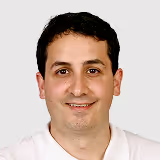
Marcel Kloos
Swiss-licensed dentist and founder of Medschool Experts
Marcel Kloos founded Medschool Experts while studying abroad; since then, over 500 study places have been secured. The Stuttgart-born dentist studied dentistry from 2015 to 2021 in Sofia and holds a Swiss dental licence.
Today he lives in Bern and runs Medschool Experts full-time as its owner.
More articles worth reading
Health Insurance for International Medical Students in Europe 2026
Scholarships and Funding for Medical Studies in Europe 2026
Medicine, Dentistry, Pharmacy or Veterinary Medicine? Choosing Your Degree Abroad in 2026
Ahmad
Sabrina
Rami
Noah
500+ students placed.
Now it's your turn!
No daydreaming, no empty promises. Just a clear plan — for the start of your medical degree.
40 minutes, no obligation