What Should I Study? What Career Choice Research Really Says
17.09.2026

Why "Follow Your Passion" Doesn't Hold Up to Research
In 2018, Paul O'Keefe, Carol Dweck and Gregory Walton published five experiments in Psychological Science that tested exactly this advice. The core finding: people differ in whether they see interests as fixed and innate, or as something that can be developed.
- People who see interests as fixed are less likely to develop interest in topics outside their own field.
- People who believe they've found "the one" passion expect limitless motivation and don't anticipate rough patches.
- That's exactly why interest collapses as soon as things get demanding: after reading a difficult academic text, interest dropped markedly more in this group than among people who see interests as something that can grow.
That's the real catch with this advice: it creates an expectation against which every real degree programme gets measured. Medicine, law, computer science – every subject has semesters that feel gruelling. Anyone who concludes from this that it can't be the right passion after all ends up switching or giving up, even though the original choice was a good one.
Interests Matter – But as Fit, Not as a Calling
The opposite claim – that interests don't matter at all – is just as wrong. In a meta-analysis, Christopher Nye, Rong Su, James Rounds and Fritz Drasgow (2012, updated 2017) drew together 60 years of research on how strongly interests relate to performance and persistence.
| Predictor | Performance at work | Performance in study |
|---|---|---|
| Interest scores alone | r = approx. .20 | r = approx. .23 |
| Person-environment fit (congruence) | r = approx. .36 | r = approx. .32 |
So what matters isn't how strongly an interest burns, but how well your interest profile fits the study and career environment. Interests predict performance and persistence over and above intelligence and personality – they are an independent piece of information that no school-leaving grade can capture.
From What Age Are Interests Reliably Measurable?
The meta-analysis by Low, Yoon, Roberts and Rounds (2005, Psychological Bulletin, 66 longitudinal studies) shows a clear pattern: during adolescence interests are still in flux, between 18 and 22 they stabilise noticeably, and between 25 and 30 they reach a plateau. At that point they are even more stable than personality traits.
The practical consequence: an interest test at 14 is a snapshot. At 18 or 19 – exactly when most people choose what to study – it has real predictive value. Feeling unsure at this stage doesn't mean you're lost; it simply means your profile is still settling into shape.
What Your Subject Does (and Doesn't) Mean for Your Income
The UK's Institute for Fiscal Studies (IFS) used LEO data – linked education and tax records for millions of graduates – to estimate the lifetime earnings effects of individual degree subjects. It is the cleanest evidence base that exists anywhere in the world on this question.
- Medicine and economics sit at the top: net lifetime earnings returns averaging more than £400,000 (2026 update).
- Creative and language subjects average close to zero – with very wide variation within each subject.
- By age 29, medicine and economics graduates earn over 20% more than comparable people who didn't study (men); for women it's around 60% more.
- Medicine graduates earn roughly twice the median income at 30 as their peers from the creative arts.
Important: the subject shifts the distribution, it doesn't guarantee any individual outcome. The differences within a single subject are large.
The second part of the truth: money buys almost no job satisfaction. In 2010, Timothy Judge and colleagues summarised 115 correlations from 92 samples in the Journal of Vocational Behavior. Salary level correlates at .15 with job satisfaction and at .23 with pay satisfaction – that's around two percent shared variance.
In plain terms: your choice of subject has a massive effect on lifetime earnings. Earnings have almost no effect on job satisfaction. Knowing both of these at once is the core of a mature decision – plan income as a boundary condition, and secure satisfaction through content, team and working conditions.
Meaning and Helping Others: Powerful, But It Requires Looking After Yourself Too
The advice to look for something that helps other people is far better supported by evidence than the passion advice. But it has a well-documented other side.
In 2009, Stuart Bunderson and Jeffery Thompson studied employees at 157 zoological institutions across the US and Canada in the Administrative Science Quarterly – a field of work classically experienced as a calling. Those who saw their work as a calling identified strongly with it, found meaning and significance, and were also markedly more willing to sacrifice salary, free time and comfort for it. The authors call this the double-edged sword of deeply meaningful work: it binds and it ennobles at the same time.
For helping professions – medicine, dentistry, nursing, teaching – this is the key insight: meaning carries you a very long way, but it doesn't replace good working conditions. Anyone working for others out of genuine conviction should actively help shape their specialisation, working-time model and framework conditions from the very start.
{{cta}}
What Actually Works: Contact and Structure
Real Contact With the World of Work (UK Data)
The organisation Education and Employers, together with Anthony Mann and Christian Percy, studied how contact with the world of work during school years affects later career paths. Young adults who recalled four or more such contacts were 86% less likely to end up not in education, employment or training, and earned around 16% more on average between ages 19 and 24 – £23,100 compared with £19,500 for those with no contact at all. Each additional contact added roughly £900 a year on average. England has embedded these findings in the national Gatsby Benchmarks for careers guidance.
Structured Career Counselling (US Data)
Steven Brown and Nancy Ryan Krane identified five effective components from 62 studies with 7,725 participants:
- Written exercises – writing down goals, options and career analyses rather than just thinking about them
- Individual feedback on test results and options
- Concrete career information – day-to-day work, the job market, entry routes
- Role models – seeing real people in the target profession
- Building social support for the decision
The effect is additive: without any of these components the mean effect size was d = .22; with one component, .45; with two, .61; with three, .99. A replication by Susan Whiston and colleagues (2017, 57 studies, 7,364 participants) confirmed a mean effect size of 0.35 – strongest for decision-making self-efficacy (0.45) – and additionally highlighted the importance of personal guidance.
Career Decision Readiness (Swiss Research)
Andreas Hirschi, professor of work and organisational psychology at the University of Bern and one of the world's leading career researchers, works with the concepts of career decision readiness and career resources: knowledge of yourself and the job market, self-efficacy, planning, social environment and active exploration. The German-language career resources questionnaire has been validated on 1,666 people. The core message: decision-making ability can be trained. Building it up leads to better decisions – regardless of which subject you end up choosing.
Why Good Guidance Pays Off
In Switzerland, according to an analysis of Federal Statistical Office data commissioned by the Swiss Maturity Commission, around 22% of first-year university students do not complete the degree they started. Among those with an academic Matura (the Swiss equivalent of A-levels), the figure is just under 19%; around three-quarters of them complete their bachelor's degree within the standard study period.
In financial terms, switching subjects after four semesters means, depending on the country, €20,000 to €60,000 of delayed earnings plus two years of lost time. Measured against that, every week invested in structured guidance is one of the best investments you can make.
Seven Steps to Choosing What to Study
- Measure your interests, don't just sense them. At 18 or 19, a validated RIASEC-based test (such as EXPLORIX) has real predictive value. What matters is the profile, not the single strongest interest.
- Check for fit, not for excitement. The right question is: what does the day-to-day work look like 80% of the time – and does that suit me? Not: what am I passionate about?
- Get at least four real contacts with the world of work. Internships, work shadowing, a nursing placement, conversations with professionals. Four is the empirical threshold, not just a rule of thumb.
- Write it down instead of mulling it over. Work through options, criteria, pros and cons in writing – the single best-evidenced component of all.
- Look at income data without making it your main criterion. Your choice of subject shifts lifetime earnings by six-figure amounts. That's a boundary condition, not a promise of satisfaction.
- Plan for meaning, and think of yourself too. Anyone who wants to help others should actively shape their working conditions, rather than defining themselves solely through self-sacrifice.
- Expect rough patches. Interests grow through engagement. One gruelling semester is not proof that you made the wrong choice.
And What If the Answer Is Medicine?
The research doesn't say anything about which country you should study in. But it does say two things that matter for anyone aiming for medicine or dentistry.
First: performance and persistence are determined by the fit between your interest profile and the subject. Your school-leaving grade is a selection criterion for scarce places, not a measure of aptitude.
Second: if you've worked through the seven steps properly and end up landing on medicine, you can get started right away. Across Europe there are universities offering medicine and dentistry without a numerus clausus, with degrees recognised EU-wide and the option to complete clinical placements and practical training years in Germany. If you'd like to know which location fits your profile, your budget and your timeline, book a free initial consultation: Book Your Consultation Now.
Frequently Asked Questions About Choosing What to Study
Should I really not follow my passion?
You should take your interests very seriously – just not as a ready-made calling that carries everything on its own. The studies by O'Keefe, Dweck and Walton show that people who see interests as something that can develop stick with things when they get difficult. People who wait for "the one" big passion tend to give up sooner.
From what age is an interest test meaningful?
From around age 18. According to the meta-analysis by Low and colleagues, interests stabilise significantly between 18 and 22 and then remain constant for decades. Tests taken in early secondary school are a snapshot, not a forecast.
How many internships should I do before choosing what to study?
At least four different contacts with the world of work. The UK data shows a clear effect on career entry and income from this threshold upwards. A nursing placement, a day of work shadowing, a conversation with a doctor and a taster day already add up to four.
How important is salary when choosing what to study?
Important for planning your life, but barely relevant to satisfaction. Your choice of subject shifts lifetime earnings by six-figure amounts, yet salary level correlates only .15 with job satisfaction (Judge et al., 2010).
Is it a bad sign if I find my degree difficult?
No. Challenge is the norm in any demanding degree programme, and it's not a sign that you made the wrong choice. This exact misreading is the documented downside of "passion" thinking.
Should I choose a profession where I help others?
A sense of meaning is a powerful factor for long-term satisfaction. What matters is helping shape your own framework: specialisation, working hours, team. Meaning carries you far, but it doesn't replace good conditions.
How do I know if medicine is right for me?
By three things: an interest profile with a strong social and investigative-analytical component, several real insights into everyday clinical or practice life, and a willingness to see a long degree with demanding phases through to the end.
What if I don't get a place to study in Germany?
Then studying at a university elsewhere in Europe remains an option. Medicine and dentistry are accessible there without a numerus clausus, degrees are recognised EU-wide, and clinical placements and practical training years can be completed in Germany.
Can I still change my mind later?
Yes, and many people do so successfully. It's cheaper to do the groundwork beforehand: switching subjects after four semesters costs an average of two years and a five-figure sum in delayed earnings.
The Author's View
I made the choice of what to study myself, twice: once out of reason, once out of conviction. The first cost me years, the second shaped my life. That's why I put little stock in the advice to simply follow your passion – and even less in the opposite advice to look only at salary tables.
What genuinely helps when advising students is simple, and yet rarely done: go and watch. Two weeks of work experience tell you more than twenty tests. Anyone who still wants the subject afterwards has made a decision that will still hold up in their fifth semester – and that is exactly the difference that counts.
Conclusion
Whatever direction you're leaning towards, you don't have to work it out on your own. At Medschool Experts we support students through the largest network of official partner universities for medicine, dentistry, pharmacy, nursing and veterinary medicine, and we assess the highest possible year of entry individually for every student – often making it possible to join in the final two years of study. Book your free consultation and let's find the path that fits you.
What students say about Medschool Experts
Over 500 placements at more than 25 partner universities across 10+ countries. Read independent student reviews on Trustpilot.
About the author
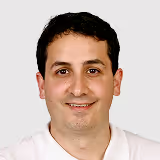
Marcel Kloos
Swiss-licensed dentist and founder of Medschool Experts
Marcel Kloos founded Medschool Experts while studying abroad; since then, over 500 study places have been secured. The Stuttgart-born dentist studied dentistry from 2015 to 2021 in Sofia and holds a Swiss dental licence.
Today he lives in Bern and runs Medschool Experts full-time as its owner.
More articles worth reading
Health Insurance for International Medical Students in Europe 2026
Scholarships and Funding for Medical Studies in Europe 2026
Medicine, Dentistry, Pharmacy or Veterinary Medicine? Choosing Your Degree Abroad in 2026

Ahmad

Sabrina

Rami

Noah
500+ students placed.
Now it's your turn!
No daydreaming, no empty promises. Just a clear plan — for the start of your medical degree.
40 minutes, no obligation