What does studying medicine abroad really cost? The monthly budget by location
17.09.2026

The four items
A realistic budget consists of four blocks: the tuition fee, the fixed monthly costs, the variable everyday costs and the travel costs. Only the first block appears on the university's website, but the other three determine how comfortable the degree feels financially.
Living costs by location
| Location | Rent, shared flat or hall of residence | Total budget per month |
|---|---|---|
| Timisoara, Cluj | approx. 150 to 300 Euro | approx. 400 to 600 Euro |
| Sofia, Plovdiv, Varna | approx. 200 to 350 Euro | approx. 450 to 650 Euro |
| Pécs, Szeged, Debrecen | approx. 200 to 350 Euro | approx. 450 to 650 Euro |
| Brno, Olomouc, Košice | approx. 250 to 400 Euro | approx. 500 to 700 Euro |
| Łódź, Szczecin, Wrocław | approx. 250 to 450 Euro | approx. 500 to 750 Euro |
| Riga, Kaunas, Vilnius | approx. 300 to 500 Euro | approx. 600 to 800 Euro |
| Budapest, Prague, Bratislava | approx. 350 to 600 Euro | approx. 700 to 900 Euro |
| Malta | approx. 450 to 750 Euro | approx. 800 to 1.100 Euro |
The range within a single location is wide, because it depends above all on the type of accommodation. A place in a hall of residence often costs less than half of a private flat, but availability is limited. A shared flat sits in between and is the usual case.
What monthly budget is realistic for the location you have in mind is something we clarify in the free advisory session.
Items that do not show up in the monthly budget
- Health insurance. Within the EU, the European Health Insurance Card covers necessary care. For a degree lasting several years, additional international health insurance is worthwhile, costing between 15 and 60 Euro a month depending on the policy.
- Flights and trips home. With two to four trips a year, 300 to 800 Euro is realistic. Locations with direct connections to Germany are clearly cheaper here.
- Deposit and initial set-up. On moving in, one to three months' rent is often due as a deposit, plus basic furnishings for the flat.
- Books and study material. Around 300 to 600 Euro in the first year, less after that.
- Language courses. Included in the curriculum at many locations, though sometimes payable separately.
- Instruments in dentistry. Provided at many faculties abroad, which saves a four-figure sum compared with Germany.
A worked example
Take an affordable location with a tuition fee of 4.250 Euro per semester and 500 Euro of living costs a month:
- Tuition fees per year: 8.500 Euro
- Living costs per year: 6.000 Euro
- Flights and other items: around 800 Euro
- Total per year: around 15.300 Euro
At a mid-range location with 7.500 Euro per semester and 650 Euro a month, you end up at around 23.600 Euro per year. Over six years of study that gives a range of roughly 92.000 to 142.000 Euro, depending on the location you choose.
What eases the budget
German student finance for studies abroad (Auslands-BAföG) is the most important lever: up to 992 Euro a month, plus a tuition fee subsidy of up to 5.600 Euro a year, which is a full grant and does not have to be repaid. For the monthly support, repayment is capped at 10.010 Euro, regardless of how much was paid out in total.
Added to that are education funds with income-linked repayment, scholarships and student loans. How these building blocks can be combined in your case is something we look at together in the advisory session.
If you want to draw up your full calculation, get free advice.
The author's view
When I talk to families about costs, one thing stands out above all: almost always only one side gets calculated. The tuition fee is written large on the sheet, while time does not appear on any line. Yet time is the larger item. Anyone who starts abroad straight after school is in the profession two years earlier than someone waiting for a place in Germany. Two years as a junior doctor is a six-figure gross sum, plus pension entitlements and two years of clinical experience. Set against that scale, the fees look considerably more plausible than they seem at first glance.
My second point concerns the size of the budget you set. I always advise planning with the upper end of the range, not the tightest figure. A buffer of ten to fifteen per cent is not a luxury but the difference between a degree you enjoy and one where every month has to add up to the last Euro. The first year of study should be budgeted higher than the following ones in any case: the deposit, the initial set-up, the textbook package and the journey there fall almost entirely at the start and do not recur later.
From my own student days in Sofia and from my work as a Swiss-licensed dentist, I take away a third thought: the question of cost is the only one of the big study questions that lies entirely in your own hands. You cannot influence school-leaving grades retrospectively, nor an admissions procedure. A budget, by contrast, can be drawn up, checked, underpinned with funding components and adjusted. That is exactly why I regard the full calculation as the most useful first step: it turns a feeling into a table, and a table can be shaped. In the vast majority of cases I have seen, the result was better than the original assumption.
Conclusion
Whatever your situation, you don't have to figure out the best path alone. At Medschool Experts, we work with the largest network of official partner universities, and we individually assess the highest possible year of entry for every student. In many cases, entry is even possible in the final two years of medical studies. Book a free consultation with our team and let's map out your personal path together.
Frequently Asked Questions about the budget
How much money per month should I reckon with?
Depending on the location, 400 to 1.100 Euro for living costs, on top of the tuition fee. Bulgaria and Romania are at the lower end, Malta and Prague at the upper end.
What does a place in a hall of residence cost?
Considerably less than a private flat, in Eastern Europe often less than half. Places are limited, so it is worth clarifying this early.
Do I need my own health insurance?
Within the EU, the European Health Insurance Card covers medically necessary care. For a degree lasting several years, additional international health insurance is advisable.
Can I work alongside my studies?
Legally yes, and within the EU without a work permit. The timetable in a medical degree is dense, particularly in the first two years, which is why work with flexible hours and a subject connection is the most suitable.
Does BAföG cover the tuition fees?
Partly. German student finance for studies abroad includes a tuition fee subsidy of up to 5.600 Euro a year, and this portion is a full grant, so it does not have to be repaid.
How much should I budget for flights?
For two to four trips home a year, roughly 300 to 800 Euro, depending on the route and when you book. Locations with direct connections have a clear advantage here.
What does a complete degree cost in total?
Depending on the location, between roughly 92.000 and 142.000 Euro over six years, including living costs. We work out the specific calculation for the locations you have in mind together in the advisory session.
What students say about Medschool Experts
Over 500 placements at more than 25 partner universities across 10+ countries. Read independent student reviews on Trustpilot.
About the author
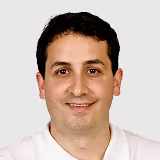
Marcel Kloos
Swiss-licensed dentist and founder of Medschool Experts
Marcel Kloos founded Medschool Experts while studying abroad; since then, over 500 study places have been secured. The Stuttgart-born dentist studied dentistry from 2015 to 2021 in Sofia and holds a Swiss dental licence.
Today he lives in Bern and runs Medschool Experts full-time as its owner.
More articles worth reading
Health Insurance for International Medical Students in Europe 2026
Scholarships and Funding for Medical Studies in Europe 2026
Medicine, Dentistry, Pharmacy or Veterinary Medicine? Choosing Your Degree Abroad in 2026
Ahmad
Sabrina
Rami
Noah
500+ students placed.
Now it's your turn!
No daydreaming, no empty promises. Just a clear plan — for the start of your medical degree.
40 minutes, no obligation