UK-German Heritage: How a European Medical Degree Is Recognised in the UK and in Germany
22.09.2026

Studying medicine or dentistry outside the UK used to mean an EU degree slotted into the UK system almost automatically. That changed with Brexit. Today, a degree earned anywhere in the EU, whether that is Czechia, Bulgaria, Romania or elsewhere, is treated by UK regulators the same way as a degree from Australia, Canada or India: as an overseas qualification that has to be individually assessed and, in almost all cases, tested.
{{cta}}Getting a European Medical Degree Onto the GMC Register
The General Medical Council no longer grants automatic recognition to EU-earned medical degrees. Graduates who finished their course after the Brexit transition ended in January 2021 are assessed as international medical graduates, regardless of the fact that their degree came from a fellow European country.
PLAB 1, PLAB 2 and the Medical Licensing Assessment Standard
Most graduates end up sitting the PLAB pathway, run under the same Medical Licensing Assessment standard that UK medical schools' own final-year students now have to meet. PLAB 1 is a written applied knowledge test, and PLAB 2 is a practical exam built around simulated patient consultations. Passing both is what the GMC treats as evidence that a candidate meets the MLA standard, whichever country actually issued the degree.
Registration Is Not the Same as a Training Post
A pass on PLAB, alongside proof of English ability through IELTS or the OET, leads to full GMC registration with a licence to practise. It does not automatically hand you a place on the Foundation Programme, the two-year training scheme new UK doctors normally start with. Foundation Programme places are allocated through their own separate, competitive application process, and PLAB graduates apply for them, or for other posts, alongside everyone else already in the system.
Dentistry Runs Through the GDC and the ORE Instead
For dentistry the regulator is the General Dental Council, and the equivalent hurdle is the Overseas Registration Examination. Part 1 is a computer-based clinical knowledge test, Part 2 is a multi-day practical assessment of clinical skills. As with PLAB for doctors, an EU-earned dental degree no longer waives this step. Passing the ORE is what opens the door to GDC registration and the right to practise dentistry in the UK.
Where It Gets Genuinely Interesting: Germany's Two-Track System
Germany is still in the EU, and that single fact reshapes the whole picture once you look at it from the German side rather than the British one.
An EU-Earned Degree Sails Through as Approbation
Under EU mutual recognition rules, a medical or dental degree earned in another EU or EEA country is accepted by the relevant German Landesärztekammer, the state medical chamber, without the school itself being scrutinised again. The main remaining hurdle is the Fachsprachprüfung, a medical German language exam that checks whether a doctor can actually communicate with patients and colleagues on the ward, not whether their training was adequate. Once that is passed, along with the standard paperwork, the Approbation, the German licence to practise, follows.
Why It Does Not Matter Whether You Hold a German Passport
Nothing in this process asks whether the applicant is a German citizen. What determines the pathway is where the degree itself was earned, not the nationality of the person holding it. A British citizen with no German heritage at all who studied medicine in Poland gets the same streamlined EU route as someone with three German grandparents.
The Reversal: A UK-Earned Degree Is Now a Third-Country Degree
Here is the twist that matters most for a UK-German dual heritage family. If the same person instead studies medicine in the UK itself, perhaps because it feels like the safer or more familiar choice, that degree is now earned outside the EU. For Germany, it goes through the Gleichwertigkeitsprüfung, an equivalence assessment that compares the foreign training against the German curriculum in detail. Where gaps are found, the applicant can be required to sit a Kenntnisprüfung, a practical knowledge exam, before Approbation is granted.
In other words, a degree from Sofia or Brno currently has an easier route into the German system than a degree from London or Manchester. It is a genuine reversal of what many families assume, and it is worth knowing before choosing where to study, not after.
Keeping Both Futures Realistically Open
None of this means either country is closed off. It means the path looks different depending on exactly where the degree is earned, and that detail is easy to overlook when a family is juggling two systems, two languages and, often, two sets of expectations. Circumstances change over the course of a career, and having accurate information now means a decision made at eighteen does not quietly foreclose an option at forty.
If you would like to talk through how your own situation looks, both for building a life in the UK and for keeping the door to Germany open, we offer a free individual consultation. You can get in touch via /contact and we will happily walk through it with you.
What students say about Medschool Experts
Over 500 placements at more than 25 partner universities across 10+ countries. Read independent student reviews on Trustpilot.
About the author
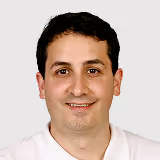
Marcel Kloos
Swiss-licensed dentist and founder of Medschool Experts
Marcel Kloos founded Medschool Experts while studying abroad; since then, over 500 study places have been secured. The Stuttgart-born dentist studied dentistry from 2015 to 2021 in Sofia and holds a Swiss dental licence.
Today he lives in Bern and runs Medschool Experts full-time as its owner.
More articles worth reading
Biology or Chemistry Degree to Medicine: Credit Transfer into a Higher Semester at European Universities
UK-Bangladeshi Heritage: How Your EU Medical Degree Is Recognised in the UK and in Bangladesh
Irish Heritage in the UK: How Medical Degree Recognition Works in Both Countries
Ahmad
Sabrina
Rami
Noah
500+ students placed.
Now it's your turn!
No daydreaming, no empty promises. Just a clear plan — for the start of your medical degree.
40 minutes, no obligation