Medical Degree Recognition: UK and South Africa for Dual Heritage Students
22.09.2026

Start with the country you live in now, because Brexit changed its rules. The UK no longer treats a medical or dental degree from an EU or EEA country as automatically valid. Before 2021, a degree from somewhere like Germany or Poland fell under mutual recognition and converted into UK registration with comparatively little friction. That ended. A European degree is now assessed by the General Medical Council exactly as it would assess a degree from anywhere else outside the UK.
{{cta}}Why the End of Automatic Recognition Changes the Plan
Graduating in the Netherlands, Bulgaria, Romania or Ireland no longer means walking straight into a UK training post. It means joining the same route as graduates from India or Nigeria: proving your knowledge and clinical competence through the GMC's own testing pathway before you can register and work as a doctor in the UK.
PLAB 1 and PLAB 2, Set to the MLA Standard
That pathway is the Professional and Linguistic Assessments Board test, PLAB. PLAB 1 is a written exam of clinical knowledge and decision-making, and PLAB 2 is a practical exam built around simulated patient encounters. Both now sit at the same pass standard as the UK Medical Licensing Assessment, the single benchmark the GMC uses so every doctor joining the register, trained in Newcastle or Warsaw alike, has shown the same baseline competence. Passing both parts within a two-year window, plus evidence of a completed clinical internship, unlocks full GMC registration.
The English Language Bar Still Applies
Growing up bilingual in a British-South African household does not exempt you here. If your degree itself was taught in Dutch, German or another European language, you will usually still need IELTS at the GMC's required level, or the OET, before registration.
What GMC Registration Does Not Hand You
Passing PLAB and registering with the GMC gives you the legal right to practise in the UK. It does not automatically hand you a place on the Foundation Programme, the structured training scheme most UK graduates enter straight after their degree. International graduates typically apply for Foundation posts through a separate, competitive route, or start in a non-training hospital post and build from there. It works, thousands do it every year, but it is a different shape to the one a UK medical school graduate follows.
The Parallel Route for Dentistry: the Overseas Registration Exam
Dentistry runs on similar logic through a different regulator. The General Dental Council requires graduates trained outside the UK, EU degrees included since Brexit removed their automatic status, to sit the Overseas Registration Exam, the ORE, split into a written and a hands-on clinical part. Demand for sittings has been heavy, and the GDC has been expanding capacity through a new exam provider, so build realistic waiting time into any plan around it.
How the HPCSA Treats a European Qualification
Now turn to South Africa. The Health Professions Council of South Africa, the HPCSA, decides whether a foreign medical or dental degree converts into the right to register there, and it does not treat every foreign university identically. Some institutions and curricula are already known to the Council and evaluated against the standard expected of a South African-trained graduate, while degrees from universities outside that circle go through a fuller curriculum review before anything else happens.
The Board Examination for Graduates Outside That Circle
Where your university is not one the Council already accepts without further testing, you sit what is generally called the Board exam, set at the level of the final qualifying year of a South African medical degree. It covers written papers in basic sciences and clinical medicine, followed by oral and clinical assessment once the written stage is cleared. The exam exists so the HPCSA has proof that a foreign-trained graduate reached the same clinical standard as a locally trained one, whatever the originating university's reputation.
The Internship Years and Mandatory Community Service
Passing evaluation, and the Board exam where it applies, is not the finish line. South Africa requires every newly registered doctor to complete a structured internship, then a further year of compulsory community service, usually in an under-resourced public facility, before independent practice is permitted. This applies to everyone, not as a penalty for training abroad.
Why South African Citizenship Still Matters Here
This is the detail that matters most for dual heritage families. Since the early 2000s, internship and community service posts, limited in number and state-funded, have generally been reserved for South African citizens and permanent residents, with narrow exceptions for a few neighbouring countries. A foreign national trained abroad can find this stage far harder to access than a South African citizen trained at the very same European university, which is one of the clearest reasons dual heritage is worth treating as a real asset.
Two Registers, One Degree, and a Door Left Open
None of this means deciding today whether you will ever practise in South Africa. Circumstances change over a career that can span thirty or forty years, and doctors who never imagined working abroad often end up doing exactly that when family, opportunity or curiosity pulls them there. A European medical or dental degree is not a dead end in either country. It is a starting point both the GMC and the HPCSA know how to evaluate, provided you walk the right steps in order.
If you would like to talk through what this could look like for your own situation, including how your background and citizenship shape the routes open to you, we offer a free, individual consultation. You can arrange one through /contact, with no obligation attached.
What students say about Medschool Experts
Over 500 placements at more than 25 partner universities across 10+ countries. Read independent student reviews on Trustpilot.
About the author
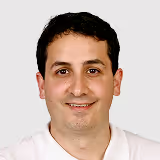
Marcel Kloos
Swiss-licensed dentist and founder of Medschool Experts
Marcel Kloos founded Medschool Experts while studying abroad; since then, over 500 study places have been secured. The Stuttgart-born dentist studied dentistry from 2015 to 2021 in Sofia and holds a Swiss dental licence.
Today he lives in Bern and runs Medschool Experts full-time as its owner.
More articles worth reading
Biology or Chemistry Degree to Medicine: Credit Transfer into a Higher Semester at European Universities
UK-Bangladeshi Heritage: How Your EU Medical Degree Is Recognised in the UK and in Bangladesh
Irish Heritage in the UK: How Medical Degree Recognition Works in Both Countries
Ahmad
Sabrina
Rami
Noah
500+ students placed.
Now it's your turn!
No daydreaming, no empty promises. Just a clear plan — for the start of your medical degree.
40 minutes, no obligation