Medical Degree Recognition in the UK and India: A Guide for British-Indian Families
22.09.2026

Before Brexit, a medical degree from an EU or EEA country carried automatic recognition in the UK under mutual recognition rules shared across the bloc. That changed at the end of the transition period. A degree from a European university is no longer waved through by the General Medical Council simply because it was earned inside the EU. It is assessed on its own terms, much like an application from a graduate of a university anywhere else in the world.
{{cta}}The GMC's Two Doors for Overseas Graduates
The GMC still treats a small number of European primary medical qualifications as directly acceptable, mainly where the degree was completed under the older recognition arrangements that predate Brexit. For almost everyone finishing a European medical degree today, though, the practical route is different: the GMC needs to see that your knowledge and clinical skills meet the standard set by the UK's Medical Licensing Assessment. Most overseas graduates demonstrate this by sitting PLAB 1, a written exam, followed by PLAB 2, a clinical skills assessment held in Manchester. A small number of postgraduate qualifications from certain bodies can substitute for PLAB, but PLAB remains the route most people actually take. Alongside this, the GMC asks for proof of English language ability, typically an academic IELTS score of 7.5 overall with no section below 7, or an equivalent OET result.
What Passing PLAB Actually Gets You
Passing PLAB 2 and registering with the GMC gives you full registration with a licence to practise in the UK. It does not, on its own, guarantee a place on the UK Foundation Programme, which is the structured two-year training post that UK medical school graduates are allocated through a national scheme. Overseas graduates who register through PLAB usually build their early clinical experience through other NHS posts and then compete for specialty training once registered. It is a genuinely workable path, thousands of doctors take it every year, but it is worth planning for rather than assuming it mirrors how a UK graduate's first years unfold.
Dentistry Runs on a Separate Track: the ORE
Dentists face a parallel but distinct system through the General Dental Council. A dental degree from a European university is, since Brexit, not automatically recognised for UK registration either. The route in is the Overseas Registration Examination, sat in two parts: a computer-based test of applied clinical knowledge, followed by a practical assessment of clinical skills carried out over several days. Passing both parts opens the door to full GDC registration. As with medicine, the GDC also expects evidence of English language competence before registration is granted.
Two Names, One Exam, on the India Side
For India, the relevant body is the National Medical Commission, which took over from the old Medical Council of India. For years, foreign medical graduates, including Indian citizens who studied their primary medical degree abroad, have sat the Foreign Medical Graduate Examination to earn the right to register and practise in India. A National Exit Test has been legislated as the eventual single exam covering the final year of Indian medical schools, general licensing, and the entry point for foreign graduates all at once. Its rollout has slipped repeatedly, and as of 2026 the FMGE is still the exam actually being administered for this purpose. Anyone planning years ahead should plan against what is currently in force rather than an exam that has not yet arrived.
The Paperwork That Has to Happen Before You Even Enrol
One detail catches families out more than any other: the NMC's Eligibility Certificate is meant to be obtained before an Indian citizen begins a medical degree abroad, not after graduating. It confirms in advance that the intended course of study meets India's requirements, including that the foreign university appears in the World Health Organization's World Directory of Medical Schools and is recognised by its own country's medical regulator. Skipping this step does not necessarily close the door permanently, but it adds friction and paperwork later, so it is worth sorting out early if keeping the India option open matters to your family.
Who These Rules Are Actually Aimed At
The NMC does not require Indian citizenship to sit the FMGE itself. In practice, though, the eligibility certificate requirement and the surrounding guidance are written with Indian citizens studying abroad in mind, and the exact position of British-born dual nationals or OCI cardholders can vary depending on individual circumstances. This is one area where it genuinely pays to get a written answer for your specific situation rather than relying on general guidance. Whatever the citizenship question resolves to, everyone who qualifies abroad and wants to practise in India must also complete a compulsory year of supervised rotating internship inside India after passing the exam, even if a full internship was already completed abroad.
Dentistry in India Is Moving Through the Same Kind of Transition
Dentistry in India is regulated by a body currently being restructured from the Dental Council of India into a National Dental Commission, mirroring the reform already made to medicine. A comparable screening step for foreign dental graduates exists in principle, but the detail of how it will run under the new commission is still settling, so this is worth checking again closer to the time rather than relying on how things stood a few years ago.
Two Systems, One Degree, and Time on Your Side
None of this is automatic in either direction, and it was never meant to be. Both the UK and India ask overseas graduates to prove their knowledge meets a defined standard, not simply to show a diploma. The reassuring part is that both paths are well established and used successfully every year by graduates who trained in Europe, including plenty of people with exactly this kind of dual background.
You do not need to decide today whether you will ever work as a doctor or dentist in India. What matters while you are still choosing a university or a degree is not closing that door without realising it. If you would like to talk through how this applies to your own family's circumstances, our team offers a free, individual consultation. You can book yours through our contact page.
What students say about Medschool Experts
Over 500 placements at more than 25 partner universities across 10+ countries. Read independent student reviews on Trustpilot.
About the author
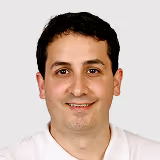
Marcel Kloos
Swiss-licensed dentist and founder of Medschool Experts
Marcel Kloos founded Medschool Experts while studying abroad; since then, over 500 study places have been secured. The Stuttgart-born dentist studied dentistry from 2015 to 2021 in Sofia and holds a Swiss dental licence.
Today he lives in Bern and runs Medschool Experts full-time as its owner.
More articles worth reading
Biology or Chemistry Degree to Medicine: Credit Transfer into a Higher Semester at European Universities
UK-Bangladeshi Heritage: How Your EU Medical Degree Is Recognised in the UK and in Bangladesh
Irish Heritage in the UK: How Medical Degree Recognition Works in Both Countries
Ahmad
Sabrina
Rami

Noah
500+ students placed.
Now it's your turn!
No daydreaming, no empty promises. Just a clear plan — for the start of your medical degree.
40 minutes, no obligation