Medical Degree Recognition in the UK and Italy: A Guide for British-Italian Families
22.09.2026

Before Brexit, a medical degree from an EU or EEA country carried automatic recognition in the UK. That changed at the end of the transition period. A degree earned at a European university, including in Italy, is no longer waved through by the General Medical Council simply because it was earned inside the EU. It is assessed on its own terms, much like an application from a graduate anywhere else in the world.
{{cta}}The GMC's Two Doors for Overseas Graduates
A small number of older European qualifications, completed under arrangements that predate Brexit, are still treated as directly acceptable. For almost everyone finishing a European medical degree today, though, the route in is the Professional and Linguistic Assessments Board test. PLAB 1 is a written exam, PLAB 2 a clinical skills assessment held in Manchester, and both are set against the standard defined by the UK's Medical Licensing Assessment. A small number of postgraduate qualifications from certain bodies can substitute for PLAB, but PLAB remains what most people actually sit. Alongside it, the GMC expects proof of English ability, typically an academic IELTS score of 7.5 with no section below 7, or an equivalent OET result.
What Passing PLAB Actually Gets You
Passing PLAB 2 and registering with the GMC grants full registration with a licence to practise. It does not, on its own, guarantee a place on the UK Foundation Programme, the two-year training post UK medical graduates are allocated through a national scheme. Overseas graduates registered through PLAB usually build early clinical experience through other NHS posts and compete for specialty training afterwards. It is a workable path used by thousands of doctors every year, but one worth planning for rather than assuming it mirrors a UK graduate's first years.
Dentistry Runs on a Separate Track: the ORE
Dentists face a parallel system through the General Dental Council. A dental degree from a European university, Italian dental schools included, is since Brexit not automatically recognised either. The route is the Overseas Registration Examination, sat in two parts: a written test of applied clinical knowledge, then a practical assessment of clinical skills over several days. Demand for sittings has been high, and the GDC has been reforming the exam to expand capacity, so timelines are worth checking close to when you need one. Passing both parts opens full GDC registration, with English competence required as before.
Why an Italian Degree Does Not Walk Straight Into Italian Practice From the UK Side
Here is what surprises many British-Italian families: a degree earned inside Italy, or anywhere in the EU, is recognised in Italy almost as a matter of course. It is a UK-earned degree that now needs a proper process, because the country of study, not the passport in your pocket, is what Italian law looks at.
The Easy Case: A Degree Earned Inside the EU
Study medicine or dentistry at a university in Italy, or anywhere else in the EU or EEA, and your degree falls under Directive 2005/36/EC, as amended by 2013/55/EU. Italy must recognise it automatically for the regulated professions of medico and odontoiatra. In practice this means a decree from the Ministero della Salute confirming the qualification, followed by registration with the local Ordine dei Medici or Ordine degli Odontoiatri. There is no entrance exam and no committee re-examining your training. The main practical requirement beyond paperwork is Italian sufficient to practise safely, since day-to-day clinical work runs in Italian.
The Harder Case: A Degree Earned in the UK
Since Brexit, a degree from a UK medical or dental school is treated by Italy as a non-EU qualification, the same category as a degree from the United States or Australia. The process starts with a dichiarazione di valore, a declaration of value issued by the Italian consulate in the country of study, certifying what the degree represents in Italian terms. The file then goes to a Conferenza di Servizi, a joint evaluation committee under the Ministero della Salute that reviews non-EU qualifications case by case rather than against a fixed table. Depending on how closely your training matches the Italian curriculum, the committee can require a period of supervised adaptation, an additional examination, or both, before issuing a recognition decree. Italian language proficiency again sits alongside the academic assessment as a practical condition of registering and working.
Why the Distinction Between Citizenship and Degree Matters
Holding Italian citizenship, by descent or through your parents, does not change which track applies. What matters to the Ministero della Salute is where the degree was awarded, not the nationality on your passport. A British-Italian dual citizen who studies in Bologna or Pavia gets the automatic EU route. The same dual citizen studying at a UK medical school faces the non-EU process, exactly as a British citizen with no Italian family connection would. For anyone weighing where to study with an eventual return to Italy in mind, that single fact tends to matter more than almost anything else.
Keeping Both Countries Open Without Deciding Anything Today
Neither system hands you a licence automatically once you cross a border, and neither is difficult for its own sake. The UK asks overseas graduates to prove their standard through PLAB or the ORE. Italy asks the same of anyone trained outside the EU, dichiarazione di valore and Conferenza di Servizi included. Both processes are established, used successfully every year, and realistic to plan around.
You do not need to know today whether you will ever practise in Italy. What is worth knowing now, while a degree choice is still ahead of you rather than behind you, is which path keeps that door open and which one adds an extra step later. If you would like to talk through how this applies to your own family's situation, our team offers a free, individual consultation. You can book yours through our contact page.
What students say about Medschool Experts
Over 500 placements at more than 25 partner universities across 10+ countries. Read independent student reviews on Trustpilot.
About the author
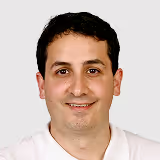
Marcel Kloos
Swiss-licensed dentist and founder of Medschool Experts
Marcel Kloos founded Medschool Experts while studying abroad; since then, over 500 study places have been secured. The Stuttgart-born dentist studied dentistry from 2015 to 2021 in Sofia and holds a Swiss dental licence.
Today he lives in Bern and runs Medschool Experts full-time as its owner.
More articles worth reading
Biology or Chemistry Degree to Medicine: Credit Transfer into a Higher Semester at European Universities
UK-Bangladeshi Heritage: How Your EU Medical Degree Is Recognised in the UK and in Bangladesh
Irish Heritage in the UK: How Medical Degree Recognition Works in Both Countries
Ahmad
Sabrina
Rami
Noah
500+ students placed.
Now it's your turn!
No daydreaming, no empty promises. Just a clear plan — for the start of your medical degree.
40 minutes, no obligation